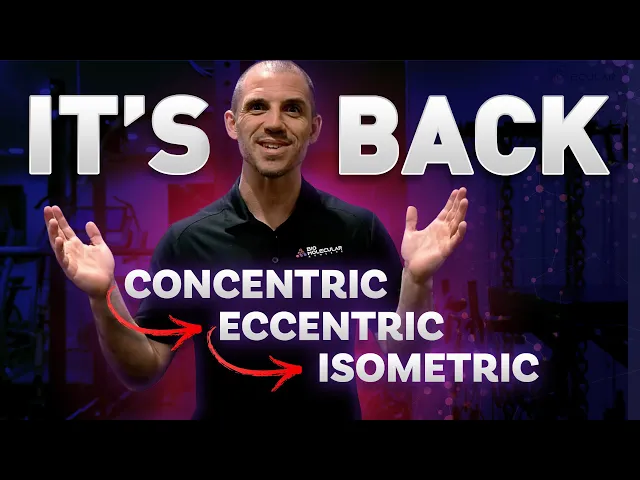
IT’S BACK! The 3 Types of Muscle Contractions Explained | 5 Min Phys
Andy Galpin
0:00 Welcome to another episode of Five Minute Physiology with Dr.
0:03 Andy Galpin.
0:05 In the field of exercise science, we describe muscle contractions in three ways.
0:09 Concentric, eccentric, and isometric.
0:12 Understanding the differences between each of them and how to use it
0:14 in training will increase your results
0:17 while minimizing your likelihood of injury.
0:19 Concentric is the most popular.
0:21 It is the shortening of muscle while generating force.
0:24 Eccentric is the opposite.
0:26 Sometimes you've heard these described as negatives.
0:28 It's the lengthening of muscle while generating force and iso meaning
0:32 same position means you're generating force but not moving at all.
0:37 Really common examples of concentric only movements would
0:40 be things like bicep curls or leg presses.
0:43 Eccentrics could be lat pull downs or the lowering
0:47 of the bench press to your chest.
0:49 While isometrics are any exercise where you're
0:52 holding the exact position, say a wall squat, holding a bicep curl,
0:56 or anything else where you're not moving
0:58 but still contracting and working really hard.
1:00 Most multi- joint exercises use all three.
1:04 In the case of a bench press, you actually would start with an eccentric
1:07 contraction as you're lowering it to your chest.
1:10 If you pause for a quick second, that'd be isometric.
1:12 And then while you're coming back up, you would hit the concentric phase.
1:16 Some exercises start concentric and end
1:19 eccentric and some do the exact opposite.
1:22 Almost all have isometric in the middle.
1:25 But think about the exercise that you're doing and how you're performing it
1:29 because that will determine which of these phases are happening in which order.
1:33 You can also isolate them.
1:35 So you can do isometric only.
1:36 Of course, you could do certain exercises like
1:39 say just lowering yourself from a pull-up position,
1:42 resetting, jumping back up and going back down again.
1:45 And that would be eccentric only.
1:47 Or the exact opposite of course could be doing
1:50 the pull up all the way up to the top,
1:52 letting dropping to the bottom and starting again.
1:55 And depending on what you're trying to get with what exercise
1:58 adaptation you're working on, you might
2:00 have more advantages doing isometric only,
2:03 eccentric, concentric, or a combination of them.
2:07 Eccentric exercises are great because they
2:09 allow you to produce more total force.
2:12 They're also really good for learning and exercise because it
2:14 demonstrates and requires you to be under more total control.
2:18 They can also be really then good for generating muscle growth and hypertrophy.
2:23 The downside though is they're by definition slower.
2:26 Not always, but most of the time that means you're lowering something
2:29 on your body and you can't go as fast as possible when doing that.
2:33 They also are going to add more to your soreness.
2:36 Now, this doesn't necessarily mean that they're breaking more muscles down.
2:40 Spoiler alert and maybe for another video, that's not actually what happens.
2:44 But the reality of it is they are good for muscle growth,
2:47 strength, and overall movement understanding.
2:50 Concentric has almost the exact opposite.
2:54 It's great for explosive stuff and power because you can move
2:57 really fast and you generally you're pushing things away from you.
3:01 They can be good for learning as well, but they won't produce as much peak force
3:05 and don't necessarily always result in most maximal growth.
3:09 To be really clear, they're both doing all that.
3:12 What we're talking about is at the end
3:14 of the spectrum when you're giving everything possible,
3:16 which one has the potential to the absolute most.
3:19 Isometrics are probably the most misunderstood or underutilized.
3:23 I certainly know I didn't pay attention to them for decades,
3:26 which was a mistake.
3:28 I love them because you're able to focus on certain positions.
3:31 So whether you're working around an injury
3:33 or trying to isolate an area of weakness, you can lock in that and not have
3:38 to worry about moving through the entire range of motion.
3:41 They are fantastic for strength and hypertrophy
3:44 and especially good for muscular endurance.
3:46 The research on isometric is really clear.
3:49 They are effective and in my opinion underutilized.
3:53 There are a ton of ways you can integrate these into your training program.
3:56 You could separate them by phases.
3:58 For example, you could spend two, four,
4:00 or even six weeks doing just eccentric work.
4:04 Spend another couple of weeks on just the isometric
4:07 and then another big chunk of time on the concentric.
4:09 That's a pretty common setup, eccentric, isometric, and concentric.
4:13 Because think about it this way,
4:15 spend a bunch of time learning control of the movement.
4:18 Spend a bunch of time making sure you own it in that bottom or final position,
4:22 and then a bunch of time actually moving through the concentric.
4:25 That approach is triphasic and is one way to integrate all three.
4:30 You could also do it in what would be called an undulating weekly program.
4:34 So maybe Monday is eccentric, Wednesday is isometric and Friday is concentric.
4:40 So we could do them across multiple weeks where we focus on one
4:43 at a time or you can integrate them and do the same individual week.
4:47 You could also do the exact same thing in a single workout.
4:50 You could start off the workout eccentric,
4:52 move to isometric, and then move to concentric.
4:55 Or really any combination.
4:57 So maybe you do one eccentric exercise, you do five isometrics and then one
5:03 concentric or any combination of them depending
5:06 upon how much focus and emphasis you want to place on each individual one.
5:11 going back to the beginning which was what is our goal?
5:14 What's our outcome?
5:14 What are we working around?
5:16 What are we working with?
5:17 And what are we needing for our most optimal adaptation?
5:20 Another approach you could also take would be to blend them within a set.
5:25 So you could say for example,
5:27 you could do one or two repetitions where you're focusing on the eccentric,
5:32 you're holding for a long period of time and then finishing concentric.
5:36 So in that particular case, you're expanding the time during isometric.
5:40 If you're still doing eccentric
5:41 and concentric in this single individual repetition,
5:44 but since you're spending way more time holding that position,
5:48 you're going to get a more much greater stimuli on the isometric part.
5:51 Or the opposite.
5:52 Let's say you do 5 seconds or 8 seconds, 10 seconds lowering,
5:56 hold for one second and then spend 1 second
5:59 or 5 seconds or 10 seconds going back up.
6:02 So hopefully this helps you understand.
6:04 You have tons of options.
6:06 Go all the way back to the beginning.
6:07 Think about what we're trying to do, what emphasis you're trying to place,
6:09 and that will determine your program design.
6:12 I hope that made sense, but it may be easier for you to just see an example.
6:15 Please keep in mind this is just one random madeup scenario.
6:18 It does work, but there's plenty of options
6:20 and no reason to think this is the exact right,
6:23 perfect, or optimal setup by any stretch of the imagination.
6:26 Often times when coaches are programming,
6:28 they'll give you three numbers next to your workout.
6:31 What they're representing there is tempo.
6:33 And that's specifically telling you how much
6:35 time to spend in these different phases.
6:37 So you could see something on your chart that looks
6:39 like 1 121 or 510 or something like that.
6:44 In this particular case, let's say you're doing a plyometric exercise.
6:47 You're going to jump up and down, land,
6:48 and jump back up as high as you can, as fast as you can.
6:51 Well, in that particular case, the eccentric is a zero.
6:54 You're going as fast as you can.
6:55 The isometric at the bottom is none because you're actually trying
6:58 to get back up in the air as fast as you can.
7:00 So that would be 0 0.
7:02 And the concentric is also as fast as possible.
7:05 So we would probably not even write a tempo there.
7:07 And if we did, it would be 00 0.
7:09 Meaning go as fast in all three phases as you possibly can.
7:12 A different example of that would be if we're doing say a pause squat.
7:16 Maybe we're going to say go down in three,00 2003.
7:21 Pause for two at the bottom and then explode up as fast as you can.
7:25 So that might look like 320.
7:27 So, we're manipulating different phases based on what we're trying to get.
7:31 If we were to blend these things into an individual workout,
7:33 it might look something like this.
7:35 The start of your workout, you're doing your speed and power.
7:37 That's going to be a 0000 tempo,
7:40 moving as fast as you can, maybe some agility drills.
7:42 You're throwing stuff and you're maximizing your peak power.
7:46 Then you might move into two or three exercises geared more towards strength.
7:50 Maybe you're going to do a three second eccentric because we
7:53 want to make sure we're under good control for whatever we're doing.
7:56 a one second pause.
7:57 Same idea, trying to stabilize, be safe,
8:00 and then we're going to explode up with a concentric as fast as we can.
8:03 We know strength requires acceleration and so we wouldn't want
8:06 to intentionally go slow if we're trying to maximize strength.
8:10 So maybe you do two or three exercises focused on strength.
8:12 You transition there to maybe hypertrophy or muscular endurance,
8:17 and we do something the opposite.
8:18 We do a 3se secondond eccentric, a 5-second hold,
8:23 and then whatever it takes you to lift the weight back up.
8:25 And you might only do two or three repetitions because of the fatigue
8:28 associated with those extra long holds at the beginning or the middle.
8:32 You can then finish at the end doing the exact
8:34 opposite actually where maybe you do a two sec eentric,
8:38 a two-cond hold, and a 5-second concentric.
8:42 This is nice because it makes the absolute load or the weight really low,
8:47 which should make it easier on your joints,
8:49 and you can get a ton of fatigue, a ton of pump,
8:51 and feel really great in a way that doesn't beat you up.
8:54 Again, just a random example to help you conceptualize how this could
8:58 look if you wanted to integrate all three into a workout.
9:01 Infinite possibilities there.
9:02 Explore what works best for you and your situation and goals.
9:05 Before we leave this, I want to throw one more quick thing at you,
9:07 and that is something called eccentric overload.
9:10 It's actually been around a long time,
9:12 but very few people are aware of it, and almost nobody uses it.
9:15 My team has actually published a paper
9:17 on this very recently and that is the idea
9:20 of taking say 110 or 115 maybe even more percent of your one rep max.
9:26 It's only the eccentric portion of it.
9:28 You just say lower yourself on the squat
9:30 or the bench with a really really really heavy load.
9:33 Well, spoiler alert, it's really effective at a lot of things.
9:37 I wouldn't try this if you're a beginner
9:39 or you don't know what your one rep max is.
9:40 A lot of caveats go into something like that.
9:42 It's an advanced strategy,
9:43 but very effective and something that you should pay attention to in the field.
9:47 If you want to hear more about that and see direct examples, let me know,
9:50 of course, the comments section,
9:52 and I'm happy to make a video if that's something of interest.
9:55 Hopefully, this was enjoyable and it helped you.
9:58 Would love to hear how this is working out.
9:59 If any of you do make any changes to your training,
10:02 you try anything based on this video,
10:04 I would love to hear how it went and get that feedback.
10:07 It's always a pleasure hearing people tell
10:09 me things worked or that they were terrible.
10:11 Whatever the case may be, want to know about it.
10:13 Thanks again for checking out another episode
10:15 of FiveMinute Fizz and we'll see you next time.
10:17 If you enjoyed this and want to keep
10:18 learning more about human health and performance,
10:21 consider signing up for the Catalyst.
10:23 That's my completely free newsletter where we share
10:26 information about places I've learned from, great books, podcasts, social media,
10:32 people to follow, and other ways to stay upto-date
10:34 with the most recent evidenceinformed approaches in this field.
10:39 I'll put a link to that newsletter in the description below,
10:42 as well as pinned to the top comments, and I'll see you there.