The Fastest Maze-Solving Competition On Earth
Veritasium
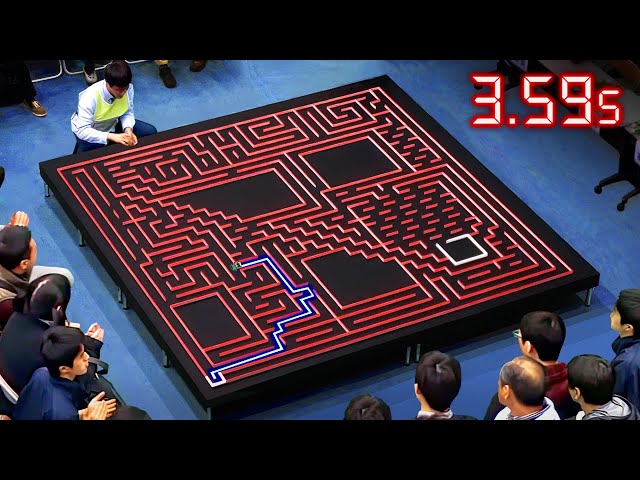
0:00 [Derek] This tiny robot mouse can finish this maze in just six seconds.
0:05 (dramatic music) Every year, around the world,
0:13 people compete in the oldest robotics race.
0:16 The goal is simple: get to the end of the maze as fast as possible.
0:20 The person who came second (announcer
0:22 chattering) (people cheering) lost by 20 milliseconds.
0:26 [Derek] But competition has grown fierce.
0:29 When somebody saw my design, they said,
0:32 "You're crazy!"- [Derek] Why is there so much tension?
0:36 What's riding on it?
0:37 Honor?
0:39 Honor (audience applauding) (audience cheering)- [Derek]
0:45 This video is sponsored by Onshape.
0:48 In 1952, mathematician Claude Shannon constructed an electronic
0:52 mouse named Theseus that could solve a maze.
0:55 The trick to making the mouse intelligent was
0:58 hidden in a computer built into the maze itself,
1:02 made of telephone relay switches.
1:04 The mouse was just a magnet on wheels, essentially,
1:07 following an electromagnet controlled by the position of the relay switches.
1:11 [Claude] He is now exploring the maze using
1:13 a rather involved strategy of trial and error.
1:16 As he finds the correct path, he registers the information in his memory.
1:21 Later, I can put him down in any part of the maze that he's already explored,
1:24 and he'll be able to go directly to the goal without making a single false turn.
1:29 [Derek] Theseus is often referred to as one
1:31 of the first examples of machine learning.
1:33 A director at Google recently said that it inspired the whole field of AI.
1:39 25 years later, editors at the Institute
1:42 of Electrical and Electronics Engineers, or IEEE,
1:45 caught wind of a contest for electronic mice,
1:48 or le mouse electronique, as they had heard.
1:51 They were ecstatic.
1:52 Were these the successors to Theseus?
1:55 But something had been lost in translation.
1:57 These mice were just batteries in cases,
2:00 not robots capable of intelligent behavior.
2:03 But the misunderstanding stuck with them, and they wondered,
2:06 "Why couldn't we hold that competition ourselves?" In 1977,
2:11 the announcement for IEEE's Amazing Micro-Mouse
2:14 Maze Contest attracted over 6,000 entrants,
2:18 but the number of successful competitors dwindled rapidly.
2:22 Eventually, just 15 entrants reached the finals in 1979.
2:27 But by this point, the contest had garnered enough
2:30 public interest to be broadcast nationwide on the evening news.
2:34 And just like the rumor that inspired the competition,
2:37 Micromouse began to spread across the world.
2:40 Micromouse, is for the taking♪♪ Micromouse, is here and now♪♪ Take a chance,
2:49 and start creating♪ (upbeat music) (reporter speaking Japanese)- A Micromouse?
2:59 [Group] Micromouse!
3:06 (audience applauding)- Even people in the top two or three,
3:34 you can see them trying to set their mice up,
3:35 and they can barely find the buttons to press,
3:38 because it's absolutely nerve-racking.
3:42 (suspenseful music) It doesn't matter what it was,
3:47 it could be horse racing, it could be motor racing, it could be mouse racing,
3:54 If you have a shred of competitiveness in you, you'd wanna win, right?
4:03 [Derek] Just like a real mouse, a Micromouse has to be fully autonomous.
4:06 No internet connection,
4:08 no GPS or remote control and no nudging it to help it get unstuck.
4:13 It has to fit all its computing, motors, sensors,
4:15 and power supply in a frame no longer or wider than 25 centimeters.
4:21 There isn't a limit on the height of the mouse,
4:24 but the rules don't allow climbing,
4:26 flight, or any forms of combustion, so rocket propulsion,
4:29 for example, is out of the equation.
4:31 (audience cheering) (announcer chattering) The maze itself is
4:42 a square about three meters on each side,
4:44 subdivided by walls into corridors only 18 centimeters across.
4:49 And in 2009, the half-size Micromouse category was introduced,
4:53 with mice smaller than 12 1/2 centimeters per side,
4:56 and paths just nine centimeters across.
4:59 The final layout of the maze is only revealed at the start of each competition,
5:03 after which competitors are not allowed to change the code in their mice.
5:09 (announcer speaking in Japanese) (audience cheering) The big three competitions,
5:21 All Japan, Taiwan, and USA's APEC,
5:25 usually limit the time mice get in the maze to seven or 10 minutes,
5:29 and mice are only allowed five runs from the start to the goal.
5:33 So if you spend a lot of time searching, that's a penalty.
5:38 Makes sense.
5:39 So the strategy for most Micromice is to spend their first run
5:43 carefully learning the maze and looking for the best path to the goal,
5:46 while not wasting too much time.
5:49 Then they use their remaining tries to sprint
5:51 down that path for the fastest run time possible.
5:57 (audience applauding) Solving a maze may sound simple enough,
6:02 though it's important to remember that, with only
6:04 a few infrared sensors for eyes,
6:06 the view from inside the maze is a lot less clear than what we see from above.
6:10 Still, you can solve a maze with your eyes closed.
6:13 If you just put one hand along one wall,
6:16 you will eventually reach the end of most common mazes.
6:19 And that's exactly what some initial Micromouse competitors realized, too.
6:24 And after a simple wall-following mouse took home gold in the first finals,
6:28 the goal of the maze was moved away from the edges,
6:30 and free-standing walls were added,
6:33 which would leave a simple wall-following mouse searching forever.
6:39 Your next instinct might be to run through the maze,
6:41 taking note of every fork in the road.
6:44 Whenever you reach a dead end or a loop,
6:46 you can go back to the last intersection and try a different path.
6:49 If your last left turn got you nowhere,
6:51 you'd come back to that intersection and go right instead.
6:55 You can think of this strategy as the one a headstrong mouse might use,
6:58 running as deep into the maze as it can,
7:00 and turning back only when it can't go any further.
7:04 This search strategy, known as depth-first search,
7:07 will eventually get the mouse to the goal.
7:09 The problem is, it might not be the shortest route,
7:12 because the mouse only turns back when it needs to, so
7:15 it may have missed a shortcut that it never tried.
7:19 The sibling to this search algorithm,
7:22 breadth-first search, would find the shortest path.
7:25 With this strategy, the mouse runs down one branch of an intersection,
7:28 until it reaches the next one,
7:30 and then it goes back to check the path it skipped,
7:32 before moving on to the next layer of intersections.
7:35 So the mouse checks every option it reaches,
7:37 but all that backtracking means that it's rerunning paths dozens of times.
7:42 At this point, even searching the whole maze often takes less time.
7:47 So why not just do that?
7:48 A meticulous mouse could search all 256 cells of the maze,
7:52 testing every turn and corner to ensure
7:55 it has definitely found the shortest path.
7:58 But searching so thoroughly isn't necessary, either.
8:03 Instead, the most popular Micromouse strategy
8:05 is different from all of these techniques.
8:07 It's a search algorithm known as flood fill.
8:11 This mouse's plan is to make optimistic journeys through the maze,
8:15 so optimistic, in fact, that on their first journey,
8:17 their map of the maze doesn't have any walls at all.
8:20 They simply draw the shortest path to the goal and go.
8:24 When their optimistic plan inevitably hits a wall that wasn't on their map,
8:28 they simply mark it down and update their new shortest path to the goal.
8:33 Running, updating, running, updating, always beelining for the goal.
8:39 Under the hood of the algorithm, what the Micromouse is marking on their map is
8:43 the distance from every square in the maze to the goal.
8:46 To travel optimistically,
8:47 the mouse follows the trail of decreasing numbers down to zero.
8:51 Whenever they hit a wall, they update the numbers on their map
8:54 to reflect the new shortest distance to the goal.
8:58 This strategy of following the numerical path of least
9:01 resistance gives the flood fill algorithm its name.
9:04 The process resembles flooding the maze with water
9:06 and updating values based on the flow.
9:10 Once the mouse reaches the goal,
9:12 it can smooth out the path it took and get a solution to the maze.
9:16 However, it may look back and imagine an even shorter,
9:19 uncharted path it could've taken.
9:22 The mouse might not be satisfied that it's found the shortest path just yet.
9:26 While this algorithm isn't guaranteed to find the best path on first pass,
9:30 it takes advantage of the fact that Micromice need
9:32 to return to the start to begin their next run.
9:35 So if the mouse treats its return as a new journey,
9:38 it can use the return trip to search the maze as well.
9:43 Between these two attempts,
9:44 both optimized to find the shortest path from start to finish,
9:47 it's extremely likely that the mouse will discover it,
9:50 and the mouse will have done it efficiently,
9:52 often leaving irrelevant areas of the maze entirely untouched.
9:56 Flood fill offers both an intelligent and practical way
10:00 for Micromice to find the shortest path through the maze.
10:03 Once there was a clear strategy to find the shortest path,
10:06 and once the microcontrollers and sensors
10:08 required to implement it became common,
10:11 some people believed Micromouse had run its course.
10:14 As a paper published in IEEE put it,
10:16 "At the end of the 1980s, the Micromouse Contest had outlived itself.
10:20 The problem was solved, and did not provide any new challenges." (people
10:26 chattering) In the 2017 All Japan Micromouse Competition,
10:30 both the bronze-and silver-placing mice found the shortest path to the goal,
10:34 and once they did, they were able to zip along it as quick as 7.4 seconds.
10:40 (audience applauding) But Masakazu Utsunomiya's winning mouse,
10:43 Red Comet, did something entirely different.
10:47 This is the shortest path to the goal, the one that everyone took.
10:51 This is the path that Red Comet took.
10:54 It's a full 5 1/2 meters longer.
10:57 That's because Micromice aren't actually searching for the shortest path,
11:00 they're searching for the fastest path.
11:02 And Red Comet's search algorithm figured out
11:05 that this path had fewer turns to slow it down.
11:07 So even though the path was longer, it could end up being faster.
11:12 So it took that risk.
11:14 (announcer speaking in Japanese) (audience applauding)-
11:24 [Derek] It won by 131 milliseconds.
11:27 (upbeat music) Differing routes at competition are now more common than not,
11:32 and even just getting to the goal remains difficult,
11:35 whether due to a mysterious algorithm or a quirk of the physical maze.
11:39 (audience laughing)- [Commentator] The corner, it's a little bit like a...
11:42 Whoa!
11:43 (commentator speaking in Japanese)- [Derek] Micromice
11:49 don't always behave as you'd expect.
11:52 (competitor speaking in Japanese) (upbeat music) Micromouse is far from solved,
12:08 because it's not just a software problem or a hardware problem, it's both.
12:12 It's a robotics problem.
12:14 Red Comet didn't win because it had a better
12:16 search algorithm or because it had faster motors.
12:19 Its cleverness came from how the brains
12:21 and body of the mouse interacted together.
12:24 So it turns out solving the maze is not the problem.
12:26 It never was the problem, right?
12:27 But it's actually about navigation, and it's about going fast.
12:31 Every year, the robots get smaller, faster, lighter.
12:34 There is still plenty of innovation left.
12:37 And there's a small group of devotees in Japan
12:41 busy building quarter-size Micromouse which would sit on a quarter.
12:46 (commentator speaking in Japanese)- [Derek] Nearly 50
12:51 years on, Micromouse is bigger than ever.
12:56 (commentator speaking in Japanese) (audience cheering)- [Derek]
13:06 Competitions have appeared solved at first glance before.
13:09 The high jump was an Olympic sport since 1896,
13:12 with competitors refining their jumps using variations like the scissor,
13:16 the western roll, and the straddle over the decades, with diminishing returns.
13:20 But once foam padding became standard in competition,
13:23 Dick Fosbury rewrote the sport in 1968 by becoming
13:27 the first Olympian to jump over the pole backwards.
13:30 Now almost every high jumper does what's known as the Fosbury flop.
13:36 If Micromouse had indeed stopped in the 1980s,
13:39 the competition would've missed its own Fosbury flops,
13:42 two innovations that completely changed how Micromice ran.
13:46 After all, a lot can change in a sport
13:48 where competitors can solder on any upgrade they can imagine.
13:52 The first Fosbury flop was one of the earliest innovations in Micromouse,
13:56 and had nothing to do with technology.
13:59 It was simply a way of thinking outside the box,
14:01 or rather, cutting through the box.
14:04 Every mouse used to turn corners like this.
14:08 (Micromouse whirring) But everything changed with the mouse Mitee 3.
14:13 So Mitee Mouse 3 implemented diagonals for the first time.
14:18 (people chattering) And that turned out to be
14:24 a much better idea than we really thought.
14:26 And because it's cool, you know,
14:28 maze designers often put diagonals into the maze now.
14:31 So, you know, you could end up with a maze where it never comes up,
14:35 but most of the time it's actually a benefit.
14:38 [Derek] In order to pull off diagonals,
14:39 the chassis of the mouse had to be reduced to less than 11 centimeters wide,
14:43 or just five centimeters for half-size Micromouse.
14:46 The sensors and software of the mouse had to change, too.
14:49 When you're running between parallel walls,
14:51 all you have to do is maintain an equal
14:53 distance between your left and right infrared readings.
14:56 But a diagonal requires an entirely new algorithm,
14:59 one that essentially guides the mouse as if it had blinders on.
15:03 Normally, if you're going along the side of a wall,
15:05 or something like that, most of the time you can see the wall all the time.
15:09 And so that helps you to guide yourself, and you know when you're getting off.
15:14 But in the diagonal situation, you just see these walls coming at you.
15:18 [Derek] And if you veer even a tiny bit off course,
15:21 snagging a corner is a lot less forgiving than sliding against a wall.
15:25 Diagonals are still one of the biggest sources of crashes in competition today.
15:30 But in exchange, a jagged path of turns transforms into one narrow straightaway.
15:36 [Commentator] Oh!
15:37 Whoa!
15:38 (audience applauding) (audience applauding)
15:42 (audience cheering)- [Derek] These days,
15:45 nearly every competitive Micromouse is designed to take this risk.
15:50 Cutting diagonals opened up room for even more ideas.
15:53 Around the same time, mice were applying similar strategies to turning.
15:57 Instead of stopping and pivoting through two right turns,
16:00 a mouse could sweep around in a single U-turn motion.
16:04 And once the possibility of diagonals were added,
16:06 the total number of possible turns opened up exponentially.
16:10 The maze was no longer just a grid of square hallways.
16:14 With so many more options to weigh,
16:16 figuring out the best path became more complex than ever.
16:20 But the payoff was dramatic.
16:22 What was once a series of stops and starts could now be a single,
16:26 fluid, snaking motion.
16:27 How Micromice imagined and moved through the maze had changed completely.
16:31 (audience cheering) Available technology was getting
16:37 upgrades over the years as well.
16:39 Tall and unwieldy arms that were used to find walls were
16:42 replaced by a smaller array of infrared sensors on board the mouse.
16:46 Precise stepper motors were traded in for continuous DC motors and encoders.
16:51 The DC motors give you more power for less size and weight,
16:54 and so we were interested in doing that.
16:56 So then you have to have a servo.
16:58 You have to actually have feedback on the motor to make it do the right thing.
17:02 [Derek] Gyroscopes added an extra sense of orientation.
17:06 It's like a compass, if you had this thing with you.
17:09 They came about cause of mobile phones, really.
17:11 so the technology provides people with things which weren't there before.
17:15 All of the turning is done based off
17:18 the gyro rather than counting pulses off the wheels,
17:21 because it's much more reliable.
17:23 [Derek] But even with all the mechanical upgrades,
17:25 the biggest physical issue for Micromice went unaddressed for decades.
17:29 One thing you'll see almost every competitor holding is a roll of tape.
17:33 Once you know to look for it, you'll see it everywhere.
17:36 This tape isn't for repairs or reattaching fallen parts.
17:40 It's to gather specs of dust off the wheels in between rounds.
17:44 At the speed and precision these robots are operating,
17:47 that tiny change in friction is enough to ruin a run.
17:53 If you wanna turn while driving fast,
17:55 you need centripetal force to accelerate you into the turn.
17:59 And the faster you're moving, the more force you need to keep you on the track.
18:03 The only centripetal force for a car turning on flat ground is friction,
18:08 which is determined by two things, the road pushing up the weight of the car,
18:12 or the normal force, multiplied by the static coefficient of friction,
18:16 which is the friction of the interface between the tire and road surface.
18:19 This is why racetracks have banked turns.
18:22 The steep angles help cars turn with less friction,
18:25 because part of the normal force itself now
18:28 points in to contribute to the centripetal force required.
18:32 If the banked turn is steep enough,
18:33 cars can actually make the turn without any friction at all.
18:37 The inward component of the normal force alone is enough
18:39 to provide the centripetal force required to stay on track.
18:43 (upbeat music) Micromice are no different,
18:46 and they don't have banked turns to help.
18:49 As they got faster and faster, by the early 2000s,
18:52 their limiting factor was no longer speed, but control of that speed.
18:56 They had to set their center of gravity low,
18:59 and slow down during turns to avoid slipping into a wall or flipping over.
19:04 But unlike race cars,
19:05 there wasn't anything in the rules to stop Micromouse competitors
19:08 from solving this problem by engineering an entirely new mechanism.
19:14 Micromouse's second Fosbury flop was almost considered a gimmick
19:18 when the mouse Mokomo08 first used it in competition.
19:22 You might be staring at the video to try to see it, but you won't.
19:25 Instead, it's something you'll hear.
19:27 (Micromouse whirring) That isn't the mouse revving its engines.
19:32 It's spinning up a propeller.
19:35 And while flying over the walls is against the rules,
19:38 there's nothing in the rules against a mouse
19:39 vacuuming itself to the ground to prevent slipping.
19:42 Dave Otten was the first person I saw put a fan on a mouse,
19:46 but he used a ducted fan,
19:48 and I think he was really looking at kind of reaction force,
19:51 you know, blowing the thing down.
19:53 He had a skirt around, but it was not terribly effective.
19:58 Forgive me for saying this, though.
20:00 The idea is to let as little air in as possible.
20:04 And like your vacuum cleaner, when you block your vacuum cleaner,
20:07 right, the motor unloads and speeds up, and so the current drops.
20:11 But if you let too much air in, the current's very high.
20:14 And these are just quadcopter motors, and they draw a lot of current.
20:18 [Derek] At the scale of Micromouse, a vacuum fan,
20:20 often just built from handheld drone parts,
20:24 is enough to generate a downward force five times the mouse's weight.
20:29 Wow.
20:30 Okay.
20:31 That's impressive.
20:32 So how much does the car actually weigh?
20:35 About 130 grams.
20:36 And if you listen, I don't know if you'll get it on your microphone,
20:39 but- (motor whirring)- Oh yeah.
20:41 you can hear the motors slow down, and it loads up.
20:45 [Derek] With that much friction, Micromice today can turn corners
20:48 with a centripetal acceleration approaching six Gs.
20:52 That's the same as F1 cars.
20:55 (engines revving) Once nearly everyone equipped fans,
21:00 the added control allowed builders to push the speed limit on Micromice.
21:04 When it's allowed to, it will out-accelerate a Tesla Roadster,
21:08 but not for very far.
21:09 (Derek laughs)- [Derek] And they can zip along at up to seven meters per second,
21:13 faster than most people can run.
21:15 (audience laughing) (Micromouse whirring) (audience
21:31 cheering) Every one of the features
21:37 now standard on the modern Micromouse was once an experiment,
21:40 and the next Fosbury flop might not be far off.
21:43 The first four-wheeled Micromouse to win
21:46 the All Japan competition did so in 1988,
21:49 but it would take another 22 years of the winning
21:52 mouse growing and losing appendages before four-wheeled mice became the norm.
21:57 With Micromice still experimenting in six- and eight-wheel designs,
22:01 omnidirectional movement,
22:02 and even computer vision, who knows what the next paradigm shift will be?
22:07 [Commentator] Your time on the maze actually
22:08 begins only when you leave the start square,
22:11 so he's not penalized for any of this time.
22:17 [Derek] But if you wanna get started with Micromouse,
22:19 you don't need to worry about wheel count or vacuum fans, or even diagonals.
22:24 It is, to my mind, the perfect combination of all the major
22:28 disciplines that you need for robotics
22:31 and engineering and programming, embedded systems,
22:35 all wrapped up in one accessible bundle that you can do in your living room,
22:40 and you don't need a laboratory to run it.
22:45 You come along because you're curious, and then you think, "I could do that.
22:50 That doesn't look so hard." And then you're doomed, really.
22:53 If it sucks you in, it turns into quite the journey.
22:57 (commentator speaking in Japanese) (audience cheering)- [Derek] At its core,
23:15 Micromouse is just about a mouse trying to solve a maze.
23:19 Though, nearly 50 years later, it's a simple problem that's a good reminder,
23:23 there is no such thing as a simple problem.
23:28 Micromouse, is for the taking♪♪ Micromouse, is here and now♪♪ Take a chance,
23:36 and start creating♪♪ Micromouse,
23:39 will show you how♪ (logo beeping)- If you wanna build your own Micromouse,
23:47 you'll likely need to design parts using a 3D CAD program like Onshape,
23:52 the sponsor of this video.
23:54 Onshape is a modern CAD plus PDM system designed for businesses,
23:58 and completely free for makers and hobbyists to use.
24:02 Any serious hardware product needs a precise design
24:05 in order to be successfully made in the real world,
24:07 from a Micromouse model like this one
24:10 to a professional V2 engine model like this one.
24:13 Unlike traditional CAD programs, which are installed on premises,
24:17 Onshape was built entirely in the cloud,
24:19 which allows engineering and design teams to collaborate like never before.
24:23 Onshape allows you to work together in real
24:25 time on the same design with multiple users, just like Google Docs.
24:29 This completely eliminates the need for emailing large files back and forth
24:33 and trying to keep track of who has the most recent version,
24:36 whether it's V2 or V22.
24:39 With Onshape, Agile methodologies that are
24:41 common in software development are now
24:43 being adopted in hardware development to allow
24:46 companies to build better products faster.
24:48 Onshape's not only great for businesses, but also for open source projects,
24:52 or just working on designs with your friends.
24:54 Again, it's totally free for hobbyists, so you can try it out for yourself
24:58 as much as you like at onshape.pro/veritasium.
25:02 You can take Onshape with you wherever you go.
25:04 You don't need a powerful desktop or a specific operating system to run it.
25:08 Whether you're on a Mac or PC,
25:10 or even just on your phone, you can easily use Onshape.
25:13 So to get started, sign up for free at onshape.pro/veritasium.
25:17 I wanna thank Onshape for sponsoring this video,
25:19 and I wanna thank you for watching.