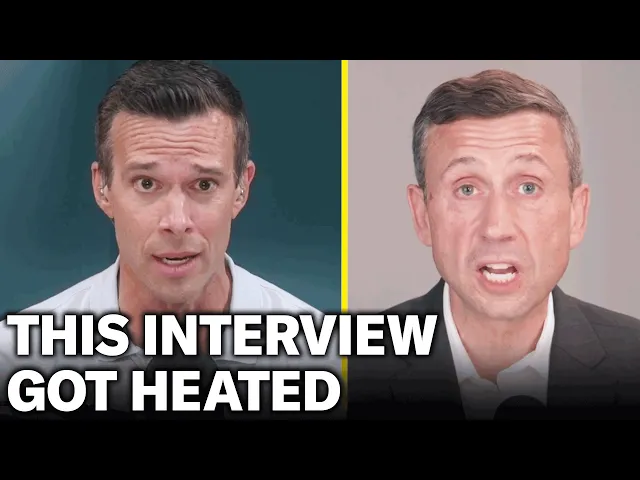
DNC Chair Ken Martin in HEATED Interview About RELEASE of 2024 Election Autopsy
Pod Save America
0:00 Ken Martin, thanks for doing this.
0:02 Yeah, thanks for having me back on, John.
0:03 It was great to see you the other night at the Grinder party of all parties.
0:07 It was amazing.
0:08 I know.
0:08 I wish I hadn't run out of alcohol by the time I arrived,
0:10 but that's neither here nor there.
0:12 Quick bit of context for listeners.
0:13 This all came about because you expressed some frustration
0:16 about criticism of the DNC coming from our direction.
0:20 So, I appreciate you coming on to talk about it directly.
0:23 Um, I'll just say upfront,
0:25 we share the goal of making sure Democrats win everywhere,
0:28 especially the White House in 2028.
0:30 I also very much understand you've got one of the hardest jobs
0:33 in politics that you took at an especially tough time for the party.
0:37 But I do want to press you on some specific
0:38 things because I think the stakes are too high not to.
0:41 Does that sound fair?
0:42 Sounds great, John.
0:43 Thank you.
0:43 I appreciate it.
0:44 So, I want to start with the 2024 autopsy,
0:47 um, which you call an afteraction review.
0:49 When you won the chairmanship in February of 25,
0:52 you criticized the DNC's refusal to release
0:54 their 2016 autopsy as exactly what not to do.
0:58 You said, quote, "Was there any utility in doing
1:01 that?" and then promised your 2024 autopsy would be different.
1:04 Your exact quote was, "Of course,
1:06 it will be released." Why did you change your mind on that?
1:09 Well, look, I mean, what I said all along, even when I ran for this position,
1:13 is that we were going to focus on the things
1:15 that will help us win the upcoming election, right?
1:18 Making sure that we learn the right
1:20 lessons that could help inform our victories.
1:23 And that's what we've done.
1:25 We said this when we uh sent out the press release
1:28 back in November saying we weren't going to release the report.
1:31 We were going to actually keep our focus on those lessons.
1:34 And we release those lessons.
1:35 We continue to do that.
1:36 Uh, and it's important for me, uh,
1:38 instead of naval gazing and looking backwards and, uh,
1:42 trying to relitigate 2024.
1:44 I don't know about you, John, but I don't have a time machine.
1:46 I don't think you do.
1:47 No one does.
1:48 So, we can't change what happened in 24.
1:50 The only thing we can do is actually change what happens in the future,
1:53 including the 26 election cycle, 28 and beyond.
1:56 That means we do need to learn the lessons.
1:58 We need to make sure they help inform um, our decisions that we're making.
2:02 And we've been releasing those.
2:03 We released them just a couple months ago
2:05 in our uh playbook which uh if you if you
2:09 want to look at that go to dnc.org/playbook and you
2:12 can get a example of some of the lessons.
2:15 We've been releasing them with um
2:17 our donors and with activists and party leaders.
2:19 We've been talking about what those lessons
2:21 are and we've actually been putting those lessons
2:23 into action and so it's not completely
2:25 accurate to say that we didn't release that.
2:28 Where we're keeping our focus is on the lessons that can actually help us win.
2:32 But um on this show in August, you told me this about releasing the review.
2:36 Quote, "We have to do it to give people who invested so much time,
2:40 energy, and money a sense of what happened and why we lost." Correct.
2:45 Especially why we lost.
2:46 So what changed between August and December?
2:48 I understand there are lessons, but those are not the full report.
2:52 Why not release the full report?
2:54 What's in the report that you wouldn't want first to publicize?
2:57 Yeah, there's no smoking gun in the report and I
2:59 know that's that's what everyone's so eager to learn.
3:02 The smoking gun.
3:03 Guess what, John?
3:04 But if there's but if there's no smoking gun,
3:06 why wouldn't you just release it then?
3:08 Because we want to keep the focus
3:09 on the lessons because what ends up happening here is
3:12 that uh people of course want to weaponize the report
3:15 in a way to look backwards to point fingers, place blame in a way that actually
3:19 doesn't keep us focused on the upcoming election.
3:22 But instead, uh, the naval gazing of focus focusing backwards,
3:26 um, actually takes us backwards.
3:28 We're 189 days from this election.
3:30 John, what we don't need to be focused on is actually relitigating 2024.
3:35 What we need to do is learn the lessons of 24
3:38 in the years preceding that can help us win this upcoming election.
3:42 That's why we've been releasing them.
3:43 That's why we've been focused in on actually putting those lessons into action.
3:48 And there's nothing that I told you in August that is inaccurate.
3:52 We've been sharing those lessons out with donors.
3:54 We've been talking about this with party leaders
3:56 and activists and others and organizations and campaigns.
4:00 It's no surprise to And I get I get it.
4:02 I get why people are obsessed with it because there's various groups
4:05 and organizations and people who think there's
4:08 some sort of smoking gun in there.
4:09 Guess what, John?
4:10 In the third closest presidential election in the last 100 years,
4:14 everything mattered.
4:15 There's nothing that didn't impact that election.
4:17 But why did why did you uh spend the money uh going to 50 states,
4:23 doing all these interviews,
4:24 doing all this stuff if and and doing this report in the first
4:27 place if you weren't going to res release the full results of it?
4:31 Like why I don't get why just you and some of the senior DNC people get
4:37 to see it but not most of the DNC
4:39 members who are uh you know state party chairs.
4:43 I mean, you know, more than a dozen DNC members
4:45 told NBC just the other week they want it released,
4:47 including Congresswoman Dia Ramirez and North
4:50 and North Carolina Democratic Party Chair Anderson Clayton.
4:53 Um, and Anderson said, quote, "Genuinely,
4:55 what did you all find that we did not how did you answer that question?
5:00 We what we found is the things we've been telling telling them,
5:03 both Anderson, Dia, other folks who have concerns about it.
5:06 We've shared all of the lessons with them, right?
5:09 And so again, I think John, the reality is you're proving my point here, right?
5:13 People are obsessed about this in a way
5:15 that uh continues to turn them away from wanting
5:18 to focus on the lessons and in instead thinking
5:21 that there's some sort of smoking gun in here
5:24 that's going to give them the one single reason
5:27 that Kla Harris lost the election or the one
5:30 single thing that we should have done differently that's
5:33 going to actually help us win in the future.
5:35 There is no one single thing that cost Kamla the election.
5:38 There is no one single thing that we can
5:40 do to help um us win the upcoming election.
5:43 There's a number of lessons for sure that will help us win in 26 and beyond.
5:49 Uh but again, I understand what you're saying, John.
5:52 We'll just have to agree to disagree on this because uh you know,
5:56 we have already started to put those lessons into action.
5:59 I'm proud of the results of what we've seen over
6:01 the last year and a half uh since I've been elected.
6:05 uh we have significant wind at our back and we're
6:07 going to continue to move forward and we're going
6:09 to continue to put those lessons we've learned into action
6:11 and I hope others will start to do the same.
6:14 Yeah.
6:14 I'm just trying to figure out because it doesn't it certainly doesn't seem
6:16 like anyone's looking for one single
6:18 silver bullet because it's a 200page report.
6:22 So I feel like on a 200page report
6:24 there's a lot of lessons for everyone to take.
6:25 And if you're going to operationalize it,
6:28 then I think the question is like are you operationalizing it on behalf
6:33 of people who um who didn't actually get to see the report?
6:37 So like do they know what they're agreeing to when they oper operationalize
6:41 lessons from the report if they haven't been able to read the report?
6:44 John, you're proving the point.
6:46 What's the point?
6:47 Point is the the the the obsession on the report
6:50 without actually um uh focusing in on the lessons.
6:54 People believe there's something there's some
6:56 sort of magic silver bullet in there
6:59 that's going to solve all of our ills at the Democratic party.
7:02 There's not.
7:03 And I understand
7:04 I don't think I don't think there's going to be a magic silver bullet, though.
7:07 Who Who thinks that?
7:08 No one thinks it's that's a such a No one thinks there's a magic silver bullet.
7:11 It's a 200page report.
7:12 You interviewed people in 50 states.
7:14 You spent a lot of donor money on it.
7:16 I think people are probably wondering money on it.
7:18 We didn't spend a lot of donor money on that.
7:20 And and that's just inaccurate.
7:21 You spent a couple hundred thousand dollars on it, right?
7:23 No.
7:23 No, we did not.
7:24 It was a free report.
7:26 We did not spend a couple hundred,000 on that.
7:29 The person and and people who were involved
7:30 in it were not paid uh to do this work.
7:33 And so I will just say that's that's inaccurate, John.
7:35 So I appreciate I'm not sure where you would even get that number.
7:38 And so do you have some some sort
7:40 of record that shows we spent any money on that?
7:43 I've seen I've seen reporting that you that you did spend money on it.
7:46 Yeah, for sure.
7:47 Okay.
7:47 Well, that's that's inaccurate.
7:48 Okay.
7:49 The person who has to do this is an unpaid adviser to the DNC.
7:52 And so I appreciate, listen, I appreciate where it's coming from, John,
7:55 but let's just trade in facts on this, right?
7:57 The reality is is we did talk to um you know, hundreds of people.
8:02 It was an exhaustive um uh exercise to really get at what are those key lessons.
8:07 And I want to be very clear, there's nothing that changed from what I said
8:10 on the campaign trail to now, which is
8:13 on the when you were on the campaign trail and you talked about definitely
8:16 releasing an autopsy and criticized the DNC
8:18 for not releasing an autopsy in 2016.
8:21 In your mind, in your mind, you thought, I'm going to do one,
8:23 but only release certain lessons and not the full report.
8:26 No, what I said at the time is exactly what I've been saying now,
8:29 which is we have to focus on the things that help us win the future elections.
8:32 We have to focus on those lessons.
8:34 We have to do this exercise, by the way,
8:37 of doing uh of conducting this analysis so
8:39 that we actually learn what happened not just in 24,
8:42 but in the years preceding that, John.
8:44 And so that's where our focus is.
8:46 I mean it, you know, the the challenge is is, you know,
8:49 think about this as an executive summary of a, you know,
8:52 like you said, a 200page document.
8:54 And I think what we've put together and what we learn, uh,
8:58 we are sharing with people so they have full insight into what we actually need
9:03 to course correct on as we go
9:04 into these final 189 days left and into the future.
9:10 So again, are you going to release, you mentioned executive summary,
9:13 are you going to release an official executive summary?
9:15 make it make that public.
9:16 We've been we've been releasing that, John.
9:18 That's what I've been saying to you.
9:19 Well, you said you said lesson there's the Democratic playbook,
9:22 the the playbook that you said you can sign up for in DNC for sure.
9:25 But I know that um you know NBC News said that before Easter about a month ago,
9:29 you told DNC officers on a call to expect an executive summary in short order.
9:33 Officers on that call told NBC they still haven't received one.
9:36 You told a North Carolina DNC member who was drafting a resolution to force
9:40 the report's release that a summary was forthcoming
9:43 and he backed off based on that promise.
9:45 So you've been saying in coming weeks on the executive
9:47 like when can people when can people expect an AC accent
9:52 sharing that with a number of folks and we'll continue
9:54 to share it with folks including the DNC and other people.
9:57 The reality is is we're not hiding the ball on this.
10:00 We have been sharing those things out.
10:02 Happy to get you over uh you know what we have been sharing out, John.
10:07 The reality is is that there's no smoking gun here.
10:10 And as much as people would like to keep focusing in on those pieces,
10:14 what they're ignoring is that we're sharing out the lessons.
10:18 We have been incorporating those and we
10:20 have actually been putting those lessons into action, which I'm most proud of.
10:24 Look, we we are 189 days away from this election.
10:28 You said on the top end of this that you
10:30 what you care most about is helping us to win elections.
10:32 Okay, let's focus on the elections coming up, John.
10:35 You know what?
10:36 Yeah.
10:36 Well, I mean, I want I want to focus on winning them.
10:38 And I feel like an autopsy on what went wrong
10:41 and when we lost the popular vote in all those states
10:43 in 2024 and figuring out what went wrong based
10:45 on a big report is pretty important for everyone to know.
10:48 I've spent uh my my entire career, John, as you know,
10:52 since 1990 winning elections up and down
10:54 the ballot both in Minnesota and across the country.
10:56 I appreciate that.
10:57 And I'm happy I'm happy to talk to you about winning elections.
10:59 If you want to actually talk about elections,
11:01 I'm happy to talk to you about those.
11:02 But again, you're proving the point that I think
11:05 many folks I I think are frustrated in this party,
11:08 which is people want to turn backwards to relitigate the 2024 election to point
11:13 fingers to place blame to to to want to learn lessons like you said.
11:18 Well, listen, to win elections, if they want to win elections,
11:20 I'm happy to share what we learned in in the way of the lessons
11:24 on why we lost uh the 24 election and the years preceding that.
11:28 Happy to share those.
11:29 We're sharing those out with everyone.
11:30 But again, this conversation doesn't help us actually win elections.
11:34 All it does is continue to uh turn people inward.
11:37 What we need to do is focus on the work we need to do in 189 days.
11:41 Learn the lessons.
11:43 And I'm happy to go over what those lessons are.
11:45 I'm happy to go over them with uh anyone who wants to talk about them, John.
11:48 But what I'm not going to do is release
11:50 a report that turns everyone backwards trying to either
11:53 point fingers or place blame and actually ignore
11:56 their own responsibility and helping us to fix the situation.
11:59 The the reality is is, you know, um we all have a responsibility,
12:03 yourself, myself, everyone in actually learning those lessons,
12:07 focusing on the upcoming election,
12:09 putting them into action so we don't repeat those same mistakes.
12:12 That's what we've been focused on, John.
12:14 So, Steve Shale, um,
12:16 longtime Democratic strategist who's run Florida for the party,
12:19 told the Washington Examiner that there's
12:21 a quote financial penalty specifically tied
12:23 to burying the autopsy because donors
12:26 want a clear accounting before recommitting.
12:28 The DNC is entering April with negative net cash on hand.
12:32 So, even on your own, you know, standard of does this help us win,
12:36 is it possible that the autopsy decision is
12:39 actually costing you the money you need to win?
12:42 That's just inaccurate, John.
12:43 And I'm sure you follow the campaign finance reports like I do.
12:46 We raised $105 million in uh 2025.
12:50 A record amount of money for the first year.
12:52 You don't you're not you don't you're not have negative cash on hand right now.
12:55 You don't you don't have debt.
12:57 Uh that's negative cash on hand.
12:59 But we also we do have debt, John, and that's because I took out a loan last
13:03 year to make sure we can make deep investments.
13:05 Uh you know what we've been doing, John?
13:07 We raised a record amount of money, $105 million.
13:10 It's the most raised for the first year chair
13:13 of any DNC chair in the history of this party.
13:16 And you know what's great?
13:17 What what you know what's great about it?
13:18 We raised in 2017, which is a analogous year,
13:22 a year right after a presidential loss,
13:24 Tom Perez uh raised $40 million less than what we raised uh this year.
13:29 I have he didn't have he didn't have the debt that you guys have.
13:31 Yes, he did.
13:32 He had $76 million in debt.
13:34 And so my point my point to you my point to you is this, John.
13:38 Okay?
13:39 I mean, we can trade in all of this, but let's actually trade in facts.
13:42 $105 million was raised.
13:44 85 million of it came from grassroots donors,
13:46 which is a record amount of grassroots donations
13:48 raised in the history of the Democratic Party.
13:51 That is shows the energy that's out there.
13:53 The average contribution is $51, by the way, John.
13:56 And um you know, we raised more than uh
13:59 any of the other committees last year, uh the DS,
14:01 the DC, and I will just tell you this, um
14:04 all of the Republican committees raised more than the DNC.
14:08 And so um uh that's just a reality of coming out of a year
14:12 when you lose the presidential election when
14:14 you're the party that's out of power.
14:17 Of course you're going to not raise as much money as the Republicans.
14:20 But to suggest that we're not raising money is inaccurate.
14:22 We raised $32 million.
14:24 We raised $32 million in the first quarter.
14:26 But what we're doing that's a little different, John.
14:30 Mhm.
14:29 Is we're spending it.
14:31 We're raising it and we're spending it because one of the lessons we learned
14:35 spending but you're spending more than you have.
14:36 I mean so you guys have 13.8 9 million cash on hand, right?
14:39 I'm reading the report.
14:40 13.9 million cash on hand, 18.3 million in debt.
14:44 So that's roughly4.4 million.
14:47 And I know it's a tough environment for the party out of power,
14:49 but the DSC and the DEC and these Senate candidates have plenty of money.
14:54 They're all doing great.
14:56 So it seems like this is a this is an issue unique to the DNC.
14:59 That's not accurate, John.
15:01 Listen, what part is not accurate?
15:03 The reality is we're spending money as we
15:06 raise it to win elections and to build infrastructure.
15:10 We have invested significant amounts of money,
15:12 record investments in Virginia and New Jersey.
15:15 Investments in Mississippi in their state legislative races to help them
15:19 flip the state uh uh the Republican supermajority in their state legislature.
15:24 Investments in the Miami mayoral race to help us win
15:27 a Democratic elected mayor in the first time in 30 years.
15:31 investments in the PSC races in Georgia to help us win the first two um
15:36 non-federal elected um uh races um statewide
15:39 races in 20 years in in their history.
15:42 Um you know, investments throughout the country up
15:45 and down the ballot and investments in infrastructure,
15:47 including the largest investments ever in a 50
15:50 state party strategy where we're making
15:52 the biggest investments in uh building out
15:55 the infrastructure of our state and local party committees.
15:58 You know, one of the lessons we learned, by the way, John,
16:00 uh from the last uh election is that we waited too long to spend money.
16:04 In fact, the Republican party starting in 2020,
16:07 right after uh Biden won that race,
16:10 the the Democratic party packed up the campaign infrastructure,
16:13 Trump and the Republicans kept going.
16:15 They kept spending money.
16:16 They kept organizing.
16:17 They kept communicating with voters.
16:19 We did not.
16:20 And as a result, they had a three and a half yearl long uh head start.
16:24 Um and going into the 2024 election, we had 10 million Democrats who actually
16:30 chose the couch instead of voting in 2024.
16:32 And part of the reason why is because
16:34 we weren't communicating with them early and often.
16:37 What did the Democratic party decide last year to start doing?
16:40 We have our local listener program that's already engaging through
16:44 year round organizing those voters who dropped off in 2024.
16:49 We you have to spend money to win elections.
16:52 And one of the lessons we learned is if we wait.
16:54 Now look, I know you came up in a certain uh time in and day in politics.
16:59 But the old conventional wisdom, John, it doesn't fly anymore.
17:02 The old conventional wisdom is that you waited to make investments until
17:05 the final 3 months of the election
17:07 because that's when people were paying attention.
17:09 Well, guess what?
17:09 That's It's it's shown.
17:12 We have to start early.
17:13 We have to build that infrastructure.
17:15 We have to flex that muscle early of having conversations
17:18 with voters so that we actually position ourselves to win.
17:22 Now, now are you criticizing me for spending money
17:24 early because that seems to be what the thing is.
17:27 And guess what?
17:28 No, I'm No, no.
17:29 I think it's great that you're spending money early
17:30 and I think it's very important to invest in state parties.
17:34 I think a 50-stage strategy is extremely important,
17:36 but we're talking about two different things.
17:38 We're talking about spending money and raising money.
17:40 And you raised $1.4 million in March.
17:44 the RNC raised double that in March.
17:46 And so if you're going to spend that much money,
17:48 obviously you have to also raise the money too because
17:51 otherwise the difference between investment and just outrunning your costs
17:55 and taking on a loan because of that is
17:57 is doesn't seem like much of a difference to me.
18:00 It's not outrunning our cost, John,
18:02 because we're able to make these investments all throughout the country
18:06 and race after race in our in our um uh state party infrastructure,
18:11 in our local party infrastructure.
18:13 you know, if we weren't able to to keep
18:15 up in terms of building out this infrastructure, then there would be a problem.
18:19 We won over 90% of the elections on the ballot and most of them,
18:23 if not all of them, we had a direct involvement in.
18:26 And I just say this to you, John, because, you know, it was a bet we made.
18:30 And I get it.
18:31 You know, again, all the PE folks in DC,
18:33 what they like to uh they seem obsessed about and they they they
18:39 spend a lot of time thinking about is how much money do people
18:42 have on hand versus actually what are you doing to build out
18:46 the infrastructure to win and what is the role of a political party, John?
18:49 At the end of the day, our job is to build infrastructure that our candidates
18:53 can tap into uh to do the things that
18:57 isn't the first isn't the the most important job of a DNC
18:59 chair to go and raise money and obviously like the
19:02 guess that's what the job of the unfortunately
19:04 no the the job of the DNC chair is singular.
19:08 It's to win.
19:08 And guess what I've been doing the last year and a half?
19:10 Win.
19:11 And guess what I did for 14 years in a very purple state?
19:14 Win, John.
19:15 And I'm just telling you right now,
19:16 I think you and others who continue to bet against the DNC,
19:20 keep betting because guess what?
19:22 Here's the reality, John.
19:23 We're winning.
19:24 And we're winning because I'm I'm the fin.
19:26 But the investments you're making are not I mean,
19:29 obviously there's a difference between offyear elections
19:31 and midterm elections and what it's going
19:34 to take to build the kind of infrastructure we need to win in 2028, right?
19:39 I mean, I I just think that that's that's
19:40 a you've talked a lot about investing in state parties.
19:43 The headline number is $20,000 a month per state.
19:46 My understanding is that also includes like the Democratic
19:49 Party of Guam and the party of the Northern
19:52 Mariana Islands who get the basically the same
19:54 check as Pennsylvania or Wisconsin or North Carolina.
19:57 I get that every state and territory has DNC members.
20:00 Every one of them voted in the DNC election.
20:02 You won, but it's also a real chunk
20:04 of money that's flowing to places without federal races.
20:08 And so I just wonder if you have this much debt
20:11 is like that the right allocation of money to be giving
20:14 it to state parties in Guam and Northern Mariana Islands when
20:17 you know Axio reported that there's also contemplating layoffs at the DNC.
20:22 There's no Again, John, you're just throwing out a bunch of garbage.
20:26 We've never report contemplated layoffs at the DNC.
20:31 I haven't laid anyone off since I've been DNC chair.
20:35 And so I just want to be very clear uh with you again
20:38 and your listeners because you're just repeating garbage
20:41 uh you know pot shots at the DNC.
20:43 I I'm used to taking the pot shots by the way, you know,
20:45 and I think the mistake that you and others make
20:48 is you know somehow um I I just don't care.
20:51 I came to this job for one thing which is to win.
20:54 And if it wasn't
20:55 So you think but you think that state you think the state party allocation
20:58 to like the to Guam and everything is is is worthwhile allocation of of funds.
21:03 I think it is a worthwhile allocation because when we organize everywhere,
21:06 we can win anywhere.
21:07 And it's important for us not to just focus on federal
21:10 power at the expense of state and local part uh power.
21:13 This is where I'm challenging the conventional wisdom
21:15 of all these smart people in Washington DC here,
21:18 which is that the only thing that matters
21:19 is control of Congress in the presidency.
21:21 My job is to help us win everywhere,
21:23 to build power up and down the ballot throughout the country,
21:26 including in our territories.
21:28 And so you and I can just dis disagree
21:30 on whether or not those are investments that are worthwhile.
21:32 I believe they are worthwhile.
21:34 It's important for us to actually build power for our party and our party
21:37 values everywhere there's Democrats and we're going to continue to do that.
21:41 And so um whether you think that's a worthwhile investment or not, that's fine.
21:45 Um you know, you can take your check back.
21:47 Uh if you don't believe it's a a good investment,
21:49 John, but let me just say this.
21:51 Uh the the role of the Democratic Party is
21:53 to build infrastructure everywhere so that we can win.
21:56 Let me give you a couple examples of what that infrastructure is.
21:59 You know, our voter file and our organizing tools and our data, every candidate,
22:05 whether they're running for school board or president, relies on that.
22:08 We spend over $10 million a year on that, John.
22:11 That's a critical piece of the infrastructure that people rely on.
22:13 Without the DNC, uh they would have to do that on their own.
22:17 all of these candidates,
22:18 our voter protection and legal infrastructure that we build,
22:21 every committee and every candidate relies on us
22:24 to be out there filing lawsuits and protecting the vote.
22:27 We filed over a thousand lawsuits,
22:29 which is a record number of lawsuits over the last year alone, right?
22:32 Including being lead plaintiffs in many
22:34 of the big lawsuits challenging Trump's executive orders.
22:38 This is a piece of the infrastructure people rely on.
22:40 Our on that you mentioned the voter file.
22:42 Um, there's been a talk that a meaningful chunk of the DNC's
22:46 debt traces to the the committee buying the Harris campaign's voter file.
22:50 Is that accurate?
22:51 Did you guys buy the the Harris campaign's voter file?
22:55 No, that's not that didn't happen.
22:56 No, you're talking about buying a fundraising list,
22:58 but but that's not a voter file.
23:00 The the fundraising list?
23:01 Yeah.
23:01 Did you Did you Of course you purchased that.
23:05 was uh I was just wondering about the rationale for that because it feels like
23:08 the DNC and the Harris campaign were operating
23:10 off largely the same data infrastructure during the campaign.
23:13 So what did buying the list?
23:14 You're confusing two things, John.
23:16 Uh data infrastructure and fundraising list.
23:18 Those are separate things and I again but even on the fundraising list you guys
23:22 didn't work off like you that was additive.
23:23 Their fundraising list for $6.5 million was
23:26 additive to that that was a good investment.
23:28 We purchased that list and let me just say this John that um
23:30 that happens all the time in campaigns and elections as you know.
23:33 Oh I know.
23:34 It's just a big chunk of money.
23:35 That's why I was just wondering why
23:37 but as you know John that happens all the time.
23:39 So it's not it's not unique to this DNC.
23:41 It's not unique to uh prior DNC chairs.
23:44 It's not unique to campaigns or elections.
23:46 Frankly, campaigns and elections um uh campaigns uh at the end
23:50 of an election sell their list to cover their debt.
23:54 Uh and so there's nothing nothing new about that, John.
23:57 And of course, that's one of the biggest
23:59 lists and the most valuable list out there.
24:01 It's a great investment for the DNC.
24:03 I'm trying to actually help us raise money so we can compete so we can win.
24:08 And that was uh not only a great investment, it's already paid for itself.
24:11 Uh you know, and we're glad to be able to do that.
24:15 And you know, we buy lists all the time.
24:18 That's what people do in this uh business.
24:20 POS America.
24:21 Breaking news is brought to you by Act Blue.
24:23 Act Blue provides Democrats up and down the ballot
24:25 with the tools they need to run effective campaigns and win,
24:28 fundra, organize, build campaign websites,
24:30 and donate with solutions that are easy to use.
24:32 Act Blue has been helping campaigns for a long time now.
24:34 Our partners at Vote Save America create digital fundraising pages
24:37 on the ACT blueue platform for initiatives like our anxiety relief program.
24:41 And we're going to use it when we try to flip some
24:43 of these seats in the house cuz we've got to win the house.
24:45 It's easy to create donation pages and features like goal tracking
24:48 and and to design custom branding
24:50 and the funds are processed quickly and safely.
24:53 Act never sells your data or personal information.
24:55 They focus on security so you can
24:57 focus on what matters most like winning campaigns.
25:00 Yeah.
25:00 So whether you're running for office or you want to make an impact,
25:02 ACLU has the tools to help you make it happen
25:04 because the right time to get involved is right now.
25:07 Donate, organize, and raise money for candidates
25:08 and causes you believe in atblue.com/crooked.
25:12 Yeah, look, look, I here's the reason I'm just being so tough about all of this.
25:16 I just think that um what I have
25:18 seen happen before is especially um in offy-ear elections,
25:22 midterm elections when we have the wind at our back.
25:25 And I feel great about the midterms.
25:27 I feel really excited about the off-year elections too as we head towards 2028.
25:32 Look, I I I I saw this in 2022.
25:34 We did well enough in the midterms and uh Democratic insiders,
25:39 Biden administration, everyone else were saying,
25:41 you know what, this proves that we're going
25:43 to win in 2024 and we're in great shape.
25:45 And I just and God, I hope so because
25:47 I think we need to win 2028 more than anything.
25:50 But it is it it concerns me that I see two things.
25:55 one this uh autopsy which you campaigned on releasing
26:00 and and I know you're releasing lessons but are
26:03 hiding still plenty of the details in the autopsy
26:05 and I just can't figure out what details that are
26:08 in there that you don't want out there because
26:10 you don't trust people with because they're going to I
26:12 guess argue about them because it feels like we
26:15 really need a robust discussion about where the party's headed.
26:18 Not just pundits like me but the state party chairs
26:21 and the DNC committee members who are asking you to release it.
26:24 They're asking you to release it.
26:25 I know you want to keep focusing on that and that's fine.
26:27 Well, I'm saying and I do think that that affects
26:30 the and the fundraising isn't going well either.
26:32 So, I feel like and the fundraising that is just completely inaccurate, John, we
26:36 I mean, you had you had a great first you had a great first year in 2025.
26:40 And we've had a great first quarter.
26:42 $32 million we raised in the first quarter.
26:44 We raised $4 million in March than Tom Perez did in 2018.
26:48 We have that's excluding debt though.
26:49 That's excluding 50% more cash on hand than Tom Perez did.
26:54 But you're excluding debt.
26:54 You don't have 50% more cash on hand if you include your debt.
26:58 John, we do because at the end of the day,
27:00 we can pay that debt off whenever the hell we want.
27:02 I I could hold that debt until the end of the year.
27:05 So, so the reality is there's nothing that's holding
27:07 me back in terms of the cash I have,
27:09 the cash on hand I have to spend it on elections.
27:12 I can carry that debt all the way through
27:14 the end of this year and beyond if I want.
27:16 So, that's just inaccurate.
27:17 I know you know campaigns, but you're just spewing stuff out that's just wrong.
27:21 I'm just I'm saying that I saw that talking point about 15% more
27:23 and it's based on excluding the raised
27:26 we raised $32 million in the first quarter.
27:29 Okay, we have $15 million on hand.
27:32 We're able to spend that money on continuing
27:34 to build our infrastructure and to help us win elections.
27:38 Okay, and we're and we've continued to raise money.
27:41 Nothing has slowed down.
27:42 In fact, the fundraising has picked up significantly
27:45 uh since even the last November's elections in 2025.
27:49 So, listen, and I know the grassroots fundraising has been great.
27:52 I I I know that.
27:54 I I concede that for sure.
27:55 I just there's plenty of reports about this.
27:58 I've talked to plenty of people about this that that a lot
28:00 of the big donors still have not come off the sidelines.
28:02 And part of the reason is that there's
28:03 a trust issue based partly on the autopsy.
28:07 Yeah, I I'm just not seeing that, John.
28:09 And I I appreciate that.
28:10 and and and you know um uh I don't believe that to be the case.
28:14 Maybe you're talking to donors that I'm not.
28:16 I I highly doubt it.
28:18 But the donors I'm talking to who are holding back uh they're not holding back
28:22 because they're frustrated with me and they're not
28:24 holding back because they're frustrated with the DNC.
28:26 Uh just the opposite.
28:28 And so I think people see that we
28:30 are actually putting into action the lessons we've learned.
28:33 We're actually building the infrastructure we need.
28:36 We're competing up in the uh down the ballot.
28:38 we're making the investments throughout the country
28:40 to make sure that we're organizing everywhere.
28:42 I mean, part of the challenge, John,
28:44 is we've talked about this on the show before,
28:47 um, that this party for years, and this is why I ran for it,
28:50 has had a very myopic vision of just focusing in on one uh campaign cycle,
28:56 one candidate, uh, one campaign at the expense of a long-term strategy.
29:01 And for us to break out of that, we actually have to have a long-term strategy.
29:05 And that requires us to build
29:06 through the lens of building long-term infrastructure.
29:09 And so, you know, you're damned if you do, damned if you don't.
29:12 If you throw all your eggs into one basket,
29:14 which is one campaign or one campaign cycle,
29:17 then you've built nothing permanent.
29:18 Or if you do, as I am, right, which is to start building the permanent
29:22 infrastructure we need to have a long-term strategy,
29:25 then you get blamed because you you don't have
29:28 enough cash on hand to compete with the Republicans.
29:32 Well, the reality is we've been competing with the Republicans
29:35 and building the long-term infrastructure at the same time.
29:38 And so what I would ask you to do is just think about this differently.
29:42 The old conventional wisdom of how we do campaigns.
29:45 I came in here and as I said, I'm challenging that conventional wisdom.
29:50 I'm challenging the idea that we just invest in the final
29:53 three months at the expense of a long-term strategy.
29:55 I'm challenging the uh the conventional wisdom that we just focus
29:59 on federal power at the expense of state and local power.
30:02 Right?
30:03 I am challenging the conventional wisdom that we just focus on seven
30:06 battleground states at the expense of the rest of this country.
30:09 So I get that that frustrates people, John, but guess what?
30:12 It will pay dividends.
30:13 It already is both in the short term and it will pay dividends in the long
30:17 term as this map shifts underneath of our feet in the next four to six years.
30:21 So I say all this, I get where your frustration comes from, right?
30:24 But as I said, you know, and I and I get it.
30:28 You know, there are people including you and others
30:30 who are in a different place on this chair's race.
30:32 But since I've come here, I have won.
30:35 And you can't ignore that fact.
30:36 We have won.
30:38 I would go and ask you to talk to Eileen Higgins, the mayor of of um Miami.
30:43 I would go and ask you to talk to Alicia Johnson and Peter Hubard,
30:47 the new PSC commissioners in uh Georgia.
30:50 I would go and ask you to talk to Mikey Cheryl in New Jersey.
30:53 I would go and ask you and talk to Abigail Spamberger in Virginia.
30:57 I would go to ask you to talk to Taylor Ramett in Fort Worth, Texas, and many,
31:02 many other campaigns and candidates that we've helped over
31:05 the course of the last year and a half.
31:07 Because what they will tell you is
31:08 that the DMC was critically involved in those races.
31:11 Was that a good investment?
31:14 I suppose by some people's standards, no.
31:16 Because we just don't we're not hoarding our money
31:19 for the November election to win back control of Congress.
31:22 Well, guess what?
31:23 I just I want to make sure you guys have enough money and I know there's,
31:26 you know, fundraising issues that you're, you know,
31:28 you RNC raised nearly doubled than you guys.
31:31 So, I want to make sure you have enough money and, you know,
31:33 the DS and the DRIP and everyone else and the Senate
31:36 candidates are raising a whole bunch of money and matching Republicans.
31:39 So, I just want to make sure you guys have the money.
31:40 They're not matching Republicans.
31:42 There's not matching Republicans.
31:43 Every every Republican committee out their uh counterpart, the RNC,
31:47 not by double as as with you guys and the RNC,
31:50 but I I I hear your point, though.
31:52 They did not raise us by double either.
31:54 We raised $32 million to their 56 million or $54 million.
31:58 I'm I'm going by the March numbers, which is 11 to 21.
32:01 But I hear you.
32:01 I hear you.
32:02 Um All right.
32:02 Well, they I appreciate you.
32:04 I appreciate you coming on.
32:05 I appreciate you answering these questions and and I just
32:07 I I do hope it it was interesting to learn
32:10 that you do still plan on releasing an executive summary
32:13 of the full afteraction report publicly to people who want it.
32:18 That that is coming I soon.
32:20 I I I guess we've been releasing those.
32:22 We'll continue to release We've been releasing them.
32:25 You've been releasing an executive summary or you've been doing individuals?
32:28 We've been releasing those lessons.
32:29 The lessons are the summary.
32:30 That's We've been releasing those since the beginning
32:33 of this year and briefing after briefing.
32:35 We published them in our playbook as I mentioned.
32:38 We'll continue to release them.
32:39 And so if anyone wants to see some of that work already,
32:42 go to dnc.org/playbook and you can see
32:45 how we're already putting those lessons into action.
32:47 We'll continue to do that, John.
32:49 I mean, that was my commitment when I ran
32:51 and that was my commitment when we talked last is
32:53 that we were going to help make sure people understood
32:56 what lessons we needed to learn going into this election.
32:58 We'll continue to do that.
33:00 So, thank you.
33:01 Thank you.
33:01 Uh, thank you, Ken Martin, for joining us always.
33:05 Thank you, John.