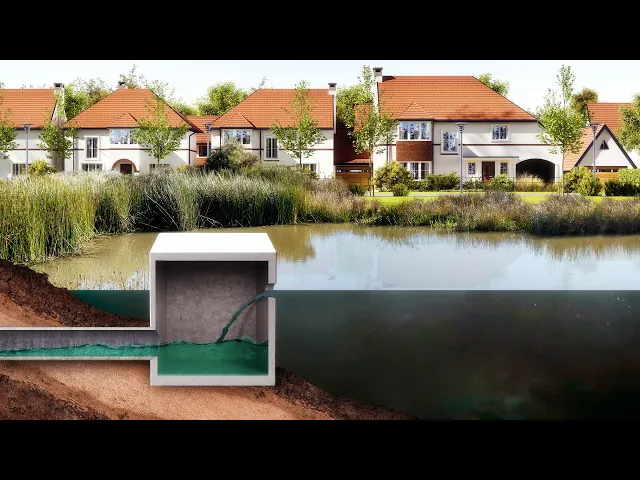
Do Retention Ponds Actually Work?
Practical Engineering
0:01 This is the Historic Fourth Ward Park in Atlanta, Georgia.
0:04 It’s got all the stuff you could want a park to have:
0:08 landscaped walkways, benches, grassy fields, a playground,
0:11 and even a splashpad and amphitheater.
0:14 The focal point is the 5-acre or half-a-hectare pond running through the middle.
0:19 But this pond isn’t just for looks.
0:21 In fact, this park would never have been built at all
0:24 except for the fact that it solves a serious flooding problem.
0:28 For years, the Fourth Ward neighborhood
0:30 struggled with drainage and flooding issues.
0:32 In the 90s, the city came up with a plan:
0:36 a massive underground tunnel to carry runoff away.
0:38 Don’t get me wrong.
0:39 I love flood tunnels.
0:41 I have a whole video about them.
0:43 But they’re not always the right call.
0:45 One engineer in Atlanta had a better idea- a solution
0:48 that would address the flooding issue for a lower cost,
0:51 and significantly beautify the area,
0:53 a rare opportunity to improve form and function.
0:57 You’ve almost certainly seen a stormwater pond,
1:00 whether you realized that’s what it was or not.
1:02 They kind of blend into the urban landscape
1:04 to the point where they’re basically hiding in plain sight.
1:08 Some have been turned into amenities in places
1:10 like parks where the primary purpose is disguised.
1:13 But I think it’s fair to say
1:15 that no other single solution has been installed more
1:19 extensively in modern cities or delivered greater cumulative
1:22 protection against runoff than the humble stormwater pond.
1:27 Let me show you how they work with a model I built in the garage
1:30 and some of the ways these ponds are evolving in the 21st century.
1:34 I’m Grady, and this is Practical Engineering.
1:47 The problem that stormwater ponds solve is pretty easy to understand.
1:52 Storms bring water, and that stormwater has to go somewhere.
1:56 Spray a garden hose on some grass and some concrete,
1:59 and just watch what happens.
2:01 How much of that water soaks in, and how much runs off the surface?
2:05 Depending on the type of soil below
2:07 the grass (and the duration of the experiment),
2:10 the answers are pretty different for the two situations.
2:13 Let’s do a little development to make this clearer.
2:16 Say we buy up this piece of land on the edge of the city.
2:20 Add roads and sidewalks; some commercial parcels with parking lots;
2:24 a park with a gazebo, tennis and basketball courts;
2:28 apartments and homes with roofs, driveways, patios, and sheds.
2:32 Before our project, this entire area was natural ground-
2:36 soil that could absorb at least some amount of precipitation,
2:39 allowing it to infiltrate into the earth, recharging aquifers.
2:43 Now, it’s covered in all kinds of impervious surfaces.
2:47 Let’s see what happens when it rains.
2:50 Essentially, two things can happen to rainfall when it hits the ground.
2:53 It either soaks in or it runs off.
2:56 How much of each happens depends on quite a few factors.
3:00 For soil, it matters what kind.
3:02 Sandy soils with large particles and interstitial spaces can absorb a lot.
3:07 Clays, with microscopic particles and almost no voids, very little.
3:11 It also matters how much water is already in the soil.
3:15 If it’s wet before the storm, there’s less room for more water to flow in.
3:20 And as soil absorbs water throughout a storm,
3:23 its ability to infiltrate more decreases.
3:26 Any water that can’t infiltrate the soil
3:29 will run off into creeks or rivers nearby.
3:31 But, for impervious surfaces like asphalt, concrete,
3:35 and roofs, there aren’t really any variables.
3:38 Essentially all the water that falls on them runs off.
3:41 When it rains in our new development,
3:43 all the runoff still flows to the same place:
3:46 maybe into a channel that runs to a creek
3:48 that eventually connects to a larger river.
3:51 It’s just that now, there’s a lot more of it.
3:54 As I mentioned, depending on the type of soil and the size of the storm,
3:58 the difference between pre- and post-development
4:01 conditions can be pretty significant.
4:03 But a single development usually only represents a small
4:06 portion of the watershed for a creek or river.
4:09 So, even with all these new impervious surfaces,
4:13 the marginal increase in water levels during
4:15 a storm downstream may be fairly insignificant.
4:18 But zoom out to the scale of an entire city, and the problem becomes obvious.
4:24 It’s basically all impervious.
4:26 Development left unchecked can dramatically increase the frequency
4:30 and severity of flooding because when it rains,
4:33 a much greater proportion of that rain runs off
4:36 into creeks and rivers instead of soaking into the ground.
4:40 So, most cities don’t let development go unchecked,
4:43 at least from a flooding standpoint.
4:46 Rules vary a lot among cities and across the world,
4:49 but the most basic requirement you’ll see in most places is pretty simple:
4:53 To get a building permit to develop a piece of property,
4:56 you’re going to have to limit the peak
4:59 runoff from the property to pre-development levels.
5:01 That means that for a given storm, on a given site,
5:04 you can’t have a higher flow rate
5:07 after development than it would have been beforehand.
5:10 Most development is going to involve adding impervious surfaces,
5:14 whether they’re roads, buildings, sidewalks, or parking lots.
5:17 And that means more runoff.
5:19 You can’t just get rid of the water (in most cases), so somehow,
5:23 you’re going to have to store it and release
5:25 it gradually to keep the peak flow below pre-development levels.
5:29 And the simplest way to do it is a pond.
5:32 This is my garage-built stormwater pond.
5:37 It’s just an acrylic flume I use for some of my demos.
5:40 But I’ve built this outlet structure that should slow down the water,
5:44 backing it up into the pond.
5:46 All the acrylic for this structure came from my friends at Send Cut Send,
5:50 this video’s sponsor.
5:51 I just love this service.
5:53 They give anyone with a CAD file access to laser cutting,
5:56 CNC machining, bending, powder coating, and more.
5:59 They don’t have minimum quantities- each of these parts was a batch of 1.
6:03 It’s super fast, super easy, made in the USA.
6:06 They make my life so easy, and they support the show.
6:09 If you need parts made from metal, acrylic,
6:11 or a long list of the other materials they have available,
6:14 give them a try at the link below.
6:16 I’m measuring flow with a meter on the inflow pipe.
6:19 I also have a level sensor measuring the volume
6:22 of discharge over time in this tank below.
6:25 These are both feeding into an Arduino so we can look at the data.
6:29 I’m going to simulate a storm event using this valve.
6:32 So, this is a hand-crafted, artisan inflow event.
6:35 A typical storm has kind of a bell-shaped runoff curve.
6:39 Starts slow, builds to a peak as more and more of the watershed contributes,
6:43 and then tapers off as the storm moves away.
6:46 And you can see that my stormwater pond captured some of that peak.
6:49 Because of the outlet structure (that just has
6:52 a small hole at the bottom right now),
6:54 the discharge from the pond is much lower than the inflow.
6:57 And, after a little post-processing, I can show you the data.
7:01 This is a plot of flow versus time.
7:04 Inflow is the solid line.
7:06 Outflow is the dashed line.
7:07 The units are arbitrary since this is just for comparison,
7:11 but I did calibrate the sensors so they match as closely as possible.
7:14 You can see that the area under both curves is the same.
7:17 Just as much water came out of the pond as into it.
7:21 But the peak outflow rate was a lot lower.
7:23 And that’s a big deal.
7:25 The peak of the flood is everything.
7:27 That’s what determines how high the water rises downstream.
7:30 It correlates closely with the total amount of damage that occurs.
7:34 So most drainage rules in cities don’t really focus on total volume;
7:38 they focus on the peak flow rate leaving the site.
7:41 And you can see that the peak coming out
7:44 of my pond is significantly lower than the peak going into it.
7:47 So great, the pond did its job.
7:50 Problem solved right?
7:51 But you know this wouldn’t be an engineering
7:54 challenge if there wasn’t something to balance.
7:56 You can imagine a pond with no outlet at all that just fills up with runoff.
8:01 In that case, the peak discharge is zero.
8:03 We’ve maximized the performance, right?
8:06 Obviously not, since that storage is expensive,
8:10 not only in the construction cost to build it but also
8:13 in the valuable real estate it takes up on the site.
8:16 So really, the optimal solution is the one that uses the least volume necessary,
8:21 while still keeping the peak discharge below what
8:23 it would have been without any development at all.
8:26 The problem is storms vary in intensity and duration.
8:29 So most of the time, you’re going to have to show that your design
8:34 works for several different storm events of varying magnitude.
8:36 A little hole at the bottom of the outlet structure might work for a small one.
8:41 However, for a larger storm,
8:42 you can see that my pond fills up pretty quickly and eventually overflows.
8:46 Sure, you could make the pond bigger to hold more volume,
8:50 but we’re just trying to trim the peak
8:53 off the flow rate to match pre-development conditions.
8:56 We can release more water from the pond;
8:58 we just have to be careful about how much.
9:01 When I remove this conspicuous piece of tape from my outlet,
9:04 you can see that I’ve already built this in.
9:07 I have a larger hole higher up on the structure,
9:10 so it can release more during more intense storms.
9:13 Let me simulate that now.
9:19 You can see as the water reaches that level,
9:21 the flows from the two holes combine,
9:23 and we get more water released from the pond, so it doesn’t overflow.
9:26 Here’s the graph of the small storm again.
9:29 And here’s the graph for the big one.
9:31 You can see that in both cases, we’re not completely eliminating the flow.
9:35 The pond and outlet structure are just shaving off
9:38 the peaks to reduce the impact of the impervious surfaces.
9:42 But that can be a tricky thing to do when
9:45 you have a lot of different storm magnitudes to consider.
9:48 Take a look at a stormwater ponds in the wild
9:51 and you’ll start to notice the wide variety of outlet designs.
9:54 Placing the various orifices or weirs is kind
9:56 of an art as much as it is a science,
10:00 because every site is different and every city has different rules.
10:04 An engineer has to tune the structure to balance the amount
10:07 of storage with the additional runoff from all the impervious surfaces.
10:11 I added a third hole on top of my structure so it can handle a really big storm.
10:17 The flow through all three holes in the outlet
10:19 combines to create more flow out of the pond.
10:28 Here’s the graph of that run.
10:30 You can see the discharge is much higher, but it’s still below the peak inflow.
10:35 But, this gets quite a bit more complicated,
10:38 because stormwater runoff doesn’t just create flooding.
10:41 It also carries pollution.
10:43 We think of rain as cleansing,
10:45 but the stuff rain washes off the landscape has to go somewhere.
10:50 That means everything from trash, oil, dog poop, sediment, road salt,
10:55 and a whole lot more ends up in creeks and waterways.
10:59 A lot of the contaminants in stormwater are
11:02 either attached to sediment (or are sediments themselves).
11:05 So stormwater ponds can serve double duty,
11:08 reducing flooding and downstream contamination.
11:11 You’re not going to get the water really clean like at a wastewater plant,
11:15 but the treatment for suspended solids can be as simple as letting water sit
11:20 still for a day or two so bits of stuff can settle to the bottom.
11:25 You may have heard the terms detention pond or retention pond.
11:29 We’ve been talking about detention ponds that simply slow down runoff,
11:33 but they eventually empty out.
11:35 Retention ponds are related,
11:36 but they keep some of that water stored permanently,
11:39 and it makes a big difference when it comes to treatment.
11:42 Let me show you in the model.
11:45 I added a bunch more mica powder to the water so
11:48 you can easily see how the water flows through the pond.
11:51 Contamination is worst during the beginning of a storm,
11:54 sometimes called the “first flush,” when streets and surfaces are dirtiest.
11:58 You can see in my model, before the pond starts filling,
12:02 everything suspended in the water is making it through to the outlet.
12:06 The water is moving pretty quickly, and it’s relatively turbulent,
12:09 there’s just not enough time for anything to settle out.
12:13 But I can put a plug in the bottom outlet of the structure
12:16 and prefill the pond so it acts like a retention facility.
12:18 Now when I turn on the pump to the same flow rate, you can see a big difference.
12:24 There’s a lot of turbulence where the water flows
12:27 in, but things slow way down toward the outlet.
12:30 It’s still just a scale model,
12:31 so most of the mica powder is still suspended at the end,
12:34 but you can imagine if we scaled this up so
12:37 the water took several hours or more before reaching the outlet,
12:40 most of the solids in the flow would have enough time to settle out.
12:45 And retention ponds have other benefits too.
12:47 They help with groundwater recharge by giving water more
12:50 time to soak in, and they often look nicer, since water features are an amenity,
12:55 and these are often landscaped like any other
12:58 pond you might intentionally install on a site.
13:00 But, obviously, there’s a tradeoff here.
13:02 You get cleaner water out, but you need a bigger pond,
13:06 since some of the volume is already taken up before a storm arrives.
13:11 However, there is a way to have your pond-cake and eat it, too.
13:15 Outlet structures don’t have to be passive like my demo here.
13:19 Imagine if you could actively control how much water flows
13:23 out of the pond based on sensors and weather forecasts.
13:26 You could hold water in the pond for longer
13:28 periods of time when there isn’t too much rain,
13:31 improving the quality of the treatment,
13:33 and then pre-drain the pond ahead of a storm,
13:36 freeing up that space for the next runoff event.
13:39 This is known as Continuous Monitoring
13:41 and Adaptive Control- it’s basically “smart” stormwater management.
13:45 It’s a pretty cool idea that’s only just starting to catch on in cities,
13:51 but it has disadvantages too.
13:53 One is disease vector control.
13:55 Because there’s no stable pool,
13:57 you can’t reliably stock fish to eat mosquito larvae,
14:00 so there are limits on how long you can
14:02 hold water before you have to drain the pond.
14:05 It’s also quite a bit more technically sophisticated,
14:08 so there’s a tradeoff there too.
14:10 Usually, these types of systems are
14:13 operated by specialized companies that install, manage, and maintain them.
14:17 Some even sell the capacity on an open marketplace,
14:21 allowing developers to buy credits in lieu of on-site ponds.
14:25 This stuff gets pretty creative- addressing
14:27 the lot-level needs of individual developments with larger,
14:31 watershed-scale outcomes.
14:32 And in fact, they’re often part of a larger idea called regional detention.
14:38 Even though on-site detention or retention is great in theory,
14:42 it can be messy in practice: small lots don’t have room for meaningful storage,
14:47 building dozens of tiny basins inevitably leads to uneven maintenance,
14:51 the small pipes and outlets of minor ponds are more susceptible to clogging,
14:56 and in some cases, they can actually make flooding worse.
15:00 You could see on my graphs that detention lowers the peak at each site,
15:04 but it also delays it.
15:06 If many basins are designed with similar outlet controls,
15:09 their attenuated peaks can arrive all at once at a confluence downstream,
15:14 spiking the creek level worse than if there were no detention at all.
15:19 Water quality benefits are hit-or-miss, too,
15:22 because performance depends on how each little system is built and maintained.
15:26 So, there are cases where developers get together or a city
15:30 or drainage district solves the problem at a regional scale,
15:34 building a single, larger facility that can
15:37 handle the runoff from multiple sites.
15:39 By routing excess runoff to a shared basin (or a network of them),
15:44 you gain real storage volume,
15:46 coordinated release rates that match downstream capacity,
15:50 and professional, centralized upkeep.
15:52 It also lets you optimize water-quality treatment and pipe
15:56 sizes across the area instead of overbuilding each parcel.
15:59 Keep the small storms where they fall for infiltration and local benefits;
16:04 send the larger pulses to regional detention so the watershed sees a calm,
16:09 controlled hydrograph instead of a patchwork
16:11 of ponds releasing a chorus of overlapping peaks.
16:15 I should make clear that detention and retention
16:18 are far from the only stormwater management tools.
16:21 Regional geology and hydrology often drive the design.
16:24 I live near Austin, which has strict
16:27 environmental rules because of the Edwards Aquifer.
16:30 Where the limestone reaches the surface,
16:32 contaminated runoff can easily enter the groundwater.
16:35 So many sites in Austin require filtration ponds that actually
16:39 pass water through a layer of sand before it’s discharged downstream,
16:45 removing pollutants before they can reach the groundwater.
16:48 I’ve talked about permeable pavement in a previous video,
16:51 and there are a lot more solutions out there.
16:53 Many civil engineers spend their entire
16:56 careers solving urban stormwater puzzles,
16:58 trying to balance the important watershed functions
17:01 with the challenge of flooding and pollution.
17:04 Detention and retention ponds are just one piece of it.
17:08 Part park, part plumbing, mostly hiding in plain sight,
17:11 they are often carefully tuned pieces of infrastructure
17:14 that help keep the city’s head above water.