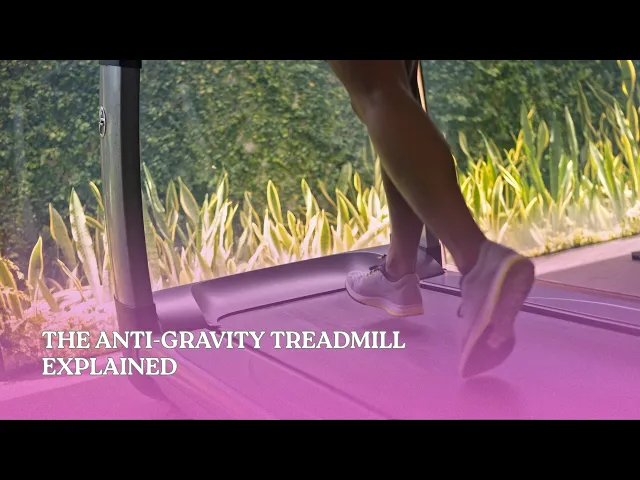
The Anti-Gravity Treadmill Explained
Mission Unstoppable
0:00 Bodies, [music] where would we be
0:01 without them?
0:02 That's a question for a
0:03 more metaphysical show.
0:04 We're here for science stuff.
0:06 Like how does a
0:07 physiatrist help [music] bodies recover
0:08 from injury?
0:09 Fig has the story.
0:13 Physicians treat illnesses, pharmacists
0:16 provide medication, Frank is a pretty
0:19 decent plumber, but what's a physiatrist
0:21 do?
0:22 To find out, [music] today we're
0:24 talking to Dr.
0:24 Monica Roe.
0:26 I was around 12 years old.
0:28 I was playing basketball, [music] basketball was my
0:30 life, and I had knee pain.
0:31 My mom took me to the doctor because the pain was
0:34 pretty bad, and the doctor basically
0:36 told [music] me to stop playing.
0:38 I was pretty devastated because I felt that if
0:40 I was a 12-year-old boy, we would have
0:42 had a totally different [music]
0:43 conversation, and that he would have
0:45 been more sympathetic.
0:47 I immediately turned to my mom and said,
0:49 "We have to find a female sports
0:51 medicine doctor." She looked, but
0:53 basically told me she couldn't find one.
0:56 And that's basically the moment where I
0:57 decided that I wanted to be a female
0:59 [music] sports medicine doctor.
1:01 Monica took that passion for sports medicine to
1:03 the next level, becoming the team
1:05 physician for the US Women's National
1:08 Soccer Team, [music] and a physiatrist
1:10 at the Shirley Ryan Ability Lab in
1:12 Chicago.
1:13 So, what exactly is a
1:14 physiatrist?
1:15 How did you get into this?
1:17 I am a physician.
1:18 Um I went to medical
1:19 school, and I specialized in physical
1:21 medicine and rehabilitation.
1:23 Physiatrists essentially uh work on the
1:25 function of people, and they improve
1:27 function across all different abilities.
1:29 [music] That will range anywhere from taking
1:32 care of elite athletes like I do to you
1:35 know, taking care of people who've had a
1:36 neurologic issue like a stroke or a
1:38 spinal cord injury or a traumatic brain
1:40 injury.
1:40 [music] So, that's essentially
1:42 what a physiatrist does.
1:43 We try to get
1:43 people back to living their life.
1:45 Monica and her team of physical and
1:47 occupational therapists [music] work out
1:49 of this cutting-edge facility where they
1:51 help patients with technology like the
1:53 anti-gravity treadmill.
1:55 This technology was [music] first
1:57 developed by NASA for astronauts to use
1:59 in space.
2:02 A tightly sealed bubble surrounds the
2:04 patient's [music] lower body, allowing a cushion of air to
2:07 support their weight as they walk, jog,
2:08 or run.
2:10 When I'm typically running, you know, on
2:12 a regular day outside, I feel a lot of
2:14 weight bringing me down, but this is
2:16 really holding me up.
2:18 And it almost feels like if I was to be running on
2:20 Mars or the moon.
2:23 But before you learn to run, you need to
2:25 learn how to walk.
2:26 And many patients build strength and [music] confidence
2:28 using the lab's body weight-supporting
2:30 harnesses.
2:31 Walking is an essential
2:33 function that a lot of people really
2:35 want to get back [music] to,
2:36 particularly after a devastating injury.
2:38 So, this helps people get back a sense
2:41 of normalcy
2:43 [music]
2:42 uh when they're trying to learn how to
2:44 walk again.
2:45 When you build someone's
2:46 confidence going up and down these
2:47 stairs, [music] then after some time,
2:50 once their confidence is built, you can
2:51 get them going up a long flight of
2:53 stairs like that.
2:54 What's also really nice about this is if they
2:57 lose their confidence halfway through,
2:59 we can actually pull them off the
3:01 stairs, float them up, and then float
3:04 them down gently [music]
3:05 back to this base landing.
3:07 So, are you ready to try it out?
3:08 Physiatry [music] is a team-based
3:10 approach to care, so Monica has one of
3:12 her expert physical therapist, Holly,
3:14 come help.
3:15 Do you feel like it's
3:16 supporting you?
3:16 I think I can let my weight go here and
3:18 just kind of hang.
3:20 Yeah.
3:21 With her joystick, Holly can
3:22 adjust how fast we move and how much
3:24 support the harness gives.
3:26 Basically, the harness will catch you.
3:28 Right.
3:28 So, you can't fall.
3:29 So, if I tripped,
3:30 [music] I would just fall into the
3:32 harness.
3:33 Exactly.
3:33 Like this.
3:34 To see yourself walking up [music] the
3:36 stairs in front of this mirror, it's
3:38 like taking seeing is believing to the
3:40 next level.
3:41 We think the mirror is super
3:42 helpful for in a patient's recovery
3:44 because they can envision themselves
3:46 walking up those stairs, and they can
3:48 see themselves actually doing it.
3:50 So, it's really helpful for their
3:51 motivation.
3:52 Okay, I have one last
3:54 question.
3:55 Can I fly down these stairs?
3:58 All right, Holly, you want [music] to make her fly?
4:00 Got it.
4:02 Look, Mom, I'm flying!
4:05 It's a bird, it's a plane, it's Fig!
4:07 Okay, this is more for therapy, not
4:11 thrills.
4:11 It's more floating than flying.
4:16 If you're watching this, you must have
4:18 really liked the video.
4:20 [clears throat]
4:19 Make sure you follow and subscribe, and
4:21 check out these other videos [music]
4:23 that are even better.
4:24 No, really.
4:25 I've seen this one over a hundred [music]
4:27 times.