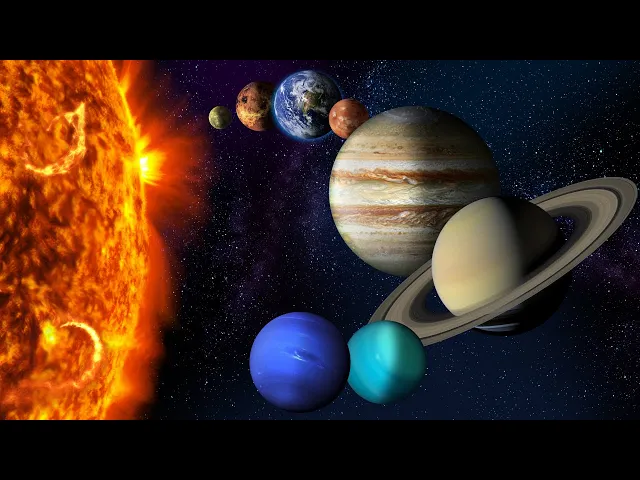
El SISTEMA SOLAR: los planetas, el Sol, características y origen☀️🌍🌕
Astraway
0:00 The solar system is a set of planets and astronomical objects linked by the
0:06 gravitational attraction produced by the single central star: the Sun. Within this planetary system
0:14 there are a multitude of smaller bodies such as moons, dwarf planets, asteroids,
0:20 meteoroids, centaurs , comets or cosmic dust. The planets of the solar system are Mercury,
0:28 Venus, Earth. Mars, Jupiter, Saturn, Uranus and Neptune.
0:34 The solar system is 4.568 billion years old and is located in the Milky Way. If you
0:43 start counting from the orbit of Pluto, it is estimated that it measures more than 5 billion kilometers.
0:50 The closest known planetary system is Alpha Centauri,
0:55 located about 4.37 light years from our Sun. In turn, the closest star
1:02 would be Proxima Centauri, located about 4.22 light years.
1:13 The Sun is the largest and most massive object in the entire solar system, measuring no less than 2 x 10 30 kg and
1:20 with a diameter of 1.4 x 10 6 km. A million Earths comfortably fit inside.
1:29 Analysis of sunlight shows that this huge sphere is composed
1:33 mostly of hydrogen and helium, plus 2% of other heavier elements.
1:39 Inside there is a fusion reactor,
1:43 which constantly transforms hydrogen into helium, producing the light and heat that it radiates.
1:51 The Sun and the other members of the solar system probably originated at the same time,
1:57 by the condensation of an original nebula of matter, at least 4.6 billion years ago. The
2:05 matter in this nebula could well have come from the explosion of one or more supernovae.
2:12 Although the Sun is not the largest or brightest star, it is the most important star
2:19 for the planet and the solar system. It is a medium-sized star,
2:23 quite stable and still young, located in one of the spiral arms of the Milky Way.
2:32 Fairly ordinary overall, but lucky for life on Earth.
2:40 There are 8 planets in the solar system, classified into inner planets and outer planets:
2:47 Mercury, Venus, Earth, Mars, Jupiter, Saturn, Uranus, and Neptune.
2:58 Inner Planets The inner planets
3:03 are Mercury, Venus, Earth, and Mars. They are small, rocky planets,
3:10 while the outer planets like Jupiter are gas giants.
3:16 This difference in density has its origin in the way the matter of the
3:21 original nebula condensed. The farther from the Sun, the temperature decreases and, therefore,
3:27 the matter could form different compounds. In the vicinity of the Sun, where the temperature
3:33 was higher, only heavy elements and compounds such as metals and silicates were able to
3:40 slowly condense and form solid particles. Thus arose the dense planets: Mercury,
3:47 Venus, Earth and Mars. Outer Planets
3:53 The outer planets are Jupiter, Saturn, Uranus and Neptune. They formed in more distant regions
4:00 , in which matter rapidly condensed into ice. The rapid growth of
4:07 these ice accumulations gave rise to objects of enormous size. However, inside these
4:14 gigantic planets are not frozen, in fact they still radiate a large amount of heat into space.
4:24 The border between the inner and outer planets is the Asteroid Belt,
4:29 remains of a planet that did not form due to the enormous
4:34 gravitational pull of Jupiter, which dispersed them. Is Pluto a planet in the solar system?
4:44 For a long time Pluto was considered a planet until 2006,
4:50 when astronomers designated it as a dwarf planet due to its lack of orbital dominance,
4:56 one of the characteristics that a celestial body must have to be considered a planet.
5:04 This means that in its environment there should be no other bodies of a similar size
5:09 and with similar gravity. This is not the case of Pluto, whose size is similar to that
5:16 of its moon Charon and very close to each other. Main characteristics of each planet The planets orbit around the Sun following elliptical orbits, according
5:24 to Kepler's laws .
5:30 These orbits are all approximately in the same plane, which is
5:37 the ecliptic plane, on which the movement of the Earth takes place around the Sun.
5:45 In this figure you can see the orbits of the planets:
5:50 Let us now see the main characteristics of each planet.
5:55 - Mercury It is a small planet,
6:00 barely larger than a third of the Earth and the closest to the Sun.
6:07 Rocky formations similar to those of the Moon can be seen on its surface, as can be seen in the images. Typical are
6:14 the lobed scarps that astronomers say are an indication that Mercury is shrinking.
6:21 It also has other characteristics in common with our satellite, for example the
6:28 chemical composition, the presence of ice at the poles and a large number of impact craters.
6:34 Occasionally Mercury is visible from Earth, very low above the horizon, just at
6:42 sunset or very early, before sunrise. This small planet has coupled its
6:49 rotation and translation movement around the Sun, thanks to the so-called tidal forces. These
6:55 forces tend to slow down the rotation speed of the planet around its axis,
7:01 until equal to the speed of translation. - Venus
7:08 In size, mass and chemical composition, Venus is very similar to Earth, however its dense
7:16 atmosphere prevents heat from escaping. This is the famous greenhouse effect, which is
7:23 why the surface temperature of Venus reaches 400 ºC, close to the melting point of lead.
7:31 The Venusian atmosphere is composed mainly of carbon dioxide and
7:36 traces of other gases such as oxygen. Atmospheric pressure is about 100 times
7:41 greater than Earth's and the distribution of fast winds is highly complex.
7:47 Another detail of the remarkable atmosphere of Venus is its rotation around the planet, which takes
7:54 about 4 Earth days. Note that the rotation of the planet itself is extremely slow:
8:02 one Venusian day lasts 243 Earth days. Venus is abundant in deuterium, an isotope of
8:11 hydrogen that is due to the lack of an ozone layer that protects against ultraviolet rays from the
8:17 Sun. There is no evidence of water today, however, so much deuterium indicates that Venus may
8:25 have had it in the last. - The Earth
8:31 The third planet in proximity to the Sun is the only one that harbors life, at least as far as we know.
8:38 The Earth is at an ideal distance for life to proliferate and also has a
8:44 protective ozone layer, abundant liquid water (up to 75% of the surface
8:50 is covered by this element) and an intense magnetic field of its own. Its rotation
8:56 is also the fastest of the four rocky planets. The Earth's atmosphere is composed of nitrogen
9:04 and oxygen, with trace amounts of other gases. It is stratified, but its limits are not defined:
9:11 it progressively thins until it disappears. Another important feature of the Earth is
9:18 that it has plate tectonics, which is why its surface undergoes changes continuously
9:24 (in geological times of course). Hence, the evidence of craters that
9:31 abound in the other planets of the solar system have already been erased. This gives the Earth a wide variety of
9:37 environmental settings: mountains, plains and deserts, along with an abundance of water,
9:43 both in the vast oceans and in fresh water on the surface and subsoil.
9:48 Along with the Moon, its natural satellite, it forms a remarkable duo. The size of our satellite is
9:56 relatively large compared to that of the Earth and exerts a significant influence on it.
10:02 To begin with, the Moon is responsible for the tides, which exert a powerful influence
10:07 on life on Earth. The Moon rotates synchronously with our planet:
10:13 its periods of rotation and translation around the Earth are the same, which is why it always
10:21 shows us the same face. - Mars
10:26 Mars is slightly smaller than Earth and Venus, but larger than Mercury. Its areal density
10:33 is also somewhat lower. Very similar to Earth, the curious always thought they saw signs of
10:38 intelligent life in the reddish star. The reddish color of Mars is due to the
10:43 abundance of iron oxides on the surface. As for its atmosphere,
10:47 it is thin and consists of 95% carbon dioxide, with traces of other elements such as argon.
10:55 There is no water vapor or oxygen. The latter is found forming compounds in rocks.
11:03 Unlike Earth, Mars does not have its own magnetic field,
11:07 so the particles of the solar wind directly affect the surface,
11:11 little protected by the thin atmosphere. As for the orography, it is varied and there are
11:18 indications that the planet once had liquid water. One of the most notable features
11:24 is Mount Olympus, the largest known volcano in the Solar System so far.
11:31 Mount Olympus far exceeds the largest volcanoes on Earth:
11:37 it is triple the height of Mount Everest and 100 times the volume of Mauna Loa, the largest volcano on Earth. Without
11:44 tectonic activity and with low gravity, the lava could accumulate to give rise to such a
11:50 colossal structure. - Jupiter
11:55 It is undoubtedly the king of the planets due to its large size:
11:58 its diameter is 11 times greater than Earth's and its conditions are also much more extreme.
12:06 It has a rich atmosphere crossed by fast winds. Jupiter's well- known Great
12:12 Red Spot is a long-standing storm, with winds of up to 600 km/h.
12:20 Jupiter is gaseous, so below the atmosphere there is no solid ground. What
12:26 happens is that the atmosphere becomes denser as the depth increases,
12:31 until reaching a point where the gas is liquefied. Hence it is quite flattened
12:37 at the poles, because of the rotation. Despite the fact that most of the
12:42 matter that makes up Jupiter is hydrogen and helium -like the Sun-,
12:46 inside it has a nucleus of heavy elements at a high temperature. In fact,
12:52 the gas giant is a source of infrared radiation, so astronomers know that
12:58 the interior is much hotter than the exterior. Jupiter also has its own magnetic field,
13:05 14 times stronger than Earth's. A notable feature of that planet is the
13:12 large number of natural satellites it has. Due to its enormous size, it is natural that its gravity
13:18 has been able to capture many rocky bodies that happened to pass through its vicinity. But
13:25 it also has large moons, the most notable being the four Galilean moons: Io,
13:32 Europa, Callisto and Ganymede, the latter being the largest of the solar system's moons.
13:39 These large moons probably originated at the same time as Jupiter. In their own right they are
13:45 fascinating worlds, since in them there is the presence of water, volcanism, extreme weather and magnetism,
13:53 among other characteristics. - Saturn
13:58 Without a doubt, what is most striking about Saturn is its complex ring system,
14:04 discovered by Galileo in 1609. Millions of ice particles make up
14:11 Saturn's rings, perhaps the remains of ancient moons and comets that impacted the planet .
14:18 Some satellites of Saturn, called shepherd satellites, are responsible for keeping the orbit free
14:25 and confine the rings to well-defined regions of the planetary equatorial plane. The
14:31 equator of the planet is quite pronounced, being a very flattened spheroid due to
14:37 low density and rotational movement. Saturn is so light that it could float
14:44 in a hypothetical ocean large enough to contain it. Another reason for
14:51 the deformation of the planet is that the rotation is not constant, but rather dependent on latitude
14:56 and other interactions with its satellites. As for its internal structure, the data
15:04 collected by the Voyager, Cassini and Ulysses missions ensure that it is quite similar
15:10 to that of Jupiter, that is, a gaseous mantle and a nucleus of very hot heavy elements.
15:18 The temperature and pressure conditions make it possible for liquid metallic hydrogen to form,
15:24 so the planet has its own magnetic field.
15:28 Towards the surface, the weather is extreme: storms abound, although not as persistent as those
15:36 on neighboring Jupiter. - Uranus
15:42 The movement of Uranus is quite peculiar, being retrograde rotation,
15:48 like Venus. In addition, the axis of rotation is very inclined with respect to the plane of the orbit:
15:55 97.9º, so it practically rotates on its side. So the planet's seasons - revealed
16:05 through the Voyager images - are quite extreme, with winters lasting 21 years.
16:14 The blue-green color of Uranus is due to the methane content of its atmosphere, which is much
16:20 cooler than that of Saturn or Jupiter. But little is known about its internal structure.
16:26 Both Uranus and Neptune are considered ice worlds, or rather gaseous or quasi-liquid.
16:35 Although Uranus does not produce metallic hydrogen because of its lower mass and pressure in the interior,
16:41 it does have a strong magnetic field, more or less comparable to Earth's.
16:46 Uranus has its own ring system, although not as magnificent as Saturn's. They are very
16:54 faint and therefore not easily seen from Earth. They were discovered in 1977,
17:02 thanks to the temporary occultation of the planet by a star, which allowed astronomers to
17:08 see their structure for the first time. Like all the outer planets,
17:14 Uranus has many moons. The main ones are Oberon, Titania, Umbriel, Ariel and Miranda,
17:23 names taken from the works of Alexander Pope and William Shakespeare. Frozen water has been detected
17:30 on these moons. - Neptune
17:37 In the confines of the solar system is Neptune, the planet farthest from the Sun. It was discovered
17:45 due to unexplained gravitational disturbances, which led to the existence
17:50 of a large object not yet discovered. Seen from Earth, Neptune is a
17:56 small blue-green dot, and until recently, little
18:01 was known about its structure. The Voyager mission provided new data in the late 1980s
18:08 . The images showed a surface with evidence of strong storms and fast winds,
18:14 including a large spot similar to that of Jupiter: the Great Dark Spot.
18:19 Neptune has a methane-rich atmosphere, as well as a faint ring system,
18:27 similar to that of Uranus. Its internal structure is composed of an ice crust that covers
18:34 the metallic core and has its own magnetism. As for the moons,
18:41 about 15 have been discovered to date, but there could be a few others, since the planet is very
18:47 far away and is the least studied yet. Triton and Nereid are the main ones,
18:53 with Triton in retrograde orbit and possessing a tenuous nitrogen atmosphere of its own.
19:00 But the solar system does not only have planets, it also has other astronomical objects.
19:06 We are talking about dwarf planets, moons or satellites of the larger planets,
19:12 comets, asteroids and meteoroids. Each one has extremely
19:20 interesting peculiarities. Dwarf planets
19:23 In the asteroid belt between Mars and Jupiter, and beyond the orbit of Neptune,
19:30 in the Kuiper belt, there are many objects that, according to astronomical criteria, do not fall into
19:37 the category of planets. The most outstanding are:
19:41 - Ceres, in the asteroid belt. - Pluto, which was previously
19:47 considered the ninth largest planet. - Eris, discovered in 2003 and larger
19:53 than Pluto and further from the Sun than this. - Makemake, in the Kuiper belt and
20:00 about half the size of Pluto. - Haumea, also in the Kuiper belt. It
20:07 is markedly ellipsoidal in shape and has rings. The criterion to distinguish them from the
20:14 larger planets is both their size and the gravitational attraction they possess,
20:18 linked to their mass. To be considered a planet, an object must rotate around the Sun,
20:25 as well as be more or less spherical. And its gravity has to be
20:30 high enough to absorb the other smaller bodies around it,
20:35 either as satellites or as part of the planet.
20:38 As at least the gravitational criterion is not met for Ceres, Pluto and Eris,
20:44 this new category was created for them, to which Pluto went in 2006. In the distant
20:52 Kuiper belt it is possible that there are more dwarf planets like these, still undetected.
21:00 Moons The major planets, and even Pluto, have
21:06 satellites that orbit around them. There are more than a hundred belonging to the major planets,
21:12 almost all distributed in the outer planets and three belonging to the inner planets:
21:19 the Moon of the Earth, and Phobos and Deimos of Mars. There may still be more moons to discover,
21:27 especially on planets farthest from the Sun, such as Neptune and other icy giants.
21:33 Their shapes are varied, some are spheroidal and others quite irregular. The largest
21:41 probably formed next to the parent planet, but others could be
21:45 captured by gravity. There are even temporary moons, which for some reason are captured
21:53 by the planet but are eventually released. Other bodies, in addition to the major planets,
21:59 also have moons. It is estimated that so far there are about 400 natural satellites of
22:07 all kinds. Comets
22:09 Comets are debris from the cloud of matter that gave rise to the solar system. They are made
22:16 up of ice, rocks and dust and are currently found on the outskirts of the solar system,
22:22 although they do come close to the Sun from time to time. There are three regions that are very far from the Sun,
22:29 but still belong to the solar system Astronomers believe that there all the comets dwell:
22:36 the Kuiper belt, the Oort cloud and the scattered disk.
22:42 Asteroids, centaurs and meteoroids Asteroids are rocky bodies
22:49 smaller than a dwarf planet or a satellite. Almost all of them are found in the
22:55 asteroid belt that marks the border between the rocky and gas planets.
23:00 For their part, centaurs receive this name because they share characteristics
23:05 of asteroids and comets, as do the mythological beings of the
23:10 same name: half human and half horse. Discovered in 1977, they have not been
23:19 properly imaged yet, but are known to be abundant between the orbits of Jupiter and Neptune.
23:25 Finally, a meteoroid is a fragment of a larger object,
23:30 such as those described so far. They can be as tiny as a wisp of matter—not
23:37 as small as a grain of dust—as small as 100 microns, or as large as 50 km in diameter.