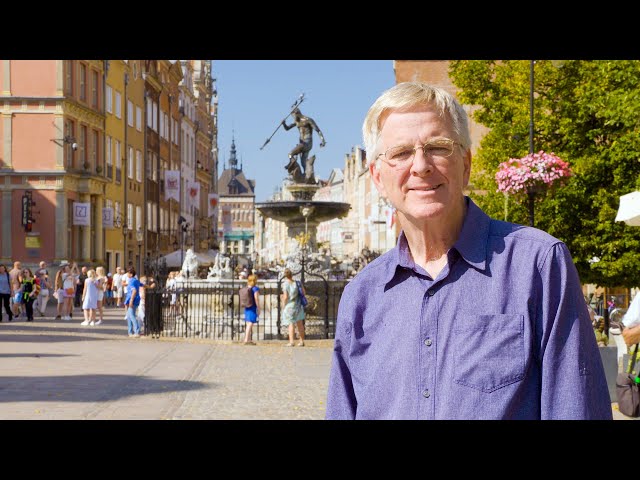
Poland’s Warsaw and Gdańsk
Rick Steves' Europe
0:00 Hey, I'm Rick Steves back with more of the best of Europe.
0:04 This time we're visiting two of Poland's leading cities.
0:08 The bustling capital Warsaw that way, the gorgeous maritime port Gdans that way,
0:13 and the most formidable pile of medieval bricks I've ever seen.
0:18 Thanks for joining us.
0:21 [Music] Most tourists visiting Poland go only to Krakow.
0:55 But there's so much more to see.
0:57 The capital Warsaw is the heartbeat of contemporary Poland.
1:00 And Gdansk up here in the Baltic coast is
1:03 a colorful historic port city with a dramatic 20th century story.
1:08 We begin in Warsaw, the cosmopolitan capital gilded
1:13 with a grand palace and a trendy urbanity.
1:19 We'll learn about its turbulent 20th century and enjoy some Shopan in the park.
1:24 Then we visit a sweet medieval town,
1:26 taste its claim to fame, and storm a massive Tutonic fortress.
1:31 Finally, we discover the port of Gdansk
1:33 and how it helped bring communism down in Europe.
1:37 Poland, about the size of Arizona, sits in the north of Central Europe.
1:42 We'll follow its main river, the Vistula, from the capital, Warsaw,
1:46 north past Tun and Malborg Castle to Gdansk on the Baltic Sea.
1:53 Warsaw is an energetic metropolis offering
1:56 a fascinating foray into urban Poland.
1:58 It comes with both a hard-fought history and a modern vibrancy.
2:04 Today, Warsaw, pronounced Barava here,
2:06 is Poland's biggest city with close to 2 million people.
2:11 It's muscular and sprawling, broad boulevards,
2:15 imposing buildings, and glittering glass office towers.
2:19 Today's Warsaw is a thriving European center of business,
2:23 banking, and politics with a cosmopolitan energy.
2:28 Warsaw's glory days peaked between the World Wars
2:31 when it was one of Europe's most gental capitals.
2:35 That spirit survives along its rebuilt main drag, the sweeping Royal Way.
2:40 With its elegant facades and its popularity with local strollers,
2:47 just being out and about, you feel the youthful confidence of this society.
2:52 Stately hotels and government buildings, this is the president's residence,
2:57 add to the royal ways grandeur.
3:01 The Blecla Bakery is every pole's favorite for Ponchki jelly donuts.
3:12 When locals here go out for donuts, they go out for punchki.
3:16 My favorite's the classic.
3:18 It's filled with wild rose jam.
3:23 But it's not all jelly donuts.
3:25 Vast squares with memorials remind all of Poland's hard-fought history.
3:30 Here, the eternal flame honors war dead with numbers almost incomprehensible.
3:37 As the city was totally destroyed by Nazis in World War II,
3:41 nearly everything you'll see, palaces, churches, and fountains,
3:45 was painstakingly rebuilt from the rubble of 1945.
3:50 I keep having to remind myself that in this city,
3:53 hardly a building standing is over 80 years old.
3:57 Consequently, Warsaw is an architectural jumble, rebuilt both old and new.
4:10 Warsaw's meticulously rebuilt old town is
4:13 dominated by its meticulously rebuilt royal castle.
4:18 The castle, a symbol of Polish sovereignty now for over 400 years,
4:23 boasts some of this country's most lavish halls,
4:26 gilded and glittering with chandeliers.
4:30 The palace reflects how Poland was independent and strong for centuries,
4:35 starting in the Middle Ages.
4:38 When the homegrown dynasty died out,
4:40 Poland's nobility elected foreign kings at gatherings like this.
4:46 Many of those imported rulers squandered
4:49 Poland's resources on their own selfish agendas.
4:53 They weakened the country until it actually ceased to exist in 1795.
5:00 For over a hundred years, Poland disappeared from the map,
5:04 partitioned by three empires, Prussia, Austria, and Russia.
5:08 But the Poles succeeded in preserving their culture until
5:12 their country was reborn in 1918 after World War I.
5:17 Today, back out on the streets,
5:19 the atmospheric Old Town entertains the tourists.
5:23 Here, the 21st century seems to rule these cobbled lanes.
5:27 In the center of the beautifully
5:29 constructed market square is a popular sculpture.
5:32 The mermaid, a symbol of Warsaw, serenades the town's people,
5:36 still welcoming friends while keeping out foes.
5:40 To me, this fountain, always energetic with kids playing,
5:43 feels like a celebration of life, Polish life.
5:48 [Music] And Polish life comes with music,
5:59 especially the genius of favorite son Frederick Shopan.
6:03 On summer Sundays, Shopan concerts pack the park.
6:07 It's an expression of this city's pride
6:09 in its culture and its enduring appetite for community.
6:20 Poland's great romantic composer sits under a willow tree.
6:26 Though he lived and worked mostly in Paris,
6:28 locals cherish the thought that Shopan's inspiration came from memories
6:33 of the breeze blowing through the willow trees of his native land, Poland.
6:40 [Music] Warsaw museums work hard to explain its complicated
6:56 history and much of Poland's story is a Jewish story.
7:00 The Museum of the History of Polish Jews
7:03 celebrates a thousand years of Jews living in Poland.
7:08 A winding route traces their experience.
7:11 [Music] With the relative tolerance of medieval kings,
7:15 Jews became established in Polish society.
7:19 But because they still suffered through pilgrims and other persecution,
7:23 few actual artifacts survive.
7:27 Many Jews lived in market towns called with richly decorated wooden synagogues.
7:34 Above the traditional elevated prayer platform is a colorful ceiling,
7:38 a humble canopy rich with symbolism.
7:42 When Poland regained its independence after World War I,
7:45 Jewish culture blossomed, especially in the 1920s when for the first time,
7:50 Jews had full citizenship and voting rights.
7:54 And Warsaw was the biggest Jewish city in Europe.
8:00 Tragically, this flourishing of Jewish culture was
8:03 crushed when fascist Germany invaded in 1939.
8:07 Jews were then coralled into a miserable ghetto,
8:11 subjected to unlivable conditions before being shipped
8:14 off to Nazi death camps and killed.
8:24 A monument captures the desperation of the ghetto's last days.
8:31 Realizing they were all doomed anyway,
8:33 the Haggar and Hungary who remained staged a desperate uprising.
8:38 Nearly all were killed.
8:42 This was just one city's experience in a Europewide Holocaust.
8:46 In this attempted genocide, Hitler tried to rid the world of Jewish people.
8:52 Of the 6 million he killed, half died here in Poland.
8:57 [Music] With its Jewish population decimated,
9:01 Warsaw's next chapter was a second valiant but doomed uprising.
9:06 This time by the non-Jewish Poles who remained under Nazi occupation.
9:12 Poles had formed the biggest underground resistance army in history.
9:18 Late in the war, as the Nazis began to falter and the Soviets advanced,
9:22 Poland's home army mobilized to liberate the country.
9:27 But the Nazis regrouped and brutally put down the Warsaw uprising.
9:33 Hitler then ordered that Warsaw be destroyed to its foundations.
9:38 [Music] The Soviet army sat here across the river and watched and waited.
9:45 Finally, when the Germans were gone,
9:47 the Russians marched in to claim the wasteland that was once Warsaw,
9:52 kicking off over four decades of communist rule.
9:56 Like a phoenix, the city has risen from the ashes.
10:00 And today, Warsaw is filled with a happy and youthful
10:03 populace that has no living memory of those hard times.
10:10 Today's Warsaw is hip and trendy.
10:13 Hulking old buildings, no longer fascist or communist,
10:17 are filled with a rainbow of global food choices.
10:21 [Music] Postindustrial architecture is all the rage.
10:27 Old red brick factories and power plants
10:30 have been transformed into convivial hubs for dining, drinking, and shopping.
10:38 I'm joined by my friend and fellow guidebook author Cameron Huitt and the show's
10:42 producer Simon Griffith at Debenda for a taste of Warsaw Zerbane foodie scene.
10:48 This trendy restaurant specializes in craft cocktails and Polish fusion cuisine.
10:54 The menu takes fresh local ingredients like heirloom
10:57 tomatoes and beets and gives them an international spin.
11:02 Padrron peppers, falafel, pumpkin dumplings,
11:08 all washed down with a good Spanish wine.
11:11 Whether Polish or international,
11:13 you can see that we thought everything was delicious.
11:16 It's a reminder of how cosmopolitan Warsaw respects
11:20 Polish tradition while also embracing a global future.
11:24 I can't think of a better way to enjoy our last night in Warsaw.
11:33 Heading north from Warsaw through
11:34 the rolling farmland of the Polish countryside,
11:37 we reach a small town break from our big city itinerary, Touun.
11:43 Torun feels affluent.
11:45 In the Middle Ages, it was part of the Hansiatic League,
11:48 a trade union of northern European merchant cities.
11:52 Like much of northern Poland,
11:54 many of its buildings are finely crafted of red brick.
11:58 The city has an easygoing ambiance
12:00 that comes with the heavenly scent of gingerbread.
12:05 Every pole knows Tun for two reasons, Capernicus and gingerbread.
12:14 This was the birthplace of the astronomer Capernicus who 500
12:17 years ago established that the earth revolves around the sun.
12:25 But today here in Torun anyway a lot revolves around this gingerbread.
12:32 This recreated old bakery is a favorite for field trips.
12:37 Costumed guides teach young students how in the Middle Ages,
12:40 Torun's trading connections gave local bakers access to exotic spices.
12:46 Spices like ginger, cinnamon, and clove.
12:49 And how the honey in the dough was a natural preservative,
12:52 allowing it to be traded far and wide.
12:57 Then the children get to actually roll the dough,
13:02 press it into traditional molds, and pop their little creations into the oven.
13:10 Local gingerbread shops let you mix and match
13:12 a variety of tasty treats with any combination of jams, glazes, and chocolate.
13:18 For locals, the word is actually a verb.
13:22 If you've eaten too much, you have gingerbreaded.
13:25 [Music]
13:30 I think this will get me to our next stop.
13:34 Further north is the Malborg Castle.
13:37 Another red brick masterpiece called the biggest brick castle in the world.
13:41 This was the 14th century headquarters of the Tutonic Knights.
13:46 These Germanic crusaders turned mercenaries were hired here
13:50 by a Christian duke to convert the local pagans.
13:54 Job done.
13:55 The Tutonic Knights decided they liked it here, so they stuck around,
13:59 built this castle, and dominated northern Poland for over a century.
14:04 Malbour Castle was essentially a fortified monastery home to monks,
14:08 knights, and their leader, the Grandmaster.
14:12 Malbour's fortifications are formidable indeed.
14:16 The complex was surrounded by an imposing moat and a mighty brick wall.
14:22 The heavy portal stopped anyone who breached the moat.
14:26 Then from slits up above, archers could rain down arrows.
14:32 And the inner drawbridge made the core
14:33 of the castle an impenetrable last refuge.
14:38 While knights lived in the outer castle, monks lived in the inner castle.
14:43 The Grandmaster's lavish and wellfortified quarters
14:46 with their fanvated assembly rooms and expansive dining
14:49 halls were the capital of those Tutonic
14:52 Knights from where they administered their domain.
14:57 Most of the main sites of Poland are connected by the Vista River.
15:01 An hour's drive takes us to its and our final stop, Gdansk.
15:07 Historically Poland's leading port sits near
15:09 where the fistla meets the Baltic Sea.
15:13 For a thousand years, a cultural crossroads with a rich maritime history.
15:17 Architecturally, it feels more Scandinavian or Dutch than Polish.
15:23 During its medieval golden age,
15:25 Gdansk prospered as a key member of the Hansiotic League.
15:30 The Hansiotic League was an association of over
15:32 a 100 cities and ports across Northern Europe.
15:36 Its mission to protect and promote trade.
15:39 Busy hunting down pirates, building lighouses,
15:41 and boycotting ports that didn't join the club.
15:44 It dominated the economy and politics
15:46 in the region through the late Middle Ages.
15:49 In a way, the Hansiotic League was a precursor to the European Union.
15:53 Its motto, all power to the merchants.
15:57 Along the embankment is a structure those merchants put to good use.
16:01 a hulking 15th century crane.
16:05 Back then, this entire river could be filled banktobank with trading vessels.
16:11 Maritime trade from distant lands made Gdansk both prosperous and tolerant.
16:16 It attracted merchants from all over Europe who
16:19 brought with them elements of their home cultures.
16:22 These were then woven into the tapestry of the city,
16:25 reflected in its eclectic architecture.
16:29 Overhead, the town hall tower holds a carolon
16:32 that marks each hour with a cheerful tune.
16:39 [Music] To better understand Gdansk,
16:46 we're joined by my friend and fellow tour guide, Agnesca Sroa.
16:52 Our first stop is the town hall.
16:58 So the city was governed from this exact room here.
17:02 And the art is there's a lot of art here.
17:05 Yeah, that's amazing, isn't it?
17:06 In the middle of the vaulting,
17:08 have a look at this magnificent painting from6008.
17:13 [Music] Visa river starts over there in the mountains.
17:17 Look at these barges filled with the grain from all over the kingdom of Poland.
17:23 So all the goods were shipped from the Dinsk
17:28 down the Vista River to the Baltic Sea.
17:31 They are taking that grain and that grain goes all over Western Europe.
17:35 And look, deals, businesses made here in front of the Arthus court.
17:40 These would be traders from all over Northern Europe.
17:43 Part of the Hansiatic League here making a deal, shaking hands.
17:46 Indeed, like 1600 stock market and God's hand.
17:50 So he's holding not the church but the town hall.
17:54 Exactly.
17:54 Because Gdansk was so multicultural and multi-religious throughout centuries.
17:59 It really never mattered what religion you are but how
18:02 much money you can bring to the city doing your business.
18:05 The guild hall is next door.
18:07 This is a magnificent roof.
18:09 It's a beautiful guild house.
18:11 A great example of a great social space where guilds,
18:16 medieval merchant groups met.
18:18 Okay.
18:18 So this was like um networking.
18:21 Exactly.
18:21 Exactly.
18:22 Merchants from all over Europe were coming here to do their business.
18:25 Each arch uh belonged to one guild.
18:29 Imagine in front of each arch there
18:31 was goldmith guild uh beer guild, amber guild.
18:36 They were very competitive.
18:38 So that the traders from Lubebec would meet
18:40 the traders from Amsterdam and from Ria coming together
18:44 and then buying grain, timber, coal and exporting that all over Europe.
18:52 The city is ornamented with fine red brick buildings.
18:56 That's because here in the marshy north of Poland, stone is scarce.
19:01 Grand buildings like this old mill elevate brick laying to an art form.
19:06 The old market hall has long provided
19:08 an impressive place for farmers to sell their produce.
19:13 The train station gives visitors a red brick welcome.
19:16 And even the modern shopping malls carry on this love of brick.
19:21 And rising high above everything is St.
19:24 Mary's Church, one of the biggest brick churches anywhere.
19:29 To be both tall and stable without the strength of stone,
19:32 it was fortified with beefy brick buttresses.
19:36 Stepping inside, you're struck by the stark, austere and very white interior.
19:41 This is a remarkable church.
19:44 Mary's church was built before reformation.
19:46 Look at the beautiful tptic altar coronation of St.
19:50 Virgin Mary.
19:51 So the altarpiece is from before the reformation.
19:54 Exactly.
19:55 And then the city converted to Protestant.
19:57 And what was really important was the pulpit because
20:00 of the word of God and music coming from magnificent organ.
20:07 Look at that pipe organ.
20:10 This is like a pavement of tombstones.
20:12 Exactly.
20:13 500 gravestones of the wealthiest merchants of Gdines who
20:18 wanted to be buried here in their parish church.
20:21 And if not buried in the tomb, you could commemorate your family on the wall
20:24 with an epito [Music] in the shadow of the church.
20:31 Atmospheric Marriottska Street is lined
20:33 with traditional porches, clever gargoyles,
20:37 and vendors selling the prized amber that the Baltic coast is so famous for.
20:48 For amber as high art, the striking amber museum fills an old mill
20:53 with precious deposits of this fossilized tree sap.
20:57 Much of the world's amber comes from Poland.
21:00 Amber, which can be tens of millions of years old,
21:02 comes in shades of white, yellow, and brown.
21:06 It's a favorite medium of local artisans who create exquisite items
21:11 from an organically sculptured candalabra
21:14 to a chessboard that would mesmerize a grandmaster.
21:18 There's an exquisite miniature storage chest and even
21:22 furniture such as this gorgeous writing desk.
21:27 [Music] Gdans lived its most dramatic moments in the 20th century.
21:35 World War II began right here in 1939 when Hitler invaded.
21:39 And those cranes marked the shipyard where 40 years later in 1980,
21:43 the Soviet block finally began to crack.
21:47 During communist times, Gdansk was home to the massive Lenin shipyard.
21:51 In 1980, after decades of frustrations and struggles,
21:55 shipyard workers went on strike.
21:59 They created a trade union called Solidarity.
22:03 Locking themselves inside the shipyard,
22:05 they refused to work and scrolled their list of 21 demands on plywood.
22:12 A fired shipyard electrician, Le Fuenza, heard news of the strike.
22:16 He came here and literally climbed over
22:18 the wall to get inside and join his comrades.
22:21 The strike had its leader.
22:23 The European Solidarity Center with its industrial strength architecture
22:28 and inspiring exhibits tells the story both vividly and proudly.
22:34 For 18 days, 17,000 workers, welders,
22:38 machinists, and steel workers stood strong.
22:42 Their only connection to the outside world was to come to the gate.
22:46 There they'd pass messages to family members and receive food,
22:50 supplies, and encouragement.
22:54 The strikers were hungry, tired, and scared.
22:58 But they were both inspired and emboldened by the new Polish Pope, John Paul II.
23:04 Finally, the communist authorities gave in and legalized the union.
23:08 Half of the nation's workforce joined solidarity, and change was in the air.
23:14 But then after 16 hopeful months, Polish authorities,
23:18 fearful of Soviet intervention, declared martial law.
23:22 Tanks rumbled through the snowy streets of Poland,
23:25 and the riot police cracked down on dissident.
23:29 Solidarity went underground.
23:31 Yet, it gained momentum.
23:34 In 1989, the roundt talks brought about elections.
23:38 The result, solidarity, now a political party, won every available seat.
23:46 These first cracks in the Eastern block spread quickly.
23:50 Within a few months, the Berlin Wall fell, borders opened up,
23:54 communist regimes voted themselves out of existence,
23:57 and Leoenza was elected the first postcommunist president of Poland.
24:03 Today, Gdansk, mindful of its history, is a forward-looking community.
24:08 Facing the skyline of old Gdansk across the river, is a modern development.
24:14 Only recently rebuilt from World War II bombings,
24:17 it echoes the historic roof lines.
24:21 With its 21st century affluence,
24:23 Gdansk provides its people a stylish boardwalk for good living.
24:28 Strolling here, you feel the promise of a bright Polish future.
24:37 The resilience of Poland's culture and the warmth of its people inspire me.
24:41 And learning from this country's hard history, I'm reminded that freedom, peace,
24:46 and prosperity are hard-earned and that we have lots to be thankful for.
24:51 I hope you've enjoyed our look
24:52 at perhaps Europe's most underrated and surprising country.
24:56 I'm Rick Steves.
24:57 Until next time, keep on traveling.
25:02 It's filled with wild rose jam.
25:07 Whoa.
25:08 It's a colorful historic port city with a dramatic 20th century story.
25:14 This is it.
25:14 This Oh, come to Gdubsk.
25:21 Yes.
25:21 To do their business, networking, commerce,
25:30 money.
25:27 [Music]