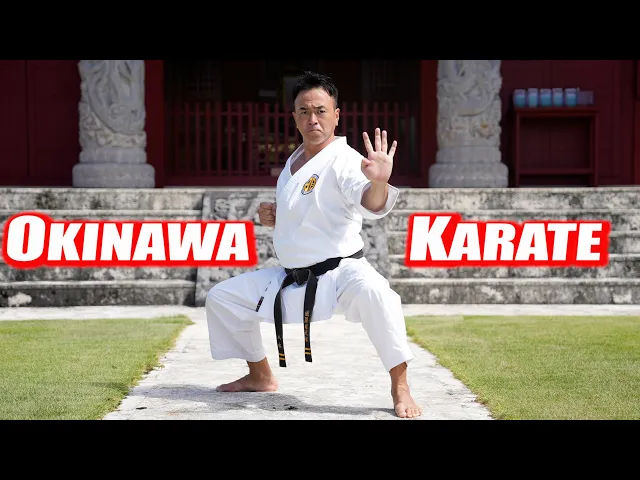
【50 minutes】Let's try "Okinawa Gojyu-ryu Karate" with Subtitles in 26 Languages!
kuro-obi world
0:05 It's been a long time!
0:06 Long time no see.
0:07 What would you show us today?
0:11 Today, I'm going to show "Ippon Kumite"
0:15 which is devised by Miyagi Chojun sensei.
0:19 It's "Yakusoku Kumite".
0:21 Maybe, only few "Dojo"s are training with it in Okinawa.
0:27 Really?
0:28 Yes.
0:28 I hardly see it in other "Dojo"s.
0:30 But we still inherit it in "Meibukan".
0:32 So I'm going to show the Miyagi Chojun sensei's "Ippon Kumite",
0:35 and "Nihon Kumite" which was devised by Yagi Meitoku sensei.
0:43 By the way, is the person in the photo Miyagi Chojun sensei?
0:47 Yes.
0:48 He is Miyagi Chojun sensei, the founder of "Gojyu-ryu Karate".
0:53 Which is Meitoku sensei?
0:57 He is here.
0:58 His name is Yagi Meitoku sensei?-Yes.
1:00 What is the relationship with you?
1:02 He is my grandfather.
1:05 I'm going to demonstrate with Yagi Akihiro sensei today.
1:10 Really?
1:11 We brothers will show the "Ippon Kumite".
1:14 Long time no see.
1:15 I appreciate your cooperation today.
1:52 These are "Ippon Kumite" of "Jodan".
1:55 There are four.
1:56 Were they devised by Miyagi Chojun sensei?
1:59 Yes.
2:05 Let me explain this prearranged "Kumite".
2:08 One attacks and the other defends.
2:11 I'll show them slowly.
2:13 "Jodan zuki" comes.
2:15 It comes with "Suri-ashi".
2:18 One step back.
2:20 Block it with "Age uke".
2:23 As I pull my hand back, I attack his "Chudan".
2:27 We call this "Soko zuki".
2:29 "Soko zuki"?
2:30 -Yes.
2:40 The name of this is "Jodan uchi uke".
2:44 Next, when he comes in, I step in and crouch to dodge his attack.
2:49 I change "Shiko dachi" to "Zenkutsu dachi" and attack his armpit with my elbow.
3:00 This is "Hiji ate".
3:08 Next one is I crouch to dodge the attack and attack his "Kinteki".
3:29 Next one is "Ashitori".
3:30 As he comes in, I hold his front leg to take him down.
3:36 And twist it, aim his "Kinteki" with sliding my hand.
3:48 This is dangerous technique, isn't it?
3:58 Do you push any particular part?
4:00 This is in the "Kata" called "Sanseru".
4:03 I pull his heel towards me.
4:05 Another point is the knee.
4:08 I push here this way.
4:13 I push here to the side and pull his heel towards me.
4:20 I see.
4:24 Then, I twist his ankle.
4:26 Sliding forward, and aim his "Kinteki".
4:30 This person is defending here.
4:33 I see.
4:34 Pull the leg with my left hand and push with my right hand to aim the "Kinteki".
4:46 From here, I twist his ankle inwards.
4:50 As I pull his leg, I attack his "Kinteki".
4:55 It'll hit if he doesn't cover.
5:01 I see.
5:05 These four are "Jodan" of "Ippon kumite".
5:09 "Jodan" of "Ippon kumite"?
5:10 -Yes.
5:11 Next is "Chudan".
5:13 It's the "Ippon kumite" against a "Chudan" attack.
5:49 These five.
5:50 I'll do them slowly.
5:51 "Chudan zuki" comes so I step back and hold it down.
5:56 And I attack with "Uraken".
5:58 Attack and defense are done at the same time.
6:10 There is a technique called "Tsuki uke".
6:12 Slide "Tsuki" to block his attack.
6:18 It’s like a counterattack.
6:20 That's called "Tsuki uke".
6:29 It's like this.
6:32 And stomp his joint with my "Sokuto".
6:50 Next is "Ku zuki".
6:51 I dodge the attack as if I rotate him.
6:58 It's with "Shotei".
7:00 Then, attack his armpit.
7:04 Armpit?
7:07 It's a kind of vital spot here.
7:09 Here.
7:11 It hurts especially here.
7:17 "Ku zuki" is just like this.
7:20 What did you say?
7:21 "Ku zuki".
7:23 What is the "Ku"?
7:24 It's the same "Kanji" character as "Kara" of "Karate".
7:29 It's like this.
7:32 This is "Uke zuki".
7:34 Next is "Osae geri".
7:36 "Osae geri"?
7:37 -Yes.
7:38 I step back 45 degrees to dodge his attack and block.
7:46 Drop and catch.
7:50 Like this.
7:52 I hold his hand down with "Nekoashi dachi".
7:56 Grab his hand and kick his "Kinteki" as I pull.
8:15 Next is "Osae zuki".
8:17 It's same as the last one.
8:20 Block and drop.
8:22 Block and drop at the same time.
8:24 And hook his hand.
8:28 Hold here with the other hand to stop his front hand, and punch here.
8:47 "Chudan" is these five.
8:50 【APPLICATION】 Block this, going in and attack here.
8:54 But this could be even like this.
8:59 Even though I block his attack, his elbow may come.
9:05 Or his "Urauchi" may come.
9:07 So I stop him firmly like this.
9:14 In addition to that, I move forward and push him.
9:19 Then, use that impact to punch.
9:22 From this short distance.
9:25 I see.
9:36 So we have five for "Chudan".
9:38 Next is "Ippon kumite" of "Gedan".
9:46 His "Gedan" attack comes so I step back with "Gedan barai".
9:51 And I grab his hand, pull and attack with "Gyaku shuto".
9:54 It's to the temple or carotid arteries with pulling.
10:08 "Soto uke".
10:09 "Gedan" attack comes so I block with my right hand, "Harai uke".
10:17 And raise his punch with my thumb.
10:21 I hold the inside of his elbow, and attack his ribs with my elbow.
10:35 This is "Soto uke" of "Gedan".
10:53 Next is "Ai zuki".
10:55 I dodge his "Gedan" attack this way.
10:57 It’s just like a counterattack.
11:11 The last one is "Sokuto".
11:15 I dodge his "Gedan" attack, and kick his armpit.
11:36 You're not blocking, you're dodging, right?
11:40 Any attacks, for example, punches,
11:46 or kicks like this, you can block them as long as you can see.
11:59 But it would be dangerous if he thrusts harder or does roundhouse kicks.
12:06 If the attacks are simple, you can block them without leg movements.
12:12 This will be okay.
12:17 But we often say "Dodge with the legs".
12:20 In "Kata", you move like this.
12:26 Right and left, front and back,
12:29 moving 45 degrees, you move in all directions, right?
12:35 -Yes.
12:36 I think this means you dodge the attack with your legs when
12:39 the opponent rushes in, or you can't block only with your hands.
12:46 Therefore, "Kata" is made symmetrically.
12:50 For example, he attacks with the other hand.
12:53 You can do the same.
12:59 "Kata" is designed to do both side.
13:03 What you showed us is "Ippon Kumite" devised by Miyagi Chojun sensei, right?
13:10 -Yes.
13:10 "Jodan", "Chudan" and "Gedan".
13:12 -Yes.
13:12 Is this not very publicly exposed?
13:16 I think there are some other prearranged
13:21 "Kumite" depending on the "Dojo" in Okinawa.
13:26 But I haven't seen much these "Ippon
13:30 Kumite" we learned from Meitatsu sensei, Meitoku sensei.
13:36 Although some "Dojo"s may do that.
13:39 Is it okay to show this to the public?
13:42 -No problem.
13:43 Okay.
13:43 Thank you very much.
13:46 Next is "Nihon kumite".
13:47 “Nihon kumite"?
13:48 -Yes.
13:48 Who made it?
13:50 -It's made by my grandfather, Yagi Meitoku sensei.
13:53 I'll show you "Ippon kumite" first.
13:56 This is the counterattack against a single attack.
14:00 "Nihon kumite" is like this.
14:02 You do the counterattack against two attacks.
14:05 I see.
14:06 It's just that.
14:08 "Nihon kumite, Jo, Jo".
14:28 "Jo, Chu".
14:29 "Jodan", "Chudan".
14:33 Attacking from inside.
14:40 This is also block, and punch.
14:44 It's "Aizuki".
14:45 Punching while blocking.
14:48 Or, You can grab the hand and punch directly.
14:58 "Jo, Chu", one more time.
15:04 "Jo, Ge".
15:08 Punching while moving back.
15:15 I think this is normal.
15:17 But, this way is rare.
15:25 "Chu, Jo".
15:26 "Chudan, Jodan".
15:42 "Chu, Chu".
15:55 "Chu, Ge".
16:10 "Chu, Ge, Gyakushuto".
16:17 "Ge, Jo".
16:21 This is stopping the attack here,
16:23 and attack the opponent's armpit while sliding.
16:42 "Ge, Chu".
17:02 "Ge, Ge".
17:07 "Gedan uke, Gedan uke", and "Kinteki".
17:34 All of them look very high level.
17:40 What we do is simple but could be unique compared to others.
17:51 This is the actual way.
17:54 Pushing with this.
17:59 It's bit dangerous.
18:06 With pushing.
18:08 Do you attack his "Kinteki" with pushing?
18:11 -Yes.
18:11 You attack the solar plexus too.
18:16 Both of them are effective.
18:24 Was it deveined by your grandfather?
18:27 -Yes.
18:28 It's same as "Meibuken" which is only in our dojo.
18:31 We train these as our original "Nihon kumite".
18:35 We don't initiate an attack.
18:38 So, instead, dodging and going in, blocking and attacking at the same time etc.
18:43 -I see.
18:44 It's for close combat.
18:47 It's same for "Kata".
18:49 Attacks and blocks are done at the same time.
18:52 -I see.
18:56 Is that possibly the feature of "Gojyu-ryu"?
18:59 Well...
19:00 I'm not sure.
19:02 We are told 1 and 2 is too slow.
19:04 So we do attack and defense together.
19:06 Or block and go in from inside of the opponent.
19:12 Block and attack together.
19:14 It'll be too late if you wait for the 2nd one.
19:16 Do you go in before the 2nd punch coming?
19:19 -Yes.
19:20 This is from the "Kata" called "Saifa".
19:22 As you step back, you block and attack together.
19:34 You can catch the hand and pull.
19:37 Actually, this is same as "Sanchin".
19:39 You strike at this distance instead of going in.
19:43 There are "Gojyu-ryu", "Shorin-ryu" and "Uechi-ryu" in Okinawa.
19:47 We snap the wrist for "Uraken" instead of extending the arm.
19:57 Is that the feature of "Gojyu-ryu"?
20:00 -Yes.
20:00 We do "Uraken" with the wrist.
20:02 Same for "Tettsui".
20:03 So it's not with the elbow.
20:05 You need to bring the target closer to strike.
20:08 So you pull in the opponent like this.
20:12 You lose the opponent's balance to take advantage.
20:20 This is same for other techniques.
20:28 Same.
20:28 -I see.
20:30 This one too.
20:34 Block and attack together.
20:42 This will be too late.
20:44 Because the other hand may come.
20:46 This is one of the options.
20:51 It's "Tsuki-uke".
20:53 A counterattack.
20:55 In most of "Kata", you block, grab and pull.
21:04 Instead of attacking a distant opponent,
21:09 you catch that person, pull and bring closer, right?
21:16 -Yes.
21:17 There are some patterns in "Kata".
21:21 By repeating the "Kata" practice, I really feel that the blocks in "Kata" are
21:27 for bringing the opponent to your best position to attack.
21:31 Most of the applications have that principle.
21:37 You can manage the opponent without attacking as long as you catch.
21:43 Is that mean you collapse the opponent
21:45 and grab the person instead of trying to catch?
21:47 Yes.
21:48 It's same as what I showed.
21:51 Yes.
21:51 I thought so.
21:52 I think that is great.
21:54 Does it have anything to do with hand move?
21:57 -Yes.
21:57 Pretty much.
21:58 Is that "Kakete"?
21:59 -Yes.
22:04 The secret of collapsing is "Kakete".
22:06 Yes.
22:07 For example, he is standing strongly.
22:12 So push him not this way, but this way.
22:19 This way.
22:21 I see.
22:22 It's towards myself.
22:24 Same as arm wrestling.
22:25 You don't push it this way, but pull this way to make the person close.
22:32 Because if I get pulled, my armpit opens and I lose power.
22:35 Even for "Tsuki", you may as well
22:40 pull your front hand instead of punching strongly.
22:46 For example, when you block "Chudan" and punch, even if your punch is blocked,
23:00 you can pull his hand instead of next punching.
23:06 We are often said, you use the power of pulling the hand to punch.
23:13 Pull this hand and put the other one out.
23:26 In "kuro-obi world", we have heard how important "Hikite"(pulling hand) is.
23:35 But, I've never seen this "Kakete" in other styles.
23:42 In other styles such as "Shorin-ryu", other "Gojyu-ryu", it's called "Kakie".
23:49 Yes.
23:49 I've heard that.
23:50 I think "Kakie" is a dialect of Okinawa.
23:54 The "Kakete" we've been training is with "Sanchin dachi".
24:00 I see.
24:00 "Sanchin dachi" is the first thing to do.
24:02 -Yes.
24:02 Make sure you fold your thumb.
24:07 This is the key.
24:09 You use this bone to hook properly.
24:13 This will be slippery.
24:15 Use this joint.
24:18 Make your fist small and open your hand as big as possible with power.
24:21 Do you also hook with your bone?
24:26 -Yes.
24:26 "Kakete" is hooking hand.
24:32 When you pull, a heavier person has an advantage.
24:41 So you pull, rotate and push simply.
24:47 Pull, hook, rotate, and push.
24:52 When you push, if you use a plane, the power will be spread.
25:01 So you use a point to concentrate the power.
25:06 It's this bone.
25:06 Focus on this point instead of using a plane.
25:11 And hook and push.
25:18 This tends to spread the power so you have to concentrate on your "Tanden".
25:27 This training is sober but very hard.
25:32 There is an application for this.
25:34 He is punching so I hook this and collapse him.
25:40 I see.
25:42 This movement.
25:43 If we see those in this order, we can easily understand how it works.
25:53 Next is "Kote-gitae", which I showed many times in "kuro-obi world".
26:03 Could you please show it again at a faster speed?
26:08 It hurts, right?
26:10 It becomes stronger just by making the fist when it hits.
26:14 My hand doesn't hurt.
26:17 But, it breaks my heart.
26:21 We do that like this.
26:29 We use only inside.
26:37 Snap is necessary.
26:39 I see.
26:40 When it hits hard like this, it is only using force,
26:43 so it needs to be twisted at the moment it hits.
26:46 Turn it the moment of block.
26:47 Does it hurt?
26:49 -Yes.
27:16 It's very fast.
27:18 It hurts very much, doesn't it?
27:20 -Yes.
27:21 Is "Kotegitae" a common training for other styles in Okinawa as well?
27:27 Yes.
27:28 Gojyu-ryu and Uechi-ryu do this.
27:32 What is this for?
27:33 We have a teaching that we should train the part
27:35 from the elbow to the tip of the arm.
27:37 It is said that when something happens,
27:40 the winning rate may increase 30% as long
27:44 as the arms are trained well by "Kotegitae".
27:48 It's the teaching that you should block
27:50 with your hands before the attack reaches here.
27:52 "Kotegitae" and "Kakete" are very important for you, aren't they?
27:58 If you train this, you will be able to defend against anything that happens,
28:03 and maybe you don't need to practice "Kata".
28:06 Could you show me your arms?
28:13 The muscle here will be built up.
28:15 Here?
28:16 Indeed, this part is built up.
28:23 Why is that?
28:25 This is to fold my thumb like this.
28:28 I see.
28:29 That's the reason.
28:30 It’s moving.
28:32 It's like...
28:34 We hit here in "Kotegitae".
28:38 Here?
28:38 -Yes.
28:39 Amazing.
28:41 We're conscious of here.
28:43 The angle of your finger is impressive.
28:46 We fold the thumb like this.
28:48 You bend your thumb toward the front.
28:50 It aims at the eyes.
28:51 Our thumb cannot bend in that direction.
29:01 Do you do that when you are doing "Kata"?
29:03 -Yes.
29:03 The idea is to point your palm
29:06 at the opponent and pierce the eyes with your thumb.
29:09 Also, we put this bone out intentionally for "Kakete".
29:14 It’s like this.
29:16 If your hand is in this position, the punch will reaches you.
29:22 So, as you turn your hand, you block.
29:33 You two have showed us a fast attack and defense move before, haven't you?
29:37 -Shall we do that?
29:39 "Jo, Chu, Ge, Onegai shimasu".
29:54 We prearrange our attacks and alternate between us.
29:58 First, he attacks, so I block it.
30:01 And, I attack and he blocks.
30:03 He attacks and I block.
30:05 -I see.
30:06 It's a prearranged "Kumite" called "Renzoku kumite".
30:10 Meitoku sensei made it.
30:13 -Did he?
30:14 This is one of our practice systems.
30:16 We prearranged "Jo, Chu and Ge" now.
30:20 It's "Jodan, Chudan and Gedan".
30:21 "Jodan", "Chudan", "Gedan".
30:25 "Jodan", "Chudan", "Gedan".
30:29 Alternate attacks are the rule.
30:31 We can also arrange this.
30:33 For example, "Chu, Keri, Ge", "Jo, Ge, Chu", "Chu, Chu, Jo".
30:38 There are various combinations.
30:43 Can you adapt to it quickly?
30:44 -Yes.
30:47 "Chu, Keri, Ge".
30:50 We are going to do "Chu, Keri, Ge".
31:05 Did you say "Chu, Keri, Ge"?
31:07 -Yes.
31:08 "Chudan", "Keri", "Gedan".
31:10 It's "Chudan zuki", "Keri", "Gedan".
31:13 Great.
31:17 It's like cryptography.
31:18 There is "Chudan, Jodan, Gedan", for example, which is "Chu, Jo, Ge".
31:24 Or it could be "Ge, Ge, Jo".
31:27 There are many different combinations.
31:29 The next step is to respond to the attacks without prearranging.
31:35 If any attack comes, you react to it.
31:49 You didn't prearrange?
31:50 -No.
31:50 We just responded to the attacks coming.
31:52 But, we move alternately.
31:54 Are you also reacting to the attack?
31:56 -Yes.
31:57 We practice at this distance, so it’s very scary even if we know what to come.
32:03 It's very close.
32:04 Could I see the distance again?
32:05 The distance that the attack can reach.
32:09 If one person hesitates, it won't be a practice for the other person to block.
32:12 So we attack with all our might.
32:18 Sometimes attacks can be messy like this.
32:23 But in that case, it's a matter of the person blocking.
32:25 So how to respond is a key.
32:26 You two have been practicing this since childhood, right?
32:30 Yes.
32:31 Since we were in elementary school, junior high school, and high school.
32:36 So, you two have done this training
32:38 hundreds of thousands of times so far, right?
32:41 Yes.
32:41 Probably...
32:42 Well...
32:43 Since we are over 40 now, we have been training with this for about 30 years.
32:51 It's hard to calculate that.
32:52 We have been training together for 40 years.
32:59 That's amazing, isn't it?
33:01 Did you notice now?
33:02 I realized now.
33:03 But, it's nothing special for us.
33:06 Are you the director of this "dojo" now?
33:11 Yes, I am.
33:12 What is your official title?
33:13 I'm a dojo director of "International
33:18 Meibukan Gojyu-ryu Karate-Do Association HQ".
33:21 In the organization I am the president.
33:24 I see.
33:25 And he is the vice president.
33:27 I see.
33:28 Meitatsu sensei is the 2nd "Soke".
33:32 I see.
33:43 We punch and then push.
33:45 It's not only surface.
33:47 In order to penetrate the target, we punch and push.
34:03 Akihito sensei.
34:04 This used to be "Kume" village, right?
34:08 -Yes.
34:09 Do you ever think about your ancestors?
34:12 Yes, I do.
34:13 It happened with age.
34:14 I see.
34:16 Because, unlike most, my grandfather and father were my Karate masters.
34:25 My family has been a "Karate" family for generations.
34:29 I'd like to continue to pass on "Kata" to future generations,
34:34 uninterrupted and unchanged, as we deal with various issues.
34:38 I will preserve Gojyu-ryu and I believe
34:43 that this will also preserve Karate in Okinawa.
34:48 As I get older, I have come to believe
34:51 that we must pass on what our ancestors have left us.
34:56 That's what I think.
34:58 We can no longer ask our ancestors about
35:03 the meaning of a particular move in "Kata".
35:07 It remains a mystery.
35:10 We can only speculate.
35:13 I teach "Kata" as it is and let the person
35:17 find his or her own way of training and teaching.
35:22 Interpret it in your own way to move your body and protect yourself.
35:28 That is what I'm aware of.
35:30 That's same for me too.
35:32 I began to think about the depth of "Kata" and the ideas of our ancestors.
35:42 I think there used to be many people
35:47 who were naughty and wanted to test their prowess.
35:52 There were no "Kata" or "Kumite" competitions in the past, as there are now.
35:57 I think their goal was to make themselves stronger.
36:03 As long as the teacher is a good person, by working out and becoming stronger,
36:09 your mind can also be refined and become a kinder person, I suppose.
36:14 I'm starting to understand a little bit more.
36:17 I realized that when I started teaching children.
36:20 The children are now able to follow me.
36:23 That's maybe I'm a parent myself.
36:27 I began to think about what each individual wants.
36:31 They don't have competitions and they don't have to fight.
36:36 I have tried to teach in an easy-to-understand manner
36:41 why they practice and the importance of facing themselves.
36:47 Since I started teaching the children, I can finally think about it.
36:53 That's because my heat level increased.
36:58 Adults practice on their own even if I don't push them.
37:04 They continue to pursue.
37:08 They think about why.
37:12 Some of them think in their heads and then move on, while
37:18 others move for a moment and later understand when given a hint.
37:24 For Okinawa, Karate may not be special.
37:29 It is culture, it is a part of life.
37:31 More and more children and women are taking up Karate.
37:38 Many elderly people also take up Karate for their health.
37:45 When I think about that, this is nothing special.
37:50 It is a culture that has taken root here.
37:53 When you get down to it, there is a depth to it.
37:57 When you have a sense of exploration and get into it,
38:02 you'll start to have a desire to improve, to practice more.
38:06 Here is "Kume".
38:08 So the Confucius Temple is close by, right?
38:13 Yes, you can see that in daylight.
38:14 It's about 100m away this direction.
38:16 I see.
38:17 This is "Kume" Village,
38:20 where Chinese intellectuals and engineers came and settled long ago.
38:28 We can still see that Yagi sensei
38:31 family are still teaching Karate in this place.
38:33 Yes, we do.
38:38 "Tenchi".
40:04 Is the name of "Kata" "Tenchi"?
40:06 -Yes.
40:06 We have five "Kata" of "Meibuken", created by Yagi Meitoku sensei.
40:19 This is the first "Kata" we learned, "Tenchi," meaning heaven and earth.
40:27 I think in most "Kata" of Karate,
40:33 including other styles, you move forward and then turn around.
40:41 But, in this "Tenchi", I thought it was different from other ones
40:46 because you are facing the front all the time.
40:49 Is that correct?
40:51 -Yes.
40:52 It is very easy for the audience to see when we are demonstrating.
40:56 Because you are always facing forward!
40:58 When you're showing your back, it's hard do show what you're doing.
41:03 -I always think so.
41:05 I have a simple question.
41:07 Your grandfather, Meitoku sensei created the "Kata" called "Tenchi".
41:13 Yes.
41:14 Did he tell you what he had in mind when he made this?
41:18 "Tenchi" was made when I was in the sixth grade of elementary school.
41:25 It was in the 1980s.
41:32 After that, we got the five "Kata", "Bo", "Sai",
41:38 "Nihon kumite", "Kakomi kumite", "Renzoku kumite" etc, in our training system.
41:45 It was great.
41:47 He made the training system with those?
41:49 -Yes.
41:49 For example, "Sanchin" and "Suparinpei" of "Goju-ryu" were
41:54 also invented by someone and still exist today.
41:58 It sparks imagination.
42:01 It has spread around the world,
42:03 and everyone practices the same thing with the same feeling.
42:07 We don't know who invented them and for what reason.
42:11 There is the contradiction that I don't understand
42:14 it and yet I teach it to everyone.
42:16 But, perhaps, the theories of each era are being applied,
42:24 accepted, and passed on to the next generation.
42:30 They also have "Sanchin" or "Suparinpei" in other "dojo" or styles, right?
42:39 -Yes.
42:40 But "Meibuken" only exists here, doesn't it?
42:45 -Yes.
42:45 That's great, isn't it?
42:48 -That's right.
42:49 You are teaching them and spreading to the members of "Meibukan", right?
42:54 -Yes.
42:55 "Goju-ryu Kata" often involves close combat,
43:02 but "Meibuken" is characterized by the inclusion of "Suri ashi",
43:08 and by the use of forward and backward movement from a slight distance.
43:11 I feel that the offense and defense are one and the same.
43:15 I see.
43:16 And, I think they have more open hands than fists, such as "Nukite".
43:23 I see.
43:24 So for the last today...
43:27 It's my turn, isn't it?
43:31 -Yes.
43:32 There is a "Kata" called "Seiryu".
43:34 What my brother showed just now is "Tenchi".
43:36 Seiryu (blue dragon), Byakko (white tiger),
43:41 "Seiryu" is the god of the east in China.
43:46 "Byakko" is the god of the west.
43:47 And these are the gods of the south and north.
43:50 They are "Shijin".
43:51 The Four Gods in China.
43:53 "Seiryu", Byakko", "Suzaku", and "Genbu" are famous, aren't they?
43:56 -Yes.
43:56 And to those, "Tenchi" was added?
43:59 -Yes.
43:59 Which one are you doing?
44:03 I'm doing "Seiryu".
44:14 "Seiryu".
45:31 This "Kata" is very active, isn't it?
45:37 -Really?
45:37 Yes.
45:38 I thought so.
45:43 It's amazing that your grandfather created this "Kata", isn't it?
45:48 -Yes.
45:51 Like the other styles, "Meibuken" also starts with "Uke"(block).
45:56 Akihito sensei and Akihiro sensei, thank you very much.
46:01 I've seen good things today.
46:05 We, "kuro-obi world",
46:07 was unable to come to Okinawa for long time because of Covid-19.
46:17 Akihito sensei, you have not appeared in "kuro-obi world" for a long time.
46:21 Do you have any message for everyone?
46:29 Thank you all for your continued support of "kuro-obi world".
46:34 I am doing my best everyday to share
46:41 Okinawa "Gojyu-ryu" with you all through "kuro-obi world".
46:48 I always feel it is important to keep going in all aspects of my own practice,
46:53 thinking, technique, and studying theories.
46:54 I keep doing my own practice, and meanwhile,
47:05 I enjoy watching other senseis in "kuro-obi world".
47:16 So I hope you also enjoy watching the "International Meibukan Goju-ryu's Kata",
47:23 techniques, and old ways of training that we have shown.
47:29 Thanks again for your support.