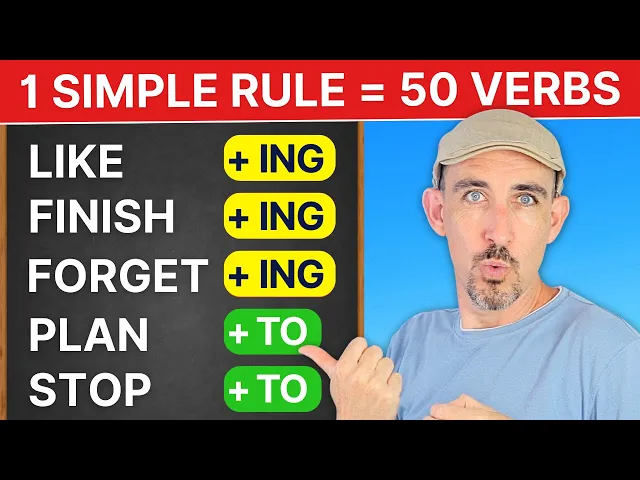
GERUND or INFINITIVE? Choose the right one with 50 common verbs!
English with Greg
0:00 Is it, I forgot calling her, or, I forgot to call her?
0:05 And is it, I regret saying that, or, I regret to say that?
0:11 How do you know whether to use the 'ing' form or the infinitive in English?
0:17 Well, it all depends on the verb that it follows.
0:22 In this lesson, you're going to learn whether to use the gerund, like calling,
0:28 or the infinitive, like to call, after 50 common verbs in English.
0:35 I'm also going to teach you a simple trick so you know which one
0:40 to use every single time.
0:43 Are you ready?
0:47 Okay, so we're going to start with the rule, then look at some verbs
0:52 that take the gerund, then verbs that take the infinitive,
0:56 and then verbs that take both, but the meaning changes.
1:01 Okay, so here's a quick reminder of the rule.
1:05 We use the verb plus the gerund if we are looking backwards.
1:12 If we're talking about a general activity or an experience.
1:19 We use the infinitive when we're looking forward or talking about a goal,
1:26 a plan, an intention, or a decision.
1:29 Now, listen, a lot of verbs follow this logic, but not all of them.
1:34 But in a part of grammar which causes so much pain and confusion,
1:40 it's a great idea to just use this little
1:43 bit of logic to try to help you make
1:47 sense from this very messy situation.
1:49 Okay, now I'm going to keep this video fairly concise and quick.
1:54 I'm going to explain 30 of these verbs in this video,
1:58 and I've included the extra
2:00 20 in this worksheet, which you can download absolutely free
2:05 by clicking the link up there, or you can also scan the QR code or
2:10 click the link in the description.
2:12 Just enter your email address and I will send you that.
2:15 And that also comes with a test so you can make sure that you have
2:20 completely learnt this grammar.
2:22 Okay, so let's have a look at some verbs which are followed by the gerund.
2:27 And as you will see, the verb in the gerund is being treated
2:33 like a general activity or an experience, and we're looking backwards at it.
2:40 Let's go.
2:41 Enjoy.
2:42 I enjoy reading in bed.
2:46 Reading is the activity.
2:48 Avoid.
2:48 She avoids driving in the city.
2:53 Again, driving is the activity.
2:55 Consider.
2:56 They're considering moving to London.
2:59 Okay, maybe they're not looking back in this one, but it still talks about
3:04 an experience, moving to London.
3:07 Discuss.
3:08 We discussed hiring someone new.
3:11 Again, we're talking about the general activity of hiring someone.
3:16 Miss.
3:16 What do I miss?
3:17 I miss England.
3:19 I miss my friends.
3:20 I miss seeing my old friends.
3:25 Finish.
3:26 He finished.
3:27 What activity did he finish?
3:29 He finished cleaning the kitchen.
3:32 Practise.
3:33 What activity do you need to practise?
3:36 You need to practise speaking English more.
3:40 Speaking in the gerund.
3:43 Admit.
3:44 She admitted.
3:46 What experience did she admit?
3:48 She admitted taking the money.
3:51 Suggest.
3:52 I suggest starting earlier.
3:55 Now, yes, actually, we can also say, I suggest we start earlier.
4:02 Watch that video to learn how to use that structure.
4:06 It's the English subjunctive, and there are lots of other ways
4:10 to use the subjunctive in that video.
4:13 But in this case, we can also use the gerund.
4:16 I suggest starting earlier.
4:19 And the last one, keep.
4:20 What activity does he keep doing?
4:23 He keeps interrupting me.
4:26 Okay, so you can see in those situations, they follow the logic.
4:30 We're talking about a general activity or experience, and we're
4:35 normally looking backwards.
4:38 Now, let's have a look at some verbs that take the infinitive.
4:43 So remember, these are usually verbs that don't look backwards,
4:47 but they look forwards, and they describe a goal,
4:51 an intention, a decision, or a plan.
4:56 So let's have a look at some of these verbs now, and remember,
5:00 if you want the full list of 50, you can download that worksheet
5:04 by clicking the link in the description.
5:07 Some common verbs that take the infinitive.
5:11 Want.
5:11 I want to leave now.
5:14 This is something that I want in the future.
5:17 We're looking forward here.
5:18 It's my intention.
5:20 I want to leave now.
5:22 And a similar verb, need.
5:24 You need...
5:25 Again, we're looking forward.
5:26 What do you need to do?
5:28 What's your goal here?
5:29 You need to study more.
5:32 Decide.
5:33 We decided to stay at home.
5:36 And yes, this verb is in the past tense, so aren't we looking backwards?
5:41 No.
5:42 Yes, I'm talking in the past, but when that action happens in the past,
5:47 we deciding to do something, the decision at that time was looking forward.
5:53 At 6pm last night, we made the decision to
5:57 stay at home for the rest of the evening.
6:01 Hope.
6:01 Again, you hope something for the future.
6:04 They hope to win the prize.
6:06 Plan.
6:07 She's planning to travel soon.
6:10 As I mentioned, we use the infinitive when we're talking about plans, decisions,
6:14 like decide, intentions, goals.
6:18 Agree.
6:18 He agreed to help us.
6:22 Again, we're looking forward.
6:23 It's that plan that he agreed to do.
6:26 Learn.
6:27 I'm learning to play the guitar.
6:31 And offer.
6:32 They offered to drive us.
6:35 Again, they're looking forward.
6:36 It's an intention.
6:38 As is refuse.
6:40 He refused to go.
6:43 Promise.
6:43 There's another one.
6:45 She promised to call.
6:47 Do you see how these work?
6:49 Again, it is a good idea to learn these and learn them in the sentence,
6:53 but also learn the logic and try to apply the logic.
6:57 You might make some mistakes sometimes, but you won't have to guess.
7:02 You will have a good idea always of whether to use the gerund or infinitive.
7:09 Now, good news and bad news, there are some verbs that take
7:14 the infinitive or the gerund, and the meaning changes a little
7:20 bit depending on which you use.
7:23 Sorry about that.
7:24 Let's have a look at a few.
7:26 Again, I've put more in the PDF that you can download, but these
7:31 verbs can take both.
7:33 In fact, the two that I mentioned at the beginning of this video
7:37 are in this little section.
7:39 The thing is with this, these little differences are the
7:44 kind of thing you need to know if you want an internationally recognised
7:49 B2 level of English.
7:51 Lots and lots of jobs require this level.
7:54 My course, Brilliant B2, will help you reach that level in 12 weeks.
8:00 So if you're working towards that level, I'll put a link in the
8:03 description for you.
8:05 I would love to have you inside that course.
8:08 Okay, let's have a look then at some of these verbs.
8:11 Remember.
8:12 I remember locking the door.
8:16 And Remember to lock the door.
8:19 Let's just have a look at these two sentences for a minute.
8:23 They follow the same logic as I mentioned earlier in the video.
8:27 So I remember plus the gerund.
8:30 I remember locking the door.
8:32 I remember that general activity.
8:34 I'm looking backwards.
8:36 It happened.
8:37 I'm talking about the experience or the activity, and it's in my memory.
8:43 However.
8:44 Remember to lock the door.
8:47 If I say that to you, I'm talking to you about a goal, an intention, a plan.
8:54 So I want you to remember to do something in the future.
9:00 Which is to lock the door.
9:02 Do you see the difference?
9:03 They both follow the logic from earlier in the video, but if you mix them up,
9:08 you could be saying something completely different.
9:11 I mean, not completely different, you're still talking about the door,
9:15 but it would be very confusing and unclear
9:18 if you chose one instead of the other.
9:20 The opposite of remember is forget, and this is also in this category.
9:26 Look at these two sentences.
9:30 I'll never forget meeting you.
9:32 And I'll never forget to meet you.
9:36 So again, when we use the gerund, we're looking backwards
9:39 and talking about an activity.
9:41 I'll never forget...
9:43 What experience am I talking about here?
9:47 Meeting you.
9:48 Wow.
9:49 When I met you, it was an unforgettable experience.
9:52 I will never forget it.
9:54 I will never forget meeting you.
9:58 However, I'll never forget...
10:00 What's my intention here?
10:02 What's my plan?
10:03 What's my goal for the future?
10:06 To meet you.
10:07 I'll never forget to meet you.
10:09 Every time you say, Hey, Greg, let's meet.
10:13 Okay, I promise.
10:15 I will not forget to meet you.
10:17 Here's another one which doesn't exactly fit in with what I'm saying,
10:23 but it's an example that every English teacher uses, so I want
10:27 to include it here.
10:28 I'm talking about this.
10:30 She stopped smoking.
10:31 Or.
10:32 She stopped to smoke.
10:34 The first one, yeah, she used to smoke 20
10:38 cigarettes a day, and then she stopped.
10:42 She stopped that horrible activity.
10:44 Good for her.
10:45 She's now living a healthier life because she stopped that activity.
10:50 She stopped smoking.
10:51 She quit smoking.
10:53 However, she stopped to smoke.
10:57 This is more like she stopped in the middle of the street.
11:01 Why?
11:02 With what intention?
11:03 With what plan?
11:06 To smoke.
11:07 She's walking along the street, she stops, she gets her cigarettes out
11:11 of her pocket, and she smokes.
11:14 She stopped Why?
11:15 To smoke.
11:17 This, for me, actually falls more into the category of,
11:21 should we use 'to' or should we use 'for'?
11:25 Many students make mistakes and aren't sure whether to use 'to' or 'for'.
11:31 I explain all those rules in that video there.
11:35 You're going to love it.
11:36 It's really simple when you follow those rules, so I'll put a link
11:39 in the description for you, too.
11:41 The next one in this little section is try.
11:45 Try pressing this button or try to press harder.
11:50 Again, try this activity, pressing the button.
11:53 Try plan, intention, goal, to press it harder.
11:57 And regret.
11:59 I regret saying that, or we regret to inform you that.
12:04 Again, both are correct.
12:05 But if you use the gerund, then we're looking back on an experience
12:10 or an activity that you regret.
12:13 But at the beginning of a letter that is giving you bad news,
12:19 you would see normally from a company,
12:21 it would say, We regret to inform you that...
12:25 Okay, because it's introducing the plan, the goal, the intention that is
12:30 going to be mentioned in that letter.
12:34 Like you get a letter from the bank.
12:36 We regret to inform you that all your money has been stolen.
12:41 I have one bonus section for you which you're going to love.
12:46 It's verbs that take both the gerund or infinitive,
12:52 and it makes no difference at all.
12:54 Why aren't all verbs like that?
12:56 Here we go.
12:58 Here are five.
12:59 Again, I'll more in that worksheet for you.
13:01 Begin.
13:02 She began to cry.
13:04 She began crying.
13:07 No difference.
13:08 Start.
13:09 I started to read.
13:10 I started reading.
13:12 You'll hear both interchangeably.
13:15 It really makes no difference.
13:17 Continue.
13:18 He continued to work.
13:19 He continued working.
13:21 Yeah, tomato, tomato.
13:23 Love.
13:24 They love to travel or they love travelling.
13:27 Again, pretty much the same thing.
13:30 And like.
13:31 I like swimming or I like to swim.
13:34 Again, normally there's not much difference in those two sentences.
13:40 Sometimes there is.
13:41 I'll put a link to an old video I did about the difference in the comments if
13:46 you want to learn the small difference between those two sentences.
13:50 Okay, I've got another great video coming for you on Friday,
13:54 so subscribe so you don't miss that.
13:56 For now, leave a comment using one of the verbs from this lesson,
14:01 and remember to download the worksheet to get the full list of 50 everyday verbs
14:07 that are followed by either the gerund or the infinitive.
14:11 Now, earlier in this video, I explained the importance of knowing
14:14 the difference between 'for' and 'to'.
14:18 So watch that video to learn the rules so you never make a mistake with that.
14:24 There's the worksheet.
14:25 Thanks for watching.
14:26 And bye for now.