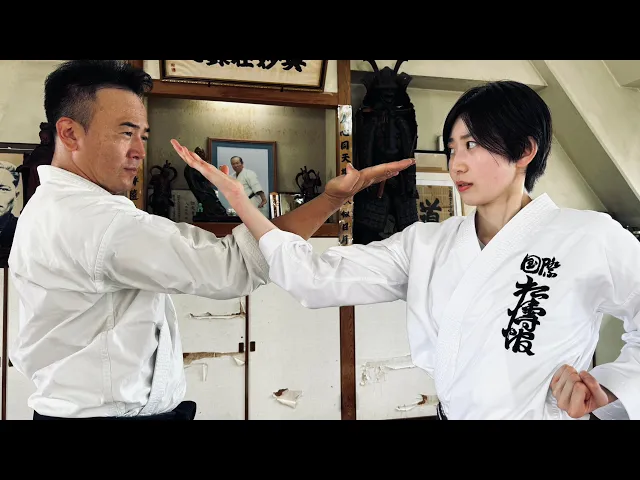
Intense Pain! Okinawa Karate Training That Turns Your Entire Body Into a Weapon!
kuro-obi world
0:05 In “Sanchin,” the basic kata of Gojyu-ryu karate, you tense all the muscles in your body.
0:12 There are also training methods called “kote-gitae” and “kake-te.”
0:17 Both are extremely painful.
0:19 Swords, staffs, and other weapons are very hard objects.
0:28 Karate means empty hand.
0:30 Therefore, you must first transform your own body into a weapon.
0:35 A sword is heated, hammered, and cooled to become stronger.
0:42 So too, your arms and legs must be hammered and forged.
0:47 Turn blocking itself into an attack.
0:50 First, we'll bump the inside of my arm against the outside of your arm.
1:00 To execute a powerful block, you must strengthen your own arm.
1:09 Look! The muscles in your arm are bulging.
1:13 They're deformed!
1:15 Bending your thumb like this causes your arm to change like this.
1:26 Your hands are completely different in size.
1:36 Yagi-sensei's hands are larger than the average man's.
1:41 Hiyori-san's fingers are slimmer than the average woman's.
1:45 What slender fingers you have!
1:51 My fingers might break...
1:52 I'm worried, will you be okay?
2:00 Alright, let's try a light one.
2:04 Flip your wrist the moment our arms collide.
2:07 This part?
2:08 Hitting this thick part means your punch has already reached me.
2:18 Originally, we hit “kote-gitae” at the part where you wear a wristwatch.
2:21 It hurts a lot, doesn't it?
2:22 It hurts a lot.
2:25 You also hit the outside of the arm with this hard part.
2:30 We hit each other there?-Yes.
2:34 Clench your hand at the moment of impact.
2:38 It hurts, doesn't it?
2:43 Now, next.
3:03 You seem fine.
3:05 No!
3:06 Try harder.
3:15 I can't take it anymore.
3:18 This is proof you're in Okinawa.
3:25 The final "kime" is extremely effective.
3:29 For example, in an actual fight, when your opponent swings at you with full force,
3:34 you don't block the attack with all your strength—you deflect it, right?
3:40 So in this case too, it's better to practice striking with relaxed power rather than putting all your strength into it.
3:53 That hurts even more.
3:55 Even more?
3:56 Usually it's like this.
4:00 But...
4:02 Swing it outward.
4:08 Did you relax your arm and swing?
4:12 Do you practice this in stages?
4:16 Yes, in the first stage, you do it with force, and as you improve, you do it with relaxation.
4:20 For example, against a punch, you relax and do it like this.
4:30 Push "tsuki" all the way in without stopping.
4:34 Next, bring your fist down onto my arm from above.
4:40 Relax your strength.
4:43 More.
4:47 This is hitting.
4:48 But...
4:51 Relax your strength.
4:52 Sorry for hurting you.
4:57 It's hard to relax.
4:58 Like flicking water off your palms after washing your hands.
5:05 That's right.
5:06 Relax more.
5:08 Just drop that arm.
5:12 As if brushing someone's hand away.
5:18 This really hurts.
5:21 Try it again.
5:22 I'm keeping my hand open.
5:30 Next...
5:32 Just by clenching my fist, all the force you brought down bounces right back at you.
5:35 It came back!
5:36 Put all your strength into it in an instant.
5:39 It's all the same.
5:45 The one who hits it hurts more.
5:49 Only when we actually collided hands did I truly understand.
5:56 It's difficult to grasp just by listening to an explanation.
6:01 When doing tuski, you strike with these bones, right?
6:03 Rather than building muscle through training,
6:05 block and strike using parts that are already strong without training.
6:10 Moreover, target areas the opponent cannot train.
6:17 Therefore, in “uke” too, use the bones, not the muscles.
6:21 Bend your wrist; there are two bones here.
6:25 Strike here.
6:29 This is using force to block.
6:31 Instead, flip your wrist.
6:34 Use the naturally firm parts that don't need strengthening.
6:42 In this block, tsuki has already reached me.
6:44 Therefore, I need to stop here.
6:53 It seemed like only a hard part lightly touched my arm.
6:58 Yet my arm was violently flung backward.
7:04 Against an opponent who still presses the attack, I strike by rotating my hips.
7:11 Will this right hand be okay tomorrow?
7:13 Shouldn't you learn this?
7:15 Yes, definitely.
7:16 Let's start with a simple block.
7:19 After striking here, flip your wrist.
8:01 It hurts when you hit it exactly right.
8:05 Was it accurate?
8:06 Yes.
8:07 But does it hurt you too when you're hitting it?
8:09 Yes, maybe because the damage from today's practice had built up.
8:14 I definitely feel like I was able to hit this spot precisely.
8:18 As a woman, I've always felt the physical strength difference between myself and men during practice.
8:24 But I didn't feel that now.
8:26 Next, let's do this.
8:41 This is meant to target the eyes.
8:43 Be careful, it's dangerous.
8:44 And the vital point in the groin.
8:46 We used to practice like this, but it's too dangerous,
8:50 so now we do it at a distance.
8:52 Then, after “kote-kitae,” let's do “kake-te.”
8:57 Bend your thumb.
8:59 Pull. Rotate. Push.
9:13 My body is being controlled.
9:16 Let's apply this movement.
9:40 This really needs thorough practice.
9:42 This is the basics.
9:45 Hiyori-san was really good for a first-timer.
9:51 Must be thanks to her regular practice.
9:55 She really was skilled.
9:56 Well, she is a karate instructor, after all.
10:00 To be honest, even after doing it for years, it still hurts.
10:06 No matter how much I do it, it still hurts.
10:13 How was your experience with "kote-kitae"?
10:19 It was super painful, right?
10:21 Yes, it really hurt.
10:23 Yagi sensei also said, “Even after years of practice, this still hurts.”
10:28 It was a great lesson—even with that level of training, it still hurts.
10:34 The fact that it hurts doesn't change.
10:36 The idea of transforming the arm itself into a weapon like a sword is a rare concept, right?
10:46 Yes, but from a self-defense perspective, that method feels like the most correct approach.
10:54 The idea that every part of the body should be weaponized and utilized.
11:01 Yagi sensei's arm wasn't ordinary.
11:06 It was very thick and deformed, right?
11:11 He said the muscles bulged when he bent his fingers like this.
11:19 It was kind of strange.
11:21 The shape?
11:24 It certainly was an unusual shape.
11:27 Today's experience was likely a unique practice method specific to Okinawa's "naha-te".
11:32 Did you practice that with your friends or "kancho" afterward?
11:40 Unfortunately, I don't practice “kote-kitae” together with ‘kancho’.
11:44 However, during “yakusoku-kumite” when doing "uke" against an attack, we often study which part to strike.
12:06 Since you're a woman, it's probably best not to practice turning your entire body into a weapon, right?
12:17 But I felt that the concepts Yagi sensei mentioned
12:22 —targeting areas that can't be trained and striking using parts that are strong without training—
12:29 are especially important for women.
12:39 Hiyori Kanazawa of Shotokan Karate-Do International Federation.
12:43 She is an authentic karateka who has won world championships in both “kumite" and “kata”.
12:50 Her grandfather is the legendary karate master Hirokazu Kanazawa.
12:54 Her father is Nobuaki Kanazawa Kancho, the head of SKIF.
12:59 She is the third generation of a karate family.
13:04 Actual footage of her experience and After-talk.
13:07 It was great to hear such a genuine karateka's thoughts, wasn't it?
13:11 Stay tuned for the next “HIYORI EXPRESS”!
13:17 Please subscribe to SKIF's YouTube channel.
13:27 Everyone is a Hero in "Kuro-obi World".
13:35 Of course you are also a Hero!
13:38 See you again in "Kuro-obi World"!