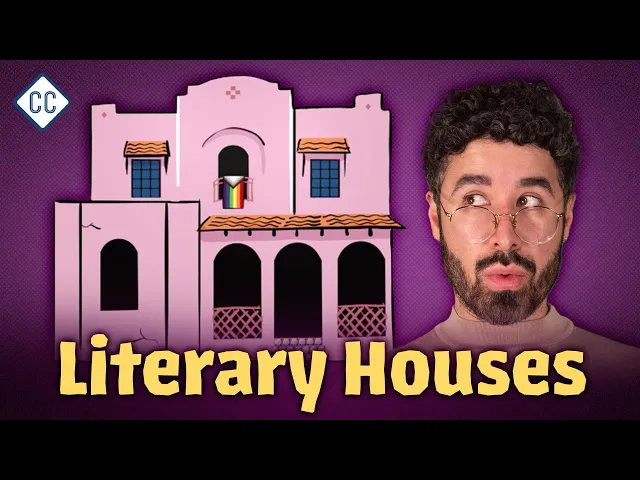
The Hidden Politics of Home: Crash Course Latin American Literature #8
CrashCourse
0:00 What makes a house a home?
0:01 For me, it's photos of my ancestors,
0:03 anything to do with La Gualupe, and of course, food.
0:06 Busas, mano, yukafita.
0:09 But I go off topic.
0:10 Houses can be more than just a place to decorate,
0:12 sleep, and eat your mom's and bananas.
0:14 Hi, I'm Krilly Velasquez, and this is Crash Course Latin American literature.
0:19 [music] A person's home can tell you a lot about them.
0:26 Their art, their knickknacks, the way they arrange the furniture.
0:29 It can all give you hints about their innermost self.
0:32 So, it makes sense that in literature,
0:34 where characters live can be key to who they are.
0:37 But not only that, houses in Latin
0:39 American literature are portals into diverse identities,
0:42 cultures, and even political conflicts.
0:45 The trick is knowing how to read them that way.
0:48 Let's look at Sandra Cisneros's 1984 novel, The House on Mango Street.
0:53 It tells the story of a 12-year-old Esparanza
0:56 Cordiero and her family in a working-class Chicago neighborhood.
1:00 Having grown up in an apartment,
1:01 Espiranza is thrilled to put down her roots in her family's new home.
1:05 I knew then I had to have a house, she says.
1:08 A real house, one I could point to.
1:11 But her family's dilapidated house is not the vibe.
1:14 And also, it's not really about the house.
1:17 Or at least not only.
1:18 See, Esparanza's discomfort in her house
1:21 mirrors her discomfort with her own identity.
1:24 Like Cisnerto herself, Espiranza Chicana,
1:27 which means she comes from a Mexican family but was born in the US.
1:32 So her identity exists somewhere between the two places and cultures.
1:36 She tells us at school they say my name funny as if
1:39 the syllables were made out of tin and hurt the roof of your mouth.
1:43 Like the house on Mango Street, Esparansza's Spanish name feels like the wrong
1:47 fit for the person she wants to be.
1:49 On top of all that, Esparansza
1:50 inherited her name from her great-g grandandmother,
1:53 but she doesn't want to inherit the life her great-g grandandmother lived.
1:56 She was married against her will as a teenager,
1:59 [music] a lack of agency based on her gender.
2:01 And when Esparansza imagines this, she pictures her ancestor
2:05 trapped [music] within the walls of her home.
2:07 She looked out the window her whole life,
2:10 the way so many women sit their sadness on an elbow.
2:13 Notice how Esparansza makes the connection between her great-g
2:16 grandandmother and countless other women looking out their windows.
2:20 With this inside looking out image,
2:22 [music] she's evoking a long-standing association between
2:26 houses and homes with women and femininity.
2:30 And by rejecting her house,
2:32 Esparansa is also rejecting her picture of traditional femininity.
2:36 Throughout the book,
2:36 the house on Mango Street literally hangs over Esparanza's head as she
2:41 contemplates all the pieces of her identity and who she wishes to become.
2:45 By the end of the novel,
2:46 a now 14-year-old Esparanza finds a new way to define herself as a storyteller.
2:52 Her writing lets her escape from the house's grasp and creates a new,
2:56 more comfortable home in the heart.
2:59 She knows someday she'll grow up and leave for real,
3:02 but she also recognizes that the house will always be a part of her story.
3:06 Now, houses in literature don't only represent our personal identities.
3:10 They can also represent larger political and national identities, too.
3:14 And I'm not just talking about sticking a sign
3:16 in your yard to endorse Dolly Parton for president.
3:18 Though, anyone who gives free books to kids has my vote.
3:22 Let's get the curly notes on Isabella's 1982 novel Laasa de los Espiritus,
3:27 the house of the spirits,
3:29 which uses the house as a symbol to address the politics of her native Chile.
3:34 Isaende is no stranger to politics.
3:37 Her father's cousin, Sarvadorende,
3:39 was the president of Chile until he was assassinated by Agusto
3:42 Pinoes coup and her family was forced to flee the country.
3:46 So, she knew firsthand the challenges of sharing this house we call a nation,
3:50 especially when our fellow citizens
3:51 and leaders aren't always the best roommates.
3:54 The House of the Spirits focuses on the Troyba family who
3:58 live in an unnamed country usually understood to be Aendis own Chile
4:02 and the action moves between not just one house but two
4:06 as a way of portraying the conflicting
4:08 political perspectives in Chile at the time.
4:10 The big house on the corner is built
4:12 for the threa matriarch by her husband Estean.
4:16 Glara represents the liberal left-wing preaching ideals of equality,
4:21 justice, and respect for everyone.
4:24 She presides over the big house, which is filled with students,
4:27 artists, [music] spiritualists, and even a few literal spirits.
4:31 Sounds kind of like my house, to be honest.
4:33 Estan, on the other hand,
4:35 is a wealthy right-wing senator who exploits his workers, hits his wife,
4:40 rigs elections through threats and coercion,
4:42 [music] and is just generally an all-around bummer of a guy.
4:45 While his wife presides over the family home,
4:47 [music] Estan's domain is Tres Maras,
4:51 a hienda in the countryside, [music] which he runs like a dictator.
4:55 So, the vibes of both houses are very different, even down to the design.
5:00 GL [music] constructs a world of freedom
5:02 and imagination with long twisting passageways [music] and whimsical
5:07 stairways to nowhere while Estimon furnishes the thres
5:11 with heavy severe furniture that mirrors his politics.
5:14 [music] But the family drama doesn't stop
5:16 with the blueprints and let me tell you it's juicy.
5:19 Just like houses are often handed down through
5:21 generations for the threases are [music] handed down too.
5:26 Estivon's grandson inherits his grandfather's politics and violent tendencies.
5:31 He goes on to become a police officer and [music] later a colonel,
5:34 playing a key role in torturing liberal revolutionaries,
5:38 including his own cousin, Alba.
5:40 And you thought you and your primos had beef.
5:41 Alba, in contrast, carries on her grandmother Clara's liberal traditions.
5:46 [music] After the Conservative Party seizes control
5:49 of the government through a military coup,
5:51 [music] Alba uses the twisting passageways and secret
5:54 doors of her grandmother's house to harbor socialist fugitives.
5:58 Notice how purposeful Aenda is about placing her female
6:01 characters right in the middle of the nation's political drama.
6:04 She even starts off the novel by introducing us to Clara's older sister,
6:07 Rosa, [music] who is all things traditionally feminine,
6:11 graceful, beautiful, obsessed with romance novels,
6:13 and on her way to embroider the largest tablecloth known to man, as you do.
6:18 But then tragedy strikes.
6:19 Rosa dies after drinking poisoned brandy meant for her politician father.
6:24 From that moment on, Aenda shows us
6:26 that despite their exclusion from form of political leadership,
6:30 women affect and are [music] affected by politics
6:33 in the sphere of the home and beyond.
6:35 I won't spoil the book's ending for you,
6:37 but let's just say there's hope for the TBA family and for Chile.
6:41 Now, that focus on family.
6:43 Oh.
6:45 Oh, it's my mom.
6:48 Mom.
6:49 See?
6:52 No, that was good and juicy.
6:57 Like I was saying, that focus on family brings me to my last example.
7:01 Families aren't always a husband, a wife, and 2.5 kids.
7:05 They can look a lot of different ways,
7:08 and literature helps to broaden the picture of what home and family life can be.
7:12 Argentine writer Camila Soaviada explores a broad
7:16 view of family in her 2019 [music] novel, Las Malas, Bad Girls.
7:20 It follows a group of trans women who find community in a large
7:24 pink two-story building that looked a little
7:27 rundown but welcome them with open arms.
7:30 This fabled [music] pink house in Cordoba,
7:32 Argentina is run by 178-year-old Thea and Cara,
7:37 picking up on some magical realism vibes,
7:39 and it serves as a landing place for young
7:42 women who have been turned away by their biological families.
7:45 At the pink house, the women find sisters
7:47 in their housemates and an auntie in Theia and Garna.
7:50 And when Thea Garna finds an abandoned infant
7:52 [music] in the park and brings him home, he too becomes a part of the family.
7:56 But despite the safety they find in each [music] other,
7:58 the residents still face the dangers
8:00 of the AIDS epidemic and their transphobic society.
8:03 As the novel goes on, the condition
8:05 of the Angadana's pink house mirrors their own,
8:07 becoming vandalized, choked by vegetation, and falling into disrepair.
8:11 In this way, the house itself becomes
8:13 a reflection of the women's ongoing plight.
8:16 In Saviada's words, the pink house is
8:18 the queerest boarding house in the [music] world,
8:20 one that complicates our preconceived notions about home, family, and belonging.
8:25 In literature, like in life,
8:27 houses can hold all the nooks and crannies of who you are as people,
8:31 cultures, and nations.
8:32 And in some ways, sitting down to read a book
8:34 is a little like an invitation into an author's home.
8:37 So, we can all become chisos.
8:39 You can peer out the window of Sandra Cisneros's childhood home.
8:43 Meet Isabel Aende's family of politicians and revolutionaries,
8:47 or stay up late talking with Saviada and her friends.
8:50 And when you're done visiting, you can say your goodbyes, close the book,
8:54 and return to your own house with your own family drama,
8:57 but also a new perspective about how other people live.
9:01 Personally, I can't wait to get back to my mom's bananas.
9:03 Next time, we're diving even deeper into family bonds.
9:06 See you then.
9:06 Thanks for watching this episode of Crash Course Latin American Literature,
9:10 which was filmed at the Gardlo Hernandez studio in Indianapolis
9:14 and was made with the help of all of these home bodies.
9:16 If you want to help keep Crash Course free for everyone forever,
9:20 you can join our community on Patreon.
9:22 Oh, and if you're interested in learning about
9:24 some of the topics covered in this episode,
9:26 we pulled together a playlist you can dig into.