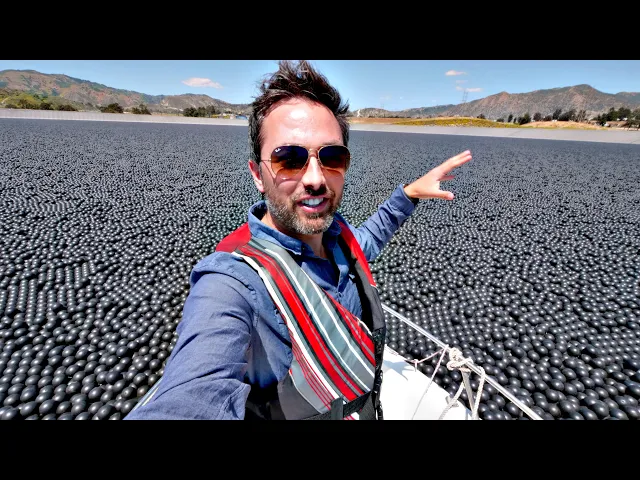
Why Are 96,000,000 Black Balls on This Reservoir?
Veritasium
0:00 (shade balls rolling)- These are shade balls.
0:06 They're being dumped into this water reservoir in Los Angeles.
0:10 And contrary to what you may have heard,
0:13 their main purpose is not to reduce evaporation.
0:17 So what are they really for?
0:20 To find out, I'm visiting the largest
0:22 collection of these balls anywhere on earth, What?
0:25 at LA Reservoir.
0:27 (tranquil music) 96 million shade balls.
0:34 [Man 1] That's correct.
0:35 (laughing)- 96 million.
0:39 It's very rare to for you to see 96 million of anything.
0:41 [Man 1] Yeah.
0:42 (laughing)- This is your life vest which you are required to wear.
0:45 All right.
0:46 Throw a leg over and climb on in any way you can.
0:49 (tranquil music) There you go.
0:52 [Narrator] Thank you.
0:54 Looking at this, I had so many questions.
0:57 Like, why are they black?
0:59 Are they safe to have in drinking water?
1:01 How much do they cost?
1:03 Do they actually reduce evaporation?
1:05 And, what is their real purpose?
1:09 (boat engine roaring) Is that hard to drive in shade balls?
1:14 It is very hard.
1:15 Why is that?
1:17 'Cause...
1:18 (boat engine drowns James voice)-
1:20 These are actually partially filled with water,
1:22 and the reason they are filled with water is
1:24 that, at LA Reservoir we have some really high winds and so,
1:27 you know, if we didn't put water into these things,
1:29 there would be balls down bouncing on the 5 Freeway,
1:31 people drive down, they'd be all over the place.
1:33 So, these keep the balls in the reservoir and if they do start to roll,
1:37 they kind of wobble because the water makes them uneven.
1:40 [Narrator] But that makes them significantly more
1:42 difficult to push out of the way.
1:43 Especially, when they form close packed crystal-like structures.
1:48 Behind the boat, the balls quickly come together in our wake.
1:52 And some close to the motor are pulled along with the boat.
1:56 (boat engine stopping) Wow!
2:04 (wind blowing) (laughing) What did you think,
2:09 the first time they suggested doing this or when it first came in?
2:14 Yeah, it was a little out there.
2:17 [Narrator] Did you think they were nuts?
2:18 No, not nuts.
2:20 [Narrator] Well, it just, it like looks absurd.
2:22 It's like we're in the world's biggest ball pit.
2:25 Right, yeah, that's what it looks like.
2:26 Yeah, you can't tell by standing here that we are actually floating over,
2:30 I think it's probably, 40 feet right here, 40, 50 feet deep below us,
2:37 and you can't even seen any water.
2:40 You'd think it was a joke, right?
2:41 (laughing) If you didn't know, you'd go like,
2:44 "No you're not, that's (laughing) a green screen or something, right?
2:48 Yeah, its fake."- So like, when I switch on my tap at home,
2:52 is the water coming from here?
2:53 [Hellen] Yes.
2:55 Sometimes or always?
2:56 [Hellen] Yes, most of the time.
2:57 Most of the time?
2:58 [Hellen] Yes.
2:59 Most of the time the water is coming from here.
3:00 [Hellen] Correct, yes.
3:01 Absolutely nuts.
3:01 So why is LA Reservoir covered in shade balls?
3:05 Well, the the problem all started with Bromide.
3:08 Bromide is a naturally occurring substance.
3:10 It's associated with salt water and so normally places like California Aqueduct,
3:16 that comes down from the Delta.
3:18 You get some some salt water intrusions, so you have some Bromide in the water.
3:21 Bromide's harmless and it's almost impossible to remove.
3:24 But, when you disinfect the water with Ozone, that Bromide becomes Bromate.
3:30 And Bromate is carcinogenic.
3:31 And so around the year 2000 they wrote regulations regulating Bromate.
3:35 And the regulation basically said,
3:37 if you have a treatment plant that uses Ozone,
3:40 then you have to watch your Bromate formation.
3:42 Be careful not to form too much.
3:44 So, the only places we ever measured Bromate was at our filter plant.
3:47 [Narrator] And the results were always within
3:49 the 10 micrograms per liter limit set by regulators.
3:52 So they were confused when they got a call from one of their customers,
3:55 a beverage company in LA.
3:57 They said, "We have some really high levels of Bromate showing up,
4:00 are you aware of this?" And we said,
4:02 "Well, we don't show anything."- [Narrator] But between
4:04 the filtration plant and the customer was the reservoir.
4:07 So they did some tests.
4:10 Almost immediately upon coming into to this open reservoir,
4:12 the Bromate levels jumped.
4:14 It turned out that Bromide with Chlorine, which was supposed to be safe,
4:18 in bright sunlight formed Bromate even more than Ozone did.
4:23 And so we made the unfortunate scientific discovery
4:25 that actually was not part of any regulatory scheme.
4:29 And so, here we are at the reservoir,
4:31 we have a water source that's got Bromide in it, harmless, we have chlorine,
4:35 we have to have to disinfect the water and we have sunlight because it's open.
4:39 The only choice we have is to remove sunlight.
4:40 So, we looked at all sorts of things.
4:42 We looked at floating tarps across the water, and normally,
4:46 you put a floating cover on the water but that's a multi-year project.
4:49 And so we said, "Well, can we manufacture these kind of trampoline
4:52 with poly-like PVC pipe?" And we said, "Well,
4:54 they'll just gonna become bird perches and we'll have a big
4:56 water quality problem." Then we knew we had high-density polyethylene pipe,
5:01 which is used in the water industry, and we know that it floats.
5:04 We at one point thought about can we
5:06 get float a pile of pipe across the surface.
5:08 Well, that's hard to do and very expensive 'cause it's a lot of material.
5:12 So maybe we can take some pipe and we can run it
5:13 through a chipper and we can make a debris field across the surface,
5:16 like the back corner of a lake somewhere.
5:18 But, then you have all this mushy, warm water with plastic floating on the top
5:22 and that however sounds like a Petri dish.
5:24 And so low and behold, Dr.
5:26 Bryan White, did some research and he found the shade ball.
5:29 (tranquil music)- [Narrator] Except they weren't called shade balls at the time.
5:34 (tranquil music)- This product existed and they were called bird
5:38 balls and they used it on ponds that had mine tailings,
5:42 where they didn't want waterfowl to go in and get poisoned.
5:45 And also around airports where there are ponds and they want to keep
5:48 the waterfowl off so they didn't take off and get into jet engines.
5:52 (airplane engine roaring) You know they have
5:55 actually done wind tunnel testing and they blew,
5:57 you know, 50, 60 mile of winds across so they could see how they'd behave.
6:01 But, they were really made to deter
6:02 birds and wildlife from sitting on the water.
6:04 [Narrator] Did there used to be birds landing here more?
6:07 Absolutely, yes.
6:08 [Narrator] Yeah?
6:09 Yeah.
6:09 Once we deployed these balls, all the birds were gone.
6:11 They used to just hangout, right?
6:13 Loiter at the curbs.
6:15 Yeah, they'd be all over the top of the dam.
6:17 [Hellen] You could see birds dropping everywhere.
6:18 [James] They'd be down at the outlet tower, they'd be everywhere.
6:21 We don't get 'em anymore like we used to.
6:24 [Narrator] But before being added to the reservoir,
6:25 the shade balls had to be tested.
6:27 Would they actually reduce the formation of Bromate?
6:30 And we bought three kiddie pools, three little inflatable kiddie pools.
6:34 And we filled them all with the reservoir water.
6:36 One was in the sunlight, one we put a tarp on and one put shade balls on.
6:40 And amazingly, the shade balls knocked out the problem immediately.
6:44 [Narrator] So the reason shade balls are black is to block
6:46 all light from reaching the water and triggering the Bromate reaction.
6:50 The black pigment is also safe for contact with drinking
6:53 water and it's stable even exposed to the elements for years.
6:57 They're black for a reason so, you know,
6:59 they're made out of a high-density polyethylene.
7:01 It's the same material that like a gallon milk jug is made out of.
7:04 It's a food grade plastic and they would be clear like a milk carton,
7:08 except that they wouldn't last in the sun.
7:10 And so, they have a material called carbon black in them and that's
7:13 what makes the plastic last for at least 10 years out in the sun.
7:16 We did test to see if there is any other colors we could use.
7:19 So we actually had the company make three different shades of blue,
7:23 but the dyes were so unstable they said,
7:25 "We can't guarantee it's gonna last more than a year." And so,
7:28 it's that carbon black that's the magic powder
7:30 in this that really makes this product last in the sunlight.
7:33 One of the concerns that people raised to me when we put first
7:36 these on, it was that, are they gonna get hot and then bleach the material out?
7:40 And they don't.
7:41 They're totally inert.
7:42 I mean, theoretically,
7:42 you could cut off a piece of this ball and you could chew it,
7:45 no harm comes to you.
7:46 This is totally food grade, nothing wrong with it whatsoever.
7:49 [Narrator] What's it like driving through these things?
7:51 It's difficult.
7:52 As you can see we've been sitting here for, well, I don't know how long,
7:56 quite a while, and there's a breeze and we haven't moved.
7:59 I mean anybody that knows, that's been on a boat in a lake,
8:01 if there's a slight breeze and you're on a boat, you're drifting, right?
8:04 Not here.
8:05 This thing, they're just stable.
8:07 They're (indistinct) It's interesting when you try
8:10 to pilot the boat through these things, its difficult.
8:13 [Narrator] It's like driving through peanut butter or something?
8:14 Or something, I guess, yeah.
8:16 Not that I've ever done that but...
8:17 (laughing)- [Narrator] Blocking sunlight
8:19 from the reservoir also provided additional benefits.
8:22 You know, one of the reasons we put
8:23 so much Chlorine was to control the algae growth.
8:25 But sometimes you still couldn't control it.
8:27 There were times years ago, in the summer, where if we had an algae outbreak,
8:32 you might actually, if you filled a bath tub up,
8:34 you might have a slight tinge of green.
8:35 I mean, it maybe healthy to drink,
8:37 but it might have a slight tinge of green from the algae.
8:39 [Narrator] You'd see a bit of algae.
8:40 Yeah, and it's just discoloring the water.
8:41 That no longer occurs.
8:42 So, with the sunlight gone, the algae problem is gone.
8:46 We put in, basically, no Chlorine.
8:47 We've only had a few times since the shade balls have been on LA Reservoir,
8:50 that we've added any Chlorine at all.
8:51 And we used to do half the Chlorine and the whole
8:54 water system went into that reservoir just to control algae growth.
8:57 [Narrator] But the big concern I had was evaporation.
9:00 When I first heard about these black plastic balls reducing evaporation,
9:03 it didn't seem to make any sense.
9:05 I mean, wouldn't they absorb more energy and so heat up the water,
9:09 leading to faster evaporation?
9:11 It turns out the answer is, no, for a number of reasons.
9:15 In an open reservoir, there is more exposed surface area where
9:18 water molecules can escape into the air.
9:20 Plus, there is greater air flow over the water's surface continually
9:23 removing the layer of moist air and replacing it with dryer air,
9:28 increasing evaporation.
9:29 Now the shade balls do absorb more energy and get hotter on top,
9:32 but the bottom of the balls stays cool.
9:35 Plus the balls mostly contain air, which is a good thermal insulator and so not
9:39 much of the heat is transferred through to the water.
9:41 It's almost like a double-paned window, you know,
9:43 you get that air gap in there and the air acts as an insulator,
9:46 and so the sun never hits the water.
9:48 Matter of fact, we've actually done some measurements
9:49 and it's actually cooler under the shade balls,
9:51 even though they're black, than it is without the balls,
9:53 just with the sun itself.
9:55 [Narrator] Huh?
9:55 [Marty] So, the balls actually have a slight cooling effect.
9:57 [Narrator] So, for all of these reasons,
9:58 shade balls reduce evaporation by 80 to 90%.
10:02 That's pretty significant for a dry climate like Los Angeles.
10:06 [Narrator] How much do they cost?
10:08 These run about, around three for $1.
10:10 I think we paid 33, 34 cents a piece, something in that range.
10:13 And they actually will have a salvage value, not that much,
10:16 but if we go to remove them, they are recyclable material.
10:21 But we figured that over the life of the balls,
10:24 between the savings in chlorination, is chemical savings,
10:28 and the savings in evaporation,
10:30 probably at least half the cost of the balls will be paid for.
10:33 I mean, of course, the water quality benefit is immeasurable,
10:36 but even the balls themselves will save money doing what they do.
10:39 [Narrator] Do you ever bring people out here for tours?
10:42 You're the first one.
10:43 (laughing)- [Narrator] Why am I the first one to get to go on a tour here?
10:46 To get this level of detailed of tour, yes.
10:48 [Narrator] This is so cool!
10:49 I've heard something about hexagonal balls,
10:52 have you heard anything about hexagonal balls?
10:54 Oh, my gosh!
10:54 So, we have the shade balls, and of course,
10:56 everyone in the world came up with another product.
10:58 I have ones I call se ravioli, it's a small hex.
11:01 We've got large hexes, we have all sorts of pieces.
11:04 And people said, "Well, they lock together." But the problem is,
11:06 they need to not stack up and they need to not sit on the bank of the reservoir.
11:09 The reservoir is gonna go up and down.
11:10 And so it was really the shape of the ball that makes them not perch
11:15 on the side because we need to make sure
11:18 that these, when the water goes up and down,
11:19 that they spread up, or they, you know,
11:21 either spread out completely to cover the water as best possible.
11:24 [Narrator] I mean, I just can't get over what I'm seeing, it's just so nuts.
11:27 I'm waiting for you to say it looks like a pool of boba.
11:30 (laughing)- [Narrator] I feel like that's the line
11:34 that'll go in, but you got it.
11:35 Like, that is, that's awesome.
11:40 Do you like boba?
11:42 I love boba.
11:43 (laughing) I might get some after this.
11:45 (laughing) (techno sound) (boat engine roaring)