Don’t Hate — eCVTs Are Genius Transmissions!
Engineering Explained
0:00 With a single planetary gear set, you can create infinite gear ratios.
0:08 What?
0:08 This is the genius of ECVT.
0:11 One of the most brilliant transmissions ever developed without
0:15 the pulleys and belts of a traditional CVT that many people,
0:19 especially enthusiasts, tend to hate.
0:21 Now, personally, I think these days that hate is misguided because modern
0:26 belt driven CVTs have gotten really good and are much more reliable.
0:30 But that's beside the point.
0:32 This system is unbelievably simple.
0:35 No belts, no pulleys, just a single planetary gear set.
0:39 And this is far, far less complicated than a traditional
0:43 automatic transmission or even a DCT or a manual transmission.
0:47 The catch is that it must be paired with two electric motors,
0:51 but it solves a very real problem in a very beautiful way.
0:55 So, to start off, what is the problem with other styles of transmissions?
0:59 Well, typical transmissions have fixed gear ratios.
1:02 This forces your engine to operate across a wide
1:05 RPM range while it stays in a single gear.
1:08 But engines typically operate most efficiently at a specific
1:12 RPM and it tends to be a lower RPM
1:14 and they tend to create peak power at a specific
1:17 RPM and that tends to be a higher RPM.
1:19 But whether you want efficiency or power,
1:22 typical engines sweep over an RPM range.
1:25 So they're typically never sitting at a peak efficiency for longer than a brief
1:30 moment and they're never sitting at peak power for longer than a brief moment.
1:34 That's where a CVT comes in.
1:35 Because in theory, a CVT has infinite gear ratios within a set range.
1:41 This means you no longer have to link your wheel speed to your engine speed.
1:45 You can adjust your engine RPM to whatever you want,
1:48 whether for peak efficiency or for peak power, and just let the engine sit there
1:53 while the transmission adjusts behind the scenes.
1:56 So you can have your engine literally just sit at its
1:59 peak efficiency RPM for the given scenario or its peak power RPM.
2:03 Incredible.
2:04 Well, many early CVTs used a system of pulleys along with a belt.
2:09 But many of the early iterations weren't
2:11 super reliable or they felt weird to drive, so people hated them.
2:15 So what if you could eliminate the pulleys and belts
2:18 and instead just use a single planetary gear set?
2:22 Well, that's exactly what an electronically
2:25 controlled continuously variable transmission or ECBT does.
2:29 So, let's get into how this transmission actually works.
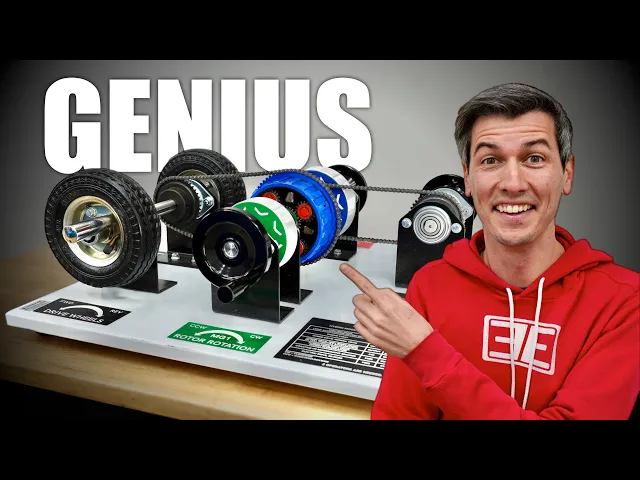
2:32 And a big thanks to Console Lab who sent
2:35 this trainer so that I can demonstrate this technology.
2:38 So, we of course have our driven wheels for our transmission.
2:41 We have two electric motors plus this planetary gear set.
2:45 And then represented by this handle, we have our engine.
2:49 So as I rotate the engine, you can see the driven wheels rotate.
2:53 Cool.
2:54 But the key to understanding this is that we have two electric motors.
2:58 The green motor is our starter generator.
3:01 So it can start the engine or once the engine is started,
3:05 it can spin to generate electricity to send to the battery pack.
3:09 The blue motor is our traction motor.
3:11 So, it's used to power the driven wheels or if you're hitting the brake pedal,
3:16 it can be used as regen to slow
3:18 the vehicle down and put energy into the battery pack.
3:22 Now, it's worth mentioning that in a real
3:24 vehicle like this hybrid Ford Maverick behind me,
3:26 which uses an ECBT, you're not going to have these chains.
3:30 This chain connecting to the blue motor is only there so I
3:34 can have a separate handle from the engine to independently control its motion.
3:39 And this chain connected to the planetary ring gear would in reality be
3:43 a direct gear drive rotating a differential
3:45 that splits power between the driven wheels.
3:48 The other key to understanding this device is that the blue traction motor
3:53 is directly linked to the outer blue ring gear of the planetary gear set.
3:58 The engine in red is directly linked to the planet carrier.
4:03 So it forces these planets as a collective to rotate and the center
4:08 gear or sungeear in green is driven by the green motor our starter generator.
4:14 All right.
4:14 So now let's dive into operation starting
4:17 with moving the vehicle forward from a stop.
4:19 So first of all you don't actually need the engine to be
4:22 on for this vehicle to move just like is true with the Ford Maverick behind me.
4:27 So in that case the engine isn't rotating at all.
4:30 So I'll hold that in place.
4:32 But if I rotate the traction motor, you can see I drive the wheels.
4:37 Awesome.
4:37 Okay, but what if your battery is getting low?
4:40 Well, then you need your engine on.
4:41 To do this, if I hold the blue motor in place,
4:45 but rotate the green motor counterclockwise, you can see this spins the engine.
4:51 So, this is how you initially crank the engine to get it running.
4:56 Okay, now that the engine is running, how do you recharge the battery?
5:00 Once the engine is running, you can see that you can rotate the green motor
5:04 without rotating the wheels by keeping the blue motor stationary.
5:09 So in this scenario, the car would be idling at a stoplight,
5:12 spinning the generator and charging the battery.
5:15 Okay, so we're sitting at a stoplight, the light turns green.
5:18 How do we go?
5:20 So as you rotate the engine or the traction motor or both,
5:25 you see that we drive the vehicle forward.
5:27 And while rotating the engine, this also forces the green motor to rotate,
5:33 which is essentially acting like our alternator in this scenario.
5:36 So the engine is sending power to both
5:38 the wheels and spinning the motor to charge the battery.
5:42 Okay, so we'll get into gear ratios in a moment,
5:45 but now that our vehicle is up to speed, how do we slow down?
5:49 Besides brakes, of course.
5:51 Clearly, while we're slowing down, we don't need the engine running.
5:55 So, we shut it off and it's no longer moving.
5:58 And you can prevent the engine from running
6:00 by spinning your green starter motor in the opposite direction.
6:04 Here you can see the blue motor is still spinning.
6:08 And so, because the wheels are forcing the blue motor to rotate,
6:11 now acting like a generator, you can use the electricity this motor
6:15 is generating to charge your battery pack.
6:18 All right.
6:18 So, we come to a stop.
6:20 So, now that we're at a stop, what's happening?
6:24 Nothing at a stop.
6:26 Nothing is rotating.
6:27 So long as we have sufficient energy
6:28 in the battery to power whatever accessories are running,
6:32 radio, AC, that sort of thing.
6:34 But now that we've come to a stop, let's put the car in reverse.
6:38 Well, you don't actually need any special reverse gear to do this.
6:42 The engine remains off, so it's not moving.
6:45 The traction motor spins in the opposite direction,
6:48 and ta, the wheels rotate backwards.
6:52 So, the only thing left to understand are the gear ratios.
6:56 All right.
6:56 When you're talking about gears,
6:58 what you're really talking about is how many times does
7:01 the engine rotate versus how many times do the wheels rotate.
7:05 If the engine is spinning fast,
7:07 but the wheels are spinning slowly, that's a high gear ratio.
7:12 So, for example, in a traditional automatic or manual transmission,
7:15 first and second gear, your lower gears are using a high gear ratio.
7:21 This means the engine spins many times for the wheels to rotate just once.
7:25 If the engine is spinning slowly and the wheels are spinning fast,
7:29 that'd be a low gear ratio.
7:31 This is similar in principle to your car being in the highest gear,
7:35 like sixth or seventh or eighth while you drive down the highway.
7:38 You have a low engine RPM, but the wheels are spinning fast.
7:42 Okay, so how does this ECVT account for these scenarios?
7:46 Let's start off at a low vehicle speed and assume
7:49 we want a high gear ratio like a traditional first gear.
7:53 Well, if the green motor spins faster than our engine,
7:56 you can see the wheels basically stop.
7:59 So, in this case, the engine is spinning a lot relative to the wheels.
8:04 In other words, a high gear ratio,
8:07 like being in a lower gear or first gear in an automatic transmission.
8:11 Okay, but what about the traditional equivalent of say third or fourth gear?
8:15 If the green motor doesn't move while the engine continues to rotate,
8:20 the wheels move at a decent speed.
8:22 This is a middle gear, like third or fourth gear.
8:26 And finally, what about a top gear like
8:28 a traditional sixth or seventh for cruising on the highway?
8:31 If the green motor spins in the opposite
8:33 direction while the engine continues to rotate normally,
8:37 the wheels spin very fast.
8:40 This is like being in a higher gear like sixth or seventh
8:43 where the engine doesn't spin much for how fast the wheels are spinning.
8:50 Let's crank it.
8:54 So, where do infinite gears come in?
8:57 Well, you can choose any rotational speed
9:00 for this green motor from fast clockwise to fast counterclockwise.
9:05 And that gives you your entire range of gear ratios.
9:08 So, we've got, for example, like a first gear.
9:11 Then we've got maybe like a fourth gear.
9:14 And then we've got our top gear, like sixth or seventh gear.
9:18 So, because you can set the motor speeds
9:21 to whatever you want within their range of operation,
9:24 you essentially have infinite gears.
9:27 All of this means you can change the speed
9:29 of the motors relative to the engine through the planetary gear set,
9:34 which means you can set the engine speed to whatever RPM you want.
9:39 Ideally, a lower RPM if you're seeking
9:41 peak efficiency and trying to maximize fuel economy,
9:44 or a higher RPM if you're seeking
9:47 peak power and trying to maximize acceleration.
9:50 You might still wonder what makes this possible,
9:52 and it comes down to the planetary gear set.
9:55 Typically in an automatic transmission, which also uses planetary gears,
10:00 between the sun, planet carrier, and ring, you have one input.
10:05 You hold one static, and the other is your output,
10:08 giving you a fixed gear ratio.
10:10 With this ECBT, you have two inputs, both this engine and this motor.
10:16 So in the scenario where you're commanding a certain engine RPM,
10:21 if you change the motor speed,
10:23 manipulating the sungeears speed, this ultimately changes the output speed,
10:29 giving you effectively a continuously variable gear ratio.
10:33 Now, it's worth mentioning I demonstrated this using the green motor,
10:37 but you can also do this using the drive motor.
10:40 So, for example, if I rotate both the engine
10:43 and the drive motor at the same speed,
10:45 I have the wheels rotating at a set speed.
10:48 But if I keep the engine rotating at the exact same speed,
10:52 but rotate the drive motor faster,
10:55 the wheels spin faster without changing the engine RPM.
10:59 And it's easier to show that just using this one.
11:02 And you can see that the blue traction motor
11:04 is driving faster than the planet carrier in red,
11:07 which is causing you to accelerate the wheel speed.
11:10 The wheel speed is now faster with a low engine speed.
11:14 But really, you're doing that with this blue motor.
11:16 So, if I increase the drive motor speed relative to the engine,
11:21 I'm decreasing the engine's gear ratio relative to the wheels.
11:25 This is the equivalent of putting it into a high gear, like sixth or seventh.
11:29 The engine speed doesn't change, but the wheels spin faster.
11:34 How cool.
11:35 Now, this technology is super cool, but it's not a new idea.
11:39 In fact, it's not even new for Ford,
11:42 who was using this same style of transmission
11:44 20 years ago in the 2005 Ford Escape Hybrid.
11:49 And Toyota has been using a similar design to this since
11:52 the 1990s with the release of the first Prius.
11:56 But there is a downside I haven't yet mentioned,
11:59 and that is what many call the rubber band feel,
12:02 which has nothing to do with belts and can just
12:04 as easily be felt in something like this, an ECBT.
12:08 The reason is because in traditional transmissions,
12:11 there is a direct link between the engine RPM and the wheel speed.
12:16 But here, that's not true.
12:18 So, for example, if you were to floor it,
12:20 the smart logic would be to use the transmission to bring the engine
12:23 speed all the way up to peak power and then provide peak power.
12:28 But because there's a delay between when you ask
12:30 for power and when you get it, this feels weird.
12:34 So, realistically, what you might do in this scenario is slowly bring
12:37 up torque and the engine RPM so that it feels more natural.
12:41 And even worse, the reality is for maximum acceleration,
12:45 you'd want to hold the engine at peak power, a specific RPM.
12:50 But people think this both sounds and feels weird.
12:53 So manufacturers force the engine RPM to slowly increase and then drop down,
12:58 mimicking a traditional automatic while sacrificing performance.
13:03 In other words, because people hate change,
13:05 we intentionally strip away performance in these kinds of vehicles.
13:09 Good job everyone.
13:10 you ruined a nice thing.
13:12 Regardless, the tech is super cool and you
13:15 can get away with holding a fixed low RPM
13:18 if you're at low throttle since most people don't
13:21 care if they're not pressing the accelerator pedal hard.
13:24 And this leads to some remarkable
13:26 efficiency from vehicles with these transmissions.
13:29 A big thanks to Console Lab for sending their unit to help demonstrate this.
13:33 And thank you all so much for watching.
13:34 If you have any questions or comments, feel free to leave them below.