Nature's Deadliest Animal Showdowns | 1 Hour | BBC Earth
BBC Earth
0:06 The struggle to survive in our green seas can have farreaching consequences.
0:14 Once a year, one particular meadow in Australia is transformed.
0:27 Around the first full moon of winter, an army materializes.
0:36 Spider crabs.
0:46 For the past year, they'd been feeding in deeper waters.
1:00 Now they march across the seaggrass plains.
1:22 Hundreds of thousands of them.
1:33 They clamber over one another.
1:42 creating great mounds, nearly 100 m long.
1:56 They're not seeking mates, neither are they laying eggs.
2:01 They have come here in order to grow.
2:08 Like all crabs, their bodies are enclosed in a hard, unexpandable shell.
2:16 So to grow, they have to break out of it.
2:29 And that allows the soft one that has developed beneath to expand.
2:43 It will take days for the new shell to harden.
2:58 Its legs are so limp that they won't work properly.
3:06 The crab is unprotected and in great danger.
3:19 a smooth stingray.
3:24 It's huge, about 4 m long.
3:30 It wants a soft, freshly molted crab that will be easier to eat.
3:56 The crabs try to stick together, but now disturbed by the gray.
4:10 They're scattering.
4:17 A newly molted crab is too weak to keep up with the crowd.
4:37 The safest place is right in the middle of the pile.
4:42 That is why they have all assembled here.
4:54 There is safety in numbers.
5:12 But the vast majority of the crabs escape, and within the next few days,
5:18 they will be ready to return to the depths
5:20 and resume their lonely wanderings in search of food.
5:37 This is no graveyard, but the triumph of a 100,000 crabs successfully molted.
5:58 It's July in the deserts of Nevada in the western United States,
6:05 the hottest time of the year.
6:21 Bands of wild horses, Mustang,
6:23 are converging on one of the last remaining water holes around.
6:33 Now, water not only offers them the chance to drink, it can also bring power.
6:42 If a stallion can control access to water,
6:46 he will have secured mating rights to the entire herd.
6:51 So stallions try to dominate these pools,
6:54 fighting off rivals who venture too close.
7:09 A stranger He's traveled 15 kilometers to be here because
7:16 the pools where he's come from have already dried up.
7:22 With him come his females.
7:27 If he can't provide them with water,
7:29 they will leave him for the white stallion who already dominates this pool.
7:44 So he will have to fight.
8:05 Fire.
8:29 Ah.
8:47 There is everything to lose.
8:50 A broken leg or a shattered jaw would mean a slow and painful death.
9:16 A missed kick and it's all over.
9:21 The new arrival has won.
9:26 And his prize is more than just a chance to drink.
9:30 He has provided for his herd and in the process stolen his rival females.
9:37 The white stallion's rule is over.
9:45 The Nile crocodile, a creature older than Africa itself,
9:50 its hunting skills honed over 200 million years.
10:05 Using extreme stealth, the crocodile needs to get within a meter of its prey.
10:17 Desperate to drink, the buffalo seemed blind to the danger.
10:33 There's another Just too much for a croc out of water.
11:20 But there'll be another chance.
11:25 The differences are only in the animals themselves,
11:28 their strategies, and their settings.
11:31 In the sky, there's no place for a stalking predator to hide.
11:41 So for the element of surprise, the peragan falcon has to resort to sheer speed.
11:50 In a dive, it's the fastest bird in the world.
11:53 So fast, it's breathtaking.
12:01 It stalks by flying high and relying on eyes that are as good as telescopes.
12:08 The fat, slow-looking pigeon might seem to be doomed,
12:12 but it evolved as peragins evolved and is equipped to watch for them.
12:17 Eyes on the side of its head enable the pigeon
12:20 to forage for seed and scan the sky at the same time.
12:28 It spies the paragrin and once it's in the air, it becomes a racer.
12:50 The paragin.
12:52 Lightness, streamlining, speed.
12:58 The pigeon.
12:59 Strength, endurance, enough speed, and a head start.
13:10 The Paragan is more maneuverable.
13:14 The Pigeon has a wider field of vision,
13:16 though, and plenty of maneuvers of its own.
13:23 It's also flying for its life.
13:30 This time, the pigeon outflies its pursuer.
13:41 This paragrin is still young and just
13:43 learning that speed by itself isn't always enough.
13:49 It must raise its game.
13:51 For sea lions to venture into deep water here is very dangerous indeed.
13:55 It's much safer to stay in the shallows if they can.
14:28 In one or two places,
14:30 channels enable the whales to get really close to the beach.
14:33 Those are the danger spots.
15:04 To get off the beach, the killer has to thrash its body.
15:13 No other whale deliberately beaches itself in this way
15:16 or has perfected this method of getting back to the sea.
15:36 As long as the sea lions stay well up the beach,
15:39 you might think they would be safe.
15:41 But the hungry whales are very daring.
15:58 Now, several of the whales are hunting in a group.
16:23 That sea lion was keeping just ahead of one of the whales,
16:26 but was caught by another it probably hadn't seen.
17:08 Heat.
17:08 Heat.
17:36 This savage beating may be to separate hide from flesh.
17:45 The Maru River marks the edge of the Ridge Pride's territory.
17:49 Right now, it looks peaceful enough, but believe me, it can be a death trap.
18:18 I can't remember the last time I saw something like this.
18:21 Lions hardly ever attack crocodiles.
18:23 In fact, normally they give each other a wide birth.
18:59 with these.
19:00 lions almost anything can happen.
19:02 The message is don't mess with the ridge pride.
19:10 Donkeys have been bred to be dosile and they have no instinct of how to escape.
20:10 No animal has a concept of restraint.
20:14 Predators least of all.
20:50 These last 45 minutes could be their undoing
20:53 and it puts Flip in a really awkward position.
20:58 He doesn't want the cubs killed, but keeps to his promise to inform the village.
21:06 These two young lions are very important to to your conservancy.
21:12 But if these lions kill any of your livestock,
21:17 you know, you can shoot them if they cause problems.
21:25 And it is not for me to say or ask for you not to shoot them.
21:30 That's your decision.
21:31 And all I'm saying to you is before people shoot them,
21:35 if they kill livestock, you've got to think very carefully.
21:38 Those two lions were born here.
21:40 They are used to this area and that's very valuable.
22:00 To see a tiger hunting bore is extremely rare.
22:05 To capture it on camera is virtually impossible.
22:25 But Bagani takes me by surprise.
22:43 I'm worried.
22:45 She's taking a terrible risk.
22:54 But as I watch, I see a new bagi, a changed tiger.
22:59 This one is the master hunter I knew at Rantambo.
23:08 She carefully moves her tail round the grass stems to ensure she makes no noise.
24:25 Hm.
25:00 Surely nothing can stop her now.
25:15 The fact that Beagani leaves her kill shows her confidence.
25:20 There is no one who would dare take it.
25:25 This really is her territory now.
25:36 If undisturbed, wilderbeast can drink 8 lers in a single session.
25:57 As his confidence builds, he is oblivious to what lurks beneath the surface.
26:16 The herd is bewildered.
26:18 Some have never seen a crocodile before.
26:29 Even as the full horror unfurs,
26:32 there is great confusion about just what is going on.
26:46 And that was just the first attack.
26:57 300 hungry crocodiles live in the Gmeti River.
27:11 Wilderbeast react differently to crocodiles and other predators.
27:17 Even the adults seem unsure of just how much danger they're in.
27:23 The cast's desire to quench his thirst overcomes any fear he may have.
27:41 The crocodiles maneuver around them with surprising ease.
27:46 They are intelligent hunters plotting their attack with precision.
28:03 A strike can happen at any time.
28:27 Despite the carnage, the mother and calf survive.
28:30 They stampede back onto the plains.
28:42 For the baboons, it's more like a spectator sport.
28:47 They might as well settle down.
28:50 A single croc can take some time to overpower its victim.
29:03 But crocodiles are cooperative feeders.
29:07 They work together.
29:14 The death roll breaks the prey into bite-sized chunks,
29:19 but aggression can spill over.
29:26 Wolves.
29:28 These in northern Canada are the largest and most powerful in the world,
29:32 and they are setting out to hunt.
29:38 The pack is 25 strong, a sign that the prey they're seeking is formidable.
29:53 These bison are even bigger than their southern
29:55 cousins and the largest land animals in North America.
30:00 For generations, wolves and bison here have
30:03 been shaped by their battles with each other,
30:06 making each the most impressive of its kind.
30:11 The bison will not stay long among the trees.
30:14 They're not safe here.
30:22 The wolves are closing in, but their chance
30:25 of ambushing the bison in the woods has passed.
30:28 Their prey are now in the open and grouped together for safety.
30:35 The wolves will need to work as a team if they're to make a kill.
30:43 They circle the herd, trying to unsettle it and split it up.
30:47 But the bison are armed and dangerous.
30:49 They will be safe as long as they stick together.
30:58 The wolves up their game, harrying the herd,
31:01 a ploy to trigger a stampede and split away one of the smaller ones.
31:08 The bison form a defensive circle around their young, horns pointing outwards.
31:19 The wolves need a bison to break rank.
31:28 But the tables are turning and now the wolves have to retreat.
31:35 The pack focus their attention on the rear
31:38 of the herd and the bison begin to panic.
32:16 A young bison falls behind.
32:24 Even this yearling dwarfs the wolves.
32:35 Running head down the herd's only thought is escape.
32:43 A stroke of luck for the wolves.
32:59 The kill will feed the pack for several days,
33:03 but then they will have to resume the chase.
33:06 At the frozen ends of our planet, the struggle for survival never eases.
33:16 Little fish try to hide amidst the undulating swell of the ocean.
33:20 The only cover there is.
33:29 It's a game of hideand seek played out amongst the waves.
33:37 Their cover blown.
33:41 Escape seems impossible.
33:52 But these particular fish have a unique ability.
34:10 They are flying fish.
34:34 With an extra thrust from their tails, the flying fish get airborne once more.
34:48 With a good wind, they can glide for hundreds of meters.
35:09 But this is just what the frigot birds have been waiting for.
35:17 When frigots join the hunt,
35:19 the flying fish are literally caught between the devil and the deep blue sea.
35:47 If the flying fish get too much lift, they become easy prey for the frigots.
36:07 If they dive to evade attack from above,
36:14 they could fall into the mouths of the Dorado.
36:55 Food is so hard to find this far north that a wolf
36:58 pack must search hundreds of square kilometers if it's to be successful.
37:04 And success means raising the next generation.
37:13 To do that here, the wolves must work together.
37:20 So the young are raised not only by their parents
37:24 but by their aunts and uncles as well.
37:27 Together they try to ensure that each pup
37:34 reaches near adult size before the snow returns.
37:42 A growing pup needs more than just a few levers.
37:47 The wolves need bigger prey and to catch that they must hunt as a pack.
37:56 Woo!
38:17 Adult hairs may be easy to spot, but they're far from easy to catch.
38:24 They run at 60 kilometers an hour.
38:32 To catch one, the wolves work as a team.
39:18 One of them gets close enough to bite the hair's tail.
39:21 tail.
39:25 But a hair can change direction in an instant.
39:37 If it can continue to sidestep and it may ultimately outlast them.
39:56 Finally, it gets away.
40:11 For the next hair, the whole pack gives chase.
40:30 Now numbers count.
40:34 The lead wolves keep up the pace.
40:36 Others run on either side so the hair can't change direction.
40:48 A tiny meal for a whole pack.
40:52 Kenya, famous for its big cats.
40:56 The supreme hunters.
41:10 Cheetahs specialize in hunting at speed.
41:14 Though fast, they're fragile creatures built to sprint after small prey.
41:21 They don't have the strength or weight of a lion to bring down larger animals.
41:28 This male is different.
41:30 He doesn't hunt alone.
41:31 He's learned that there is strength in numbers.
41:48 But here there are not just two but three cheaters.
41:53 A band of brothers.
42:02 They have changed their tactics and by doing
42:04 so have taken their prey by surprise.
42:09 They have learned that working together they can bring down large prey.
42:19 An ostrich, a bird that towers over a cheetah and is more than twice as heavy.
42:26 It can't fly to escape danger, but it can lash out with a deadly kick.
42:33 A female unaware as yet of any danger.
42:43 Even with three of them, this is still highly risky.
42:47 If one gets injured, the other two couldn't hope to tackle such large prey.
43:00 On the other hand, if they get it right, the rewards are huge.
43:13 The male has spotted one of the brothers, but only one.
43:18 It's not too worried.
43:32 Then suddenly there are three.
43:46 The female is slower to realize the danger and the cheaters switch targets.
44:16 It takes the combined effort and weight of all three brothers.
44:20 to bring down this powerful bird.
44:23 Even now, the ostrich could land a fatal kick.
44:34 So far, the brothers are winning.
44:36 Ostriches have yet to find a way to foil such tactics.
44:44 Lions will normally avoid hunting in such heat.
44:50 But they're also opportunists.
45:14 The lions will need to bring him down quickly before they overheat.
45:53 Even away from the herd, a bull is a formidable opponent.
45:59 He could gore and kill a lion.
46:03 Heat.
46:15 Heat.
46:55 close to overheating him.
46:56 They finally succeed in bringing him to the ground.
47:13 But the massive bull is not giving up.
47:28 Against the odds and the full weight of the lions, he regains his feet.
47:41 And it is now that the tables turn.
47:50 The lions are exhausted.
47:53 After a 20inut struggle, only the bull has the energy to finish the fight.
48:21 In such exposed and extreme conditions,
48:25 the challenge for predators and their prey is at its most intense.
48:45 In the Serengeti, youngsters spend years watching
48:48 how old the lionesses tackle large prey.
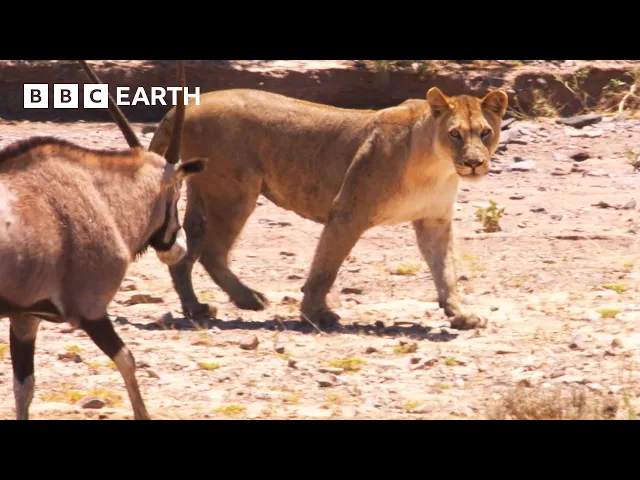
48:52 However, it looks as though these cubs will
48:54 have to teach themselves through trial and error.
49:24 They begin the stalk like seasoned hunters.
49:28 using the scant cover to conceal themselves
49:39 and they have to be incredibly quiet.
49:42 Orics are spooked by the slightest sound.
50:44 One of the youngsters looks as though it's made a mistake.
50:48 It's broken cover.
50:54 Actually, very cleverly, it's pushing the orics towards the other lion.
51:29 An orx is quite capable of seeing off a lion
51:32 as long as the antelope stands its ground and doesn't run.
51:36 But will the orics keep its nerve?
52:05 Finally, the youngsters lose heart.
52:19 Back in the hive, those bees too young to forage are housekeeping.
52:28 Like the hornet queen, the queen bee has the immeasurable task of laying enough
52:33 eggs to ensure the health and future of the colony.
52:43 The custom of keeping wild Japanese bees is as old as society itself.
52:48 And Yamaguchi has kept bees since boyhood.
52:55 Japanese bees are so sensitive that it
52:58 takes great patience and skill to keep them.
53:02 The art of keeping them lies in understanding their behavior.
53:07 They make honey stores for the winter,
53:10 but they also produce enough for Yamaguchi to harvest.
53:16 Japanese bees may produce less honey than European bees,
53:20 but the taste is very special.
53:26 It's the smell of this growing store of energy richch honey
53:30 which could be their downfall if it draws in a hornet scout.
53:38 But right now, the hornets have other problems to contend with.
53:43 The nest is now monstrous.
53:45 The workers have excavated over a ton of earth.
53:56 There are so many bodies living at close quarters
53:59 that the queen and her dynasty are in danger of overheating.
54:07 So workers create air conditioning.
54:10 Keeping a steady flow of fresh air circulating.
54:17 Being unable to cope with high temperatures is a giant hornet's Achilles heel.
54:26 The warmth of the hornet's nest belies the change in season.
54:36 Seasons change fast up here in the mountains,
54:39 and when autumn arrives, there are far fewer insects around.
54:47 This means my hives are even more vulnerable to attack.
54:53 For me, it's an anxious time.
55:01 In the search for autoutumninal food,
55:04 a scout hornet discovers Yamaguchi's wild bees.
55:15 The honeybees fan an alarm pheromone through the air.
55:19 This alerts the whole hive to the hornet's presence.
55:26 The scout smells the honey within.
55:29 A prize this rich is worth scent marking.
55:40 But unlike the European bees, these Japanese bees do not attack.
55:45 Instead, they lure the scout inside.
55:56 Still the bees hang fire.
56:04 Then one is caught.
56:06 It's the signal the others have been waiting for.
56:19 Surrounded by vibrating bodies,
56:45 the hornet at the core of the bball begins to overheat.
56:50 The bees have the advantage.
56:52 A heat tolerance 2° above that of their enemy.
56:56 At 46° C, the aggressor is roasted alive.
57:14 The wild bees have spent millions of years living with the enemy.
57:18 That's why they alone have developed this extraordinary survival strategy.