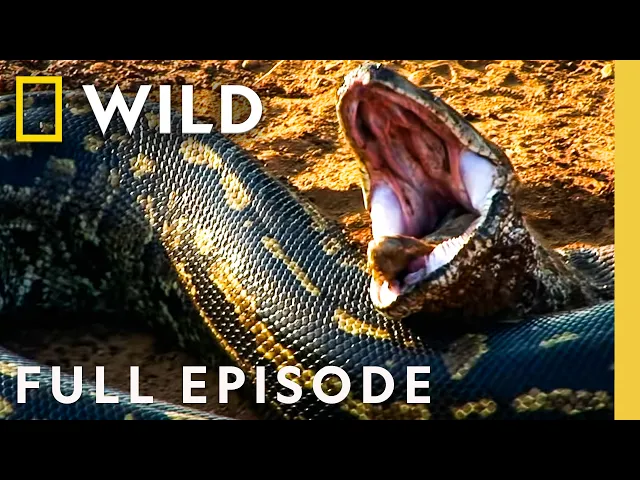
Who are the Monster Snakes? (Full Episode) | Monster Snakes | Nat Geo Animals
Nat Geo Animals
0:02 NARRATOR: They slither through Amazonian swamps.
0:07 Glide across Everglade waterways.
0:11 And lurk in caves across the world.
0:14 BRADY: Here comes the head! Watch it, ah!
0:16 NARRATOR: Monster serpents are the stuff of nightmares!
0:23 Pythons and boas are among the biggest reptiles on the planet...
0:29 And they eat big too.
0:33 First, the victim is squeezed to death...
0:37 Then, swallowed whole.
0:41 Even humans have become prey.
0:43 (scream)
0:47 From the biggest to the baddest, and every killer
0:53 constrictor in between...
0:56 These are Monster Snakes!
1:00 (theme music plays).
1:12 The Green anaconda, known as the heaviest snake in the world.
1:19 They reach up to 25 feet long and
1:22 can weigh more than 300 pounds.
1:30 To support its bulk,
1:31 anacondas spend almost all of their time in and around water.
1:47 Camouflaged to blend into plant-choked water, this snake
1:50 usually waits for prey to come to it.
2:02 Eyes and nostrils positioned on top of their heads allow
2:06 the snakes to remain almost completely submerged as they
2:10 wait to ambush.
2:15 The anaconda shares this flooded plain with the
2:18 capybara, the largest rodents on Earth, often reaching more
2:22 than 100 pounds.
2:28 Capybara are social animals and herbivores.
2:33 Much of their diet consists of aquatic plants, so they spend
2:36 a lot of time near water.
2:41 Prime hunting ground for the anaconda.
3:00 Underwater it can stalk without being seen...
3:03 Poking its head up just long enough to gage the distance.
3:18 Then it waits.
3:28 It strikes, latching on with six rows of teeth,
3:32 coiling itself around the large rodent.
3:38 There is no escape.
3:42 Anacondas don't kill with venom...
3:44 They are constrictors.
3:46 They compress the blood flow to their prey's heart causing
3:49 cardiac arrest.
3:55 Once the heart has stopped beating,
3:57 they begin to eat their meal whole,
4:01 toes and all.
4:05 They do this with the help of both stretchy ligaments and
4:09 mobile joints in their mouths.
4:14 In the middle of the anaconda's upper jaw are two
4:17 rows of backward-pointing teeth.
4:21 These teeth can move independently, biting into prey,
4:25 and helping move the snake's head up and over its meal.
4:30 But eating this way creates a problem...
4:33 With its mouth stretched so tightly,
4:36 breathing could be a challenge...
4:40 Evolution developed a solution for that...
4:44 The windpipe gets pushed forward from deep within the throat,
4:48 it becomes like a snorkel.
4:51 Effortlessly breathing while feeding.
4:59 It's a huge meal.
5:07 The anaconda will rest, digesting its catch for weeks.
5:13 A capybara this size will satisfy it for months,
5:17 but eventually it will need to feed again...
5:23 For females, finding large prey is vital.
5:27 30% of their body weight is used for reproduction.
5:35 Anacondas give birth to live babies,
5:38 up to 50 at a time.
5:43 But not all of them make it out of the den alive.
5:46 And after 7 months of fasting,
5:48 the mother will eat the babies that didn't survive.
5:57 The rest leave the nest, ready to kill from day one.
6:06 These nearly two-foot-long snakelets will become the next
6:08 giants of South American waterways.
6:20 These snakes are hard to find,
6:22 so adventurers like Richard Terry are eager to learn more about
6:26 these mysterious monsters.
6:29 RICHARD: We're still close to water.
6:31 We are literally looking along the riverbank using our eyes,
6:35 looking for bubbles or any signs of disturbance.
6:38 Track marks.
6:39 But if they're here on land they could be hungry,
6:42 and we've got to be really careful.
6:53 NARRATOR: It doesn't take long to find signs that an
6:55 Anaconda is nearby.
6:58 SAMUEL: Richard, there are the marks.
7:00 The little tree, the little bush has been crushed.
7:03 RICHARD: You can see that the leaves have been pushed into the mud.
7:06 He says the snake gets onto this so that he can put his
7:09 head in the sun, before it then enters the water and then
7:12 out onto the land to hunt.
7:14 SAMUEL: I can see it! RICHARD: Really?
7:15 SAMUEL: I don't know where's the head!
7:17 Come here!
7:18 Come help me, put your hand underneath here.
7:21 Just grab it. I'm gonna pull it.
7:24 Just grab it! Pull that. Yeah, pull it.
7:27 RICHARD: Ohhh look at this!
7:34 It is... It's got the black oval markings!
7:38 Look at this!
7:40 That is...
7:41 SAMUEL: Pull it! Pull it! Pull it!
7:43 RICHARD: The anaconda! Where's the head?
7:46 (painful scream).
7:48 SAMUEL: Grab it, just grab it!
7:50 RICHARD: OK!
7:51 SAMUEL: It's got you, it's got you!
7:52 RICHARD: It's got me!
7:53 Arghh, I've got it!
7:54 SAMUEL: Yeah!
7:55 RICHARD: Release. Release. She's aggressive!
7:57 SAMUEL: OK, I got it!
7:59 RICHARD: She's aggressive! I got it!
8:01 She sank her fangs into my thumb right away!
8:03 As soon as we had our hands in the water!
8:06 Look at the markings, green, black ovals all over it!
8:10 This is the green anaconda!
8:15 Look how thick it is!
8:17 Look at the girth of this!
8:18 She's hissing!
8:20 (hissing)
8:21 Sleek, efficient, fast, stealthy;
8:25 the Green Anaconda is the largest snake in the world.
8:30 This thing here has the ability to crawl out of the water,
8:34 to actually rear up out of the water and strike.
8:37 Strike people in their canoes, in their boats.
8:39 And also to climb up onto land.
8:43 Although these creatures do swallow their prey whole,
8:46 you can see from my thumb, they will strike,
8:48 and they will attack!
8:50 If someone is cornering them like we just did then in the hole,
8:52 it will turn around and it will bite.
8:55 NARRATOR: Richard may have gotten off easy,
8:57 others haven't been so lucky...
9:05 Anacondas are the most aquatic of the boa family,
9:09 their soft, loose skin helps them withstand long periods of immersion.
9:15 Quiet stealth allows for rapid attacks and raw power.
9:21 This force of nature can even set its sights on humans.
9:29 Jose Damaso and his father-in-law were out fishing
9:32 in the Amazon rainforest of northern Peru.
9:39 This fishing spot happened to be home to an especially large anaconda.
9:45 The two locals had seen this beast before but never thought of it as a threat.
9:56 Jose failed to notice that the anaconda was nearby.
10:04 The giant serpent can hold its breath underwater for up to ten minutes.
10:11 Fully concealed, it silently closes in...
10:20 (scream)
10:30 NARRATOR: An anaconda's razor-sharp teeth dug into Jose's thigh...
10:36 Teeth designed for exactly that purpose.
10:40 If the snake succeeded in coiling around him,
10:43 there'd be no escape.
10:46 Luckily, his size and quick reaction probably saved his life.
10:52 But he's left with a reminder of just how close he came to the unthinkable.
10:59 Attacks like this have occurred before but there are
11:03 no confirmed cases of an anaconda killing a human.
11:08 But with humans building houses on the edge of their
11:11 territory, it might just be a matter of time...
11:18 Anacondas aren't the only constrictors with tales of
11:21 terror attached to their name.
11:27 In Africa, a species of python plays the villain in
11:31 legendary stories throughout the region...
11:37 It lies in wait...
11:39 watching for the prey to approach...
11:41 And readies an attack: a deadly embrace.
11:50 The African Rock Python.
11:55 There's a story going around sub-Saharan Africa,
11:58 about a sleeping goat herder and a giant python on the hunt.
12:04 They say the boy was stalked by a beast two feet around and
12:09 18 feet long, with dozens of needle-sharp teeth
12:13 and jaws as wide as the boy's shoulders.
12:17 It's said to have snatched the sleeping boy,
12:20 squeezed the life out of him,
12:23 and then swallowed him whole.
12:29 And for this snake,
12:30 consuming a small boy wouldn't be difficult.
12:36 To devour giant prey, the python starts by opening
12:39 its jaws 180 degrees.
12:44 Its teeth are curved backwards.
12:47 And the two sides of the skull move independently,
12:50 rocking back and forth,
12:52 inching the jaws up and over the prey.
12:57 And once inside, the python's stomach expands,
13:02 enough to accommodate animals two to three times wider than itself.
13:10 But snakes will give up their meals if they sense serious danger...
13:16 Shedding the extra pounds enables a python to
13:19 retreat quickly, or provide a distraction so it can escape.
13:26 Digesting massive meals can take weeks.
13:30 Regurgitation is sometimes necessary for survival.
13:38 Like anacondas, African Rock pythons aren't venomous.
13:43 Its weapon is all muscle.
13:46 This serpent can weigh nearly 300 pounds and
13:50 grow to almost 20 feet.
13:53 Making it one of the largest snakes in the world!
13:59 This python lives throughout the Savannas and forests of
14:02 Sub-Saharan Africa...
14:06 Hunting on land and in water.
14:18 This giant tracks its target with special heat-seeking pits.
14:23 These sensors home in on body heat...
14:27 Stripping prey of camouflage and targeting
14:29 the point of attack.
14:36 Already powerful on land, this brawny serpent employs a more impressive tactic,
14:42 from underwater...
14:44 Where it glides with fluid grace.
14:48 Ever adaptable, Pythons that live near water thrive on fish.
14:54 Some snakes find even bigger prey here...
14:59 it waits, underwater.
15:03 Rising every 30 minutes for a discrete breath...
15:12 Hours of coiled tension...
15:16 Waiting, until...
15:26 scores of teeth seize the prey...
15:31 Then muscular coils envelope the victim.
15:38 Crushed, the springbok's heart slowly stops beating.
15:46 The Python devours up to 130 pounds of lifeless prey...
15:52 whole.
15:56 After a meal like this, it won't need to eat again for a while,
16:05 but hungry or not, pythons are always dangerous.
16:15 Grazing livestock make perfect meals, and farms are ideal hunting grounds.
16:22 SIMON: How you doing?
16:23 NARRATOR: Snake catcher, Simon Keys, helps to rescue
16:26 and relocate menacing reptiles.
16:30 SIMON: Yeah.
16:31 SIMON: Yeah.
16:40 SIMON: Down into there?
16:42 SIMON: We know it's a big python.
16:44 There is no other snake in Africa capable of eating an adult chicken.
16:47 Show us the hole, let's have a look there anyway.
16:49 JOSEPH: Yeah.
16:50 SIMON: Just in case it is in there.
16:53 SIMON: Okay.
17:00 SIMON: Underground. JOSEPH: Yeah.
17:04 NARRATOR: Pythons can't dig their own holes,
17:06 so they often invade and take over dens dug by aardvarks.
17:12 Farmers rely on snake catchers for help but handling
17:15 killer pythons is always a high stakes risk.
17:20 SIMON: See, there, it goes a bit wider there again for a minute.
17:23 There are those wider bits and then there are really narrow ones.
17:26 Makes you feel claustrophobic.
17:29 Snakeskin, big one too.
17:33 I'm just going to grab it now but yeah, it's big.
17:35 Big, Big. Yeah, it's pretty fresh.
17:41 There it is! It's a python!
17:47 He's getting away; use that hook.
17:50 Wait there, wait, wait!
17:53 (groan).
17:57 SIMON: Okay, I've got it!
17:59 Alright, it's got me as well though.
18:01 I've got to sort my hands out; I've got a loose grip.
18:05 Jeez this is strong, eh?
18:07 Ugh!
18:08 I've got to get this thing off.
18:11 Can't actually get it off me.
18:12 If you can unwind it and I'll check over here, here we go.
18:18 It's flippin' strong!
18:20 Alright, I've got it. Just.
18:23 But it's got me as well. And it's (bleep) all over me.
18:27 I don't blame it.
18:28 Now I've got to try and get out of this tunnel.
18:31 Quickly as possible, it's got my leg.
18:35 It's stuck like a rope.
18:40 Sioux!
18:41 SIOUXSIE: What?
18:42 SIMON: Sioux, I've got it, got it.
18:44 SIOUXSIE: You've got it?
18:45 SIMON: Yeah, I've got it, got it.
18:46 Don't let go of it please.
18:48 SIOUXSIE: It's big.
18:54 You alright?
18:57 SIMON: Yeah, I'm alright. You alright?
19:00 SIOUXSIE: Yeah but I've got to get up here.
19:02 What about you?
19:03 Do you have the head, have everything?
19:05 SIMON: Yeah, I've got the head.
19:07 SIOUXSIE: You good?
19:08 NARRATOR: Moving these huge snakes is necessary
19:10 so that both humans and snakes can live in peace.
19:14 SIMON: Okay. Thanks.
19:16 SIMON: No worries, alright. Glad to be out alive.
19:26 NARRATOR: South America is home to another Monster Snake.
19:32 The Boa Constrictor.
19:41 It stretches up to 13 feet and weighs up to 60 pounds..
19:50 and it's fast.
19:55 And once in the coils of this serpent, escape is not an option.
20:04 This highly adaptive snake can live in various habitats;
20:08 from grassy plains to dense tropical rainforests.
20:16 It is both terrestrial, occupying hollow logs and
20:20 abandoned burrows and arboreal, living in the trees.
20:30 The Boa constrictor coloring and markings vary greatly to
20:34 blend into these different environments.
20:39 They are excellent swimmers,
20:41 but prefer to stay on dry land.
20:48 During the day, it sleeps.
20:51 Clear scales cover its cat-eye pupils,
20:54 making the boa constrictor look like it's awake.
20:59 They also have excellent night vision.
21:05 And that's when the hunt begins.
21:11 The boa waits inconspicuously in leaf litter.
21:26 The strike is lightning fast.
21:28 Less than half the time it takes to bat an eye.
21:35 Trapped in the snake's hold...
21:38 Death comes slowly.
21:48 The hunter takes its time digesting the rodent.
21:53 Its next meal may be weeks away.
21:58 Boas may be the most adaptable of all the Monster Snakes.
22:05 A cave in Puerto Rico is home to thousands of bats.
22:10 Agile predators in their own right.
22:14 Tonight, they are the hunted.
22:18 When the sun sets, a slithering bat-assassin emerge,
22:24 the Puerto Rican boa.
22:28 Welcome to the "Cueva De Los Culebrones",
22:31 "The Cave of the Long Snakes."
22:37 These boas are known for their unique hunting strategies,
22:42 patience and persistence are key.
22:45 While bats prepare to hunt, the snakes set their trap,
22:49 slithering up to the mouth of the cave and then uncoiling.
22:54 Just 25% of the snake's body stays on the rock as
22:58 they hunt by sense of touch.
23:02 Which means until a bat brushes up against them,
23:05 these snakes are just hanging around.
23:14 Eventually, an unfortunate bat will get too close to the snake's mouth.
23:23 The boa wraps his body around the bat twice and squeezes to kill.
23:29 Then in true snake fashion, he eats his prey whole,
23:34 wings and all.
23:43 India is home to some of the biggest and most powerful pythons.
23:49 Two of these giants are the "Burmese" and
23:54 the "Indian rock".
23:57 The Indian Rock Python thrives in jungles from India to Southern China...
24:04 And throughout Southeast Asia.
24:11 Topping out at over 13 feet and 150 pounds;
24:17 it's actually the smaller of the pair.
24:24 Its cousin, the Burmese python,
24:27 reaches lengths of almost 20 feet.
24:31 But its range is much smaller and nestled within the Indian rocks.
24:37 Human fatalities from either species are rare.
24:42 But when they do occur, they only add to these
24:45 snake's giant reputations.
24:48 And now they are becoming a problem in the United States.
24:57 NARRATOR: In the Florida Everglades foreign monster serpents
25:01 are on the prowl.
25:04 The carnage is evident...
25:07 Bodies are turning up...
25:10 But in a shocking twist...
25:12 Both victim and perpetrator are mysteriously dead.
25:19 A Burmese python...
25:22 An American Alligator...
25:25 Two gigantic reptiles in a battle nature never intended.
25:33 September 26, 2005.
25:37 A chopper pilot is out on a routine flight over the
25:39 Florida Everglades.
25:44 The pilot spots something in the saw-grass.
25:48 It looks like a reptile,
25:50 but not like any reptile normally found in the Everglades.
25:54 He's seen pythons before, but this one...
25:57 somehow...
25:59 has a gator sticking from its side.
26:04 Anacondas are capable of killing 300-pound caimans,
26:09 they evolved together.
26:12 But a Southeast Asian python eating a North American gator seems unlikely,
26:20 a research team from the University of Alabama
26:23 investigates on a smaller scale.
26:46 SECOR: Wow look at that...
26:49 That little alligator doesn't have a chance.
26:52 NARRATOR: The gator's streamlined body helps the
26:55 snake ingest its grisly meal...
26:59 But what really makes it possible is the python's jaw...
27:03 Four rows of razor-sharp teeth work independently to walk up and over the gator,
27:11 pulling the throat over the meal.
27:20 A tiny camera hidden in the prey allows a view from the inside.
27:25 SECOR: It is an amazing feat for the snakes to eat large items.
27:30 A python can easily consume a food item that might be 3, 4 times
27:35 the diameter of its head and that's, that's huge,
27:40 when you look at other animals in the world, they just can't do that.
27:49 NARRATOR: It took just 10 minutes for this python to polish off
27:53 a gator nearly half its size,
27:55 but can it really digest the meal...
27:59 One that's full of bones, claws and tough hide?
28:04 Digital X-rays provide a rare glimpse inside the python's
28:08 amazing digestive machinery...
28:12 Swallowing boosts oxygen intake by 3,600%...
28:17 Driving tremendous amounts of hydrochloric acid
28:20 into the stomach...
28:21 SECOR: And that acid can break down the skin,
28:24 it can break down hooves, it can break down teeth, it can break down bones.
28:29 NARRATOR: Still, it takes nine full days and during digestion,
28:34 the snake is listless and slow.
28:38 Finally, almost nothing remains.
28:43 So what happened when a monstrous 13-foot Burmese Python
28:47 was found badly bloated, head missing,
28:50 its belly burst...
28:51 And half-inside, a six foot Florida gator?
28:58 Stephen Secor thinks he figured out what happened in
29:01 the 'Glades that day...
29:05 A python heads out in search of a meal...
29:11 It finds a target lying motionless.
29:14 A gator suffering from fresh head wounds.
29:20 Instinct tells the snake to go for it.
29:28 The python's kill and big swallow sets its digestive
29:32 juices to work on the gator's tough, bony hide.
29:38 But the snake's body becomes bloated and stressed.
29:43 Now the python is vulnerable to attack...
29:51 This invasive snake may have been able to eat one
29:54 alligator, but it was unprepared for another.
30:03 The fight may have been fierce enough to push part of the
30:06 swallowed gator out of the snake.
30:12 In the end, the python and its gator meal lie dead.
30:19 Not all of the experts are convinced it happened that way.
30:23 But the possible role of another gator might be a sign
30:26 that some native species,
30:28 won't give up their territory lightly.
30:38 One obvious question:
30:40 how on earth do giant snakes from Asia
30:43 get 10,000 miles to the 'Glades?
30:53 Pythons are survivors, they are extremely tough,
30:57 cold-blooded, able to last months without a meal.
31:02 But these reptiles don't cross oceans on their own,
31:06 they're imported on purpose as pets.
31:15 The Fisher family is happy to share their south Florida home with pythons.
31:20 They have eight.
31:22 GIRL: Daddy? MAN: Hey kid.
31:26 NARRATOR: Two of them are the same species that's causing havoc in the Everglades,
31:30 only a newer breed, designed for the pet market.
31:33 MAN 2: Say hello to Casper.
31:38 NARRATOR: After school, the fisher kids take the snakes for a walk.
31:43 MAN: Those are real? MAN 2: Yeah. MAN: Oh my god!
31:46 NARRATOR: But the Fisher Family may be living on borrowed time.
31:52 In the US pet pythons are a danger,
31:56 killing or seriously injuring more than 20 people in the last 10 years.
32:03 Rescue firefighters in Aurora, Colorado still remember this
32:07 911 emergency call from several years ago.
32:10 DISPATCHER (over phone): Fire Emergency?
32:12 WOMAN (over phone): My roommate is being choked by a snake.
32:14 WOMAN 2: Oh, my God!
32:16 NARRATOR: They rush to the home of Rick Barber.
32:22 His pet python has always been gentle.
32:25 WOMAN: I can't even get near that thing.
32:27 NARRATOR: The snake may have suddenly felt nervous and it starts squeezing.
32:31 WOMAN: He's down here. He's not breathing.
32:32 MAN: Fire department! Fire department!
32:35 NARRATOR: Four firefighters and a policeman pry the snake
32:38 off of Barber.
32:41 But it's been constricting more than 10 minutes,
32:44 more than enough time to starve the brain of oxygen.
32:49 Paramedics rush Barber to the hospital...
32:54 All of the firefighters and even the pet snake survived.
33:00 The pet's owner did not.
33:12 NARRATOR: In Florida, non-native Burmese pythons are
33:16 on the loose and it's a big problem.
33:22 When pet snakes become too much for their owners to handle,
33:26 they resort to dumping them into the Everglades.
33:33 Now they are threatening native wildlife and pets.
33:40 Their numbers may be growing but so is the army that's
33:43 determined to wage a counter-offensive.
33:52 So much so, it's turned into a full-time job for wildlife wrangler
33:57 Todd Hardwick.
33:58 TODD: Yeah, no, I'm in front of your house right now, I'll be right...
34:01 NARRATOR: Today, he's responding to a house call.
34:04 A cat is missing and someone has seen a giant snake.
34:09 TODD: I catch animals from all over the world without ever leaving Miami.
34:15 Is the snake still here?
34:17 HOMEOWNER: Oh, my gosh I have no idea where he disappeared
34:19 he was right over here and I'm terrified.
34:38 TODD: These snakes show up just about anywhere.
34:41 Usually in the most unexpected place.
34:46 NARRATOR: Finally, Todd sees something in the
34:49 corner of the yard and a cornered python can be trouble.
35:00 Getting control of its head is a must...
35:02 TODD: Big snake, big snake.
35:10 This is an exotic invader species it doesn't
35:12 belong here in Florida or anywhere in this country.
35:27 NARRATOR: He bags it, but there are hundreds more
35:29 out there finding cracks to exploit in the local ecology.
35:38 Exotic reptiles are on the move in south Florida and the
35:41 most disturbing aspect of a python attacking a gator is
35:45 what might happen next.
35:48 Anything could be on the menu.
35:52 If a python can kill and swallow a six-foot alligator,
35:56 why couldn't they eat something smaller,
35:58 like a two or three-year-old human child?
36:03 In Africa, similar sized animals can disappear in the
36:07 blink of an eye.
36:14 All snakes seem to have special features,
36:19 but there's one lurking out there that has it all...
36:24 Multi-talented and especially deadly.
36:30 It's one of the biggest...
36:32 arguably the baddest...
36:35 The reticulated python.
36:39 Its size alone is intimidating.
36:42 An adult male can grow to 25-feet long and
36:45 weigh over 250 pounds.
36:49 And it's packed with 10,000 powerful muscles to crush its dinner to death.
36:56 It slithers across much of south Asia...
37:00 in a region of humid rainforests and rivers.
37:06 The reticulated, or crossed pattern, of its scales allows
37:10 it to blend seamlessly into its surroundings.
37:14 Despite its considerable bulk...
37:16 this super snake will go to any lengths for a meal.
37:20 Even up a tree.
37:22 Monkeys on the highest branches aren't safe.
37:26 Neither are deer...
37:27 no matter how swift.
37:31 This hunter is on the prowl,
37:34 and it has an arsenal of weapons at its disposal.
37:40 The eyes feature cat-like pupils that open wide so they
37:44 maximize available light.
37:47 Heat-sensing pit organs on the face detect the heat generated by nearby prey.
37:54 And chemical sensors on its tongue pick up odors in the air.
38:00 It can maneuver just about anywhere.
38:04 Detecting prey is one thing.
38:07 killing it is another.
38:10 And the reticulated python excels at both.
38:18 All these tools guide the python to its ultimate act...
38:22 A deadly one-two...
38:25 strike and coil.
38:30 The snake's powerful jaws have over 80 sharp,
38:33 backward-curving teeth that latch onto prey to prevent escape.
38:41 It constricts with so much power...
38:43 it stops the flow of blood and oxygen.
38:47 Eventually, the victim's heart will stop beating.
38:53 And then... the final trick.
39:01 NARRATOR: Like most snakes...
39:02 the Reticulated python eats its meal in one long gulp.
39:06 Unlike human jaws, which are fused together, these snakes
39:10 have loosely connected jaw bones and elasticated skin.
39:15 The skin can stretch to seemingly impossible proportions,
39:20 overlapping scales expand to accommodate the size of the meal.
39:31 Of all snakes the Reticulated python ranks among the most impressive...
39:36 if not the most terrifying...
39:38 of them all.
39:42 Even for seasoned herpetologists like Brady Barr,
39:45 the reticulated python represents a very real danger.
39:50 He's headed into remote caves, researching python strategies
39:54 for surviving tropical heat.
39:58 BRADY: Oh, huge, huge python, huge python!
40:01 See it?
40:10 Quick, quick, quick, quick, quick!
40:13 MAN: You want this, (inaudible).
40:15 He's got a good grip.
40:16 BRADY: I know, I know okay I'm going in.
40:17 I'm going in, I'm going...
40:18 Oh (bleep).
40:20 MAN: What happened?
40:21 BRADY: He just bit the rock.
40:22 Be careful, he's got a mouthful of teeth.
40:24 I've got him by the head.
40:26 Oh, he's out, he's loose!
40:28 Okay, can you pull him?
40:29 Whoa, whoa, whoa, here comes the head!
40:30 Here comes the head!
40:32 Watch it! Watch it, watch it... Watch it, watch it, watch it!
40:36 Aagh, (bleep), aagh!
40:39 Aagh, he's on me!
40:41 He's got...
40:43 (bleep)! He's, he's bitten me!
40:46 Where's his head, where do you see it?
40:49 Like a really bad bite.
40:52 MAN: Is he still grabbing you?
40:53 BRADY: No, he's squeezing me very tightly.
40:55 I gotta get out of this stuff, I mean, I'm bleeding.
40:58 There's his head! There's his head!
41:00 Where are the snake sticks?
41:02 Mark, just start pulling him backwards toward the shallow end,
41:05 then when you get in the shallow, I'll get the head.
41:08 Okay, look, he's using his thermal imaging to get me.
41:09 I'm gonna have to cover his head.
41:11 Hang on to him.
41:15 Great, got him! Whew, we got him!
41:17 Let's go out, let's go out!
41:19 Hang on, let's get this thing in a bag and just check my wound,
41:22 then we'll continue.
41:23 Man, that's a big snake, that is a big snake.
41:28 Okay.
41:30 That's the good thing about these giant bags.
41:33 What a battle!
41:35 Oh, man.
41:37 You know, the thing bit me under water.
41:39 How bad does it look?
41:41 MARK: Oh, yeah, it's bad.
41:43 Brady, it's not good, it sliced you open.
41:46 BRADY: Yeah, it hurts bad.
41:47 We're going to have to get to a doctor.
41:49 MARK: Yeah.
41:55 Can you pull the trouser a bit more up, Brady?
41:57 The left side, yeah, okay.
41:59 Oh, oh no. There's another big wide gaping wound...
42:03 Pretend you're biting into wood.
42:06 BRADY: Aah!
42:11 NARRATOR: In the pursuit of gathering data,
42:13 sometimes there are casualties.
42:16 For Brady, this bite is painful,
42:21 but close encounters with reticulated pythons have proven deadly for others...
42:29 In Sulawesi, Indonesia, two people have recently met
42:32 a gruesome fate.
42:37 In March 2017 a 25-year-old man was missing from his
42:41 family's palm oil plantation,
42:44 after finding a 23-foot reticulated python lying motionless in a ditch,
42:50 villagers cut into the snake and found Akbar Salubiro's
42:54 lifeless body.
42:56 Then in June 2018,
42:59 Wa Tiba never returned after checking on her vegetable garden.
43:04 Locals found her sandals and a machete the next day,
43:09 only about 100-feet away from a large, bloated python.
43:13 Sadly, she had been consumed by the snake.
43:21 As cities continue to expand,
43:23 natural habitats decline,
43:26 forcing snakes to hunt and seek shelter in human dwellings.
43:32 increasing the risk of these dangerous encounters.
43:37 But snakes are not our enemies.
43:41 They typically attack humans only when provoked.
43:45 and usually after fair warning.
43:49 Snakes will continue to fascinate us,
43:52 with their smooth accuracy,
43:56 brute strength, and hidden skills that
44:01 make them unique and sometimes terrifyingly deadly.