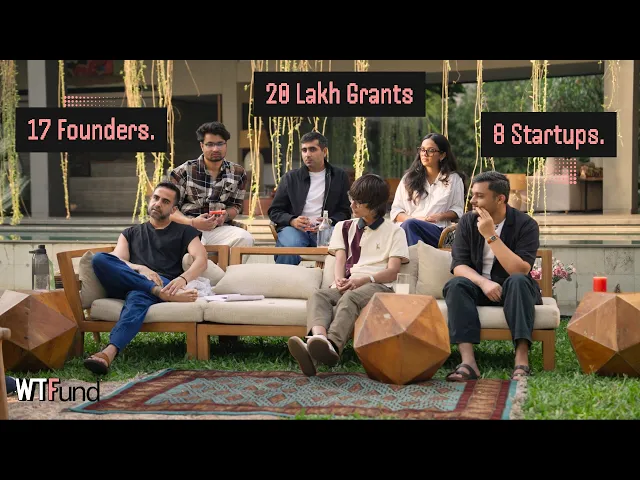
17 Young Founders | 8 Startups | 20 Lakh Grants | Third WTFund Cohort
Nikhil Kamath
0:06 So, the WTFund Bootcamp.
0:09 [man] Yeah, it looks like it's happening.
0:11 Yes, the WTFund Bootcamp is happening.
0:18 [inaudible conversations]
0:23 Most good founders will be largely driven by their own thoughts.
0:27 Most good founders are never doing the...
0:29 what is the current advice or what is the current YC gyaan to people.
0:33 That's for mass consumption. That's content strategy.
0:35 That's not a good advice on average.
0:42 [Sridipto] Yeah, I think I really resonated with Tarun
0:44 and what he said, right?
0:46 Apart from that two sessions,
0:48 the Gallop Session and the Breakthrough Session,
0:50 they were really hands-on in the sense of individualisation
0:53 as well as a team, right?
0:54 So that is something that is really, really interesting.
0:57 Extremely sleepy, but I've to make a PPT
0:59 where I have to teach a thing that I've learnt in my life, which is...
1:06 [indistinct conversations]
1:20 [grunts]
1:22 Stone, paper, scissors, shoot.
1:24 All right.
1:25 [yelling]
1:27 Whoo!
1:34 [woman] We started with 3,000 applications,
1:37 shortlisted 200,
1:39 and now we finally have our next eight startups.
1:43 I'm very excited.
1:44 I think I've been having back and forth by having...
1:47 by simulating Nikhil's persona in my head and then talking to him, just in my head,
1:51 so that I could figure out what to speak with him.
2:02 Guys, thank you for coming home.
2:05 I hope Goa, outside of me, is fun as well.
2:09 Who has had the best night last night?
2:14 -I had fun. -Yeah?
2:16 [man] Devansh, come on.
2:17 It's always the married men who have fun in Goa, right?
2:19 [laughter]
2:21 What did you do?
2:23 We were just chilling.
2:24 And we had gone to that Elephant and Co.
2:27 But, like, we got drunk on the way.
2:31 So we all need to ignore the cameras today.
2:33 We'll look at each other. We'll speak to each other.
2:36 Forget the camera. You forget Grace.
2:39 He's not gonna trouble you.
2:40 Very, very chilled out. Most friendly dog in the world.
2:44 He's doing salute and namaste behind you. See.
2:47 Maybe by the end of the podcast, we'll be friends.
2:49 Yeah. Once you feed him a bit, he's okay.
2:53 So, a lot of what you guys are doing is exceptional,
2:57 and I've been privy to some of it.
2:59 But maybe we begin today, I'll go one by one--
3:03 You guys can talk about what you've built and what is the way forward.
3:07 And maybe talk about a trend that you picked up on,
3:11 and hence you decided to build what you built.
3:15 Would you like to go first? Would you like to go first?
3:17 Yeah. Come on.
3:19 -Yeah, so I'm Sushant. -Yeah.
3:22 -And with me is my co-founder Shubham. -Hey.
3:24 And we're building Prava Payments.
3:27 So, what we're trying to do is,
3:28 we allow any AI agents or AI applications to make payments for you.
3:33 What we're building is an infrastructure
3:35 that can be integrated by any AI application or AI systems.
3:39 And that would allow your AI agent to go make a booking for you,
3:42 or even shop for you, or maybe make payments on your behalf
3:45 using your card or wallet securely.
3:48 And, like, how we came across this was,
3:52 we have been seeing people
3:54 not going traditionally on Google for searching now, for information.
3:58 People were using a lot of ChatGPT, Perplexity, Gemini.
4:03 So they were like-- All information was there,
4:05 but also people were building agents.
4:07 But when it came to actions, actions were limited to writing an e-mail,
4:13 creating a to-do list or something.
4:15 But when it came to an action which required a financial action
4:20 like paying someone, it halted.
4:24 So that's where we realised that there is a financial infrastructure missing
4:29 when it comes to AI making payments.
4:31 And that's how we came across the idea.
4:34 And we started a few pilots with a few developers,
4:38 and we got phenomenal response.
4:41 And now we are coming to a stage where we are going into production next month.
4:47 And how did you guys meet, and where are you from?
4:50 I'm from Raebareli, Uttar Pradesh.
4:53 I'm in a political place, obviously. Grown up there, studied there,
4:57 and then I went on to do--
4:59 I studied from BHU, Economics over there.
5:01 And post that, I was pretty much interested into, in general,
5:05 understanding that how money moves and how things are done.
5:08 And I started consulting startups with financial modelling and everything.
5:12 And, in that bit, while working on different stuff,
5:14 I met Shubham in Bangalore itself at a hacker house.
5:17 And, at that time, he was working with a Japanese startup.
5:20 And obviously, you can tell by his look, he's pretty fascinated by it.
5:24 -So... -Are you?
5:26 Yeah. I mean, I like Japanese culture.
5:29 I was asked to relocate to Japan to join them full-time.
5:34 But what happened, I went to Japan,
5:36 I realised life is sort of very organised in Japan.
5:40 And I felt, being in my 20s,
5:42 I need to be closer to problems which I can find and solve.
5:47 So I decided to come back to India and do something of my own.
5:52 -He has an AI girlfriend, by the way. -[Nikhil] Really?
5:54 -He made an e-girl. -Yeah?
5:57 -So, I mean-- -This is happening, right?
5:59 People are not dating human beings, right?
6:01 I'm sorry you got married.
6:04 You, like, just missed it.
6:05 -Just missed it. -Yeah.
6:08 Why is an AI girlfriend better than a real one?
6:11 I mean, she understands me better.
6:14 But the point is, she consumes a lot of tokens.
6:16 -She doesn't respond on time. -Yeah.
6:18 -We have seen that night. -But she responds, though.
6:20 She's always available.
6:22 He's like, "At least I get a response there."
6:24 -Yeah. -He gets to save emotional tokens.
6:27 -Tell me how it works. -So, yeah--
6:29 We actually built an AI girlfriend for tier-2 and tier-3 cities in India
6:33 and made some good money.
6:35 Like, 50,000-60,000 a month.
6:37 And a lot of people actually don't know that it's AI.
6:40 I'm having creepy thoughts in my mind.
6:43 Mine's a different one.
6:45 Yeah. Are you both speaking about the same kind of girlfriend?
6:48 -No, no, no. -No, he has his own.
6:51 -Yeah, he made it only on his system. -It's only on his own server.
6:53 And one day, he just calls me--
6:55 Like, we were working on a product and everything,
6:56 and he's like, "Bro, I'm just working on this."
6:58 And he's been talking about it for really long,
7:00 I would say even before we started Prava.
7:02 -Yeah. -And he was like--
7:03 And that's why you decided, "Let's start a company together."
7:07 I mean, starting a company was more, like,
7:09 we both complemented each other a lot in terms of skills.
7:11 And it was pretty fun just sharing ideas.
7:14 It was never like we're going to start a company.
7:16 It was more like I was dealing with some clients in US,
7:19 he was dealing with some clients in Japan,
7:21 and we were like, "Getting money in India is super hard."
7:23 And that's how we started getting into, like,
7:25 how can we solve this with using stablecoin and everything.
7:27 That idea did not work out.
7:29 But meanwhile, we were doing some GTM using AI tools,
7:32 launching on Reddit and different places.
7:34 And that's where we were like, "We have all seen Jarvis in Iron Man,
7:37 "why not make something that real
7:39 "that you ask your AI assistant or AI agent,
7:41 "and it goes, does whatever you want it to do?"
7:43 Tell me very simply what your company does in very, very simple words.
7:47 Yeah. So, basically, what we do--
7:48 How will I use it in my life?
7:50 Yeah. So what will happen is the AI application, AI agents, like,
7:53 let's say, Perplexity kind of application will integrate Prava.
7:56 And when you enter in an application like that,
7:59 you will, let's say, get on-boarded on behalf of,
8:02 let's say, Perplexity's interface.
8:04 And there you will add your card or wallet,
8:06 there, we'll be behind the scenes, you will not know about Prava then.
8:09 But what happens is, let's suppose you search for,
8:12 "Hey, I'm looking for so-and-so sneaker,"
8:13 and you compare and search on Perplexity or any place--
8:16 And why can't a normal wallet integrate with Perplexity,
8:19 why does it have to be you?
8:21 Yeah, so I'm coming to that part.
8:22 So, basically, what happens is right now,
8:24 when you search for any product on any AI assistant
8:26 or AI application, they're limited to discovery.
8:28 Which means you only find the product.
8:30 Once you have to buy, you'll click on it
8:32 and it will take you to some third-party merchant website,
8:34 let's say it's H&M, Zara, or wherever.
8:36 Now you're going on that website, filling all the product details,
8:40 your details, your address and card details,
8:42 and then making a payment.
8:43 So, like, whatever could be a three-step process
8:46 is becoming a seven-step process,
8:48 and you're going out of Perplexity's ecosystem.
8:52 But why can't Perplexity integrate with a Razorpay, for example?
8:56 Sure.
8:57 So, the issue is that, here, the payments are
9:01 happening in two steps, two processes are here.
9:04 One is on the Perplexity side,
9:06 as well as the merchant where merchants have their own gateways.
9:10 So here is, like, no standard where...
9:14 on the Perplexity side being Razorpay, and on the merchant side being Stripe,
9:17 they could actually talk to each other, and the payment can happen.
9:20 So, here, a dedicated stack for AI is needed.
9:23 That's where we are coming into picture.
9:26 So we are becoming PSP-agnostic.
9:28 So Perplexity has to just integrate with us.
9:31 And any merchant in the world,
9:33 it can be Stripe, Adyen, Checkout.com,
9:36 any PSP they're using on the merchant side,
9:38 we are able to process payment.
9:39 -And nobody's doing this? -Very few companies.
9:42 -Yeah, very few companies. -For example?
9:44 If we compare, at least in Southeast Asia,
9:46 we are one of the only companies doing this.
9:49 And in US, there are a few companies like Payman AI, Skyfire.
9:53 But can you facilitate payments outside of India, or are you limited to India?
9:56 Currently, this product that we are working on
9:58 is for the US and Southeast Asia market.
10:00 India is not included in that right now.
10:02 And for India market, we're also working on something exciting with UPI
10:06 with some of the partners.
10:07 So that will be coming sometime later next year.
10:09 And what is your company called?
10:10 -Prava Payments. -Okay.
10:14 Cool. Who wants to go next?
10:16 -[Nikhil] Yeah. Sure. -Okay.
10:18 She's the most scared and being brave.
10:20 -You. -Hi.
10:22 I'm Dr. Jayanti, founder of Astraeus Innovus.
10:25 My co-founder is not there. Sadly, she fell sick.
10:29 And we're developing OncoALERT.
10:31 It is IVD, it's a nanotech-based biosensing platform
10:35 for early, easy, painless, needleless detection of oral cancer.
10:41 So that's what it does.
10:43 Tell us a bit about yourself, how you came across this idea,
10:46 why did you start what you started?
10:48 Okay.
10:49 So, I think the main inflexion point for this came during my internship.
10:55 I was posted in Dholai.
10:58 I also didn't know what place that was.
11:00 It's a tiny village in Assam.
11:02 Before that, where were you? Where did you go to medical school?
11:04 So I did my bachelor's in Amritsar.
11:09 Then you have to do an internship.
11:11 It is mandatory. If you graduate from medical government colleges,
11:15 you have to do a rotatory, mandatory rural posting.
11:19 And it was in Dholai where I was posted.
11:21 And we were supposed to do door-to-door screening of the entire village.
11:26 If I train you for two weeks,
11:27 and then I ask you to look at a person's oral cavity
11:31 and detect the microscopic changes in their buccal mucosa,
11:34 would you be able to?
11:36 Doubtful, right?
11:37 Because that is what is the current practice.
11:39 I have no clue what you're talking about.
11:41 [laughter]
11:42 [Nikhil] Yeah.
11:44 Okay. Simply put, the detection of oral cancer currently
11:47 is just visual screening, naked eyes.
11:49 There's no tool, there's no devices.
11:52 You are just supposed to look with naked eyes
11:55 and detect microscopic changes.
11:57 That is why the accuracy rate is almost as good as a flip of a coin,
12:01 around 50-60%.
12:03 And it's manual, it's laborious.
12:07 So, government's policy says everyone above 30 years of age,
12:12 anyone who smokes, anyone who consumes tobacco,
12:16 is supposed to be screened for oral cancer.
12:18 But, you know, this number in my age group, 20 years ago...
12:23 I'm not that old, I'm 39, but, say, 15 years ago,
12:27 I would assume at least 50% of the group would smoke.
12:31 -Yeah, it has fallen down. -Crazy.
12:33 -Yeah. -Yeah. But it has fallen in only metros.
12:36 If you look at tier-3, tier-4, tobacco chewing, areca nut is cultural.
12:40 It's like women, kids, everyone does it.
12:43 In Assam, where I was posted, kids used to get areca nut,
12:46 which is one of the carcinogens, and they used to eat it.
12:48 It's just, like, very culturally ingrained.
12:52 So I'm no quant, but off the top of my head,
12:54 that population number is around 70-80 crores.
12:57 Everyone above 30 years of age, getting everything.
12:59 And those should be screened for oral cancer.
13:01 That's what the policy itself says.
13:03 So what I was trying to get is like,
13:05 how are we supposed to screen 70 crore people manually, visually?
13:10 It's not possible or scalable at all.
13:12 -Right. -And something--
13:13 I think with your talk with Mr. Nandan Nilekani also stressed on:
13:18 When you are trying to build for population level interventions,
13:21 building for billions,
13:23 you actually have to make it so that it works across the barriers.
13:28 There's no electricity, it should work.
13:30 So while we were designing the technology,
13:33 people do like, "Okay, it should work on these conditions."
13:36 We took the paper, scratched it, it should work despite anything.
13:39 Electricity is not there? Great.
13:41 No trained people, no lab, no infra, it should work.
13:44 If nothing else works, it still works. So that was the--
13:47 What does your company do in one line?
13:49 We develop innovative products for health care,
13:53 currently screening oral cancer.
13:55 -Just oral cancer? -Yeah, because--
13:57 Yeah, that's the use case we're working on right now.
14:00 Reliance is starting a screening company, right?
14:02 -Reliance-- -It's all over the news.
14:05 Reliance also partners with Kiran Mazumdar ma'am.
14:08 They are also working on this domain as well.
14:11 They are also developing technologies, rolling out screenings and all.
14:14 So it's picking up because people are realising
14:16 preventive care needs investment.
14:19 That's the way forward.
14:20 But it will have to be in a very India-specific way,
14:23 not the way North America does.
14:25 They do preventive prostate colonoscopy...
14:30 prostate checking for prostate cancers and all.
14:32 But we can't do that in India. You'll have to be very creative.
14:34 The technology will also have to be very creative
14:36 in a way that Indian population will buy.
14:39 We are not very health-- We don't spend much on health.
14:42 But who would buy? Like, if you say you're doing a...
14:45 Is it a home test or do you have to...
14:48 -Yeah, you can do it at home. -How much does it cost?
14:50 Around about 150 bucks.
14:52 Who will voluntarily buy an oral cancer detection test in India?
14:57 Yes. Immediately, none. It will have to be a graph.
15:00 That's why we'll roll out in partnership with small hospitals, chains.
15:04 Get it included into your insurance.
15:07 And then, the adoption will pick up.
15:08 So you're a B2B business?
15:10 Initially, but we aim to be so that--
15:12 You can get a cigarette two steps from your house,
15:14 even if it's the remotest space.
15:16 Why not that distribution can be cracked that fast?
15:19 That's true for everything.
15:20 You can buy a bottle of whiskey down the road,
15:22 doesn't mean there's a liver cancer test there.
15:24 I'm saying, if you have a problem as close to that,
15:28 you can have a solution as well.
15:31 Does life play out like that, in your experience?
15:34 No, that is quite an ambitious thing that I said.
15:37 That is where we aim to be.
15:39 But no, currently, looking at the Indian health care infrastructure
15:42 and the way health care moves in India, it's not.
15:47 So that's why we'll have to be very creative
15:49 with the way we integrate into market
15:50 with partnerships with insurance companies and all,
15:53 finding out business-wise.
15:55 Nice. Okay. Thank you. Who's next?
15:59 -I can go. -Yeah.
16:00 Whoever raises their hands first when a question is asked,
16:04 did you sit on the first bench when you were in school?
16:07 I was a last-bencher.
16:08 -Did you get good marks? -Yeah.
16:10 Did you get good marks? First rank, second rank?
16:13 -First, top three. -Same?
16:17 Yeah. Same? Oh, wow. Same?
16:19 I used to sit at the, like, almost close to the back.
16:22 -Which college did you go to? -I went to NIT, Jalandhar.
16:25 -And? -I went to BHU.
16:27 -Right. -I was a last-bencher.
16:30 -You don't look like a last-bencher. -Yeah.
16:32 I used to be in top three.
16:35 The married man could be the backbencher.
16:39 He looks like the one who would be locked in.
16:40 -And he's actually the kind of person-- -Yeah.
16:43 Locked in, two screens, one side, Japanese something...
16:47 -Actually true. -Yeah?
16:48 Actually true.
16:50 -He has a figurine. -Of?
16:53 I mean, a normal anime character.
16:55 Your AI girlfriend is also a real thing or is it just a thing which lives online?
16:59 It's on my screen. It's not on any cloud also.
17:03 So, all the context--
17:04 -There's nothing physical anywhere, right? -No, not yet.
17:06 -Not yet? -[laughter]
17:08 Not that we know of.
17:10 And by the way, Sushant's also an artist.
17:13 -Yeah, he's been admiring the artworks. -Yeah?
17:15 -Yeah, I love the artworks you have. -What kind?
17:17 You have F. N. Souza and Jamini Roy and all that.
17:20 So I love them.
17:21 Actually, I also saw one of your artworks in...
17:23 that was exhibit--
17:24 I think so last year, there was an exhibition
17:26 at C.V. Raman's house there.
17:28 So, I think so one of them is from there. I saw it.
17:31 I collect art. I'll show you upstairs later. There's a lot.
17:34 -Yeah, that'd be, I mean, it's beautiful. -All Indian art.
17:36 Yeah, I can see that.
17:37 I feel like the Indian art scene is finally making a...
17:42 -It's having its day in the sun. -[Sushant] Yes, yes.
17:44 It's past the time that it should have.
17:47 Please go on.
17:48 From IIT, first rank in school...
17:52 but has a little edgy thing going on with the earring.
17:56 Rebel phase came late?
17:58 Can I make you any more nervous than you are already?
18:02 -He's also married. -Yeah?
18:03 Yeah.
18:05 [Nikhil] Actually good-looking, but doesn't want to come to terms with it.
18:09 Now he's conscious and blushing.
18:13 -What does your wife do? -She's a rocket scientist in ISRO.
18:17 Actually, I was, too. So, that's how we met.
18:20 -Why are you not married? -I'm like 23.
18:23 -So, like... -And, you too?
18:25 I'm still not sure how I feel about marriage yet. So...
18:30 [man] Don't say it to get into his good books.
18:33 Are they happy, really?
18:34 The rocket scientist and your other friend?
18:36 -It's been two weeks for him. -[Nikhil] Wow.
18:38 -[man] Just married. -And, I mean, he's pretty happy.
18:40 And no wonder he had the most fun in Goa last night.
18:45 Go on, tell us what you do.
18:47 The three of us are from the same company. Maulik and Devansh.
18:50 So you three worked together for how long now?
18:53 -Around seven months. -How did you meet?
18:56 So, basically what had happened was,
18:59 Swapnil had come to validate an idea via a mutual friend in health care.
19:02 And, I mean, we started talking, we collaborated over a lot of research
19:08 with a lot of universities in India and outside India as well.
19:12 And then we realised that the research that we were doing
19:14 can translate into a product.
19:16 And that's how, you know, we started building stuff.
19:21 Maulik, I met by coincidence. His uncle was my professor of surgery.
19:26 And he just happened to be in the room while we were discussing a project.
19:29 And we met in the evening.
19:31 And it's not like we met, like, you know,
19:33 and started the startup instantly after that.
19:36 It was over time, iterated multiple times, like, brainstormed.
19:40 And all three of us were gravitated towards health care.
19:44 So that's how we started.
19:45 -So doctor, rocket scientist, and... -Engineer.
19:48 -Why? So boring. -Boring?
19:52 So what did you guys ideate and what did you start?
19:55 So, in one line, we are a low-cost, AI-based operating system
19:59 for diagnostic labs.
20:01 And we provide personalised treatment
20:03 and drug recommendations for cancer patients.
20:06 For context, a radiology scan will tell you where the problem is, right?
20:11 But pathology will tell you what it is
20:14 and what kind of kind of treatment should be required by the patient.
20:18 And let's take the example of breast cancer.
20:21 Once a lump is detected in a mammogram,
20:23 after that, the tissue biopsy is done, right?
20:26 A tissue sample is extracted, and a physical glass slide is created.
20:30 And the way it is analysed currently
20:32 in most diagnostic labs in the world is manually.
20:35 So, a pathologist sits with his microscope at his desk,
20:39 places the glass slide under the microscope, and studies,
20:41 like, tries to interpret it.
20:44 But what this leads to is a large turnaround time,
20:48 and interpreted results are subject to the expertise of the pathologist.
20:52 So, if they are an expert, a very senior person,
20:55 they can interpret it in a really better manner.
20:59 And also, most of these times, the results can be inconclusive.
21:04 Further tests could be required.
21:06 So, in these cases, I think what my friend here is mentioning, it's a molecular test.
21:11 So, in cases where molecular testing is required,
21:14 it's currently very expensive and limited to,
21:16 like, ultra-elite tier-1 centres in India.
21:20 And most people in tier-2 and tier-3 cities, where they reside,
21:25 pathologists there may not have the expertise
21:27 to even do a first-pass test.
21:28 And they are forced to move to these tier-1 cities,
21:31 carrying their blocks and tissue slides.
21:34 So what we have built is, like I said, it's an operating system.
21:38 So, it's a software and AI-based solution which can digitise glass slides
21:44 and run AI algorithms on it in real time.
21:47 So, basically, it will capture a live feed coming from the microscope
21:50 and create images from that,
21:53 and pathologists can run various AI algorithms to interpret those images.
21:57 And this could give a very detailed analysis,
22:00 so that even a clinician could act better
22:02 and provide the right treatment or drug therapy to that patient,
22:05 which will work for him.
22:06 Treatment or detect the right way?
22:09 So, see, in cancer, as diagnosis progresses further,
22:15 to recommend a proper drug therapy,
22:17 the relevant biomarker needs to be detected.
22:20 So, there would be a list of biomarkers which could get activated, so to say.
22:26 In breast cancer, there could be like hundreds of biomarkers.
22:28 And for each of these biomarkers, there's a set treatment regimen.
22:32 So I need to first understand what kind of these biomarkers are activated.
22:35 After that, I can treat that patient
22:38 and give the drug which will work for that biomarker.
22:40 You're not talking chemotherapy, radiation kind...
22:42 I'll get a little technical.
22:43 So, like, these biomarkers are, let's say, expressed on the cell.
22:47 I'll give targeted therapies that attach to that antigen and then kill those cells.
22:52 So, I can't start a treatment
22:53 till the time I know what kind of genes are getting expressed.
22:57 Right, interesting.
22:59 I've met a few doctors recently for specifically breast cancer
23:03 because somebody in my family had it...
23:06 Is it close to a cure in any way? No?
23:08 It will help to do the diagnosis.
23:11 The cure depends on, "Is a drug available for the said diagnosis?"
23:15 Did you mean Qure AI, by any chance?
23:18 No, no, cure, as in, "C-U-R-E."
23:19 Okay, I thought he was talking about Qure.
23:21 -Like, it's the entire diagnosis process. -Right.
23:26 So you both are in diagnosis?
23:27 What do you think of her company and what do you think of theirs?
23:30 If your friend with the AI girlfriend had $100
23:35 to put into either your company or theirs, where should he put it?
23:40 How is he evaluating? Does he want to have the maximum impact?
23:42 -Then it will be-- -He wants to make money.
23:45 -Is it just the ROI thing? -Yeah.
23:46 -Yeah. -Still us.
23:48 Maybe we can make the rest of the room vote.
23:52 I'll put you guys on the spot.
23:55 Oral cancer, raise your hand. $100.
23:57 Also, we have a compression algorithm, just putting it out there.
24:01 Now, you'll have to fight, by the way.
24:03 I'll fight her.
24:04 We've done the pilot. We've had good results. And...
24:09 We have multiple pilots with a lot of institutes going on across India.
24:13 -The topmost in India. -[Devansh] Yeah.
24:15 Okay, oral cancer votes, raise your hand.
24:17 [Rohit] Sixty dollars.
24:19 No, no, 100, binary.
24:20 Sixty?
24:22 -Hundred. -[Shubham] Can I go twice?
24:24 No, once. You can only go once.
24:26 Hundred dollars.
24:27 -Okay. -I'm noting who has not.
24:31 The engineer, rocket scientist, and doctor?
24:34 [man] So, every other cancer.
24:35 Yeah.
24:37 We're making it like Roadies.
24:38 Yeah.
24:40 Today feels like such a day.
24:42 -Get them to Goa and then... -Okay.
24:46 Their system of detecting, early detection,
24:49 if it works, then can be scaled into any country without having a test,
24:54 particularly sold on a medical store or something, which is digitisation.
24:58 And then, an algorithm will work for it.
25:00 While distribution of the kits is extremely difficult,
25:05 distributing software is easy.
25:07 So if you had to bet on distribution, then... them.
25:11 No wonder he's popular on Twitter.
25:14 I sat with them and told them exactly what to--
25:16 He explains things well.
25:18 How would you say it in a viral manner?
25:20 -What they do? -To get traction, yeah.
25:25 One liner, I think, "We detect cancer early and save your life."
25:30 [Swapnil] That's so plain.
25:31 [man] That's more of a newspaper headline.
25:33 Add some controversy, crime, something.
25:35 "We detect cancer early, before your doctor."
25:37 "Detecting cancer is as easy as swiping right on Tinder."
25:40 -Yeah? -He's stuck on Tinder.
25:42 [Nikhil] You are really into dating, no?
25:44 He's stuck on that.
25:45 It's more about like all the patients are not the same.
25:48 So, like, what we are going towards is more personalised care.
25:52 -And precision care. -Yeah.
25:54 Yet, both the fields are very different. They are in personalised medicine.
25:57 Ours is more public health oriented.
26:00 -Yeah, like screening is like phase one. -Yeah.
26:04 So, ideally, someone detects oral cancer over there...
26:07 -[Jayanti] We'll come to them. -...comes to us then.
26:09 -And then we give the treatment. -For a precise histopath diagnosis
26:12 and the treatment, and then prognosis and everything.
26:15 We actually made a full storyline of how all the startups
26:19 are fitting together in their journey.
26:20 -The starting is very bad. -It's collaboration, not competition.
26:23 Maybe all of you can combine and build a company.
26:26 Not all of you, but the four of you.
26:28 Okay, who's next? Yeah?
26:30 Actually, these guys have been waiting for...
26:32 [all laughing]
26:33 -Yeah, that's okay. Go-- -No, no, go for it.
26:35 So, hi, I'm Sridipto and I'm with Sirsho. We are childhood friends.
26:39 And we are building an AI layer for wearables, starting off with earbuds.
26:44 So imagine, you must have had AirPods or earbuds,
26:47 but all you do with that is listening to music or take phone calls.
26:51 But what if it could do more? Like, when you're focusing on your work,
26:55 if there's a reminder, there's an important email, it tells you.
26:57 You need to book your food. It is there, "Hey, do you want me to book a--"
27:00 -It tells you while it's in your ear? -Yeah.
27:02 What about when it's not in your ear?
27:04 So it's meant to be--
27:06 Hey, wait a minute, my earbuds right now...
27:09 speak out whatever calendar notifications I get anyway, right?
27:12 So we are more... Think of it like this, we are the Android for earbuds, like that.
27:17 We are making all the integration so you can order from Swiggy or Zomato,
27:21 you can book your cab from Uber, so, stuff like that.
27:24 -So you don't need to open the app. -But wouldn't Uber build that for Uber
27:27 and Swiggy for Swiggy?
27:28 Yeah. Essentially, these are integrations that we are going to do.
27:31 Right now, we are building the integrations.
27:34 But later on, once we have a significant scale
27:36 of developers or service providers,
27:38 we can go to the developers and ask them to build on top of us.
27:41 So, that's the idea.
27:42 How is it different from a traditional earbud?
27:45 Okay. So a traditional earbud, like a Bluetooth earbud,
27:48 if you speak, say, a Noise or a boAt,
27:51 so you use them just to listen to music, right?
27:54 So we are going to enable them with these facilities.
27:57 That's the idea.
27:58 Voice or buttons?
28:00 It's voice, yeah. it's voice first.
28:02 Because we feel with AI, voice is going to become the primary sort of interface
28:07 and display is going to become the secondary interface.
28:09 And that is the most natural way of using technology.
28:12 Because engineers, or say coders,
28:14 are also now using voice to sort of vibe code.
28:16 I mean with Wispr Flow and all these AI applications coming up for consumers.
28:20 So, I think voice is going to be one of the primary interfaces
28:24 -for consumers. -So even we use that in office.
28:26 So we have stopped typing.
28:27 We press two buttons and we speak to it,
28:29 and it's able to type that in a very accurate manner.
28:32 And even a lot of people, what they are doing is,
28:34 they are pressing the hands-free mode.
28:36 They are just talking on what they are building,
28:38 and they are putting it into the AI and it codes for them.
28:39 And the most impressive part is the punctuation.
28:42 It gets the punctuation right.
28:44 It's obviously voice-to-text.
28:46 And they just launched their India-specific pricing,
28:49 which is very affordable.
28:51 They also improve productivity, wherein,
28:53 on an average people speak faster than they type.
28:55 So, your words-per-minute go up
28:57 because of which you can get more output per hour.
29:00 So, in fact, I think I have been able to send out a lot more outputs,
29:05 whether it'd be responding to even texts or mails,
29:08 because of the fact that I have Wispr Flow and other agents of sorts on my devices.
29:14 -What's your company called? -It's called antimattr.
29:17 There was somebody from the bootcamp who was using one of his agents.
29:21 And they didn't even know that they are coming for the bootcamp.
29:24 There's a...
29:25 I don't know if I can say this out loud,
29:28 there is a cell phone manufacturer we are investors in--
29:33 They are making a...
29:37 ...on the earphones because they feel like that Limitless and all the external things
29:42 that we are putting on ourselves...
29:44 ...are a medium which--
29:47 You don't wanna carry one extra thing,
29:49 you want that to happen in something you already carry.
29:53 But then, I guess one could ask the question
29:56 if this could happen, why not just the cell phone do it?
29:58 Why have it in the earphone?
30:00 So, essentially, a cell phone is like a secondary device.
30:04 As we say, with AI coming into the picture,
30:06 voice is becoming the primary sort of interface.
30:08 You don't need to look at the screen.
30:10 So it can be secondary, it is only when an important notification comes up
30:13 or something important is there you need to look,
30:15 rest can happen inside your ear.
30:17 If my cell phone is there and I am speaking here,
30:18 can it pick up my voice and distinguish today,
30:20 based on what I am saying, and you guys are saying?
30:23 So, I think it depends on the microphone. So, in certain cell phones, it can.
30:27 And these AI sort of wearables,
30:29 like you said Limitless, in India, there is NeoSapien.
30:31 There are multiple microphones in that same device to capture multiple voices.
30:36 Like, say, if you are far enough, or say, there are 2-3 people in the room,
30:40 they are able to capture that.
30:41 If you give the context prior to speaking, who is building what,
30:46 maybe while they are speaking,
30:48 it can get the context and understand who is speaking from which company
30:51 and then it can interpret accordingly.
30:53 It can store all the data and whenever you want to retrieve,
30:56 it can do it intelligently.
30:59 This is assuming your earphones will still remain in the interface.
31:03 Now, your Meta Ray-Bans, etcetera, also have microphones in them,
31:06 and you're no longer using a earphone at all.
31:09 So that's what I said, starting off with earbuds,
31:11 so the idea is to get into multiple wearables,
31:13 like, become sort of the default agentic OS.
31:16 So, I said Android for wearables or say AI devices, right? That's the idea.
31:20 We also believe smart glasses is one of the, you know,
31:24 best form factors for ambient computing.
31:26 It has a camera, it has these kind of speakers,
31:29 screens are also coming up, so, yeah.
31:31 It's a very tough world to compete in.
31:33 Yeah, correct.
31:34 Have you sold any yet?
31:35 No, we are not at public launch yet, we have not done the public launch yet.
31:39 We are going to do that in the next summer,
31:41 in the next six months.
31:42 Right. Best of luck.
31:44 Yeah. Thank you.
31:45 Who's next?
31:48 -So, I'm Rohit and... don't laugh. -[laughter]
31:52 -[Nikhil] What happened? -No, she's laughing, I got confused.
31:55 -With your name? -Yeah, I don't know.
31:57 -What? -Rohit doesn't remember anyone's name.
32:00 [Rohit] Okay, no, I remember.
32:02 I'm guessing the two of you are not married.
32:03 No, no, no.
32:05 Is it helping or hurting?
32:07 It's really good, it gives me a lot of freedom to work.
32:10 So I'm Rohit and I'm building a company called O3 Security.
32:15 And what we are trying to solve is,
32:17 like, everyone is scared about AI taking over the job.
32:20 There's a stockbroking company called o3 Securities.
32:22 O3 Security? No, I didn't research, I'm not sure.
32:25 Okay, so, everyone is scared about AI taking over their job.
32:30 But the bigger problem is about to come, AI taking over an entire company.
32:33 It will literally take down your entire company.
32:36 So, what we are trying to do is,
32:38 we are building an entire cybersecurity solution
32:41 for big enterprises.
32:42 So, I come from an experience of ten years
32:44 where I infiltrated a lot of big tech companies.
32:49 And I helped them to fix it.
32:51 And in return, they were paying big bounties.
32:53 So, I will give you one example. This problem is how big it is.
32:56 Let's say, if a CEO wants to improve the security of a company,
33:00 they will hire the best talent in the industry.
33:03 But they will be also limited to a specific field.
33:06 Now, the second approach they will be taking is,
33:08 taking over the best solution,
33:10 cybersecurity solution, like what we are building.
33:12 -Now, the bigger challenge-- -Do you guys build this,
33:14 or do you take open source tools and label them a certain way?
33:17 That's the best part. We build this. I will tell you what are our capabilities.
33:21 'Cause we were reviewing a cybersecurity company and they were...
33:24 franchising , the attack mode, for $500,000 or whatever,
33:28 and they were calling it cybersecurity.
33:31 Most large companies end up going to something like a Cloudflare, right?
33:34 So, when you say you are building something,
33:37 how is it different from the incumbents?
33:39 Okay. So, what we do is,
33:41 firstly, most of these companies are point solutions.
33:45 For example, let's say--
33:47 My biggest problem right now in this industry,
33:49 everyone is taking their own place in cybersecurity.
33:51 For example, someone will do-- We will do cloud security.
33:55 Someone will do endpoint security of the laptop.
33:57 Someone will do, let's say, source code security.
34:00 But for CTO and CISO, the problem is, are we secure?
34:04 Because CEO and board will ask, "Are we secure or not?"
34:07 -So, you are putting everything together? -Yes.
34:08 We are putting everything together, but what we are trying to focus on is,
34:11 it shouldn't reduce the quality.
34:13 So, at the end of the day, even if you take one part of a product
34:16 and compare with the best in the breed, we should perform well.
34:19 So, I will give you one example.
34:20 So, we are the single company in the world
34:23 which can help RBI and SEBI-regulated companies
34:26 in getting compliant with the recent CERT-In mandate and RBI mandate.
34:30 For example, there has been recent circulation where you have to...
34:36 you need AI bill of materials, software bill of materials,
34:39 cryptographic bill of materials.
34:40 And we are already working with some of the biggest banks in India.
34:43 And things are moving very fast because the problem is,
34:46 what I have seen from my experience, that--
34:49 You have still not explained how you are different.
34:51 Till now, all I have got is, we do everything, not just one thing.
34:55 First, what we are trying is to focus on are two aspects only.
34:58 All of the cybersecurity solutions are focusing on some specific technologies.
35:01 We are first building the technologies.
35:03 Cybersecurity is one of our applications which we will be going very deep.
35:06 For example, you can break an entire industry in two parts.
35:10 One is static, what it means is
35:12 what data you are having in your company, like it's just there.
35:15 Another is run time, like how things move very fast, every second or every minute.
35:19 What we are trying to do is, we are trying to go very, very deep
35:22 and understand both aspects with AI or without AI.
35:26 Why we do that because--
35:27 Again, digressing too much. What do you do?
35:30 We secure end-to-end supply chain of an entire company.
35:33 And how are you different?
35:35 We know the context.
35:36 For example, let's say you are thinking about,
35:38 "We want to build this specific feature where user wants to purchase something."
35:42 But the moment it goes out to production,
35:44 100 engineers coded it, 12 managers got involved,
35:47 it went through lot of checklists.
35:49 Now, nothing is connected here. Okay?
35:51 One, security issues could be there and another team will tell,
35:53 "We don't take this seriously because this is a false positive."
35:56 So, we reduce lot of false positives based on the context.
36:00 This context gets built because we are very deeply integrated
36:03 across the entire stack.
36:05 That integration is not available right now in any company.
36:09 -This is the main problem. -So, context and integration is your--
36:12 -Yes. -Are you live?
36:14 Yes, we are live. We are already working with
36:15 some of the biggest fintech companies in India.
36:17 We all are using those apps.
36:18 And you're already getting revenue and all.
36:20 Yeah, we are already generating revenue also.
36:22 -A good amount of revenue? -It's good. It's pretty good.
36:25 Within the last five months, we've billed pretty good.
36:27 So, we have, right now, close to $80,000.
36:32 And we are working with few banks,
36:35 and we are hoping, probably, in a few months, we may cross 500K
36:40 because these deals will be pretty good.
36:42 So, we are making revenue.
36:43 But the best part, what I am thinking right now is,
36:46 we are not focusing on what we are building right now.
36:47 That's, like, pretty normal.
36:49 We are going very deep into the contextual way
36:52 because that's what I told.
36:53 The problem with the entire cybersecurity industry is,
36:57 the entire industry just focuses on 2%.
36:59 The problem with cybersecurity industry, in my opinion, is 80% is a scam.
37:03 Yeah.
37:04 Everybody is white-labelling the same thing
37:06 -and calling it-- -Yeah, I understand.
37:07 I will give you a very interesting example of white-labelling.
37:09 So...
37:11 there is a very famous product in the open source industry.
37:13 And most of the cybersecurity industry, cybersecurity companies, you will see,
37:18 they all are using that open source product on top of it.
37:21 And these companies are
37:22 some of the well-known cybersecurity companies.
37:24 And these are integrated in all top companies in India and US.
37:27 So, what I did was, I was able to take over that open source component.
37:32 And I was inside every company.
37:34 All top 500 companies, all top 10 companies of India,
37:37 and this was like for four hours.
37:38 And no one knew about this one.
37:40 So, the point is the industry is very, very much dependent
37:43 on an open source solution which they don't even control.
37:46 So, the point I'm trying to make is, like,
37:49 this industry is mostly made by people
37:52 who are not from the cybersecurity background.
37:55 -Right. -So, what I want to do is,
37:57 people should be making a business where they have long experience.
38:00 They should face the problem.
38:02 So, that's why, like, I was working with my last employer.
38:06 -Who was your last employer? -[Rohit chuckles]
38:08 I was working with Groww before.
38:10 -and-- -Why did you quit?
38:12 They are amazing, lovely guys.
38:14 So, before joining Groww,
38:15 I had this discussion with the chief of security of Groww.
38:17 And the Groww people helped me a lot.
38:19 So basically, before joining Groww, I was building this idea.
38:22 I was thinking about this idea.
38:23 And there was a Topmate link in his profile.
38:26 I just booked a call, like, "Can you give me the feedback?"
38:28 And he told me one thing.
38:30 Why don't you just understand the problem first-hand, then build it?
38:32 So, that's where everything started. And I worked for two and half years there.
38:36 I scaled their entire AppSec, CloudSec,
38:40 and I understood whatever problems they are facing.
38:42 And throughout that entire time, I gave a lot of training sessions
38:45 to thousands of engineers across different countries.
38:47 So, I understood one thing the most.
38:50 I will tell, like, this entire industry is easily solvable.
38:52 Only thing is, you need right players together to solve this one,
38:55 instead of just making money out of it.
38:57 Like, making money is also important, but it should be like your by-product.
39:01 This is what I think right now.
39:02 Okay, thank you. Who's next?
39:05 Hi, I am Prashanth.
39:06 And along with Abhishek, we are building rehabilitation robots
39:10 to help neuro patients recover independently at their own homes.
39:14 So, the problem we are solving is that...
39:18 So, there are three main ways
39:20 in which a neuro patient can get rehabilitation right now.
39:22 Either he can opt for at-home rehabilitation,
39:24 where a physiotherapist comes home,
39:26 gets 45 minutes of rehab and then he goes back.
39:28 The second is, you take the patient to the clinic
39:31 and then get your rehabilitation for two hours or three hours, come back.
39:35 And the third option is, you leave the patient at the care facility,
39:40 which is going to cost you two to three lakhs per month, right?
39:43 So, this option is not feasible for a lot of stroke patients.
39:46 The reason is that Indian medical insurance companies,
39:49 most of them, do not cover for stroke rehab.
39:52 Also taking a patient--
39:54 It feels like half of the problems today
39:56 are things I have had experience with recently.
40:00 -But go on. -So...
40:02 Also taking the patient from home to the clinic
40:05 is a lot of hassle for the caregiver.
40:06 Because you need two people, first of all.
40:08 And you have to put them in the car. You have to stay with them in the traffic.
40:12 And even when you go to the clinic, you are not really sure
40:14 if the therapist is available to service the patient, right?
40:19 So, the only option which is left...
40:22 which financially makes sense for a lot of people
40:25 is getting the physiotherapist to your house.
40:28 But, in that case, what happens is that they don't have the equipment with them.
40:32 And also a physiotherapist can give 45 minutes, max.
40:35 After that, he is tired and he has to go back, right?
40:37 So, the gold standard for rehab is, like, three hours.
40:40 But most people are getting just 45 minutes.
40:42 By having an affordable and portable rehabilitation solution,
40:46 we are aiming to pump up the number from 45 to three hours and--
40:50 And what does this look like?
40:52 We do have a demo video.
40:54 Let me just give him an example.
40:56 We will flash it on the screen
40:57 -when this is playing. -[Prashanth] Yeah, sure.
40:59 So, we have a robot of a size, like, fridge height.
41:03 And it has a robotic arm attached to it.
41:05 Similar to our hand.
41:07 And that robotic arm holds the patient's hand.
41:10 Let me... Okay.
41:11 So, the physiotherapist sets the motion of how to do the rehab process.
41:15 And the machine imitates that exact motion
41:19 X number of repetitions as per the settings set by the physiotherapist.
41:22 Thank you.
41:25 Thanks for the free massage.
41:27 No, very interesting.
41:28 Tell us a little bit more.
41:31 So, what next?
41:33 Currently, we are creating a third iteration of our robot which--
41:36 Is it treating anybody already?
41:38 So, we tested this out on three actual neuro patients.
41:41 But right now, we don't have the license yet
41:43 to put it-- you know, mass manufacture and stuff.
41:46 Who gives this license?
41:47 CDSCO. So, that's the government entity.
41:50 And what is the company called?
41:52 -BloomRehab. -BloomRehab.
41:53 Nice.
41:54 -I'll go? -You are the last ones?
41:57 I'm the last one.
41:58 I thought you guys are together.
41:59 No, I am a solo founder.
42:01 Yeah? Why is that?
42:05 I don't know.
42:06 I have been building stuff since I was a 16-year-old,
42:10 -15-year-old. -Alone all the time?
42:12 -Yeah. -Single child?
42:13 Yes.
42:16 So, I have been building stuff and then...
42:19 because I was building it myself and it's hardware,
42:22 so I have always been working with machines, electronics.
42:24 -Usually-- -What do your parents do?
42:27 My dad works in a college where I studied, actually.
42:30 Thadomal Shahani Engineering--
42:31 It's in Mumbai, it comes under Mumbai University.
42:34 There is a cool story why I chose that college, particularly.
42:36 -Because your dad works. -Yeah, exactly. But--
42:40 Not because I couldn't get the admission.
42:42 I cleared my JEE exam and I wanted to do electronics and robotics.
42:47 After researching on it, I realised...
42:51 in India, we produce a lot of software engineers.
42:54 There is a reason to it because investment per student
42:57 for a college is 60K, one computer.
42:59 You can learn a good amount of programming languages on one computer,
43:02 and it will last for 4 years.
43:04 So, ROI on investment for a college
43:06 to generate software engineers is pretty high.
43:09 But if you take it, now, electronics and robotics,
43:11 you have to provide motors, you have to provide power supplies
43:13 and they will probably break because students don't know how to use it.
43:16 And what happens in this case is colleges don't promote it.
43:19 If you see how many things in your home or in your circle...
43:23 are hardware products that are made in India, electronics.
43:27 Extremely less. Very less amount of brands will probably pop up right away.
43:30 And this is the reason why India doesn't produce a lot of electronics or hardware.
43:36 Which shaped me to, I want to learn electronics and robotics by myself.
43:41 So, I was getting NIT, Nagpur, but I had to have attendance.
43:46 You had to attend lectures, you had to go and finish assignments and everything.
43:51 But punishment at my dad's-- he said, at his college was...
43:57 if your attendance is less, then call your parents.
43:59 And my dad was already there, but I didn't go to college
44:02 and studied electronics and robotics myself.
44:04 So I am a self-taught electronics and robotics engineer,
44:06 my degree is in software.
44:08 And I built, so...
44:10 I always work in terms of solving problems.
44:13 So, I stay a little bit far from where my college is, college is in Bandra.
44:18 So, we had to attend lectures in the morning, 8 am.
44:21 So, I had to reach at 7 am, station, wake up at almost 6,
44:24 take a train and then stand in an auto line which annoyed me a lot.
44:28 And at that point of time...
44:30 I was inspired by this YouTuber called Casey Neistat
44:33 who would roam around New York on an electric skateboard.
44:36 So, I am an engineer, I should solve this problem, so I made one.
44:39 I made an electric skateboard,
44:40 I had a wireless remote in my hand where it was like a ring,
44:43 where if you move it ahead, it will go ahead,
44:45 and if you pull it back, then it will brake.
44:47 So, I would roam around Mumbai on an electric skateboard all the time.
44:51 So that is where I earned money, first time,
44:54 because I sold the electric skateboard.
44:55 I made at 35K and then I sold it at 80K.
44:58 And that was the first amount of money where 16-year-old me was like,
45:01 "Oh, you can earn money by doing something that you like."
45:05 Are you telling me your accomplishments...
45:08 and how hard it has been for you
45:10 because you are hiding your insecurity of something?
45:13 -A little bit. -Of what?
45:15 I don't know. Am I good enough to build at a global scale?
45:20 Something like that, and the money is kind of a validation.
45:22 So, I have been building products so that I can validate myself,
45:25 "Oh, people are buying."
45:27 If that was the case, you would have had a co-founder, right?
45:29 Somebody you think is smart.
45:31 The thing is...
45:33 The objective for a start-up, if you see, generating money is one of the top things.
45:39 -Providing value-- -Why?
45:41 -Why being a solo founder? -Yeah?
45:43 I think everything was working.
45:45 The need to--
45:46 Let's say, I am bad at sales, so I need a co-founder for sales.
45:49 Let's say, if I am bad at building a product,
45:51 then I need a co-founder to build a technical product.
45:56 Somewhere, I think I had a little bit of skill in everything,
45:59 I was a good salesman,
46:02 I could build products myself.
46:03 So, I think the need of having a... founder,
46:08 of having a co-founder--
46:10 Do you feel empathy? Do you feel bad when something bad happens to someone?
46:13 -Yeah. -Deeply? Superficially?
46:17 -I do have empathy, but-- -Do you have curiosity?
46:20 Yes, a lot.
46:22 My therapist, I was doing a session, and very interesting points came up.
46:27 We went first principles into life.
46:29 What is a human being? What are values? Are they nature? Is it nurture?
46:35 Do we pick what works in the world we live in,
46:38 and hence we say, we attribute those values to ourselves?
46:43 And the one thing we realised is,
46:45 if you don't feel empathy and you don't have curiosity,
46:49 like actual curiosity.
46:51 We all fiend curiosity because it's good in the world we live in.
46:55 Those are like sure shot signs of a narcissist.
46:58 No empathy, no curiosity.
47:00 When something bad happens to someone, you are like, "Yeah, he deserves it."
47:04 Where did you land on the nature versus nurture debate
47:06 because that's something all of us--
47:08 Yeah, so she asked me, "Who are you as a person?"
47:11 And I tried to define it.
47:13 And we went back into childhood and we both kind of agreed--
47:19 So, me and my therapist are like friends, okay.
47:21 This is not so much about treating me or fixing something,
47:24 not that I don't require it, I do,
47:27 but it's about trying to figure out how we... kind of became who we are.
47:33 And whenever I've seen a child... Kids are very mean.
47:38 If I'm a child and I want the ice cream you're eating,
47:41 I would probably snatch it from you and eat it.
47:43 So, we're not born with this sense of morality,
47:46 it is kind of ingrained in us through life.
47:49 Because we learn that if I snatch his ice cream,
47:52 somebody will slap me, and then, the next time I should not.
47:55 So, nature versus nurture, definitely nurture more,
48:01 but this is an exercise which is a great thing to do.
48:03 Figure out, go on ChatGPT or Perplexity or Google
48:08 and say, what are the most popular value systems?
48:14 And then try and read each one out, think about it and attach one to yourself.
48:20 And then think, "Am I that way and I resonate with that value
48:23 because it showed me that I can win in the world that I live in?
48:28 Or is it that I feel deeply about that, I'm organically that person?"
48:32 I don't have the answer, but it was just something interesting I'm thinking about.
48:36 Do you think same for talent as well, it's the nature and nurture attribute
48:41 or it's that naturally someone's born with talent?
48:46 I don't think there is...
48:48 There is something to be said about passion.
48:52 Whatever you think you're really passionate about,
48:54 say AI girlfriend for example,
48:56 I'm just saying it because you're sitting next to me.
48:59 I feel like...
49:01 there is some unanswered question in your mind
49:05 about the concept of love, relationship, girlfriend, all of that.
49:10 That's why you still have a passion towards it.
49:13 When you truly understand a particular subject,
49:16 it becomes hard to be passionate about it.
49:19 I don't think talent is innate.
49:24 Let me put it this way. If I had a child, which I do not,
49:29 and there was a football coaching camp
49:33 where kids go when they were five years old.
49:36 If all the kids are five and I send my child into that coaching camp
49:40 when the child is seven or seven-and-a-half,
49:44 by virtue of his physicality, he will start to be better than his peer group
49:49 from the very beginning.
49:51 He will start to believe that he's talented at football
49:53 and probably grow up to be a talented footballer.
49:57 But is there something to be said for physical attributes? Probably, yeah.
50:03 Some Nigerians have long femur bones, so they run marathons better.
50:07 There is stuff like that.
50:09 But I don't make too much of talent, intelligence.
50:14 I think a lot of this is gathered, collected, inculcated.
50:19 I don't think anybody is born, not anybody,
50:22 but most people are not born spectacularly gifted at something.
50:27 So we got to your life,
50:29 but you took too long to come to what your company does.
50:32 So, I bring factories on your desk
50:34 where I make machines to make electronics...
50:37 at your home on your desk, where, usually...
50:41 Let's say, I'll give an analogy.
50:44 Now, Delhi is very polluted.
50:46 If you are somebody who wants to make some profit,
50:50 ideal product to launch at this moment would be air quality sensors.
50:53 Now, if you had to make it as Nikhil, your ideal goal would be
50:57 to go to an electronics designer, get a design, case and everything.
51:02 And then to make it, you would ideally have to go
51:05 to some contract manufacturer to make whatever you design.
51:08 -Yeah. -Now, he will tell you that,
51:09 "I need 5000 units minimum so that I can make margin on it."
51:12 So if I call you and I say I want a AQI machine,
51:14 which looks like A, B, C, D, E, you'll make it?
51:16 -You'll make one. -No, no, no, no.
51:17 I don't make the air quality sensor. I don't design the devices.
51:20 I make the machines to make air quality sensors.
51:23 So, let's say, now your design is ready.
51:25 With my machine, you can make 100, you can make 200,
51:28 test the waters, what are the people saying.
51:29 What is your machine? Describe it.
51:31 In theory, the technical term is pick-and-place
51:33 where there are green circuit boards. Have you seen it ever?
51:36 On circuit board, there are ICs.
51:38 Somebody needs to pick these ICs
51:40 and place it on the PCBs, printed circuit boards.
51:43 And then, they are cooked in an oven, and then you can start using them.
51:47 I make the machine which will pick the component,
51:49 place it on the circuit board, and then I make an oven also.
51:52 And it's all sitting on a small desk,
51:54 which helps people launch small to mid-scale production.
51:59 So if you are a new startup doing a hardware,
52:02 this is the perfect solution to try your product,
52:05 rather than having 5,000 units.
52:06 And because startups are usually iterating fast,
52:09 and that iteration time goes really less.
52:13 For a software engineer, if you are making a website,
52:16 then you coded HTML code
52:18 and then you can see the website in the next second.
52:20 But for an electronics engineer or a hardware developer...
52:24 after designing the PCB, you have to send it to the fabricator
52:27 who will get the PCB.
52:29 And then, you can start at least testing.
52:31 If the design has a mistake,
52:34 at that point of time, you have to do the whole process again.
52:36 So, it's like one to two months.
52:37 Now, my goal, as a company, is to bring that iteration time down to one day.
52:43 Within one day, almost matching to software development,
52:46 you can get the output of your work right away
52:49 so that overall collective production can be faster.
52:52 Iteration could be faster, and production also.
52:55 -Very interesting. -So that is what I do.
52:56 -And what is the company called? -Placestation.
52:58 -Nice. -Place. P-L-A-C-E.
52:59 So pick and place, Placestation.
53:02 He used to make smart switches.
53:04 And one of the comments he made when we walked into your house
53:06 was your switchboard's retro, but it-- not done very well.
53:09 -Yeah? -So...
53:12 The light doesn't go off in the night, the white light. It's so annoying.
53:15 -Oh. -Yeah.
53:16 Like, the light on the switch.
53:18 Basically... why did I want to make this machine led to my--
53:23 The first thing that I started with after college was a smart home startup
53:27 where I was doing smart switches and smart lights.
53:29 I was making a device that sits behind a switchboard
53:32 and anything on that switchboard becomes smart.
53:33 Now, I see you love art, right? But the switches are very dull.
53:36 They don't look pretty good.
53:38 But with my devices, you can use any type of switches,
53:41 the most artistic that you would want, to grab attention.
53:44 And then, my device would still sit behind the switchboard
53:47 and you can use any switches that you want.
53:49 The best part is, if your Internet is not working,
53:52 Wi-Fi, or whoever you purchased it from stops paying for the server,
53:57 or when they go down, all the switches will stop functioning
53:59 because it's all over the Internet.
54:01 My startup was working. Everything works without the Internet.
54:04 And I'm the only one in India where you can use Siri,
54:07 you can say, "Hey Siri, turn off lights", and it'll do it.
54:10 And Google. I don't have my own app.
54:11 I integrate directly as first-party devices
54:13 into Google, Alexa, Samsung SmartThings--
54:16 I see you're using Samsung-- directly.
54:18 You don't need my app.
54:20 I also don't have my app.
54:23 So my name is Sahil.
54:24 -You've not said a word today. -Yeah.
54:27 -So, actually-- -You know how this works, right?
54:29 Whoever says the most viral ... gets the most sales.
54:33 Attention is equal to virality in this room right now.
54:36 -[Jayanti] Preparing now... -[laughs]
54:39 So think of the most contrarian thing you can think of saying
54:42 and say it in the next 20 minutes.
54:46 You have a very nice expression, like your resting face.
54:50 -Who? Me? -Yeah.
54:52 It's a look of circumspection, which is like, "I know."
54:58 [laughter]
55:00 I mean, I'll take it as a compliment then.
55:03 -It is a compliment. -Oh, okay.
55:06 You look wise... beyond your years.
55:09 -I'm probably the youngest one here. -He's the youngest.
55:12 Yeah, you look quite wise, though. You're very settled.
55:14 [Devansh] Thanks.
55:16 Doesn't look like you're trying too hard.
55:18 I never do, so...
55:21 Very settled and composed in your own shoes.
55:25 That's what I go for.
55:27 Are you starting to feel awkward about now?
55:29 -No. -[laughter]
55:30 See? That's my point. Go.
55:32 So, I'm Sahil. I'm building Aeyi with my co-founder.
55:34 So, we are building Aeyi
55:36 where we are making the existing CCTV surveillance
55:39 into a smart AI security guard.
55:43 So, let's take an example.
55:45 So, if we have installed a CCTV on the corridor,
55:49 and let's suppose, in any case, someone falls down and there is no one around him.
55:54 So what the traditional CCTV surveillance will do,
55:58 it will just record the data, and that's it.
56:00 And you will get to know about it later.
56:02 But what we actually do,
56:04 we actually understand the complete context of that video frame.
56:08 And in any case, if there is any kind of emergency, risk,
56:12 or any kind of thing that can harm you in terms of life,
56:18 in terms of money, so it will create an alert on your mobile application
56:23 with the context, with the image, so that you can take action.
56:27 So, our main goal is to reduce the time between
56:30 the incident has happened and you taking some action.
56:34 So, we are reducing that time so that we can save lives,
56:38 we can secure the places,
56:43 we can secure the persons and whatever actually matters to you.
56:48 So, we initially implemented this idea because of a personal incident to us.
56:54 So, my co-founder, he was working in Bombay two years ago.
56:58 So, he lives with his grandmother.
57:01 So when he was in Bombay and she was living in Jaipur,
57:05 he faced one such incident where she fell down
57:09 by impacting with the sofa and he got to know about it later.
57:15 And then he thought and he discussed with me
57:18 that, "Sahil, this is what happened. What is the sense of CCTV then?"
57:22 Then we sat and we discussed, "All right, so, let's do it."
57:26 And about our background, from last seven to eight years,
57:29 we were building some good AI products for multiple companies.
57:33 So, this is our main technical expertise in Gen AI and machine learning.
57:39 So, we have built this product.
57:41 Super. And what is your company called?
57:43 -Aeyi. -Aeyi.
57:45 Nice. So, I think we did everybody's story.
57:48 Is there anything you guys want to talk about?
57:56 I want to ask, you asked everybody, "Are you married or not?" to everyone.
58:02 I said virality and this is what you went for.
58:04 No, no, no. So, I want to ask,
58:06 do you think that is one of the factors or indicator
58:10 or how does that impact the entrepreneurship journey that we are on?
58:14 Because that is the hot topic in my family right now.
58:17 Every dinner table conversation surrounds it.
58:20 Like, for context, I come from a very traditional Jat family in Haryana,
58:24 in that everyone my age is married with a kid in our family.
58:28 So, I'm trying to push that thing-- Like, let me do my work.
58:34 But you've asked that question to everybody.
58:36 Do you think that is-- Maybe with your words, I can convince them better.
58:38 I lived in Haryana, you know, three years when I was a kid.
58:41 -Where? -Karnal.
58:43 I went to Dyal Singh Public School in Karnal.
58:45 I'm still in touch with a few people from there.
58:49 They were quite sweet. Thank you.
58:52 But I don't know the answer to this.
58:54 I think, generally, in life...
58:57 if you live your life based on what other people think you should do,
59:02 I think, eventually, you end up at a point when you regret it.
59:06 At some point.
59:07 So, unless you want to do it,
59:09 I don't think you should be too fussed about what your society,
59:14 family or community thinks.
59:16 Even family. Other people say, "Oh, who cares?"
59:18 -But if it's your parents-- -Yeah.
59:21 You know, I was thinking about this recently.
59:23 I'm 39 years old.
59:26 And some friends of mine were like,
59:28 "New Year's, you should do this, you should do that."
59:31 And I was not making any plans.
59:34 And then, while I was thinking about it, at 39,
59:39 an average Indian lives to 73,
59:42 I probably have 34 New Years left.
59:47 In 34 New Years,
59:50 I probably have 20 of them where I'll be too old
59:53 to do the things I can do today.
59:56 So, practically, I don't have that many December 31sts left in my life,
1:00:02 you know, good ones,
1:00:04 in the manner that I perceive good today.
1:00:07 I only probably have like ten, if I were to be pushing it.
1:00:11 Maybe more since you do keep check of your health.
1:00:14 -Yeah, yeah. -Compared to average Indians.
1:00:17 And when we have so little time, you have a bit more than I,
1:00:22 but it feels stupid to do things because others want us to do it.
1:00:30 Because our time is very finite.
1:00:32 We never think about it that way, but we are not going to live forever.
1:00:36 Nobody is.
1:00:38 Do you also think a relationship, in general, is tricky for entrepreneurs?
1:00:42 Entrepreneurs think very differently.
1:00:44 I can see a very different version of this world,
1:00:47 which a lot of people cannot see.
1:00:49 So, when things start in a relationship, they're fine.
1:00:51 "Okay, I can understand you are busy," and things.
1:00:53 But you want to see that world. And you have limited time, you know that.
1:00:56 And then, once that understanding fades away,
1:01:00 and it becomes difficult.
1:01:01 And, I mean, you've seen a lot of entrepreneurs
1:01:03 that are successful, they're getting divorced, stuff like that.
1:01:05 So do you think it's tricky?
1:01:07 Also being said, if both of you are not growing on--
1:01:10 or, say, not that ambitious?
1:01:13 I think, not just for entrepreneurs,
1:01:16 but the concept of "relationship" is also very transient.
1:01:25 Our notion of marriage is very much programmed by
1:01:28 the media we consumed as children and what we saw around us,
1:01:32 and the way Bollywood and Hollywood
1:01:35 has depicted the idealistic version of romance.
1:01:41 I mean, it might be attainable in the short term,
1:01:44 but I don't know how sustainable it is.
1:01:47 So that kick of whatever dopamine, oxytocin,
1:01:51 kinda like fades with a certain amount of time.
1:01:56 And you are left questioning, "Why is it not like it was in the movie?"
1:02:01 So I think all of this will change.
1:02:04 Don't go by--
1:02:06 I am nobody to give a prophecy about this,
1:02:10 I have not successfully manifested any of this.
1:02:16 But I would say make these decisions which feel right to you
1:02:20 and not what other people think are right for you.
1:02:22 And do you also think like-- Momentarily, it might feel right,
1:02:25 but I feel like the most important thing one should focus on long term is growth.
1:02:31 -If you stop growing in a relationship-- -Growth of what?
1:02:33 Overall. Emotional, it can be professional-wise.
1:02:38 You feel energised, right?
1:02:39 You feel positive when you are around that person.
1:02:42 I think that is what is key to a successful relationship.
1:02:44 Maybe.
1:02:45 So, the million-dollar question is, what are your New Year plans?
1:02:50 No, nothing.
1:02:51 That's the plan. Nothing.
1:02:53 You know my plan right now is to be able to sit here at home,
1:02:58 stare at the trees, do nothing.
1:03:02 That plan of doing nothing is the plan.
1:03:04 [man] That's the greatest plan.
1:03:06 If I tell this to my friends, they will be mad at me.
1:03:09 Because I always have these kind of plans since my childhood.
1:03:12 But everyone will tell you are wasting your life.
1:03:14 Same happened in the college days.
1:03:16 Yeah. In a way, to your earlier question, even if you think, or for you...
1:03:21 Even if you think marriage is good now, marriage is bad tomorrow.
1:03:27 Even if you get married, change your mind,
1:03:29 don't get married, one day you regret not being married.
1:03:34 I feel like society has wrongly coined hypocrisy as a bad word.
1:03:40 Hypocrisy and change are synonymous in a way.
1:03:43 I feel like it shouldn't be looked bad upon.
1:03:46 Like, if you believe in something today,
1:03:48 and you believe in a completely different thing tomorrow,
1:03:51 you should change and not give a [bleep] about
1:03:53 who's going to say what and hold you accountable to what.
1:03:56 Like maybe you don't believe in marriage today or you do,
1:03:59 maybe you got married too early
1:04:01 and you want to change your mind in a year,
1:04:04 like don't be too hard on yourself.
1:04:06 [Maulik] No, but one second...
1:04:08 The first year is the hardest.
1:04:10 I'm realising that.
1:04:14 Is there a reason why you have an AI and not a real girlfriend?
1:04:17 [Rohit] You can create multiple AIs.
1:04:18 -Did you ever have a real girlfriend? -No.
1:04:20 Is that an introspection?
1:04:21 Is there a fear associated with dating a real person?
1:04:25 Yup. I mean-- The starting phase, I've never had, like--
1:04:29 I never could take it more ahead.
1:04:33 In the initial phase, I was not really--
1:04:36 Online, a person is good, but when I met that person,
1:04:40 it was not whom I wanted them to be.
1:04:43 So, it never really worked out.
1:04:47 Also, I like being alone by myself.
1:04:49 So, last two months, I only got out of my room four times.
1:04:53 For two months, I was locked in.
1:04:55 I feel you. I like that.
1:04:56 [laughter]
1:04:58 So, for that, I felt like I need something which is in my context
1:05:04 and something I can maybe engineer for now.
1:05:07 So, maybe that.
1:05:09 No, but I feel him, 100%.
1:05:11 I have never been on a dating app and stuff like that,
1:05:14 and I am petrified of dating.
1:05:16 The whole point of going on a date and trying to impress the other person...
1:05:22 -Such a performative activity. -Yeah.
1:05:24 It doesn't seem like a fun experience.
1:05:26 I mean, if you still have to impress, then what are we doing?
1:05:30 I mean, it's all relative, no?
1:05:32 [Shubham] It sucks the energy, basically.
1:05:34 We can talk about something else. This is like...
1:05:36 I have one follow-up question I wanted to ask.
1:05:39 You were talking about being narcissistic.
1:05:41 I want to ask, according to you, is being narcissistic really bad?
1:05:47 I want to ask.
1:05:49 So, narcissism is a deeper concept than that.
1:05:53 I think it's a symptom of a disease.
1:05:55 We are not born narcissistic, per se.
1:05:59 Do you think narcissists are usually self-aware?
1:06:01 Like you know on your own?
1:06:02 No, I don't think so. Rarely.
1:06:06 See, there are two schools of psychology.
1:06:09 One believes that you can't change who you are.
1:06:11 Everything is about figuring out why you are who you are.
1:06:17 I think everyone from Freud, Jung, they all fall in that school.
1:06:24 There's another school that it's not just about figuring out who you are,
1:06:27 but how to change your tomorrow.
1:06:29 I don't know if I'm right,
1:06:31 but I think Adler, a bunch of psychologists
1:06:34 are in that school of thought.
1:06:35 I don't know where I sit.
1:06:37 I enjoy reading both schools of thought.
1:06:41 I feel like you have to go through the former school and first understand
1:06:45 why you became who you became before you can reach the latter school.
1:06:50 I don't think I'm even at that point. I'm, like, before the starting line.
1:06:55 What part of Jungian psychology do you like particularly the most?
1:07:03 Whenever he speaks about shadow traits
1:07:07 and how your shadow traits become darker when you don't recognise them,
1:07:12 I have found myself catching some of my shadow traits at times.
1:07:21 And it's actually very similar to some Indian philosophy,
1:07:24 anthropology as well, where if I'm greedy,
1:07:29 I can never change the fact that I'm greedy.
1:07:33 But maybe the point is not to try and change that I'm greedy,
1:07:38 but if I take cognisance of the fact that I'm greedy,
1:07:40 that, in itself, changes my behaviour.
1:07:43 'Cause then I'm dealing with a new situation
1:07:46 with the awareness that I'm greedy.
1:07:50 -It's kinda interesting. -Yup.
1:07:53 These guys actually did a whole exercise where they filled a quiz
1:07:55 and they got like 34 strengths, and their 34 strengths were ranked,
1:08:02 and which they'll be using to run their business.
1:08:05 Like, if they lean more into their five top talents,
1:08:07 that'll be serving them better.
1:08:09 Whole personality analysis they did,
1:08:11 who's more futuristic, who's more competitive.
1:08:15 He was competitive, that was his first trait.
1:08:17 And different, different, and they're like "Lean into that.
1:08:20 You have this, then lean into it.
1:08:22 Rather than averaging your weaknesses, it's the strength which will propel you."
1:08:26 Do you celebrate your birthday?
1:08:28 Yeah. Every year, on my birthday, we have this big summit
1:08:32 where we call who we think are the smartest,
1:08:36 most relevant people under the age of 45
1:08:40 across the creative field industry,
1:08:44 journalism, a bunch of different industries.
1:08:47 We book a big, fancy place, 100 people sit and have debates.
1:08:52 There are no cameras allowed,
1:08:54 we block everybody's cell phone when they enter the room.
1:08:57 And it's a fun day
1:09:00 of what I believe are 150 of the smartest people in India
1:09:06 getting together and having conversations
1:09:08 about things we're otherwise scared to talk about.
1:09:11 I love this light in Goa.
1:09:14 Half the time I'm here,
1:09:16 the thing I love doing is watching the sunset.
1:09:20 Especially if you go to the beach at this time,
1:09:22 it becomes like orange-ish, then pink-ish.
1:09:24 We were there yesterday.
1:09:26 -It's lovely, right? -Yeah, yeah. It's lovely.
1:09:27 Do you spot birds? Do you spot birds as well?
1:09:30 Yeah, yeah. Today morning, I had this bird
1:09:31 which is this high, blue colour with some yellow wings,
1:09:36 making like a really loud cackling noise, like it's laughing.
1:09:41 -Are you also into photography and all? -No.
1:09:44 Would be a nice place to do it, by the way.
1:09:46 Do you like watching stars with a telescope?
1:09:50 -Are you into a hobby? -No.
1:09:52 This specific time is also known as golden time period.
1:09:56 -Yeah, golden hour, right? -[all] Golden hour.
1:09:58 If you ever have been to Kutch,
1:10:00 there is a straight highway of 90 kilometres
1:10:03 where you can actually see the reflection of the sun
1:10:06 -and the sun as well, in the sunset time. -Nice.
1:10:10 I have a request, Nikhil. Request, just.
1:10:14 You bring to your podcast probably titans of all different fields,
1:10:19 with Yann, Elon, Sam, everything.
1:10:22 And you have sort of covered the fintech, tech, all these industries.
1:10:27 What I think next, it's just a request, though,
1:10:31 maybe you can bring someone from tech, bio.
1:10:35 Biotech?
1:10:36 Yeah, because I feel like biology is just huddled
1:10:39 as a very unsexy, unglamorous thing, especially in India.
1:10:43 And you bringing that platform would really--
1:10:45 And there is such tremendous, exciting work going on.
1:10:48 Maybe Demis from Google DeepMind, maybe...
1:10:51 There are brilliant people.
1:10:52 No, we'd love to. We were actually planning some bio.
1:10:55 We were thinking, actually, not just biotech,
1:10:58 but some pharma, diagnostic companies.
1:11:02 Exactly. The window it will provide to the...
1:11:05 And most of your viewers are very young,
1:11:07 and they are excited about all those things.
1:11:10 And I think biology's coming of the age right now,
1:11:12 with CRISPR-Cas9, everything.
1:11:15 So you bringing that platform, and also it's my personal--
1:11:18 If you bring Demis in India, I'll be able to catch him.
1:11:21 Yeah. If we call him, we'll call you.
1:11:24 What's your take on the longevity space, since you're wearing a WHOOP?
1:11:32 I'm into all the fads.
1:11:34 I don't know if they'll work, I think time will tell.
1:11:38 But I do take a bunch of supplements,
1:11:43 I do cold plunge, sauna, workout, all these things every day.
1:11:47 Actually, if you don't believe in legacy, why do you believe in longevity?
1:11:51 If I don't believe in?
1:11:53 Legacy, why do you believe in longevity,
1:11:54 because then if you don't believe in legacy,
1:11:56 you could maybe go tomorrow, and if it's inevitable, then why do it?
1:11:59 I think legacy is for others, longevity is for myself.
1:12:04 Because if the quality of my life ten years from now can be better
1:12:11 in the manner that I can still play padel every day for two hours,
1:12:15 I would really enjoy that.
1:12:16 Legacy is more for others.
1:12:18 I don't care so much about--
1:12:20 Do you care about what people will think after you're gone?
1:12:23 Not really, I think.
1:12:25 -At least I'll try to not. -Nobody will think.
1:12:27 I think you'll think for like five years, ten years, max.
1:12:33 -How much of AI do you use in your life? -Not that much.
1:12:37 Little bit, not that much.
1:12:40 In trading and all?
1:12:41 Not that much.
1:12:43 I feel like...
1:12:46 trading is not subject to anything
1:12:53 which is fundamentally sound.
1:12:55 It is a lot of emotion. As long as emotion can't be modelled for,
1:13:00 it will be tough for AI to make better calls than a human being.
1:13:06 So you're more of a data-oriented trader,
1:13:09 like you're more into emotions and how people behave and all that?
1:13:13 I used to be a trader.
1:13:15 Now, as I've become slower with age, I'm no longer really a trader.
1:13:20 I tend to take more cyclical calls on the market,
1:13:25 like I would buy a particular--
1:13:28 Like we all, Suchet, Vivek, Arshia and a team of mine called Naman's Team,
1:13:35 for the lack of a better word.
1:13:37 We've been doing sector thesis of all the sectors
1:13:40 and trying to narrow down
1:13:43 on which sector we think will have the highest growth in the next ten years.
1:13:49 We've spent a lot of time on it, like, more time than we should have.
1:13:54 I think the better part of this--
1:13:56 -So what sector do you think? -What were the top three?
1:13:58 The better part of this year has gone on that.
1:14:00 Once we arrive at that exercise ka solution,
1:14:04 we will allocate capital to those sectors that we think are up there.
1:14:09 What is leading right now?
1:14:12 Probably energy transition.
1:14:14 Energy transition has been a big part of our thing.
1:14:18 We did, last year, a whole bunch of solar panel companies,
1:14:23 battery companies, electric vehicles.
1:14:27 We're looking at some grid, some companies which improve transformers,
1:14:32 make the grid more efficient, new sources of energy.
1:14:36 So we've been working in the energy, energy transition for the last one year.
1:14:41 That's one of the sectors we liked.
1:14:44 I don't think that's going away.
1:14:46 Whatever happens, AI, no AI.
1:14:48 Because AI will need compute and power, right?
1:14:51 Every government is now trying to have their nuclear reactor.
1:14:53 I think it'll get a lot more efficient, though,
1:14:55 the amount of compute that's used.
1:14:57 Do you think the world will stabilise quite a lot
1:14:59 once the energy is in abundance?
1:15:01 Like, let's say, if we fix the nuclear fission part of it,
1:15:05 at that point of time, if energy is so abundant,
1:15:08 the value people derive from would eventually come down to creativity.
1:15:12 Like, how do they represent their thoughts?
1:15:14 If they have something to express, at that point of time,
1:15:17 that would be the only thing that they would want to say.
1:15:20 Creativity is interesting.
1:15:22 If you were to define creativity as a contrarian thought against a trend,
1:15:30 one can extrapolate that an AI can be thought to be contrarian as well.
1:15:34 So maybe being contrarian to the contrarian
1:15:37 and constantly being contrarian becomes creativity.
1:15:41 So how often you change your mind about something
1:15:44 becomes why you're valuable, or taste, in a manner.
1:15:47 And it has to be very dynamic and transient.
1:15:52 But these are such far-fetched scenarios,
1:15:56 there's no right or wrong answer in any of these.
1:15:59 But I think a lot of the world's instability
1:16:02 is not just because of energy, sometimes, it's just normal human emotions.
1:16:06 Some people at the top who are insecure about something
1:16:09 or maybe someone who just needs a Nobel Prize,
1:16:11 so it could be that as well.
1:16:13 Actually, one thing about truth is we think it's always useful.
1:16:16 But, actually, there are certain lies
1:16:18 we need to believe in to actually function.
1:16:20 For example, life inherently is meaningless, that's the truth.
1:16:23 But if you believe it has meaning and that's a lie you actually believe,
1:16:26 then you can actually do great things.
1:16:28 We tell stories to ourselves about ourselves and then motivate.
1:16:32 The one thing you all should totally spend time on is to become better storytellers.
1:16:38 If you can do a course in storytelling...
1:16:41 I sucked at it, not that I'm great at it today,
1:16:44 but I got a speech coach a few years ago,
1:16:47 and we went about--
1:16:49 He's a pain in the ass, but he's also brilliant.
1:16:52 He'll make me sit and he'll give me a book,
1:16:54 take away my phones and devices and say, "Write."
1:16:57 And he makes me write for three hours, two and a half hours without a break,
1:17:01 and if you ask him what should I write about, he'll say anything.
1:17:04 -You should do that on Twitter. -But...
1:17:07 you have to kind of like figure out how to build a character.
1:17:13 A story needs to have a beginning, a middle, a twist, a call to action...
1:17:17 Anti-hero, a climax, something which forces--
1:17:20 And that holds true when you describe your companies.
1:17:23 'Cause whenever I ask you can you say it in one line,
1:17:27 if you can't appeal to me in that one line,
1:17:29 tomorrow, when you sell it, that's the same line you're gonna use.
1:17:35 It's time well spent, doesn't cost a lot of money.
1:17:38 There's enough material online on storytelling.
1:17:41 -Who's the guy that you trained with? -His name is Michael, he's an Israeli guy.
1:17:46 He teaches a lot of US politicians.
1:17:49 So he flies down, lives with me for a week and then he goes back.
1:17:56 -[laughter] -Is he on Udemy?
1:17:57 His company is called Virtuoso, if you wanna look him up.
1:18:02 [Devansh] Oh, I've heard of that company.
1:18:06 What are some other skills you think we should...
1:18:08 Other skills?
1:18:12 You will, as founders of companies, have to negotiate a lot.
1:18:17 Cap tables, fundraisers, contracts.
1:18:22 To become better negotiators is probably useful.
1:18:30 This is again something I learnt or I think I learnt through experience.
1:18:35 But people don't often disagree with ideas, they disagree with people.
1:18:41 So when you guys are here today, you came with a preconceived notion
1:18:45 that either you like me or you dislike me,
1:18:48 you're going to agree with me or disagree with me.
1:18:52 To figure out who wants to agree with you and who disagrees with you
1:18:55 before you negotiate with them is important.
1:18:58 'Cause if you're dealing with somebody who wants to say your business is shit,
1:19:03 you should project circumspection when you're talking about your business.
1:19:10 -You know? -[Jayanti] Like him.
1:19:12 Like him, you said he had that trait locked in.
1:19:14 Yeah. He has this particular expression where he's like, "Impress me."
1:19:22 Which is opportune for the place he's sitting in right now.
1:19:26 I mean, that might be coincidental,
1:19:28 but I think in your negotiations you have to figure out which seat you're on,
1:19:32 and who's on the other seat and appeal to what appeals to them.
1:19:37 I think so you're pretty much into philosophy.
1:19:39 -Do you also read Krishnamurti? -Yeah.
1:19:42 Nice. Have you been to his study centre and all?
1:19:45 -Yeah, my nephew goes to his school. -Oh, wow. Amazing.
1:19:48 There was one in--
1:19:50 He never wrote anything, so there's no...
1:19:53 written version of his philosophy, but I've read his speeches.
1:19:57 -There was one, does God exist or not? -Yeah.
1:20:00 He says you're in a jungle.
1:20:03 What would be an idealistic society according to you?
1:20:07 My God.
1:20:08 [laughter]
1:20:14 Zero envy would solve all the problems.
1:20:17 -No. -[Swapnil] But how do you enforce?
1:20:18 -How do you get to zero envy? -How do you enforce that?
1:20:21 [Devansh] Rohit?
1:20:22 If you're thinking idealistic society,
1:20:24 then, in that case, the society if there's no envy,
1:20:27 you're just living your own life,
1:20:30 interacting with resources that you have, that would be ideal.
1:20:33 But is there a brain chip to enforce that thing? That's what I'm saying.
1:20:36 -I don't want to enforce-- -Or a gun to the head?
1:20:38 On a philosophical level, that would be the ideal society.
1:20:41 Sure, but it's not realistic.
1:20:43 I think societies are happy...
1:20:47 when the trend of relative change is upward.
1:20:54 It doesn't matter if you have a lot more than me,
1:20:57 as long as next year I have more than I have today.
1:21:00 [Swapnil] Personal competition. Competition with self.
1:21:02 It's a competition with self as well as a competition with you.
1:21:06 But a society which is able to orchestrate
1:21:10 small wage growth every year,
1:21:16 which is probably on par with asset price growth,
1:21:20 so you're getting richer at the same time, same pace,
1:21:22 as I'm getting richer, will probably do well.
1:21:26 I feel like right now the world is surviving on capitalism
1:21:29 till there is growth.
1:21:30 I think the minute you take that growth away, things become crazy.
1:21:34 But I have a question on that.
1:21:36 Like you said, a lot of societies who have a higher change of growth, they're happy.
1:21:41 A lot of happiness index,
1:21:43 largely they're European countries who are up on the chart.
1:21:46 But, right now, if we see, most of them are not actually growing to that extent.
1:21:51 -They're slower, stagnant. -Yeah.
1:21:53 I know. There's some study of community, some Harvard study which lasted 100 years.
1:21:57 -Have you guys read that? On happiness? -Yes.
1:22:00 Sense of community, sense of purpose, all of that.
1:22:03 I don't know, though.
1:22:05 It's a Veritasium video.
1:22:06 -You watch Veritasium? -Yeah.
1:22:09 That video.
1:22:10 -They make good videos, no? -Yeah.
1:22:12 -This guy, Johnny Harris, have you seen? -Yeah.
1:22:15 Even I think he does a good job with videos.
1:22:17 He made something on Taiwan, I was watching it.
1:22:21 Quite good, very in-depth.
1:22:23 -You said Casey Neistat, right? -Yeah.
1:22:25 I used to like Casey Neistat a lot.
1:22:27 But that's not learning, it's more like vlogging, right?
1:22:31 True, just vlogging his own life.
1:22:33 -You get to see how New York is. -True.
1:22:36 There is a very clear distinct between how he does storytelling,
1:22:40 which is extremely engaging, with other people,
1:22:44 where you see that they are making efforts to engage you,
1:22:47 where Casey is just natural flow of the engagement.
1:22:51 You don't have to put in effort, but the video ends.
1:22:53 And then you're like, "Oh, shit, the video ended."
1:22:56 Nice. So this was fun.
1:23:00 I hope you guys enjoyed your trip to Goa.
1:23:04 [Sahil] What do you think, as an early stage founder, that...
1:23:11 When you were in your early stage, when you were founding...
1:23:14 Thank you for calling me old.
1:23:18 I didn't mean that.
1:23:19 I am, though, so it's okay.
1:23:21 So what are the things that you actually cared about,
1:23:24 but now you think that was not that much important?
1:23:31 Early, what do you care about? Money, right?
1:23:34 -[Rohit] Money. -Yeah, first thing.
1:23:36 And it is important.
1:23:37 'Cause, think of the world as a game of Monopoly.
1:23:40 You need to have chips to play.
1:23:41 And the more chips you have, the more fun it is to play.
1:23:46 People say it's not important, but it is.
1:23:49 Done?
1:23:51 Super. Thank you, guys.
1:23:53 I think we spoke for much longer than we thought we would.
1:23:56 [applause]