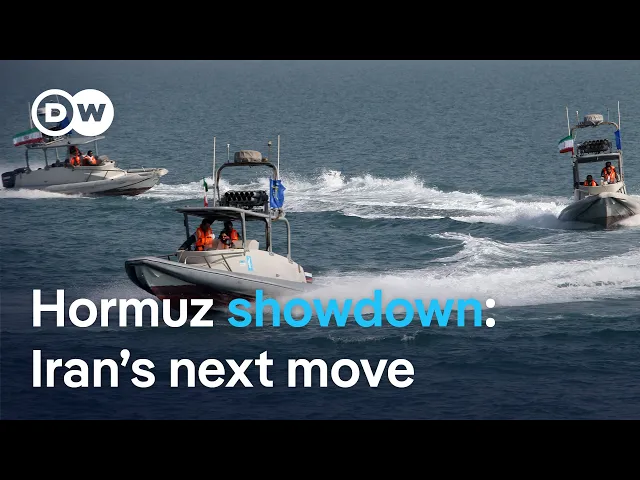
Hormuz showdown: What will Iran do next? | DW News
DW News
0:00 The truce in the straight of Hormuz is looking ever more
0:03 fragile as the United States and Iran edge closer to direct confrontation.
0:08 The US and Iran are again trading strikes
0:11 as they v for control over the strategic waterway.
0:15 Washington says two of its warships have now passed through the strait
0:19 which carries a large share of the world's fossil fuels and fertilizer.
0:24 It says it sank several Iranian speedboats, the type of fastm moving vessels
0:29 that Iran's Republican Guard have used to swarm, harass, and attack shipping.
0:34 But Iran says that the US struck two civilian boats,
0:38 killing five people and seemingly retaliated by striking
0:42 oil facilities in the United Arab Emirates.
0:45 US President Donald Trump has since repeated his threat to blow
0:49 Iran off the face of the earth if it attacks US vessels.
0:55 So let's talk about how this might develop.
0:58 Megan Suckliffe is principal analyst for Middle East and Africa at Cibiline.
1:02 That's a private consultancy for geopolitical
1:05 risk intelligence and strategic insights.
1:08 Uh really great to speak to you Megan.
1:10 Let's start with Iran's latest moves.
1:14 What do you see Thran's strategy as being here?
1:18 Well, over the past few days,
1:19 we've certainly seen many developments in the Middle East and particularly
1:23 in the straight of Hormuz after we saw US President Donald Trump
1:27 announcing Project Freedom and their intention of the US to provide
1:32 naval convoys to commercial vessels in order to reopen this critical waterway.
1:38 We've seen Iran effectively double down on many of its diplomatic positions,
1:43 stating that this is effectively a violation
1:46 of the ceasefire that exists between the US and Iran,
1:49 engaging in missile and drone attacks targeting the United Arab Emirates,
1:54 and also engaging in attacks targeting
1:56 commercial vessels in the Straight of Hormuz.
1:59 most prolifically a Panama flagged South Korean operated vessel
2:03 that was empty at the time that it was targeted,
2:05 but at the time that we're recording is currently
2:08 still experiencing a fire as a result of these hostilities.
2:12 In response to this, we have seen the United States
2:15 indicate that it has engaged in attacks targeting Iranian small craft,
2:19 attempting to enforce the de facto closure of the Straight of Hormuz.
2:23 And effectively what we're seeing now is both the US
2:26 and Iran digging in and trying to enforce their respective blockades
2:30 of the straight of hormuz to maximize economic pressure on the other
2:34 in order to gain a diplomatic concessions in potential ceasefire negotiations.
2:39 So Megan, let's let's talk about let's focus
2:42 on Iran and the messages it's sending here.
2:45 Is it essentially trying to demonstrate how strong it is?
2:50 Exactly.
2:50 Essentially what we're looking at when it comes to Iran
2:53 is that when we saw the US announcing so-called
2:56 project freedom and the intention to reopen the straight
2:59 of form this potentially presented a major blow to Iran's strategic
3:04 leverage over this conflict indeed restricting the movement of vessels
3:08 through the straight of moose has been one of the primary
3:10 ways that Iran has been able to influence the global
3:14 economy and to influence the trajectory of this conflict.
3:17 So it doesn't want to lose that.
3:19 Therefore, its reaction is in keeping with that.
3:22 Essentially, it's attempting to demonstrate that it
3:25 has the capacity and the willingness to restrict vessels from moving through
3:29 the straight of Hormuz by directly attacking them,
3:32 whether or not they are accompanied by US naval vessels.
3:35 It's notable that one of the first hostilities that Iran reported that it
3:39 engaged in after Trump's announcement was
3:41 a missile attack targeting a US naval destroyer.
3:45 Iran is attempting to demonstrate its capacity and its willingness to continue
3:49 engaging in hostilities and to show that it will not back down.
3:53 And and behind that, I mean,
3:55 is this about deterrence, about leverage for for negotiations,
4:00 or do you see this potentially as preparation for something bigger?
4:04 Lit's likely primarily geared towards reestablishing leverage for negotiations,
4:10 but it also forms part of Iran's efforts
4:12 to demonstrate that it is able and willing to re-engage
4:16 in conflict with the United States if there is
4:18 not a diplomatic breakthrough that is provided on Iran's terms.
4:23 Something similar can be observed in the White House.
4:25 The US is also demonstrating that it is capable and willing
4:29 to re-engage in hostilities if Iran is not effectively willing to play ball.
4:35 It's very clear as well that both sides retain
4:37 the capability to engage in that type of hostility.
4:40 Iran is able to credibly threaten vessels from the air,
4:44 from the surface and from the subsurface in the straight of Hormuz.
4:47 And so the acute risks that commercial vessel operators
4:51 and crew are facing at the moment cannot be overstated.
4:54 And the risk of this conflict rapidly reescalating is
4:58 unfortunately becoming more and more likely as time goes on.
5:02 Let's take a quick look at uh something the Iranian
5:04 parliamentary speaker Muhammad Bagar Galibaf um posted on on X.
5:09 He issued a warning over the strait of Hormuz framing
5:13 the crisis as a a new power dynamic taking shape.
5:18 So he wrote the new equation of the straight
5:19 of Hormuz is in the process of being solidified.
5:23 The security of shipping and energy transit has been jeopardized by the US
5:28 and its allies through the violation
5:30 of the ceasefire and the imposition of a blockade.
5:34 He goes on to write, "Of course, their evil will diminish.
5:37 We know full well that the continuation of the status quo is
5:40 intolerable for America while we have not even begun yet." So Megan,
5:47 remind us just how significant Iran's control over the the Strait of Hormuz is.
5:55 How effective is it as a bargaining trip?
5:58 Well, it is extremely effective.
6:00 The Straight of Hormuz is one of the global economy's trade arteries.
6:05 Before the conflict began, it was the point at which over a fifth of global
6:09 energy supplies transited out of the Gulf and to global markets.
6:13 It's also effectively a maritime highway
6:16 for the export of critical goods like helium,
6:20 prochemicals that are used in the production
6:22 of plastics and fertilizer components like nitrates and ura.
6:26 All of these are jigsaw pieces that fit into the global economy.
6:31 And when they are taken out, when they are effectively sealed up,
6:34 it's not just that we see price volatility on global markets
6:37 as we have with say the cost of oil and liqufied natural gas.
6:41 It's also the risk of shortages that emerge from this.
6:44 If we look specifically at fertilizer, for example,
6:47 the Gulf monarchies are producers of approximately
6:50 50% of the globe's ura supply.
6:53 And without ura, you cannot produce fertilizer.
6:56 If you do not have fertilizer, then of course agricultural yields will decrease,
7:00 particularly for countries that are currently engaged in their planting
7:05 season where the temperature is right for that.
7:07 And so when we're looking at the straight of horses, of course,
7:09 our primary concern is usually going to be oil
7:12 and gas because that's where price pressure is felt most quickly.
7:15 But when we're looking at the broader picture,
7:17 it's very clear that the straightfor is effectively a global trade artery.
7:22 And the fact that Iran has been able to essentially
7:25 close this waterway is a major bargaining chip for them.
7:29 Not only in terms of the economic pressure
7:31 that it exacts exacts on the United States
7:34 and on the United States's allies both in the Gulf
7:37 who currently can't export their goods to global markets,
7:40 but also in Europe and Latin America, subsaharan Africa, and in Asia,
7:45 where of course those products can't be
7:46 bought because they're simply not being exported.
7:49 There is another way in which Iran is leveraging this control though and that is
7:53 through exacting tolls on vessels that would hope
7:55 to move through the straight of four moves.
7:57 Now it's not exactly clear how many vessels Iran is
8:00 allowing to move through approved shipping channels on a daily basis
8:05 but industry experts indicate that there are approximately a dozen
8:08 vessels on a daily basis that are potentially granted safe passage.
8:12 This is almost always in exchange for the payment
8:15 of multi-million dollar tolls either in the form
8:18 of flat fees or in the form of essentially a toll per barrel of liquid,
8:23 usually gas and oil that is being exported via a vessel.
8:27 This is a very lucrative loophole that Iran has established
8:31 and something it's likely going to hope to hold on to.
8:34 And so when we're talking about just
8:36 how important the straight of form moves is,
8:38 we're not just looking at a waterway that is vital to the global economy.
8:41 It's also one that is becoming increasingly vital to Iran's economic
8:45 stability based on the major pressure that it is currently facing.
8:48 Yeah.
8:49 Which brings us on to Project Freedom,
8:50 which you which you you talked about earlier.
8:53 Uh President Trump announced it on Monday,
8:55 saying the US will help guide ships um that have
8:58 been stranded by Iran's closure of the Strait of Hormuz.
9:02 Iran's um response was immediate.
9:04 It said that it would attack any foreign armed
9:07 force that tried to approach or enter the straight.
9:09 Um, and then it said safe passage
9:12 through the straight must be coordinated with Iran.
9:16 I mean, is that realistic for Iran to demand something like that?
9:21 Well, the question is not so much whether
9:22 or not it's realistic for Iran to demand it.
9:25 The question is whether or not it's realistic
9:27 for Iran to be able to implement it.
9:29 And it's very clear that Iran is demonstrating that it is ready,
9:32 willing, and able to do so.
9:34 It continues to levy tolls on vessels
9:36 that are moving through the straight of Hormuz.
9:38 and it has demonstrated that it is capable of engaging in attacks that can
9:43 critically damage vessels that do not receive
9:45 permission from the Iranian authorities to do so.
9:48 As we saw with the incident of the South Korean operated tanker last night,
9:53 vessel operators will be extremely aware of those capabilities
9:56 and of the threats that their vessels, crew, and cargo will face if they attempt
10:01 to move through the straight of Hormuz without
10:03 explicit permission from the Iranian authorities or without
10:07 a substantial naval guard from the United States.
10:11 But even if we did see the United States being able to provide a naval escort
10:16 to every vessel that hoped to move through
10:18 the straight of form on a daily basis,
10:21 of course that would be extremely expensive for the United States.
10:24 It would be a very slow process and so the congestion that we're seeing
10:27 for global supply chains would be unlikely to abate in the very short term.
10:32 But it's also not a guarantee of safe passage.
10:35 Essentially, when we're looking at the threats that Iran can pose,
10:38 it can attack from the air with missile or drones.
10:40 It can attack from the surface
10:42 with unmanned surface vehicles or small attack craft.
10:45 And it can uh attack from under the water using submarines or indeed sea mines.
10:50 That's an extremely complex situation for any vessel to move through,
10:54 let alone a commercial one that maybe doesn't have advanced defense systems.
10:58 And so, while it may not necessarily be realistic for Iran to claim that it
11:03 could critically destabilize and damage any vessel
11:07 that moved through the waterway without explicit permission,
11:10 the fact that that threat is there, that it has been demonstrated,
11:13 and it would almost certainly impact vessels if they were targeted,
11:17 that's likely enough to destabilize global markets
11:19 and to deter a broad resumption of shipping activity,
11:22 even with US naval escorts.
11:24 Yeah, President Trump is describing Project Freedom as humanitarian,
11:28 but um also as you've been saying, you know, critics are saying it's risky.
11:31 It's escalatory.
11:33 Um and at best it would be a temporary relief.
11:36 I just wanted to take a listen to what
11:37 a a captain of one of the ships in the strait said.
11:41 He's been stuck there uh since the start of this conflict.
11:44 Let's take a listen.
11:47 Well, we are total 24 crew member on board and we
11:50 are stuck here ever since the war started on 28th February.
11:54 uh and the situation has been uh you know various
11:57 ups and downs uh are there ever since the war started.
12:02 So uh but uh ever since there
12:05 was a ceasefire announced situation was pretty normal.
12:08 No attacks were uh there but past few days it's been choppy again you know
12:14 it is quite disturbing and my crew morale is again you know uh going down.
12:20 We are not uh certain about this news you know we haven't received
12:25 any concrete news so far regarding
12:28 this transit through straight of hormos because
12:31 we are still awaiting uh confirmation
12:34 from various maritime authorities and our company
12:36 office and there are hundreds of ships around me most of them are
12:40 oil tanker and there are containers as well but yes earlier we have
12:46 passed this straight 100th time you know and it was it was pretty
12:49 normal you know and it's my my I have around 28 years of sailing
12:55 experience so we have uh we have transited through these areas several times
13:01 so he talked about their morale uh going down I have to say he sounded quite
13:06 calm didn't he after being stuck for so long but if we can we can talk
13:10 about uh sort of the idea of of of project freedom and and what it might
13:15 lead to I mean is there a a risk
13:18 of triggering direct confrontation here if this continues.
13:24 There absolutely is.
13:25 Iran has been very clear that it sees US efforts to reopen the Strait of Hummus
13:30 as a violation of the ceasefire that exists
13:33 currently between the United States and Iran.
13:36 And it's also notable that essentially Iran not only views
13:40 this as a violation in the context of the ceasefire itself,
13:44 but also in the context of the ongoing US blockade of Iranian ports.
13:49 It was Iran's foreign minister Abbas Aragi
13:52 who characterized essentially project freedom as a military
13:56 solution to a political problem and therefore one that would not be effective.
14:01 Iran views the incidents that we're seeing at the moment
14:04 in the Persian Gulf and in the straight of four moods as well as in the Gulf
14:07 of Oman as effectively the result of diplomatic
14:11 tensions and as something that cannot be resolved
14:13 by US force and that if the US attempts
14:16 to do that, attempts to physically reopen the Strait
14:20 of Hormuz without engaging in negotiations with Iran,
14:23 that that will constitute a resumption of conflict.
14:26 If we see that occurring, we can expect Iran to respond with a resumption
14:30 of attacks targeting Israel, targeting the Gulf,
14:33 and targeting US military installations in the region,
14:37 as well as commercial and naval vessels
14:39 that are operating in proximity to Iranian waters.
14:42 Essentially, the ceasefire that exists between the US
14:45 and Iran at the moment is under unprecedented pressure,
14:49 and I'm not particularly optimistic when it comes
14:51 to the ability of this agreement to survive,
14:55 particularly when we're not seeing continued engagement between the US and Iran,
14:59 either directly or indirectly through regional mediators.
15:03 So, do you see any realistic diplomatic offramps at the moment?
15:08 Well, I think that there is always the chance
15:10 for diplomacy to provide an off-ramp to escalating tensions,
15:14 particularly before those tensions have turned into a resumption
15:18 of the conflict that we saw before the ceasefire began.
15:22 But that's not to say that those diplomatic offroads are the guaranteed outcome
15:27 of this dynamic or that they will magically appear out of thin air.
15:30 No, rather both parties would have to demonstrate
15:33 that they are interested in diplomacy and that they're
15:36 willing to soften some of their negotiating positions
15:39 in order to bridge the gap between them.
15:41 We haven't seen that approach from the United States
15:44 and we haven't seen that approach from Iran just yet.
15:46 And so in the coming days,
15:48 if there is any indication of further talks of Pakistan attempting to revive
15:53 this diplomatic file and build bridges
15:55 between the US and Iran's negotiating positions,
15:58 then it's possible there will be offramps there.
16:00 But unfortunately, without productive and meaningful engagement,
16:03 it's unlikely that they're going to come about and resolve the situation
16:06 that we're seeing evolve so rapidly in the straight of Hormuz.
16:10 A quick question, Megan, about the United Arab Emirates.
16:12 Again, you'd mentioned this earlier.
16:14 It's accused Iran of attacking it with a barrage
16:16 of missiles and drones which set an oil refinery um ablaze.
16:20 Now these attacks marked the first on the UAE
16:22 since the ceasefire was announced on the 8th of April.
16:26 Just again given that this is sort of you
16:28 know a major regional uh uh uh situation.
16:31 How significant is that escalation?
16:36 It's very significant because of course this is the first
16:39 incident of missile and drone fire that we've seen since
16:42 the ceasefire came into force between the United States
16:45 and Iran and brought a degree of calm to the region.
16:49 It is particularly significant because not only did it target the UAE,
16:52 arguably one of the United States's closest allies in the region,
16:56 but it also targeted an oil depot in Fujara.
16:59 Now, this is very significant because
17:03 for those of you not aware of the UAE's geography,
17:06 most of the UAE is located before the Straight of Hormuz.
17:09 It's located on the Persian Gulf.
17:11 But Fujara is significant because it's located
17:14 on the other side of the straight of Hormuz.
17:16 And as an oil depot,
17:18 it could potentially allow the UAE to a certain degree to bypass the blockade
17:23 of the Straight of Hormuz by shipping oil out directly into the Gulf of Oman.
17:29 This is likely part of why we've seen Iran engaging in these hostilities.
17:33 Not only is it attempting to destabilize the operational environment
17:37 in the UAE and to exacerbate economic pressure on the Emiratis,
17:41 but it's also attempting to disrupt the operationality of facilities
17:46 that potentially would allow the UAE and its Gulf
17:49 allies from exporting oil beyond the straight of moose
17:52 to bypass the essential blockade that Iran has put in place.
17:56 It's showing that Iran is not only
17:58 engaging in hostilities that address current tensions,
18:01 but it's also Iran attempting to futureproof its blockade of the straightforward
18:06 moves to maximize its leverage in the medium to long term.
18:09 Megan Suckler, a for Middle East and Africa expert at Cibiline.
18:13 Megan, it's been a pleasure to speak to you today.
18:16 Thank you so much.
18:18 Thank you very much.
18:21 So, what comes next?
18:22 Can the ceasefire hold despite the bombs and bluster on both sides?
18:26 Or is the leadership on either side really in control of events?
18:30 Let us know what you think in the comments.
18:32 Subscribe to DW for news and analysis.
18:34 And remember, you can find more news on our website.
18:37 That'sdw.com.
18:38 I'm Anna Cooper McKinnon.
18:40 Thanks for being here.