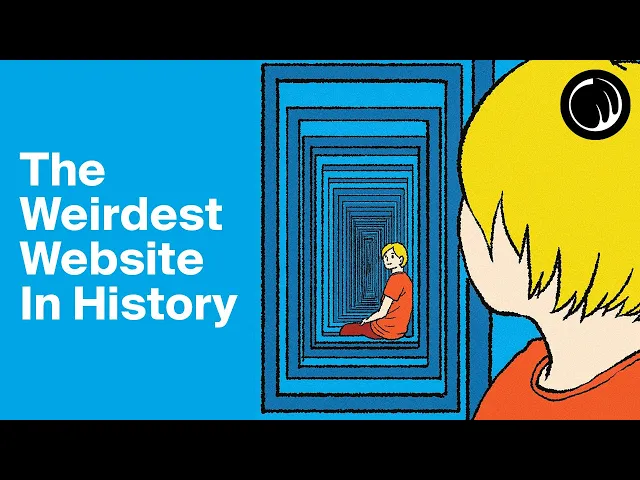
This website can predict what you’re going to do next...
Pursuit of Wonder
0:00 This video is sponsored by the personal information removal service incogn.
0:04 Protect yourself from data brokers and search sites.
0:06 Use my link in the description to get 60% off in Cognney's annual plan.
0:11 Every sentence you've ever thought or said.
0:13 Every visual you've ever seen, photographed,
0:16 filmed or animated in the world or in your head
0:19 in some very real sense already existed.
0:22 The sentences were already there and the images were already fixed.
0:26 Not only that, but every sentence and image you've never thought of or seen,
0:30 but that have been by someone else, these two already existed.
0:34 The most powerful lines ever written in books, uttered in speeches,
0:37 and thought of in the most genius of minds.
0:39 The most remarkable all-striking photos, artworks, and scenes in films.
0:44 The most world-changing ideas, blueprints, and instructions.
0:47 These all existed prior to their human origins.
0:50 In fact, everything that's never been said or seen,
0:53 but can or will exist right now.
0:56 the description and images of the first human.
0:58 Every moment of your life moving forward,
1:00 everything you or anyone will ever see or say,
1:04 the story and image of the future of the planet,
1:06 the solar system, and the cosmos are all here right now.
1:11 If you're not already familiar
1:12 with the concepts and technologies behind these claims,
1:15 this all likely sounds impossible, like a science fiction premise.
1:19 But in a specific, albeit limited sense, it is true.
1:23 There is an algorithm on a website right
1:25 now that through a fixed and predetermined set
1:27 of parameters contains every sentence and image that has
1:30 ever and could ever be written and seen.
1:35 In 1941, the Argentine short story writer and essaist Jorge
1:39 Luis Bourhees published a short story titled The Library of Babel.
1:44 In the story, there is a seemingly infinite library
1:46 with hexagonal floors going up and down without any apparent end.
1:50 On each floor, there are shelves of books.
1:52 Inside all the books appears to be gibberish, random letters and punctuations.
1:57 The characters in the story initially have no
1:59 idea what the books are or what they mean.
2:01 To them, they mean nothing other than perhaps confusion,
2:04 intrigue, or wasted space.
2:07 Eventually, however, the characters come to a realization.
2:10 The books contain every possible combination of the letters of the alphabet,
2:13 a space, a comma, and a period.
2:16 Amidst all the gibberish is also every complete comprehensible
2:19 work that has ever and could ever be written.
2:23 At first the characters are overjoyed.
2:25 The narrator of the story says all men felt
2:28 themselves the possessors of an intact and secret treasure.
2:31 There was no personal problem, no world problem whose eloquent solution
2:34 did not exist somewhere in some hexagon.
2:37 The universe was justified.
2:39 The universe suddenly became congruent with the unlimited
2:41 width and breadth of humankind's hope.
2:45 Quickly, however, this joy turns to madness
2:47 and despair as the discovery amounts to very little.
2:50 The characters soon realize they will likely never find anything of meaning.
2:54 The narrator continues,
2:55 "The certainty that some bookshelf and some hexagon contain precious books,
2:59 yet that those precious books were forever out of reach was almost unbearable.
3:04 The library is simply too vast and meaning too sparse.
3:08 And so, it becomes a prison of certainty,
3:10 forever guarded by futility." Bourhees's short story
3:15 is essentially a literary expression of a thought
3:18 experiment in mathematical probability that would come
3:20 to be known as the infinite monkey theorem.
3:23 Essentially, the thought experiment goes as follows.
3:25 If a monkey were given a typewriter and an infinite amount of time,
3:28 hitting keys independently and at random,
3:31 it would almost certainly produce any and every possible text
3:34 from the Bible to the Odyssey to the complete works of Shakespeare.
3:38 From a philosophical point of view,
3:39 this mirrors a modal principle where over an infinite time scale,
3:43 anything with a nonzero probability of occurring will occur with certainty.
3:48 There are, of course, numerous critiques of the infinite monkey theorem.
3:51 Most critiques, however, seem to miss the point.
3:54 Firstly, it's a thought experiment.
3:56 Secondly, it's a thought experiment designed
3:58 to demonstrate the probability and concept of infinity,
4:00 not a way of making practical predictions.
4:03 Trying to map out intuitions or smaller scale assessments and predictions
4:07 onto an infinite scale is a failing mission from the start.
4:10 But of course, that isn't to say people haven't tried.
4:13 In 2003 at Payton Zoo in England,
4:16 six Makox were given a computer with the keyboard.
4:18 The aim was to replicate a small scale version
4:20 of the infinite monkey theorem and see what they would produce.
4:23 After about a month, the Makox generated five pages in total.
4:27 Each page was mostly filled with the letter S.
4:30 Then the Makox destroyed the computer.
4:33 In that same year, with the onset of more powerful software programs,
4:36 the thought experiment was also attempted with virtual monkeys through
4:39 an independent web project known as the monkey Shakespeare simulator.
4:43 Running a program designed to simulate the same
4:45 sort of random typing of real monkeys.
4:47 The experiment generated a partial line from Shakespeare's Henry IV part two.
4:52 In 2004, a separate program developed by Dan Oliver generated
4:56 a 19 character sequence from Shakespeare's The Two Gentlemen of Arona.
5:00 Estimation suggested that this sequence would
5:02 have taken somewhere around 4.2* 10 28th power in years or 42 bill162,500,000
5:12 billion billion years to accomplish in reality.
5:16 What these experiments seem to actually reveal is that infinity cannot
5:20 be tested or experimented in a finite system with finite constraints.
5:24 Nor can it be fathomemed by the human mind.
5:26 This is important because it helps us make a little bit
5:28 better sense of the absurdity of what was alluded to earlier.
5:32 The real world version of Bourhees's Library of Babel.
5:36 In 2015, writer and programmer Jonathan Basile
5:40 created a website directly inspired by Bourhees's story.
5:43 In Basile's words, the website is an attempt
5:45 to faithfully render Bourhees's vision of the total library.
5:49 The website accomplishes this by using
5:51 a deterministic reversible algorithm that generates, locates,
5:55 and displays all possible 3200 character combinations of the 26 English letters,
6:00 a space, a period, and a comma.
6:03 In doing so, each available page on the website replicates a complete
6:07 page of a book that might be found in Bourhees's Library of Babel.
6:10 And just like in the story, every page which is organized into books
6:14 appears to be random gibberish, but it isn't.
6:18 Everything is deterministically defined within
6:20 the algorithm encoded to ensure that every
6:22 possible combination exists and that every page is tied to a unique number,
6:26 that the algorithm always translates into a consistent string of characters,
6:29 guaranteeing the pages and books never change.
6:32 And so also like in the story,
6:34 amidst all the nonsense is also every complete comprehensible
6:38 work that has ever been and could ever be written.
6:42 Of course, this doesn't mean the website literally stores all these pages
6:46 since that would require more memory than the entire universe can hold.
6:49 But the algorithm simply ensures that every possible page is predetermined,
6:53 fixed, and retrievable on demand.
6:55 In an instant, by searching it directly,
6:58 you can find where the last sentence you thought,
7:00 said, read, or heard exists in the library on its specific page,
7:04 volume, shelf, wall, and hexagon.
7:06 If that wasn't unsettling enough,
7:08 there's also another section of the website known as the Babel Image Archives.
7:13 This section does a similar thing with the comparable algorithm,
7:16 but does it with images.
7:17 It generates every combination of 4,96 different
7:20 color pixels in a 640x 416 pixel canvas.
7:24 The resulting archive contains 10^ the 961,755th power images in total.
7:31 To get a better sense of size,
7:33 you could fit all of the universe's atoms 10 to the 80th power
7:36 inside the Library of Babel roughly 10 to the 4597th power times over.
7:42 And you could fit the entire library of Babel
7:44 inside the Babel image archives 10^ the 957,78th power times.
7:51 In other words, it's very big.
7:55 Together, this means that right now on this website,
7:58 not only are there literal written descriptions of your birth and death,
8:02 the origins and end of humanity,
8:03 Earth and the cosmos, the answers to life's greatest questions and paradoxes,
8:08 the cures to diseases and instructions to build the most advanced technologies.
8:12 But there are also images of all these things, technically just one click away.
8:17 In fact, there are images that if put together in just the right order,
8:21 would produce videos of these moments of all possible moments,
8:25 past, present, and future.
8:28 If every line that has ever been written or could ever be written,
8:31 and if every visual that has or could
8:33 ever be seen or made by humans currently exists, what does that mean for us?
8:38 What does it mean about us?
8:41 If these things technically already exist as potential before
8:44 the website and as literal instantiations within the website.
8:47 Are we creating or discovering these things when we think,
8:50 write, do, or perceive them for the first time?
8:53 What does it mean to see, experience, think, say, do,
8:57 or create, if not to simply come across a particular pixel,
9:01 image, sentence, or page in the infinite library of the universe,
9:04 a predetermined pre-existing realm of potentiality.
9:08 Of course, from our perspective,
9:10 there is a meaningful difference between creation and discovery.
9:13 What we create feels different from what we discover.
9:17 This difference can vary, of course,
9:18 as both creation and discovery always exist on a constantly shifting spectrum.
9:22 But there is no doubt that discovering a great
9:24 book or tool feels very different from creating one.
9:27 And naturally, we treat these things differently, as we should.
9:31 But if we zoom out, if the human brain is merely a product
9:34 of the arbitrary ordering of material
9:36 in the universe interacting with other material,
9:39 creation is at bottom merely a form
9:41 of interaction of information collection and discovery.
9:45 It is only that when this involves
9:46 a conscious sense of agency and internal transmutation, we call it creation.
9:52 In a world that is now infused with artificial intelligence,
9:55 the implications of the Library of Babel are more significant than ever.
9:59 The sorts of questions it raises about creativity, discovery,
10:02 potential, and algorithms have never been more literal yet uncertain.
10:06 If something else can create what we create, faster or better,
10:10 does that change the meaning of what we create?
10:13 Does it change the meaning of creation itself?
10:16 Perhaps artificial intelligence is like a hyper
10:18 advanced robotic librarian in Bourhees's library,
10:21 able to scan the floors, halls, and shelves faster than any human ever could.
10:26 But speed is not meaning.
10:27 Just because words or pixels can be or have been put together does
10:31 not mean they are or have been put together in a way that matters.
10:34 And just because they could be put together faster
10:36 or more vastly does not necessarily mean they matter more.
10:40 In a universe of babble, perhaps what matters,
10:43 what's meaningful solely depends on those who read, who can read.
10:49 Arguably, it will never not be impressive when a human across
10:52 the entire infinite library of the cosmos finds and shares a poignant phrase,
10:57 a moving visual, some detailed instructions for an innovation,
11:00 or a paradigm shifting idea,
11:02 whatever creation or discovery might mean, and however it might be carried out.
11:06 How we get to these intonations and moments matters
11:09 so much less than that we get to them.
11:12 For whatever reason, our consciousness seems uniquely able to make
11:15 the cosmic randomness and impossibility accessible, ordered, and intentional.
11:20 The chaos and irrationality seem to us to be the exception.
11:24 But in truth, it is the norm.
11:26 Rationality, meaning, and order, we are the exception.
11:31 Infidel's claim that the rule in the library is not sense but nonsense
11:35 and that rationality even humble pure coherence
11:38 is an almost miraculous exception writes Bourhees.
11:43 Maybe at true bottom everything in the universe is babble
11:46 and we merely get better at turning it into meaning over time.
11:49 A sort of alchemy of necessity.
11:52 We're like stranded librarians with access to the library of everything
11:55 but no way of ever objectively penetrating the sheath of infinity.
11:58 And so perhaps our best bet isn't to find everything,
12:02 but to make everything everything.
12:05 As humans, we find it hard to imagine
12:07 something like a monkey producing the works of Shakespeare,
12:10 even if given an infinite amount of time.
12:12 But is it not infinitely more impressive that any one person could write
12:16 all the works of Shakespeare with awareness and intention in just 52 years?
12:22 So many humans in history, in the present, and surely in the future,
12:25 have and will accomplish similar feats to Shakespeare that would otherwise seem
12:29 impossible across infinite time scales for any
12:31 other being and any other scenario.
12:34 And yet, here we are continually forging through the babble.
12:39 In the words of the physicist Brian Cox, "If the universe is infinite,
12:42 which it may well be,
12:44 if it's in accord with the laws of physics, then it can happen.
12:47 And everything that can happen in an infinite universe will happen.
12:51 I contend that even the most unlikely possibility must happen.
12:55 In fact, formerly an infinite number of times.
12:58 So maybe Shakespeare was actually just lucky.
13:02 Surely Shakespeare was lucky.
13:04 But in this sense, so were all of us.
13:07 The absurdity of our position in the archive of the cosmos as a line on a page
13:11 or a pixel in an image that possesses not only
13:13 life but the capacity to know of and realize itself.
13:16 To see the babble and the meaning and know the difference.
13:19 To forge discovery or invention.
13:21 To consider or create concepts like infinity and explore them through art,
13:25 thought, and technology.
13:27 This is all nothing short of the perfect book pull or the perfect
13:30 click at just the right time in just the right place.
13:35 Another thing that people can search
13:42 for and find online is your personal information.
13:46 Your name, social security number, login credentials, home address, and so on.
13:50 Only in this case, it's easy.
13:53 Just a quick Google search away.
13:55 This video sponsor, Incogn helps you ensure that when
13:58 it comes to finding your personal information online,
14:00 the internet becomes like a library of babel.
14:03 If you search your own name and address on Google right now,
14:06 you'll likely be both surprised and unsettled by what comes up.
14:09 Who you are, what you like, where you live, and so on.
14:12 All this information is now sought, packaged,
14:15 and sold online by what are known as data brokers and people search sites.
14:18 Within Cognney's unlimited plan,
14:20 everything you find that you don't want available online by simply
14:23 copying and pasting the links to where your data is exposed,
14:26 Incogn's privacy specialist will get it taken down.
14:29 And you can do this an unlimited number of times.
14:32 And on all Incogn plans, it also constantly works in the background,
14:35 automatically locating and requesting removal
14:38 from sites where your information shows up.
14:40 And if and when these sites try
14:41 to put your information back up after initial removal,
14:44 Incogn automatically ensures this is caught and prevented.
14:48 Legally, these sites must remove your information if
14:50 you request it and every time you request it.
14:53 And by granting incognibility to do so on your behalf,
14:56 you essentially point a giant automated hyper
14:58 powerful fire hose at all your data.
15:00 The benefits aren't just safety, avoiding identity theft, fraud,
15:04 or stalking, but also a cleaner daily experience online.
15:07 Far fewer spam emails, texts, and robocalls.
15:11 Begin protecting your data today by clicking my link
15:14 in the description or going to incogn.com/pursuit of wonder,
15:18 and you'll get 60% off incogn's annual plan.
15:22 And of course, as always,
15:23 thank you so much for watching in general, and see you next video.
15:28 [Music] [Music]