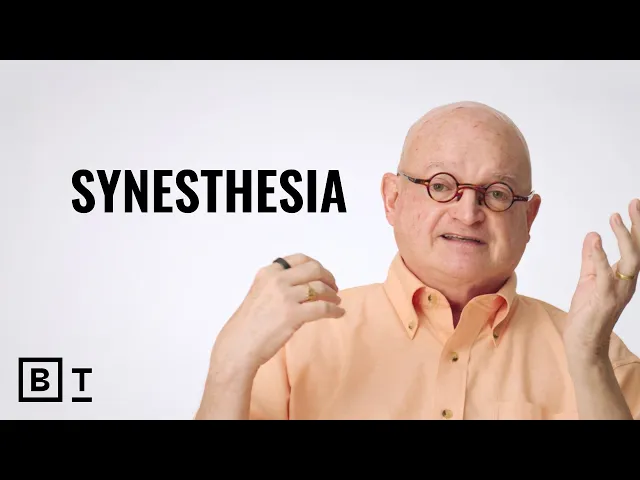
The real reason so many great artists experience reality differently | Richard Cytowic
Big Think Clips
0:00 I'm Richard Cytowic, professor of neurology at George Washington
0:03 University and an author recently of “Synesthesia:
0:09 A Union of the Senses.”- [Narrator] Understanding synesthesia.
0:15 You know, I got into synesthesia, totally by accident.
0:20 I'm a writer, so of course I love words.
0:23 And I came across a book called “The Mind of a Mnemonist” by A.
0:27 R.
0:27 Luria, a Soviet neuropsychologist.
0:29 And this memory expert had a limitless
0:33 memory because he had a five fold synesthesia.
0:37 He had all these hooks that he could
0:40 hang things on that he was supposed to remember.
0:44 And I thought, oh, what a great word.
0:48 Anesthesia.
0:48 No sensation.
0:49 Synesthesia.
0:50 Joint sensation.
0:51 So I filed it away in the back of my mind.
0:54 All right, fast forward.
0:55 I have a new neighbor who teaches lighting design
0:57 at the school of the arts and he invited me to dinner.
1:00 And he says, “Oh, it will be a few more minutes.
1:04 There's not enough points on the chicken.” Now,
1:06 his friends asked what he was smoking, and Michael Watson,
1:10 who was the man who tasted shapes,
1:12 looked at me beet red and said, “Oh my God, you're neurologist.
1:17 Maybe you'll understand.
1:19 When I taste something.
1:21 I also feel it on my face and in my hands with an intense flavor,
1:26 a feeling sweeps down my arm and I feel weight,
1:30 shape and texture as if I'm actually grasping something.” And I nodded and said,
1:37 “Oh, you have synesthesia.” I mean, I was just trying to be polite.
1:41 And he, the look on his face.
1:44 He said, “You mean there's a name for what I do?” And then I thought,
1:48 how could he not know?
1:50 And that's when the light bulb went off, that this could be something really
1:55 interesting because it's an elevated function.
1:58 A hyper connection among the senses.
2:01 And, there is a small category of neurological phenomenon like that.
2:06 So I told my my, colleagues, fellow residents about it,
2:12 and they immediately said, well, what's this CAT scan show?
2:14 And I said, no, he doesn't have a hole in his head.
2:18 He's got something extra.
2:20 This is an elevated function.
2:22 And they said, man, you stay away from this.
2:26 It is too weird, to New Age.
2:29 It is going to ruin your career.
2:32 Well, fast forward, it didn't.
2:34 Obviously.
2:35 Basically, I reintroduced it to modern science.
2:38 It has, it had been very popular at the turn of the century,
2:42 all the way up into the 1930s, when behaviorism came around and behaviorism
2:47 said subjective experience was taboo.
2:50 So that meant memory, language,
2:55 certainly synesthesia was, you know, like like bogus.
2:58 You couldn't do it.
2:59 But then I said, well, I'll show you.
3:02 I was intrigued by it first, I first thought it was because of my father,
3:07 who was a physician, a magician, an archer, a raconteur.
3:11 He was larger than life personality who
3:14 introduced me to the unusual and the offbeat.
3:17 And I thought, well, that's the reason that this appealed to me.
3:21 And then it was years later that finally another light went off and I thought,
3:25 oh, no, it's because I'm gay.
3:27 So as a ten year old in New Jersey,
3:30 my father's medical profession said that I was sick.
3:33 The state said that I was a criminal.
3:35 And the church said that I was doomed to hell.
3:39 And I hadn't done anything.
3:40 I was ten years old, and I thought,
3:42 these people don't know what they're talking about.
3:44 They don't know me.
3:46 How dare they say that I shouldn't exist?
3:48 And so when I heard people say, well, synesthesia is bogus.
3:52 It can't exist.
3:53 It can't possibly be real.
3:54 I thought, oh, man, I've heard this before.
3:57 And that's what prompted me to look into it.
4:00 I mean, subjective experience is difficult to study.
4:03 It's messy experimentally, but it can be done.
4:07 It's tedious, but it can be done.
4:10 And so I did it.
4:12 My first papers came out in 1989, and then my first book about synesthesia
4:18 also came out in 1989 by Springer-Verlag.
4:20 So, of course, I had a lot of exposure in the press and on radio and all that.
4:26 And so I remember one woman who now
4:28 is the head of the American Synesthesia Association.
4:31 She's an artist.
4:32 She heard me on the WNYU’s book talk.
4:36 And she, you know, she dropped your brush and she just cried and said,
4:42 oh, my God, I can't believe somebody is talking about this.
4:45 I can't believe it's real.
4:47 I've had grown men call me on the phone in tears saying,
4:51 nobody ever believed me.
4:53 You made me feel heard for the first time in my life.
4:59 So it's from a philosophical point of view.
5:04 It's qualia, which is, let's say red is a qualia of color,
5:10 and one qualia becomes linked to another.
5:14 So, for example, suppose I show you a matrix of fives
5:19 within which I've hid a geometric figure that's made up of twos.
5:24 Now you and I will take a while to search and find that hidden figure.
5:29 But for synesthetes, who see twos as differently colored than fives,
5:33 a shape will instantly pop out without any effort on their part.
5:37 The same thing for music.
5:39 Days of the week are colored.
5:42 Time units are color.
5:44 I mean, it's involuntary for one thing.
5:46 It happens to you.
5:48 You can't.
5:49 You can't make it happen.
5:50 So in that sense, it's like perfect pitch,
5:54 which is another kind of sensory, phenomenon.
5:57 It's apparent at a very, very young age.
6:00 You there's nothing you can do to make it happen.
6:04 The associations are the same over the course of a lifetime.
6:08 I read, one woman wrote, she said, well, I'm 65 years now,
6:11 and the colors are as bright as ever, you know, when I, when I was a teenager.
6:16 But for others, like take Sean Day,
6:18 who's head of the International Synesthesia Association,
6:21 who's got colored taste, among other things,
6:24 he said, yeah, he likes blue foods, he says.
6:27 But, you know, after after living through this all my life,
6:31 you get used to the wow factor, so it's not so much.
6:35 It's still there, but it's not so much of a wow.
6:38 It's like when you first open the refrigerator and the light goes on.
6:42 Wow.
6:42 What a surprise that is.
6:44 But, you know, every time I open the refrigerator now,
6:47 the light coming on doesn't faze me in the least,
6:49 because I know that's what's going to happen.
6:51 The other thing is that synesthesia is almost always a one way street.
6:56 So sound goes to sight, but not the other way.
7:00 So music, environmental sounds, the clattering of dishes,
7:02 a dog's bark, the sound of my voice.
7:06 Those produce photisms which are colored shapes that arise
7:10 and they scintillate or move around a bit, sort of like fireworks.
7:14 And they keep up as long as the stimulus keeps up.
7:18 So let's say the sound of my voice and you're
7:21 seeing these puffs of steam and sparkle and it's geometric shapes.
7:25 And when I stop talking, then they fade away.
7:29 There's a handful of exceptions in which it does go by directional.
7:35 So which, sight activates sound.
7:37 So Liddell, who's profoundly hard of hearing, has it going both ways.
7:43 So when he sees, like, those red lights and those towers that were,
7:47 you know, warn airplanes to stay away.
7:49 He says he has what he calls photonic hearing.
7:52 And that red light flashing causes this this sound that he hears.
7:57 And there's another woman who's studied extensively.
8:01 She, Julie Roxburgh, she's a music teacher in, in rural England.
8:07 And she has been studied extensively to show
8:10 that her synesthesia goes in both directions.
8:14 Now, she very bravely agreed to go into Piccadilly Circus at night,
8:21 and she's there and she's saying, okay, I'm now entering the circle,
8:26 and this, this harsh green light is
8:29 flashing and it's making this terrible sound.
8:32 And then I've got the motion of the traffic and the people around me.
8:37 And then this other sign is flashing,
8:40 and I'm starting to feel a little nauseous and and lightheaded.
8:43 And if I don't get out of here soon, I think I'm going to faint.
8:48 So basically, she had this sensory overload from the sights
8:52 and sounds and movements in Piccadilly Circus in her bidirectional synesthesia.
8:57 Some have it more than others.
9:01 So, for some, it's simply the only association of color
9:04 and numbers with with with one another with others,
9:07 there's more of a wow factor.
9:09 So they talk about a street name being gorgeous or a certain,
9:15 food being, you know, unbelievable.
9:18 The most mundane stimuli they describe in these highly affective laden terms.
9:25 And I call that the wow factor.
9:28 Synesthesia turns out to be fairly common,
9:30 much more common than I expected when I began all this work.
9:35 It occurs in 4% of the population worldwide.
9:38 It doesn't matter what your nationality or content continent is.
9:43 And so that's about 1 in 23 people inherit the gene.
9:48 And I'll use the singular gene,
9:50 although it's actually several genes are involved, so far as we know.
9:55 Synesthesia is transmitted as an autosomal dominant trait that is
9:59 either parent either gender parent can transmit it to their offspring,
10:03 and they they have a 50% chance
10:06 of transmitting that gene as an autosomal dominant.
10:10 And initially they're turned out to be, too many women compared to men.
10:15 And at first when it got up to 2.5,
10:19 then we came up with, variations in how that could be,
10:23 which is autosomal dominance with lethality, meaning that half of the female,
10:27 half of their male embryos would be would be lethal and not survive.
10:31 But then the ratio in all the way up to 6 to 1,
10:34 I was like, oh my God, what do we do?
10:36 How, we're not going to be like, explain this by genetics.
10:39 But then Julia Sinner in Edinburgh did a study,
10:43 at the Kensington Science Museum in London,
10:45 where they asked people as they walked in the door,
10:48 do you see colors with letters and numbers and all that?
10:51 And was they did it random population like that?
10:54 It turned out that it was basically 1 to 1.
10:57 And the answer of why so many women initially was
11:01 that women were much more willing to talk about unusual experiences,
11:05 including having synesthetic orgasms, which they loved very much.
11:09 You asked men this question and they hem and haw and they shuffle their feet.
11:14 And so, but eventually, you know,
11:16 men became around and the more men were around and talked about the experience,
11:20 the more men were likely, willing to talk about them.
11:25 There are some, musicians who refused to, you know, be studied.
11:30 They won't talk about it,
11:32 because they think they're going to be made fun of and, you know,
11:36 they're they're very rigid in their resistance.
11:39 Billy Joel, on the other hand, you know,
11:41 he talks about his colors and his music.
11:44 So 1 in 23 people had the genes,
11:47 but because it's not expressed with 100% fidelity,
11:50 a smaller number has then some kind of overt or outward synesthesia.
11:55 And that comes about 1 in 90.
11:57 And the most common forms are anything that has a sequence
12:01 to it is going to have a color associated with it.
12:05 So three days of the week for example,
12:07 integers, other kinds of numbers, temperature, scales, shoe sizes.
12:11 They can be anything that has a sequence to it.
12:15 That's called grapheme synesthesia,
12:17 grapheme being the written elements of of speech.
12:21 And then there's spatial sequence synesthesia.
12:23 So anything that has a sequence.
12:26 So Monday to Wednesday,
12:27 Thursday Friday takes on like a spatial map in three dimensions in front of you.
12:33 So when you say where's the November.
12:35 Oh it's down here.
12:36 It's brown by my knee.
12:37 And when I look at November then that opens up and I
12:40 have a calendar I can put in all these dates that I remember.
12:44 So when I need to look at like, okay, what am I doing, you know, next week?
12:48 Your mind goes, your attention goes to that space,
12:51 and you look up the data that you put there.
12:55 So colored music is quite interesting because people say,
12:59 I see music and, well, what is it?
13:01 For some people it's the tone, an absolute tone.
13:05 Joseph Long, a Scottish pianist who was blind, by the way,
13:08 said he was astonished when he went to do music lessons and his his teacher's
13:14 “A” was totally different than his “A.” Synesthesia
13:17 is fairly common in blind individuals.
13:21 Why might that be?
13:23 Well, there V1 the primary visual cortex,
13:26 is not getting a signal from the retina, so it's just sitting there unused.
13:31 And if it says anything, it says, well, everything is black.
13:36 So other areas of the brain can then encroach on this unused area.
13:41 And then they, they there you've got synesthesia where the visual cortex is
13:48 now responding to, tones or touches
13:51 or other kinds of stimulation tastes, smells, whatever.
13:56 Now, colored music, is interesting because
14:00 there's some famous composers who are synesthetic.
14:03 Olivier Messiaen for example, the French composer,
14:06 he's been interviewed many times about this, and for him what it
14:11 turns out to be is the, the spatial is the chord structure,
14:17 the distance between notes and a certain chord
14:20 and, Messiaen said that his, the colors of each
14:24 chord structure are you could predict what
14:27 the color was going to be, of the piece.
14:30 So, for example, he was commissioned to write a piece for the US,
14:35 Centennial and, he said, I went in Bryce Canyon and my eye went
14:40 up to canyon wall and the music wrote itself.
14:44 Color is very prominent perhaps because vision, it,
14:49 accounts for about 85% of the inputs to the brain.
14:54 So it's got its network goes all over the place, including the brain stem,
15:01 let alone the cortex and the limbic system and the thalamus and whatnot.
15:06 The other thing is that synesthesia is not just color.
15:10 For example, in phoneme synesthesia.
15:13 Phonemes are the spoken elements of speech.
15:16 The sound of my voice might be something that people, not only see,
15:21 but also they they think they tasted or feel it as a physical touch.
15:29 Or having a certain taste and then feeling
15:33 a warm sensation rising up from your from your belly.
15:38 Hearing, a word like college is a certain color and shape,
15:43 but so is sausage and message and other words, with the “ige” sounding.
15:48 So it's the “ige” phoneme that's triggering the synesthesia.
15:53 So when you have enough of these kind of people,
15:56 you can then sort of predict what the taste is going to be,
15:59 for example, we did this with James
16:02 Wannerton in England who has this taste synesthesia.
16:05 He was in the documentary called “Derek Tastes of Earwax.” We
16:09 were able to give him a word and predict what it was, but he couldn't do that.
16:16 He couldn't make a mnemonic association that would
16:19 be very easy for the rest of us.
16:22 He had to actually hear the word.
16:24 So that's sort of interesting is that you don't
16:27 have a, you don't have a mental picture of this.
16:30 You've got to have a perceptual experience of it.
16:33 So that's sort of the experience of synesthesia like.
16:37 The other thing is that synesthetes have extraordinary memories.
16:41 When you test them on a traditional memory quotion scale,
16:46 they perform very close to the top of the range.
16:50 And then the odd thing is they'll say things like,
16:54 well, I don't remember her name.
16:56 It was a green name.
16:58 Let's see, green.
16:58 D’s are green.
16:59 It was the Doris, Denby, Dorothy...
17:02 Dorothy.
17:02 Oh, yes, it was Dorothy.
17:05 So for you and me, like going through the mental gymnastics
17:11 of how does that help you remember that her name is Dorothy,
17:16 you know, it's almost, it has a logic of its own, but it works.
17:21 So I already talked about you know, that they have they have excellent memories,
17:26 because they have all these, these extra hooks to hang things on.
17:30 Some things they're really poor at, for example,
17:32 their sense of direction tends to be really bad.
17:35 But for example, they might cook.
17:37 Michael Watson cooked according to how he wanted a certain dish to feel,
17:41 never relied on a recipe, was always cooking by feeling.
17:45 It's also, synesthetes tend to be more creative than than other people,
17:51 that is, as a group, they, they are more creative.
17:57 And this is why I said the synesthesia gene is a gene for metaphor.
18:00 So they've they play a musical instrument, they speak a foreign language or two.
18:06 They engage in, sculpture or archery or a knitting or some other creative,
18:13 endeavor, much more often than the general population does.
18:18 So, for example, Kandinsky, the artist, is quite interesting.
18:22 He had four different kinds of synesthesia,
18:25 which involve taste and smell and touch.
18:29 Like a midnight blue, he called that, a soft,
18:34 angelic color, like stroking your hand across velvet.
18:38 Orange was the prickly color, he said.
18:41 It's hard to predict.
18:42 So he never really sort of gave her a key for what he might,
18:47 to which we could, like,
18:49 translate back the other way and predict what, what these colors would be.
18:52 But there they are.
18:53 And this is what he said about it all his life.
18:56 And, they were they were just there.
18:58 Another one would be Vladimir Nabokov, the writer.
19:01 He had colored hearing quite intensely.
19:04 And he wrote about this in his novel “Speak, Memory.” And so,
19:09 for him, the like the, the alphabet had not only,
19:13 certain colors like I described the, you know, the black,
19:16 the black was like the back of a hand hand mirror and had a certain sheen to it.
19:22 Others had a certain taste to them.
19:25 So that was his kind of synesthesia.
19:28 And it ran in families.
19:30 He wrote about “Portrait of My Mother,” who's
19:32 got the same kind of synesthesia as he does.
19:35 And then his son Dimitri,
19:37 who wrote the afterword to “Wednesday is Indigo Blue.” But the families,
19:41 each had their own letter associations were different from one another.
19:47 So the mother’s and Vladimir's and the son’s were all different,
19:51 even though they stayed constant throughout their life.
19:54 So where do synesthetes see these things or experience these things?
19:58 Is it in front of them on a screen?
20:01 Is it in their mind's eye?
20:03 And the answer is yes to both.
20:05 There are what are called projector synesthetes,
20:08 for example, people who see colored letters and numbers.
20:11 Where do they see it?
20:13 They see it in Technicolor on the page overlying the black,
20:18 black and white printed letters.
20:20 Then there are associative synesthetes.
20:22 So if you say what color is “f”?
20:26 Well, they they get an overall sense of pink,
20:30 or else they see it in their mind eye or somehow they know.
20:35 One woman says, “Well, I know it's two because it's white.” And I said,
20:41 so there's something about two-ness and whiteness that is similar in her mind.
20:46 Now to the rest of us, there's there's nothing in common about them.
20:52 But to her there's almost an identity among them.
20:56 And that really speaks to metaphor,
20:58 which is seeing the, the similar in the dissimilar.
21:02 So there is something about, two and whiteness for this woman that is identical.
21:09 It's important to note that, synesthesia is not universal across people,
21:14 so that for one person, when they have a certain letter or number or whatever,
21:21 a certain color, that for another synesthesia,
21:25 it'll be something totally different.
21:28 Julia Simner, in Scotland, asked a bunch of synesthetes,
21:31 you know what color is five?
21:34 Five is green.
21:35 But it wasn't just green, it was a particular shade of green.
21:40 And so she ended up with a table of 63 different names for, you know,
21:45 lime green, pea green, fog green, bright green, metallic green.
21:49 I mean, Sir Francis Galton noticed this over 120 years ago is
21:53 that when synesthetes say that a certain stimulus is a certain color,
21:58 they mean it very specific color, which they struggle to articulate.
22:04 And again, why is this?
22:07 Well that's because, non optical inputs are going into the visual cortex.
22:15 And so they're triggering these kinds of very specific
22:20 colors colors that you can't see in the real world.
22:23 I mean there's there's a there's a colorblind synesthetes,
22:26 he has a M-cone deficiency.
22:28 And that makes it hard or impossible
22:30 for him to distinguish between blues and purples.
22:33 But he says he speaks of seeing his martian colors,
22:38 that is colors that he's incapable of seeing in the real world,
22:43 and yet that are activated because his visual
22:46 cortex is being activated by non optic means.
22:50 The big question is, you know, are there cross connections among the senses
22:56 in synesthetes and the answer is yes, of course there are.
23:00 The question is how much crosstalk is there?
23:03 Because crosstalk is present in all of our brains.
23:07 There's a wonderful experiment where you,
23:10 where you take volunteers and you blindfold them for two days,
23:16 and after that you're doing evoke responses.
23:17 You have electrodes on the back of their head,
23:20 and you're recording the responses in V1,
23:22 the primary visual cortex, and all of a sudden V1,
23:26 which is now been blocked off from any kind of visual input,
23:33 suddenly responds to sounds, to touches, to aromas, to tastes.
23:38 Now, two days is too short of a time for new
23:42 synapses to grow from these other sensory areas into V1.
23:47 So the conclusion is that visual connections must have been already there,
23:54 but unused as long as vision was inputting a signal.
23:57 And to prove that that’s so,
24:00 you take the blindfolds off and just two hours later,
24:05 V1 reverts to responding only to visual input.
24:10 Sight and sound are so tightly coupled that even bad
24:14 ventriloquists convince us that the dummies is doing the talking.
24:18 Cinema is another illusion where we are convinced that the dialog is coming
24:23 from the actress mouths on screens and not on the speakers around us.
24:28 Dance is another kind of synesthesia,
24:30 where the we're we're impelled to move to the beat of the music,
24:36 and move our body in this kinetic way, in response to the to the music.
24:42 Also, you know, taste and vision go together.
24:45 So, a darkly tinted liquid, taste and smell stronger than a pale liquid.
24:51 So most things that we think of as tastes are
24:55 actually smell that we taste in the rectal pharyngeal area.
24:59 That is the back of our nose.
25:01 So I can put a close pin on your nose and blindfold you
25:05 and give you a piece of onion and say to taste this apple.
25:09 And you might think, oh, this is onion.
25:13 You'll think that you can't distinguish any taste to it at all.
25:17 So I think one of the things synesthesia
25:19 has shown us is it's not some weird outlier.
25:23 It's like the foundation.
25:25 Common misconceptions.
25:26 Well, for one, that it's bogus, that they're making it up.
25:30 They want attention, or else they're,
25:33 artists and everybody knows that artists are crazy.
25:36 Or they're having residual hallucinations from too much marijuana or LSD use.
25:40 I mean, whenever you try to show that synesthesia is real,
25:45 you get one excuse after another about why it can't be.
25:49 And yet every one of those is very easily shot down.
25:53 So it's not bogus.
25:55 It's a real perceptual phenomenon.
25:57 You do not need million dollar machines to prove that this is so.
26:01 You show it by paper and pencil tests.
26:04 So you ask them, okay, what is X?
26:07 Know what is, what is, what is, what color is R and what gender is it?
26:13 What personality is it?
26:14 Over a year later, you do it again without giving
26:17 them any warning that you're going to ask them again,
26:20 and you ask them again and they give you, give you the same answer.
26:24 Now people have tried to say that, well,
26:26 these are learned associations, but you can't learn synesthesia.
26:30 People have tried and you ask them, okay, we're going to do this.
26:34 And now I'm going to ask you again.
26:36 In one week you give them the warning.
26:39 So you got to really remember what
26:41 you're telling me about these color associations.
26:43 And when you ask them again a week later,
26:47 they they perform below chance level because
26:50 they can't remember what they said because they're
26:53 not having a synesthesia that's telling them
26:55 what the answer is in front of them.
26:58 One of the prime, problems with the did disbelief that I faced,
27:05 my neurology colleagues saying, oh,
27:07 this cannot possibly be a real brain phenomenon is that, they were
27:12 they were demanding a third person
27:16 technical explanation for a first person experience.
27:19 And so you have to go to the first person,
27:22 and then you have to go to the second person
27:25 and sort of query the experience of what is it like.
27:29 So for Michael Watson okay.
27:30 So he takes shape okay.
27:32 All right.
27:33 How do we prove that.
27:34 Because at the time we didn't have million dollar machines.
27:38 I used a method called radioactive xenon 133,
27:41 which is very early method of brain imaging.
27:44 So I thought, okay, he sees shapes.
27:47 So we do a pilot experiment, and I come out with a tray full of all
27:51 these different flavors in a liquid form in syringes,
27:53 and I squirt them in his mouth and he tells me what they are.
27:57 And so he showed absolute effects where some shapes were,
28:02 very much on the pointed dimension,
28:05 and others were, if you're giving him something that was relatively sour,
28:09 then it would be some other shape.
28:12 So it all depended on the context
28:14 of these 13 different flavors that we were giving him.
28:17 So fast forward to more sophisticated imaging.
28:20 We now have functional magnetic resonance imaging, where if you say, okay,
28:25 you see colors in response to spoken words and you
28:29 put them in that scanner and lo and behold,
28:32 V4 the color in the human color area activates.
28:36 So you can show what you know by theory.
28:40 So basically just proving what theory says should happen.
28:43 And so for people who insist on pictures of the brain, you know,
28:47 we showed them that and that shut them up from saying that, okay,
28:51 this is fake because there was the picture that they wanted.
28:55 It's not fake.
28:56 You've got your proof.
28:58 I don't know what the next big leap is going
29:00 to be from where we currently are in our state of consciousness.
29:04 I would say if you, you know,
29:06 you can ask synesthetes to interbreed with one another
29:09 and produce more synesthetes and then we'll see what happens.
29:12 Interestingly, though, is like is is there's a number of groups.
29:15 There's five groups around the world that are
29:17 tracking down the synesthesia genes to see
29:21 what chromosome marker they lie on and they're
29:25 getting better and better at this.
29:27 David Eagleman was so funny when he started out.
29:30 He said he was dealing with spatial sequence synesthesia,
29:33 you know, the number forms.
29:34 And he said, “Oh, it'll be just a couple of months.
29:37 We'll we'll get the genes and knock it out and have an answer.” Well,
29:40 that was decades ago.
29:41 And he still hasn't gotten an answer, but we are getting better at it.
29:47 And now once we have these markers, okay, we know that, you know,
29:52 on chromosome four, on chromosome 16, these certain markers.
29:56 Then we go out and we take a huge sample of people at random,
30:00 let's say 1000 or 5000 people and we do their gene markers and say,
30:05 who's got these markers?
30:07 And okay, you've got you got the synesthesia gene markers,
30:11 but you're not synesthesia.
30:13 You're not synesthetic.
30:14 So what do you like?
30:16 Well, what what are these people like?
30:19 You know, are they geniuses?
30:20 Are they psychopaths?
30:22 We don't know.
30:22 We just have to do the work.
30:24 But it's interesting, I think, is to be able to go in reverse and and say,
30:28 here's the data, here are the genetic
30:31 markers for synesthesia and these people have them.
30:34 What are they like?
30:36 Maybe we could teach that group synesthesia.
30:39 I don't know, I don't I'm I'm doubtful, but I mean anything is possible.
30:46 One of the things I love about school children doing
30:50 book reports and things like that is that they say,
30:54 oh, Joanne sees the world differently than the way I do.
30:58 And yet she's still Joanne.
31:00 She's my playmate, my classmate.
31:02 And so this lightbulb goes off that, oh my God, other people know things too.
31:08 My way isn't the one and only way.
31:12 It's not the right way.
31:14 And so it opens up people to being open to seeing
31:20 that there are other kinds of points of view in the world,
31:24 and being able maybe to do what I do in terms of resilience
31:29 is letting go of needing to have my point of view always be right.
31:35 You know?
31:36 You know, I let go of that and, you know, surprising things happen.
31:39 I learned something that I didn't think I would learn if I had
31:43 clutched on to what I thought was the only real way of seeing things.
31:48 You need to understand them.
31:49 That that's the more important thing is not
31:52 trying to correct them or argue with them,
31:54 but trying to understand what it's like and nothing is better.
32:00 Then tell me or tell me more.
32:07 [Narrator] Want to support the channel?
32:11 Join the big Thick Members community where
32:13 you get access to videos early ad free.