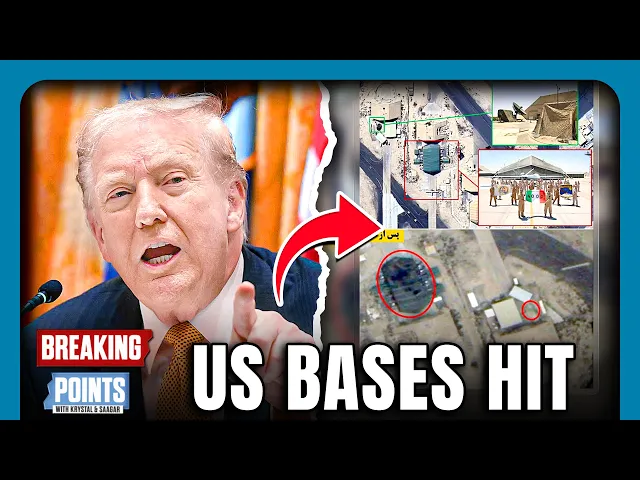
SHOCKING Radar Reveals US Base Iran Damage
Breaking Points
0:00 Let's turn now to the uh Gulf countries
0:02 and also to the bases of ours which were hit.
0:05 We have a CNN report here which details much of this A-10.
0:09 Let's take a listen.
0:10 To get a sense of just how vulnerable US facilities have become,
0:14 have a look at this.
0:15 It's the war room at Qatar's Al Udeid airbase,
0:18 the theater command and control hub for US airpower across 21 nations.
0:24 Struck not just once but twice.
0:26 And according to US source, causing significant damage.
0:30 The base had been largely evacuated
0:31 at this point and no casualties were reported.
0:34 Iran's visibility over its targets has never been clearer.
0:38 In 2024, according to the Financial Times,
0:40 Tehran secretly acquired a Chinese satellite known as the TEE-01B,
0:46 a massive upgrade from its own satellites.
0:49 That means that Tehran went from looking at images of this quality to this.
0:54 This is the first time America has fought an adversary
0:56 with satellites that capture high-res imagery almost as detailed as its own.
1:02 As the scale of the damage comes into focus,
1:05 many will wonder whether America's presence,
1:07 once a protective shield in the Middle East, has turned into its Achilles heel.
1:12 This really highlights your point, sir,
1:14 uh which is not only about the diminishing of US
1:17 military might and the ability even to project power,
1:21 but to have these, you know,
1:22 rockstar installations which have taken immense damage in only a 38-day period.
1:28 As you said, would be equivalent of not defeating Saddam in the whatever
1:33 30 days that it took in the opening days of the Iraq war.
1:36 It just seems as this continues to be even
1:39 more of a grand strategic defeat for the United States.
1:43 Certainly, and I think it raises another element here,
1:45 which is was hinted at at the in the CNN report, which is quite extraordinary,
1:50 but it also tells us of how much misinformation
1:52 we have gotten from the US government during the war
1:55 in which all of these things were being denied
1:58 and massive exaggerations of how much the Iranians suffered military setbacks.
2:03 It is the fact that now we're going to be in a scenario
2:06 in which many of these countries who
2:08 have benefited from the US security umbrella,
2:10 who have wanted the security umbrella,
2:12 who have lobbied for it and who have lobbied
2:15 against restrainers in Washington for more than a decade,
2:18 restrainers who wanted to see a different approach to security,
2:21 who wanted to see a withdrawal of many
2:23 and closure of many of these different bases,
2:25 or at least handing over the responsibility
2:28 of security to these different states, that was always being pushed back against
2:32 not only by the military-industrial complex but also
2:35 by many of these allies who very
2:37 much benefited from free riding on American security.
2:40 Now, they have seen that that security was a bit
2:42 of an illusion and many of them are going to be asked to pay for the rebuilding
2:46 of these bases and I'm not so sure that they will.
2:48 I wouldn't be surprised if many of these bases,
2:50 not all, will actually essentially be phased out.
2:54 Mhm.
2:54 And that then means that the push against this grand strategy
2:58 of liberal hegemony and this total military dominance of the world is
3:01 not just going to become from the American public but also slowly
3:05 from some of these very same allies who once benefited from it,
3:08 who once lobbied for it, they're going to turn against it as well
3:11 because it proved to be unreliable and ineffective.
3:15 There also appears to be a growing split among some of these nations.
3:19 We can put A12 up on the screen.
3:21 This is from Axios, but I know you've been discussing this as well.
3:24 The year that shook the Gulf.
3:26 The UAE is leaving OPEC,
3:27 Saudi Arabia's ending its splashiest foreign sports venture.
3:30 The two US allies are in the midst
3:32 of a messy divorce even as both face fire from Iran.
3:36 So, can you talk also about, you know, I think I ran analysis that Saudi
3:40 Arabia so far actually economically had benefited
3:43 from the war because they're benefiting from the premium
3:46 price that they're able to sell oil from.
3:48 UAE, on the other hand, has been, you know,
3:50 very economically damaged by the war and certainly their brand as, you know,
3:54 playground for global elite has been very much damaged.
3:57 So, can you talk about those dynamics?
3:59 I think the GCC as a political entity is,
4:03 if not dead, about to essentially go towards its death.
4:07 It is a security organization that was set up in the early
4:13 1980s in response to a specific geopolitical situation at the time,
4:18 which was that these smaller six GCC states, although Saudi Arabia is not small,
4:23 felt a greater threat from Iraq and from Iran at the time.
4:26 So, notably, Iran and Iraq are not part of this organization.
4:31 But that, again, was based on a common security
4:36 imperative and a common security threat perception at the time.
4:39 That is no longer the case.
4:41 It's not that the Iran is not seen as a threat,
4:43 but the approach of how to deal with Iran is dramatically different.
4:47 And UAE has turned into a complete Israeli ally.
4:51 And many of these states in the GCC view Israel as a greater threat than Iran.
4:56 And on top of that, also believe that the UAE's alliance with Israel
5:00 have actually undermined the broader security of the Persian Gulf as a whole.
5:05 So, we're seeing these splits.
5:06 And on top of that, there's egos,
5:08 there's economic competition, there's competition in the Horn of Africa.
5:12 There's a lot of different things that have
5:13 been tearing these different countries in a different direction.
5:17 And the Iran war has now really put that to the fore.
5:20 We have seen that the Iranians struck at the UAE much
5:23 much harder than they did against any of the other countries.
5:26 And they also actually spared Saudi Arabia tremendously in that war,
5:31 which clearly was an indication of the Iranians wanted to keep the pathway open
5:35 for some sort of a more positive relationship with Saudi Arabia after the war.
5:41 So, whereas with when it comes to the UAE,
5:44 they struck them much harder largely as a punishment
5:47 for the UAE being so close to Israel.
5:49 And if Trump restarts the war, incidentally,
5:52 I think one of the things we will see is not
5:54 only that there will be again this horizontal escalation by the Iranians,
5:59 but I suspect that there will be even more
6:01 of a laser focus on the UAE because now the Iranians
6:05 are going to try to drive an even deeper wedge
6:07 between the UAE and some of the other GCC countries.
6:10 It makes sense.
6:10 It actually fits with the news this morning.
6:12 The Adnoc carrier that was struck, the Abu Dhabi National Oil Corporation tanker
6:17 which was struck by the Iranians this morning.
6:18 That's been confirmed by the government of the UAE.
6:21 And the UAE has been the most belligerent in the United
6:24 Nations and other places in calling for direct military escalation against Iran.
6:29 Now, that's actually kind of my last question here
6:32 is when we see this fracture within the Middle East,
6:35 these alliances in these countries between Oman, the UAE,
6:38 and Saudi Arabia, what do you expect, you know,
6:41 the ability for US bases to even be present in the country,
6:45 even to be after this conflict is settled?
6:48 Let's say we don't voluntarily do it,
6:50 but what if those countries themselves say, "Hey,
6:52 we don't want these bases in our countries anymore." I
6:54 think most of the countries will diversify their security basket.
6:58 They will continue to buy a lot of American weapons.
7:01 In fact, they may increase their purchases of American weapons.
7:05 But I think they will start phasing out the bases.
7:08 Not all of them, they may be keeping one or two,
7:11 but this type of a system in which I think right now there's about 19 bases,
7:15 permanent bases in the region, I think is is going to be something that we're
7:18 not going to see 5 to 10 years from now.
7:21 And again, it's also going to come down to cost.
7:23 The United States is not going to pay for the rebuilding of these bases.
7:25 It's going to ask these states to do so.
7:27 And many of them are going to say, "Well,
7:29 we would rather use the money to buy weapons from the United
7:32 States or weapons from other countries and diversify our basket." Now,
7:36 the UAE may be the exception.
7:38 The UAE may actually triple down not just on the United States but on Israel
7:43 as well and become an even closer
7:45 ally of the United States and Israel militarily.
7:48 Dr.
7:49 Parsi, thank you so much for joining us, sir.
7:50 We deeply appreciate your time.
7:51 Thank you so much for having you.
7:52 Appreciate it.
7:53 Hey, if you liked that video, hit the like button or leave a comment below.
7:56 It really helps get the show to more people.
7:58 And if you'd like to get the full show ad-free and in your inbox every morning,
8:02 you can sign up at breakingpoints.com.
8:04 That's right.
8:05 Get the full show, help support
8:06 the future of independent media at breakingpoints.com.