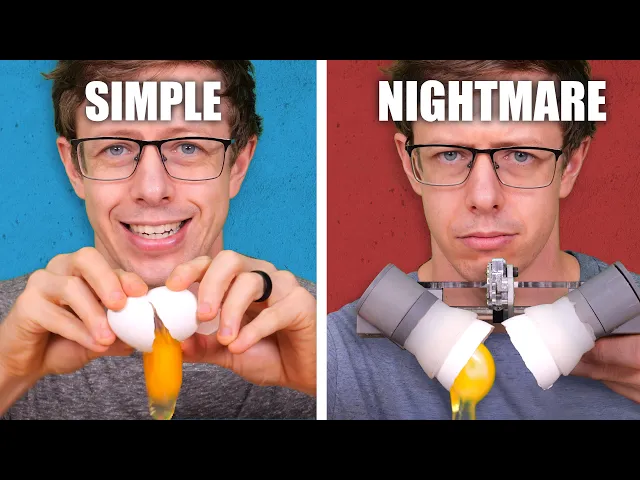
Why is this task so difficult for machines?
Stuff Made Here
0:00 For 10 years, I've been making eggs for breakfast.
0:03 And for 10 years, I have been annoyed.
0:06 I always get egg on my fingers.
0:08 So, I go wash them off, grab the next egg, and do [music] it again.
0:12 GH, which drives me absolutely crazy.
0:16 I've been fantasizing for years about [music] some kind
0:19 of tool that would cleanly crack an egg for me.
0:22 So, I decided to make my own, thinking, how hard could it be?
0:26 Turns out very very hard is the answer.
0:30 I was thinking this would be a pretty simple [music] mechanism but one
0:32 thing led to another and I basically
0:35 ended up designing a mechanical computer which
0:37 of course was very hard to get working and since every failure basically meant
0:42 exploding an egg [music] in my shop wasn't very fun to test and the smell.
0:49 And after all that my wife wasn't nearly
0:51 as impressed as she [music] should have been.
0:53 It's huge.
0:54 It's complicated.
0:56 It's ugly.
0:58 But they say you can't make an omelette without breaking a few eggs,
1:00 or in my case, a few pallets of eggs.
1:03 So, come watch me go from youthful optimist [music] to mature
1:07 pessimist as I try to solve one of the trickiest kitchen tasks.
1:11 I want this to be a handheld thing that I could actually use in a kitchen.
1:16 So, no electronics, no software, no 500lb milling machine,
1:20 no lasers, handheld, compact, purely mechanical.
1:24 And I think I have an idea for how I could do this.
1:28 Eggshells are brittle.
1:29 If you stretch them beyond a certain point, they just crack.
1:33 Which reminds me of a cool thing about glass.
1:34 [music] If you scratch it and then crack it,
1:37 the crack tends to follow the scratch.
1:41 [music] And I'm wondering if we could do the same thing with an egg.
1:44 put a scratch around it where we want it to break
1:46 and [music] then start a crack and hopefully split the egg in half.
1:50 It's actually kind of hard to make a scratch on an egg
1:52 that goes all the way back around to where it started.
1:55 So, I really hope this doesn't blow up in my lathe.
2:00 That would have been a lot easier if I hadn't
2:01 glued the egg in with an inch of run out.
2:04 But, [music] we have a decent scratch.
2:05 Let's see if we can get it to crack.
2:10 [music] Yeah, it totally split right along the crack.
2:13 And it hasn't [music] just split in half because
2:15 there's still that membrane on the inside holding it together.
2:18 So to actually crack it,
2:19 we're going to have to hold it on both sides [music] and hopefully tear it.
2:25 Oh man, I [music] crunched it.
2:27 But the side that didn't get crushed looks great.
2:29 Nice clean break.
2:31 I think this is really promising.
2:32 And we can make a device that does this.
2:35 Scratch the egg, crack [music] it, dump the contents.
2:38 Let's go make an egg cracker.
2:41 I'm imagining a handheld tool that kind of looks like this.
2:43 It would hold the egg from both sides
2:45 with some kind of gripper that can spin it,
2:47 and then it would have a cutting head with a little knife to scratch the egg,
2:50 and then a hammer to hit that scratch [music] and crack it.
2:53 After that, the grippers would pivot down to tear the membrane and dump the egg.
2:57 And we don't want egg on our fingers,
2:58 so they also [music] have to eject the shell.
3:00 And I want this easy to use.
3:01 So, all of this will happen when you turn a crank.
3:04 And it's the crank that [music] makes this crazy.
3:06 Like, how do you scribe and then hammer and then
3:09 dump and then eject just by turning a crank?
3:13 It's going to be bad.
3:14 But we have to put a pin in that thought
3:16 because there's a riskier problem we have solved first,
3:18 which is holding the eggs.
3:20 We have to hold the sloped end of an egg,
3:22 which is going to want to just pop right out of the gripper.
3:25 And then there's a lot of variation in the shape and size of eggs.
3:28 And whatever I come up with has to be able to hold them all.
3:31 I spent a really long time trying to figure this out.
3:33 I considered everything from spikes to glues to suction cups,
3:38 but I have an idea that just [music] might work.
3:40 So, let's see.
3:41 So, this is a mold that's 3D printed.
3:44 I'm using it to cast silicone around a 3D printed part,
3:47 which is surprisingly easy to do.
3:49 You inject the liquid rubber, wait a few hours, and then you have your part.
3:53 This is called over molding.
3:55 The egg just slides in like this, and it
3:57 [music] basically palms the egg and holds it really well.
4:00 And the stretchy silicone can expand
4:03 to accommodate pretty much [music] any egg size.
4:05 One of the tricky things about making something like
4:07 this is that the silicone doesn't really bond to the plastic.
4:10 So, we had to make a special shape within the hub that the silicone
4:13 will mold around and [music] get physically
4:15 trapped so that they can't come apart.
4:17 And then after the egg has been cracked,
4:19 there's a built-in spring-loaded ejector that can eject the shell.
4:26 That was close.
4:27 And then, oh, having too much fun.
4:33 So, I want to test these to make
4:34 sure they work before we build [music] anything else.
4:36 I'm going to scratch and crack it by hand.
4:39 Then, we're going to see if we can split
4:40 the membrane with these, which I think is the hardest part.
4:42 [music] So, if I put the other gripper on here and twist, it should split.
4:47 It's not [music] even close.
4:50 Man, that membrane is strong.
4:52 I thought this was [music] going to work for sure.
4:55 I tried a bunch of different rubbers from really [music] soft
4:58 and grippy ones to stiffer ones that'll grab the egg tighter.
5:02 [music] Nothing is working.
5:07 So, fundamentally, the problem seems [music]
5:09 to be that they can stretch this way,
5:10 which limits how much torque they can apply to the egg.
5:13 So, we don't want it to stretch this way,
5:16 but we want it stretch in this direction so that we can still get eggs into it.
5:20 And I think it should be pretty easy to do.
5:23 This is the new hub for our egg gripper.
5:25 It has these tethers built into it which are really flexible in this direction,
5:29 but they're really strong in this direction.
5:31 They don't stretch at all.
5:33 And the silicone gripper is cast around these tethers.
5:36 This is a partial pore,
5:37 so we can kind of get a cross-section view of what's going on.
5:39 The little T-shaped ends of these keys into the rubber.
5:42 It makes it really strong in this direction.
5:44 If you try to pull on it, it doesn't stretch at all,
5:47 but their flexibility still lets the rubber stretch outward,
5:50 so we can get an egg in there.
5:51 This holds the egg 100 times better.
5:53 Here's one of the old ones.
5:55 [music] So, I'm just going to manually score and fracture
5:59 the eggshell and see if these grippers can pull it apart.
6:04 Oh gosh.
6:06 [music] Yes, [snorts] I knew it.
6:18 You just have to hold the egg, right?
6:21 We can finally hold the egg.
6:23 Now we have to make everything else.
6:25 And what we're gonna have to do, I think,
6:27 is work backwards from the egg grippers to everything
6:30 else because these are sort of set in stone.
6:33 Which means we need to figure out the main body and crank.
6:37 When you're trying to figure out how to even do something,
6:39 [music] it makes it 10 times harder to only have a tiny bit
6:43 of space to do the thing in that you don't even know how to do.
6:47 Every time I've ever made something handheld, I've said,
6:51 "I'm never doing [music] that again." And then I do it again.
6:54 These are some of the most complicated parts I think I've ever had to design,
6:58 and it's for [music] a stupid egg cracker.
7:01 But I think I have something that might work.
7:04 So, let's get them made and find out.
7:08 3D printing is always my preference because it's so easy to do,
7:11 and thankfully, I've been able to use it for most of the parts.
7:15 There are a few select machine parts, but they're all pretty simple.
7:21 And here it is all together.
7:23 Doesn't really do anything yet, [music] but we're getting there.
7:26 This is the crank that's going to drive everything.
7:28 And it spins the egg through a series of drive shafts and bevel gears.
7:32 And then to split the egg and dump it out,
7:34 the egg grippers [music] can pivot down like this.
7:36 And they're spring-loaded against a hard stop,
7:38 so they always return to the starting [music] position.
7:41 And to make them pivot, you pull on this cord, which is routed around a pulley
7:44 that's integrated into the pivoting [music] part.
7:47 The cord isn't connected to anything yet,
7:49 but the plan is to make a mechanism that will pull on this at the right time.
7:52 And this side pivots on the drive shaft.
7:54 It's kind of a two for one special,
7:56 which I hope doesn't come back to bite me later.
7:59 And there's a critical detail here.
8:00 The drive shaft has to be designed to rotate this [music] way.
8:03 If it rotates this way,
8:05 its torque will also make the egg gripper pivot down, which is no good.
8:09 And then we also have the eggshell ejectors.
8:12 The ejectors are a spring-loaded shaft that goes
8:14 through the drive [music] shaft and is
8:16 held back with a little latch which releases it when you push it up.
8:19 But the latch isn't going to release itself.
8:21 We need something to trigger it when the time [music] is right.
8:24 But it's tricky because they're inside this rotating gear box
8:27 and running another mechanism through this pivot would be a nightmare.
8:30 So I designed the egg dumping [music] to have two positions.
8:33 The first would dump the eggs.
8:35 Then we'll rotate even further [music] which lifts up
8:38 the latch with a little ramp releasing the ejectors.
8:41 And even this was [music] tough to fit in here.
8:43 And then the last detail is this side slides back
8:46 and forth so we can fit all the different sizes of eggs.
8:50 Now that we can spin the egg,
8:52 we need the thing that scratches and cracks the shell.
8:54 I'm imagining a sort of floating head
8:56 with a tiny knife that can cut [music] into it.
8:59 And then next to that, we'll have a spring-loaded metal
9:01 rod which can hammer on the scratch to crack it.
9:04 And here's what it actually looks like.
9:06 This cutting head is tiny.
9:07 It was a challenge to fit all this in here, but we got it done.
9:11 So, let's go do some five-axis machining.
9:15 [music] Parts like this cutting head make
9:19 me so thankful to have a five-axis mill.
9:21 [music] It has holes and features on every side that are offaxis,
9:25 and a lot of stuff isn't even square.
9:27 And the five axis can rotate the part to all
9:29 the different orientations and machine it all in one shot.
9:33 Well, except for that tab on the bottom, but we don't talk about that.
9:37 [music] And so much for everything being 3D printed.
9:41 This used [music] pretty much all of my tools, even some weird ones.
9:48 This tiny little part on the end of all this is the cutting head.
9:52 It is so tiny.
9:54 And ultimately, it's going to mount on the main
9:55 drive shaft floating above the egg like that.
9:58 And this is the cutting blade.
10:01 [music] It goes in like this so that we can
10:02 tune how deep it cuts and try different blades.
10:04 The cutting head will contact the egg right about here.
10:07 Getting the shape of this dialed in so that it
10:09 could cut all the different shapes of eggs was really challenging.
10:13 [music] And then this is the hammer.
10:14 It's a metal rod with a rounded tip that's spring-loaded.
10:18 It's positioned to hit exactly on the scratch made by the cutting blade.
10:21 And this spinning cam lifts and drops it.
10:23 The main drive shaft will go through here.
10:25 And as it turns, it'll spin the cam with this belt.
10:29 Although this means the hammer will always be
10:31 hammering and I'm worried that might cause issues.
10:33 So I'm going to also have a little pivoting latch
10:36 which will catch the hammer in the pulled back position.
10:38 But if you push the latch out of the way,
10:40 then the hammer is free to hammer as much as it wants to hammer.
10:43 This gives us a simple way to turn the hammer on and off
10:45 by pushing and pulling on a rod with some other part of the mechanism.
10:48 So I was just looking at this and I realized I'm an idiot [music] unfortunately.
10:56 So, I designed everything for the hand crank to be turned this way,
11:00 but that'll just jam up the hammer.
11:02 I even had an item in my to-do list
11:04 to check that everything was turning the right direction,
11:07 and [music] I checked it off.
11:12 It's going to take a bit of hacking.
11:14 This ended up being less bad than I was expecting.
11:17 I just stuck another gear in there and it reversed everything.
11:20 I don't think I've ever had a literal UNO reverso card work before.
11:25 Awesome.
11:28 At this point, this thing has all the hardware that it needs to crack an egg.
11:32 But if I turn the handle, [music] it'll just spin the egg forever.
11:36 And that's because there's nothing in here to actually make
11:38 it do all the different functions in the right order.
11:42 [music] So, we basically need to program it, but we don't have a computer in it.
11:47 So, we're going to have to do it mechanically.
11:49 Imagine connecting our main crankshaft to another shaft
11:53 with a very weird set of gears that look like this.
11:55 Every rotation of the crankshaft will make
11:57 this gear move through a set of distinct positions.
12:00 I'm going to call this the program wheel because we should be able
12:02 to use its movement to [music] make this thing do a series of programmed steps.
12:06 For example, when we start cracking an egg,
12:08 we want the scribe to be pressed into it to cut a groove.
12:11 We could make a shape that pushes the cutting head
12:13 into the egg when the program wheel is in the first position.
12:16 Then when it moves to the next position, it would release the pressure.
12:19 And because the egg is also spun by the drive shaft,
12:21 this would scratch the egg all the way around.
12:23 This shape is called a cam.
12:25 And with a bit of cleverness,
12:26 we should be able to use cams to control everything.
12:29 Remember that little latch to turn the hammer on and off?
12:31 We can make a cam push on that to turn
12:33 the hammer on after we're done scratching the egg.
12:36 Then after that, we can make a cam that lifts the cutting head out
12:38 of the way so it doesn't get dirty when we dump out the egg.
12:41 And then the trickiest part is making it pivot the egg grippers down.
12:45 Both sides have a cord that if you pull on it, twists [music] them down.
12:49 So we can attach those cords to a pivoting arm that looks like this.
12:52 Engineers call this kind of thing a bell crank.
12:55 But in this case, we can put a little wheel on the side of the bell crank,
12:58 which can roll against a cam, which if we shape it right,
13:01 we'll put the egg grippers down part way for one rotation of the crank,
13:04 which will dump the egg out.
13:06 And then the next rotation will rotate
13:08 them further which will trigger the eggshell ejectors.
13:11 Then one more rotation and everything sets back.
13:14 And putting it all together and running it does this.
13:17 It presses the scribe into the egg to cut a groove and then releases
13:20 that pressure and turns on the hammer to hit the scratch and break it.
13:24 Then it lifts the cutting head so it
13:25 doesn't get dirty [music] and dumps out the egg
13:27 and then pivots the egg grippers more to trigger
13:30 the ejectors and then resets for the next egg.
13:33 pretty crazy how much mechanical engineering it
13:35 takes to replicate like four lines of code.
13:39 It's simultaneously really complicated but also really simple.
13:43 You just turn the crank and it cracks your egg.
13:45 So, it's beautiful.
13:47 I love it.
13:48 Although, it would have been a lot easier
13:49 just to write [music] four lines of code.
13:51 But, aren't you glad that I didn't?
13:52 I mean, just look at this thing.
13:54 It's so ridiculous.
13:55 I love that [music] this can exist.
13:57 But at the same time,
13:59 all the incentives are not to make stuff like [music] this.
14:02 The pressure is to make things that are simpler,
14:05 more mainstream, more tuned for the algorithm.
14:07 And I [music] feel this pressure and I'm afraid of it
14:10 because I don't want it to change what I make.
14:12 [music] Like imagine if instead of doing things I think are cool,
14:16 I was trying to do things that would perform well.
14:20 All right, what's up team?
14:21 I made a money cannon.
14:22 Let's go out and pretend to help people.
14:24 But the pressure is real.
14:26 And sometimes I wonder if the pain that I go through is [music] worth it.
14:30 Like the puzzle solving robot, it almost killed me.
14:34 But one day out of the blue, I got an email [music] informing me that I'd won
14:37 an imi award because they really liked my puzzle robot video,
14:40 which was [music] unexpected and amazing and of course
14:44 completely transformed my [music] view of the puzzle robot.
14:47 It's probably my favorite project now.
14:49 So imi stands for [music] independent media initiative.
14:51 They're working with foundations to get nonprofit money
14:55 and then [music] they do the leg work
14:56 to find people that are creating things that they
14:58 think are authentic [music] and artistic and wonderful.
15:02 Then they give them that money.
15:04 They're basically [music] creating a new set of incentives that aren't
15:06 dictated by algorithms and popularity and all that kind of stuff.
15:11 So, thank you imi.
15:12 I am very inspired to make more completely ridiculous things like this.
15:18 And I guess we should see if it works.
15:23 All right, here we go.
15:28 [music] Come on.
15:31 When you put everything together, it never works.
15:34 [music] Or as I like to call it, integration hell.
15:37 The program wheels jamming up under load.
15:40 But after microoptimizing the design, I got it working.
15:43 And then in the spirit of getting
15:44 everything that [music] could possibly be wrong,
15:47 the hammer turned out to actually be a hole punch.
15:50 But that can be fixed with a different shape and different springs.
15:53 Then we had a scriber that didn't make a mark.
15:55 The blade was too dull.
15:56 Then we had a scriber that ripped chunks out of the egg.
15:59 The blade was too sharp.
16:00 Then we had a blade that was in between [music] and it was just right.
16:04 Sorry, the kids are doing a number on me.
16:07 [cough and clears throat] There was a lot of other
16:09 little problems and a lot of me making this face,
16:13 but eventually we got it running smoothly.
16:15 Well, kind of.
16:17 Remember how we made the egg grippers a lot stronger?
16:19 They're so impressively strong that the egg ejectors don't [music] work.
16:22 I don't understand because I tested them when I redesigned them,
16:27 but they don't work now.
16:29 The reason I didn't just put a giant
16:31 spring in here is that I'm extremely space constrained.
16:34 So, we're going to try a different approach.
16:36 Because the egg grippers are airtight,
16:38 if you put air in behind the egg, it pops out.
16:41 I like this because it's a surprisingly easy mod.
16:44 And with air power, there's basically no limit to the egg ejection force.
16:48 The trickiest [music] part is getting air to the spinning egg holders.
16:51 But since they have hollow shafts, we can just make a spinning seal on the end.
16:54 And next thing you know, you got loose eggs.
16:58 I don't know what I did to my boy.
16:59 This is a complete hack job, but it's going to let us test the concept.
17:03 [music] We've got air lines going to both the egg grippers.
17:05 And pushing this syringe in will pump air behind the eggs, releasing them.
17:09 But I realized this can do something else that's really useful.
17:11 [music] If you pull the syringe back, it vacuums the egg into the gripper.
17:16 I'm not sure if we absolutely need this, but more grip is better,
17:19 especially with weird shaped eggs.
17:21 [music] So, let's see if this abomination works.
17:24 All right, so here's how I put the egg in.
17:26 Push it in the one side, bring in the other side, close it, squeeze.
17:30 And if we try to pull a vacuum, it'll just pull the syringe back in.
17:34 So, for now, I'm just holding it back with this bolt.
17:36 Very userfriendly.
17:38 [music] This egg is fully cracked,
17:43 but the program is going to keep hammering it for [music] two more rotations,
17:47 which is busting up the shell and ripping chunks out.
17:49 So, I'm just going to lift up the cutting head
17:51 for now [music] and see how it cracks the egg.
17:54 Oh, yes.
17:56 It's amazing.
17:58 Although the egg spinning is bad.
18:00 That's going to break off shell pieces.
18:03 All right.
18:03 Now, let's see if we can eject [music] the shells.
18:05 3 2 1.
18:10 This one come out.
18:11 All right.
18:12 Just [music] about.
18:13 Very close.
18:14 This thing can definitely work.
18:16 The syringe basically did what it needs to do.
18:19 I think with a bit of tuning that'll be good.
18:21 But I just don't like everything being driven from the crank.
18:24 So, the egg we just cracked was scored
18:26 and ready to crack in like one or two rotations,
18:29 but the program is just going to keep running.
18:31 So, it just kept hammering and scribbing it even though it didn't need it.
18:34 I think we need to be able to control all the different steps independently.
18:38 I think I see a way to do this without changing everything,
18:41 but unfortunately, it requires us to change almost everything.
18:46 So, I think I know what I'm going to be doing for the next week.
18:52 I tried to keep as much of this the same as I could,
18:54 but I ended up changing like 90% of the parts.
18:57 But on the plus side, it was mostly water jetted or 3D [music] printed parts,
19:00 which are a lot easier to remake.
19:03 A big part of my effort was making
19:04 the air system easier to [music] use and not crappy,
19:09 which meant routing all the airlines internally,
19:12 which was a [music] huge pain and changed almost every part.
19:17 It is finally together.
19:20 It's almost like a real thing.
19:21 [music] Everything is properly designed on some level.
19:26 Maybe it was worth it.
19:27 I don't know.
19:27 Probably not.
19:29 Let me show you how it works.
19:30 You put the egg in just like before.
19:32 [music] Then pull this back to vacuum the egg in place.
19:35 And if you want to eject the egg, you press this button.
19:37 [music] But let's not get ahead of ourselves.
19:39 The next thing we do is turn this knob a few times to score and crack the egg.
19:43 And then instead of the program [music] wheel, we have this little lever.
19:46 And this operates all the cams.
19:48 lifting up the cutting head and pivots
19:50 the egg grippers which should [music] not do that.
19:58 What?
20:00 I thought we were done with this.
20:02 Let's just say there are problems with the vacuum system, the egg grippers.
20:08 Oh.
20:08 Oh my goodness.
20:10 And the shell ejection [music] system.
20:12 Now, it'll probably eject this side first.
20:16 And it should eject this side now.
20:23 But there is one problem that's [music] kind of a big deal.
20:26 Do you see it?
20:27 Only half of the egg is coming out.
20:29 [music] This happens when one of the shells comes off first,
20:32 which releases all the air pressure.
20:34 And no air pressure, no eject.
20:36 I saw this on the previous [music] version,
20:38 but I thought I'd be able to tune it out.
20:41 Nope.
20:42 A proper fix is too much work.
20:43 So, I just added this valve.
20:45 Now, if one side fails to eject, [music] you can close off the open side and run
20:49 the ejector again to get out the other shell.
20:52 I actually spent a whole day trying to make pistons [music] that would push
20:55 the shells out with little check valves
20:57 in them so they could still pull a vacuum.
20:59 I just couldn't make them reliable.
21:01 So, this is what we have for now.
21:03 But, I'm okay with that because this is a prototype.
21:05 I know if I did another iteration of it, I could fix all these things,
21:08 but right now I just want to see the process
21:11 work [music] and prove that the concept is sound.
21:14 And it's looking pretty good.
21:15 So, let's see if [music] this thing will work.
21:34 Beautiful.
21:41 Oh man.
21:43 And look [music] how clean this brake is.
21:44 It's like almost perfect.
21:46 All right.
21:47 Now it just has to eject the eggshells.
21:49 All right.
21:49 Here we go.
21:50 3 [music] 2 1.
21:57 Oh, that's so good.
21:59 I know it's just cracking an [music] egg, but it took so long to get here.
22:03 is so cool to see it finally doing it.
22:06 And it [music] is a bit more complicated than I was expecting, but I don't know.
22:10 I just love it.
22:14 With another [music] iteration of redesign
22:16 and remaking probably every single part, [music] we could get rid of the valve.
22:21 I think we could get rid of pulling back
22:22 the syringe and always eject [music] both shells reliably.
22:26 But kind of tired of redesigning and remaking stuff,
22:28 so we're not going to do that right now.
22:31 [music] What I'm curious about is what my wife thinks.
22:33 I suspect she's going to find it a little bit hard to use,
22:36 but only one way to find out.
22:40 All right, wife is here.
22:43 She's ready to judge things.
22:44 She looks like she's got her judging face on.
22:46 Does this look like the future?
22:48 It looks like the stuff [music] of future infomercials.
22:52 Okay, let's not get ahead of ourselves.
22:54 Here's your egg.
22:54 [music] Put the egg in there.
22:57 All right, pull that back.
22:59 The egg is now suctioned in place.
23:02 And give this a few cranks.
23:07 See the little crack?
23:14 Oh.
23:14 Now, [music] how do we get the shells out?
23:16 Press this button.
23:19 All right.
23:19 There goes one.
23:20 [music] Do I do it again?
23:21 Uh, no.
23:22 Pull this back out.
23:24 Now, turn this 90°.
23:26 All right.
23:27 Press it again.
23:29 [music] The future of egg cracking is here.
23:36 Looking past the obvious things that need to be fixed, how many out of 10?
23:41 I don't see an egg cracker.
23:47 How many out of 10 would you give this?
23:51 [music] Three.
23:55 Three.
23:55 That's just evil.
23:57 Do I even need to explain [music] it?
23:58 Yes, explain.
24:00 It's huge.
24:01 It's complicated.
24:02 It's ugly.
24:04 I think it's great.
24:05 It's beautiful.
24:06 [music] You would so cool.
24:13 And maybe if all I had to do was turn the crank, I would try using it.
24:19 [music]
24:19 You take that three and stick it right up your sleeve and get out of here.
24:25 I ain't got no sleeves.
24:26 Jokes's on you.
24:28 I don't know why I even brought this lady in here.
24:31 Three out of 10.
24:33 I don't know.
24:33 I don't agree.
24:35 I'd give it at least a five.
24:39 So, there's this kind of funny story.
24:40 When me and my wife first got married,
24:42 we went and got our first Christmas tree and we had no ornaments.
24:45 We had no lights.
24:46 And I was trying to figure out how many
24:48 strands of lights do I need to [music] buy?
24:49 I want to get the minimum amount cuz we don't have very much money.
24:52 So, of course, I whipped out my TI89.
24:54 [music] And with a bit of calculus,
24:56 I got the length and spacing that I needed and they fit perfectly,
25:01 which was just [music] incredible.
25:03 And I just love this as a tiny little example
25:06 of how useful [music] knowledge can be even for silly problems.
25:10 But if you're trying to learn this stuff,
25:12 it's a whole other story that can be really challenging.
25:15 Which is why I [music] think this video sponsor is important.
25:19 It's called Brilliant, and it solves the problem of learning really well.
25:23 It does it by taking difficult subjects like programming and breaking them down
25:27 into a series of small [music] lessons which aren't too bad to do.
25:30 But they build one on top of the other.
25:32 And if you do them at some point you can just program.
25:36 It's crazy.
25:36 [music] But the the secret sauce is how the lessons work.
25:41 They're interactive and [music] built around
25:43 solving actual problems like writing code,
25:46 solving equations, or even designing circuits.
25:49 Imagine the difference between [music] reading about
25:52 building a house and actually building a house.
25:55 Brilliant.
25:56 Kind of like actually building a house.
25:57 [music] And there is so much useful stuff on here.
26:00 There's literally thousands of lessons across math,
26:03 programming, data science, regular science, AI.
26:08 Although something I've heard from people is that they [music] don't think
26:10 they're smart enough to be able to learn this kind of thing.
26:12 But you absolutely can.
26:14 And I hope that you do.
26:16 It'll make you a [music] better thinker, better problem solver,
26:19 and it'll give you a lot of joy as [music] well.
26:21 So, I hope you check it out.
26:23 You can actually learn for free on Brilliant.
26:25 Just go to brilliant.org/stuffmade [music] here, scan the QR code on screen,
26:29 or click the link in the description.
26:31 Brilliant's also given our viewers 20%
26:33 off an annual [music] premium subscription,
26:34 which gives you unlimited daily access to everything on Brilliant.
26:38 And that's it.
26:39 Thank you, Brilliant, for sponsoring this video,
26:41 and thank you for taking the time to check it out.
26:45 And that's a wrap.
26:48 [music] [music]