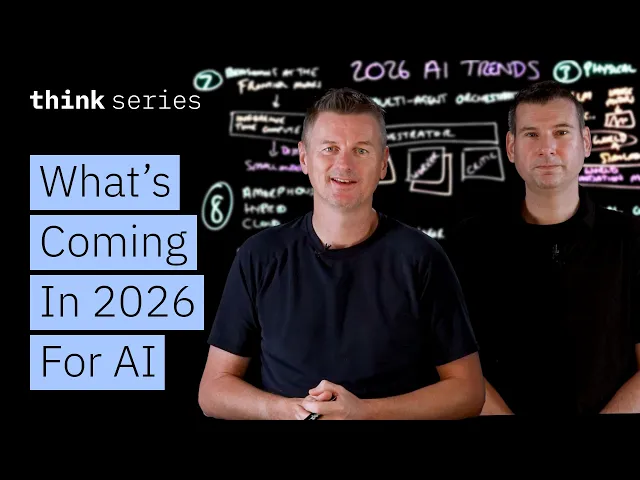
AI Trends 2026: Quantum, Agentic AI & Smarter Automation
IBM Technology
0:00 What will be the most important trends in AI in 2026?
0:03 Well, we take a stab at this every year with with some success, I would say.
0:08 And this time out, I have the knowledgeable assistance of my colleague,
0:12 Aaron Baughman, to help us out.
0:14 Well, yeah.
0:15 You know, after your prediction of infinite memory last year,
0:17 I thought maybe you could use just a little bit of help.
0:20 Yeah, that's that's fair.
0:21 Well, how about we each take four trends each?
0:24 That sounds good.
0:25 How about you first?
0:26 All right.
0:28 Okay.
0:28 So my number one trend of 2026 is multi-agent orchestration.
0:35 Now last year we said 2025 was the year of the agent.
0:40 AI agents that can reason and plan and take action
0:43 on a task and agents I think it's fair to say really delivered.
0:46 There are new numerous agentic platforms for tasks like coding
0:50 and basic computer use but no single agent really excels at everything.
0:55 So, what if you had a whole team of agents working together?
0:59 So, maybe we've got an agent here that kind
1:02 of acts as a planner agent that decomposes goals into steps.
1:07 Maybe we have some worker agents here that do
1:11 different steps like one specializes in writing code,
1:15 others call APIs and so forth.
1:17 And then perhaps we have a critic agent that evaluates outputs and flags issues.
1:24 And these agents collaborate under
1:28 a coordinating layer that is the orchestrator.
1:33 And multi-agent setups like this help
1:35 introduce cross-checking where one agent checks the other agents work and it can
1:41 break problems into more discrete verifiable steps.
1:44 Well, great.
1:45 So, how could I really follow that trend?
1:47 Well, I think I might just have one.
1:49 So, the second one is going to be the digital labor workforce.
1:53 So now these are digital workers that are
1:56 autonomous agents that can do a couple of items.
1:59 So the first one is they can parse a task by interpreting multimodal input.
2:04 So after preparation the worker then executes what's called a workflow.
2:08 Now this is where at the end of an action
2:12 plan you know it would follow a sequence of steps
2:15 but then it has to be integrated into some
2:18 sort of system that then in turn can take action.
2:22 And these could be downstream components.
2:24 Now these systems are then further
2:26 enhanced by what we call human-in-the-loop AI,
2:28 which then provides a couple of items.
2:31 The first one would be oversight.
2:33 The next one would be correction and then
2:35 we're looking at these strategic guidance or these rails
2:38 um to ensure that all of these agents
2:40 are doing what they're supposed to be doing.
2:42 Now this overall trend will create
2:44 a force multiplying effect to extend human capability.
2:48 Now trend number three is physical AI.
2:52 Now we all know that large language models they generate text like ABC.
3:00 And then there are other models as well.
3:02 So for example there are plenty
3:04 of diffusion image models and they generate pixels.
3:08 They generate images.
3:10 These are all operating in digital space.
3:13 Now, physical AI is about models that understand and interact
3:17 with the world that we live in, the the real 3D world.
3:22 And this is about models that can perceive their environment,
3:27 reason about physics, and that can take physical action like robotics.
3:33 So, previously getting a robot like
3:36 this to do something useful meant programming explicit rules.
3:40 So if you see an obstacle, you should turn left, for example.
3:44 And it was all done by humans.
3:48 It was up to yeah, smart guys like this to code these rules.
3:54 Now, physical AI kind of flips that around.
3:58 So you train models in simulation that simulate the real world
4:04 and it learns to understand how objects behave in the physical world,
4:08 how gravity works, how to grasp something without crushing it.
4:13 Now these models are sometimes called world foundation models.
4:18 They're generative models that can create and understand 3D environments.
4:23 They can predict what happens next in a physical scene.
4:27 And in 2026, many of these world models are
4:30 taking things like those humanoid robots that you found there,
4:34 Aaron, and they're taking them from research to commercial production.
4:38 Physical AI is scaling.
4:40 Well, Martin, you just took my trend,
4:43 but let's just go ahead and say number four is about social computing.
4:47 Now, this is a world where many agents
4:50 and humans operate within the shared AI fabric.
4:53 So say if I have an agent here and then a human here.
4:57 So they're going to be connected through this fabric
5:01 and here if I have information that flows between the two,
5:04 they begin to understand each other and then they
5:07 can gather what the intent is going to be.
5:10 And then once they have the intent and information, they have actions.
5:14 They can affect each other or maybe even the environment of which they're in.
5:18 But all of this flows seamlessly across this system.
5:22 It's this shared space that enables collaboration,
5:25 context exchange as well as event effective understanding.
5:28 Now the outcome is really an empathetic emergent network of these interactions.
5:32 It's what we call this collective
5:35 intelligence or this real world swarm computing.
5:38 So teams of agents, digital labor, humanoid robots,
5:42 and tech that can understand me with effective computing.
5:46 2026 could be uh quite the year and we're only halfway through the trends.
5:52 So trend number five that is verifiable AI.
5:58 Now the EU AI act is coming and by mid 2026 it becomes fully applicable.
6:06 And think of this a little bit like GDPR but for artificial intelligence.
6:11 Now, the core idea here is that AI systems, especially high-risk ones,
6:17 need to be auditable and they also need to be traceable.
6:20 Now, what does that mean?
6:22 Well, it means a few things.
6:24 It means documentation.
6:25 So, if you're building high-risk AI,
6:28 you need technical docs that demonstrate compliance to how
6:31 you tested the models and the risks that you identified.
6:35 It means transparency.
6:36 So, users need to know when they're interacting with the machine.
6:41 So things like synthetic text,
6:43 they need to be clearly labeled and it means data lineage.
6:47 You need to be able to summarize where your training
6:51 data came from and prove you respected copyright optouts.
6:54 And just like how GDPR has shaped global privacy, not just folks in the EU,
7:00 the EU AI act will probably set the template for AI governance worldwide.
7:04 Wow, that's great.
7:05 And you know, trend number six, right?
7:08 It really changes everything, but it also changes nothing at the same time.
7:13 And now this is where we put in quantum utility everywhere.
7:17 So 2026 is where we start to see this quantum
7:20 computing to reliably start solving real world problems better,
7:25 faster, or more efficiently than classical computing methods.
7:28 Now, at this point, we have this quantum utility scale.
7:32 is these systems that begin working alongside and together
7:35 with classical infrastructure to deliver
7:37 these practical value in everyday workflows.
7:40 Now, this is going to help with optimization
7:43 and then we'll also look at simulation and decision-making.
7:46 Now, all three of these tasks were
7:49 previously out of reach within the classical realm.
7:52 But this hybrid quantum classical error,
7:54 it will begin to transform quantum computing into this mainstream paradigm
7:58 as it's going to be woven into our everyday business operations.
8:03 Now my trend number seven is reasoning at the edge.
8:08 Now last year, we talked about very small models,
8:11 models with just a few billion parameters
8:13 that don't need huge data centers to run.
8:16 They work on your laptop or well maybe even your phone.
8:20 Well, in 2026, those small models are learning to think.
8:23 So, if we think about the best models that we have today, the frontier models,
8:29 well, pretty much all of them now use something called inference time compute.
8:36 They spend extra time thinking before giving you an answer,
8:40 working through problems step by step.
8:42 Now, the trade-off for that is they need more compute.
8:47 But here's what's changing.
8:49 Essentially, teams have figured out how they can
8:54 distill all of this reasoning information into smaller models.
8:59 So now these smaller models can perform thinking as well.
9:03 You're taking massive reasoning models that generate
9:06 tons of step-by-step solutions and we're
9:09 using that data to train the smaller models to reason the same way.
9:13 And that's resulting in reasoning models with only a few billion parameters.
9:18 They work offline.
9:19 Your data never leaves your device.
9:21 And there's no roundtrip latency to a data center.
9:24 So for anything that's real time or mission critical,
9:27 having a model that can actually reason through
9:30 a problem locally is a pretty big deal.
9:33 Yeah.
9:33 So that's all very true, Martin.
9:35 But now our last and final trend is number eight.
9:39 So this is what we're calling amorphous hybrid computing.
9:42 So this is a future where both AI model topologies and the cloud infrastructure,
9:48 they blend into what's called a fluid computing backbone.
9:51 So AI models, they're shifting beyond just this pure transformer design, right?
9:56 They're beginning to evolve into these other architectures that integrate
10:00 transformers and we call them these state space models.
10:04 And then in 2026, you're also going to see different emerging algorithms
10:09 that are combine both the state space
10:11 and transformers and other elements together, right?
10:14 And that's going to be really fun to watch, very artful.
10:18 And then at the same time, we have this cloud computing piece that's becoming
10:23 fully differentiated by combining many different chip types.
10:26 So we're going to have CPUs, GPUs, TPUs as well.
10:31 And finally, what we just talked about in trend six,
10:35 quantum, we're going to have QPUs.
10:38 I did also want to mention and note that you'll see
10:41 these neuromorphic chips that are coming out and those emulate the brain.
10:45 But all of these are going to be put together right
10:48 into this unified compute environment where parts
10:50 of each of these types of models,
10:53 they're going to be automatically mapped to the optimal compute substrate.
10:56 And this is really going to help
10:59 to deliver this maximum performance and efficiency.
11:01 And you know what?
11:02 Who knows?
11:03 But at this pace, probably not in 2026, but I think further out,
11:07 you might see DNA computing entering into the mix.
11:10 Well, those are some lofty goals.
11:12 And look, these are what we think are some of the biggest AI trends in 2026.
11:19 But what are we missing?
11:21 Which AI trend do you expect to be a big deal in 2026?
11:26 Yeah, let us know in the comments below.