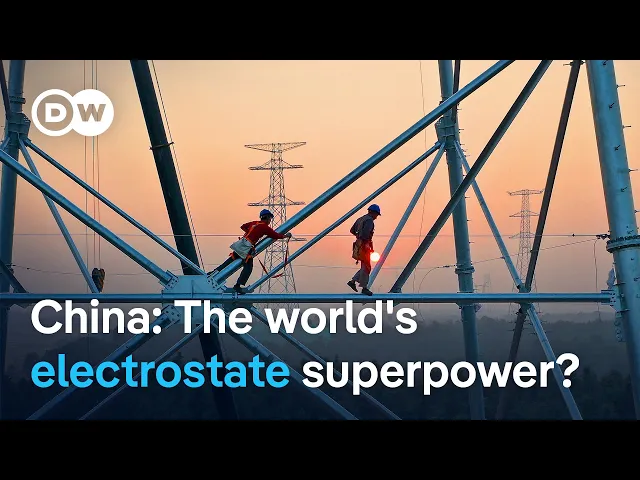
The Iran war is turbocharging China's bid to become the world's first electrostate | DW News
DW News
0:00 Far far away from the straight of Hormuz,
0:02 something really interesting is happening.
0:05 Countries are changing their energy strategy almost overnight.
0:09 Decisions that might have once taken years are being made in weeks.
0:13 So, we're seeing some really interesting dynamics playing out in Asia,
0:17 in Europe, in North Africa, in number of places around the world.
0:20 Um, in Asia, some are calling it the Ukraine moment for Asia.
0:25 the um the analogy being that in Europe after Russia's invasion of Ukraine,
0:31 we realize the extent to which um
0:33 European countries were reliant on uh Russian gas.
0:38 Um and in a similar way,
0:40 Asian countries have suddenly been realizing the extent to which
0:43 they've been reliant on LG on liqufied natural gas imports.
0:47 That's Sam Gil, associate fellow at Chattam House and senior
0:50 visiting research fellow at the Oxford Institute for Energy Studies.
0:54 and he's an expert on the geopolitics of energy with a focus on China
0:59 and says that country after country is not only pivoting to renewable energy,
1:04 they are making a run for it and
1:06 a number of countries have been making plans to switch very quickly.
1:10 The Indonesian president called it a wakeup call for um electrification.
1:16 Um announced that motorcycles need to switch over to become electric.
1:21 um announced a major new solar pledge in Vietnam.
1:24 The uh largest conglomerate in the country, Ving Group,
1:28 um announced that it is cancelling the country's largest LNG fired
1:34 um power plant project and replacing it with a renewables project.
1:38 Um in the Philippines, in South Korea, they've announced uh big solar pledges.
1:43 In Egypt, there's a major new um uh solar uh project planned.
1:48 And all of this really just in the past couple of months
1:50 in response to an obvious need to um uh to make our economies resilient.
1:56 So there's a clearly a kind of strong energy security argument which is
2:01 about the volatility and um variability
2:05 and uh entanglements associated with imported fossil fuels.
2:09 Um, and for the first time really, it's it's the same argument as uh as the one
2:14 that had um has typically been associated with the climate change argument.
2:18 Uh, which is to say it's a renewable energy uh argument or at least
2:22 uh it's driving a case for non-fossil uh fuel sources of energy,
2:27 including of course nuclear as well.
2:29 Uh in Japan, there's a major conversation also about um the need potentially
2:33 to restart uh nuclear energy plants as a as a source of uh resilient energy.
2:39 Um the prime minister there has called
2:42 for uh Japan to become 100% energy self-sufficient.
2:46 Um and for them uh nuclear is a big part of that too.
2:49 The notable thing is that this no longer seems to be a partisan matter.
2:54 Remember how political parties would battle
2:56 over the merits of switching to renewables,
2:58 the costs, the subsidies, and how fast?
3:01 Now, with this global energy shock,
3:03 those ideological battle lines have kind of been set aside
3:07 as countries around the world realize they don't have good energy security.
3:12 So, you know, we're we're arguably living through, I guess,
3:15 the third sort of energy shock in some four
3:18 years after CO and then uh Russia's invasion of Ukraine,
3:21 but this one has hit much harder and faster.
3:23 And actually, it's reintroduced sort of an argument
3:26 around the need for uh renewables, non-fossil fuel sources as a way to uh
3:31 to reduce dependency on on imported fossil fuels.
3:35 So it's sort of cut the other way and arguably
3:38 created a kind of new coalition of of actors
3:40 where people who might previously been skeptical about renewables are
3:44 now realizing that there's a very strong energy security argument
3:47 for them which of course there's always been in some
3:50 countries particularly China uh which
3:52 has really seen electrification and renewables
3:54 as a major part of uh their um uh mission
4:00 to uh to mitigate um uh fossil fuel fuel reliance.
4:06 Now, China is very interesting.
4:09 Beijing absolutely needs the straight of Hormuz to reopen.
4:13 And yet, as Sam pointed out there,
4:15 it has also planned for this moment for two decades.
4:19 China's sometimes been described as a green energy superpower.
4:22 Sometimes there's a description which um I might prefer,
4:26 which is an electro state.
4:27 You know, it's a country that is becoming increasingly
4:31 um bound up with the electrification of the economy.
4:34 um as opposed to the import of molecular fuels.
4:37 You might call it green energy statecraft.
4:40 Beijing bet on renewables even as it burned through coal and oil.
4:44 Chinese policy makers decided renewable energy would be
4:47 good for the economy and good for national security.
4:51 China, you know, relies on fossil fuels
4:52 for its uh for its energy and its growth.
4:55 And yet, it's also probably the most resilient of the major economies.
4:59 It's highly diversified and highly electrified at this point.
5:02 They've really invested over the past uh two decades in building out
5:07 a you know highly electric and diversified energy system and a large
5:12 part of that has always been about mitigating the uh uh
5:17 volatility and the geopolitical entanglements
5:19 associated with uh imported fossil fuels.
5:22 Their concern particularly has been the choke point
5:24 uh around the straight of Malaca as opposed
5:26 to the straight of Hormuz and the fact
5:27 that it's patrolled by the US Navy's seventh fleet.
5:30 But it's led to very concerted um investment in clean energy in particular.
5:36 Um and that's really underpinned sort of 20 years now
5:39 of buildout of a really impressive um uh solar uh wind um
5:45 and other renewables non-fossil energy sources system leading now to um
5:51 sort of total dominance really of the clean energy supply chain.
5:55 Some 90% of solar panels are manufactured in China.
5:59 similar commanding share of uh of wind power uh turbines,
6:04 batteries, electric vehicles, um critical mineral uh processing.
6:09 Many of the components and and elements
6:11 of the supply chain that are um important
6:13 for the renewable energy transition are based really
6:16 in long-term quite patient innovation and industrial policy in China
6:20 which has really been about unleashing those technological
6:23 forces becoming the leading supplier of the um
6:27 uh new technologies needed for a carbon constrained
6:29 world and have been really tied up with energy
6:31 security arguments rather than uh just being about
6:35 environmental concern which has sort of been where
6:37 I guess the association in in Europe Europe
6:39 in the west uh has been there's always been a very tight understanding that um
6:43 or tight relationship between energy security and climate action
6:47 in China and I think that argument is
6:49 now starting to resonate uh in other other economies.
6:52 Remember those countries mentioned earlier Indonesia,
6:55 Vietnam, the Philippines, Japan.
6:58 Okay, so they've recognized that it's not great
7:01 to be overly reliant on oil and gas, but switching to renewables will require
7:06 buying a lot of renewable energy infrastructure.
7:09 You know, the actual solar panels,
7:12 the massive blades for wind farms from one major source, China.
7:17 Yeah, I think the bind is particularly difficult for um so-called middle powers,
7:23 countries in Europe, countries in Southeast Asia who are um looking,
7:28 you know, quite seriously to decarbonize their economies
7:31 and they're facing at least three challenges at once.
7:33 One is how to decarbonize rapidly.
7:36 U something something their publics want to see,
7:38 something that they need to see um in order to mitigate
7:40 the sort of vulnerabilities and dangers associated with climate change.
7:44 But they also want to keep costs down in a an environment where um inflation
7:49 has also spiked particularly as a result
7:52 of the war and they're concerned about security.
7:55 They're concerned about dependencies.
7:56 So how can you balance um that so-called sort of trillemma?
8:00 It's a really uh difficult ask and in Europe for example uh
8:05 people worry about are we uh moving from one dependency to another.
8:09 Are we are we moving away from you know a dependency
8:12 on Middle Eastern oil much as uh you know we also had one
8:15 on uh at least in parts of Europe on Russian gas towards
8:19 a dependency on uh Chinese supplied components for a renewable energy system.
8:26 Um and at the same time of course the US is a wild card.
8:29 It also um you know to a greater or lesser extent is uh sort
8:34 of forcing the hand of uh of countries that are sort of caught in the middle.
8:39 um on in supply chains.
8:40 So it's a really difficult bind for countries and it and it
8:44 means that geopolitics is completely bound up with those clean energy choices.
8:49 Countries face few good options but Sam makes the point
8:53 that at least with renewables once you build out the infrastructure which
8:57 again will depend on buying from China but once you do
9:01 in the medium and long term you will be in better shape.
9:04 But I will say that there is a difference between fossil fuel energy imports
9:09 and renewable energy systems in so far as you can't actually blockade the sun.
9:15 You can't blockade the wind.
9:16 There is a there's a difference in once you build out these systems,
9:20 they do provide greater resilience um uh from the kind
9:25 of entanglements uh and volatility associated with imported fossil fuels.
9:30 What's special about this moment is that we may be at an inflection point.
9:35 Adopting renewables has been a constant policy fight,
9:38 but this time because of this war,
9:41 the pivot away from oil and gas might be real.
9:45 And if that's the case, there's no going back.
9:48 I think any energy shock actually helps
9:51 to create the argument for the alternatives.
9:54 And previous energy shocks have done the same.
9:56 What's different about this one is not only
9:58 that it's happened so fast and in such
10:00 a sort of hard and unpredictable fashion um
10:05 but also actually that the alternatives are really there.
10:07 They're mature.
10:08 Uh renewable energy systems are coming in at uh
10:11 at a cost that means they can be installed and at scale
10:14 and the the technology exists and and there's of course
10:17 willing suppliers and mature industries that can do so.
10:21 So it kind of feels different as a result and I think as a result yes
10:24 there might be some immediate snapback as uh
10:27 fossil fuel prices fall again as they will.
10:30 Um but then I think the cost of renewables will continue
10:34 to fall as they have consistently over the past um decade
10:39 or so and we'll see the increasing adoption of electric vehicles again
10:44 because the argument is sort of being one on its own terms.
10:46 the um you know the technologies are coming in at a price point that works
10:50 for consumers um that work for governments
10:53 and they also have the added um security benefits
10:57 of of increasing the resilience of our economies
11:00 in in a context of greater tensions and uh
11:04 and a need to extricate ourselves from some
11:06 of the dependencies associated with um imported oil.
11:10 So what do you think?
11:11 Are we seeing a real moment when the world finally fully goes for renewables?
11:16 And how do you feel about China as the world's electrostate superpower?
11:21 Let us know in the comments.
11:23 That's all for now.
11:24 DW News is giving you the latest and also sharing
11:26 deep dives on here and across the rest of social media.
11:30 I'm Melissa Chan.
11:31 Until next time.