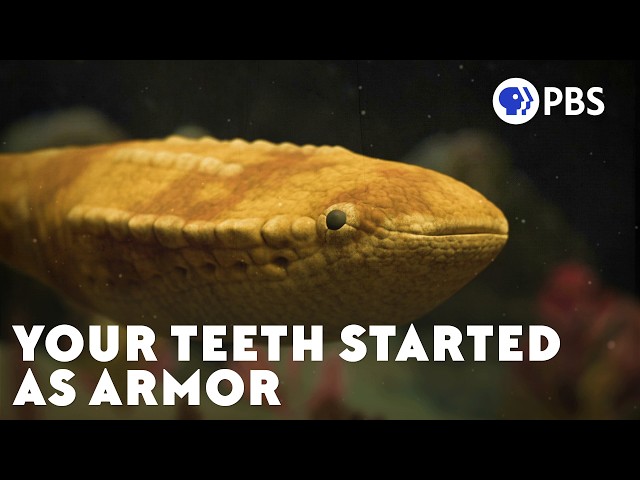
Your Teeth Went From the Outside In
PBS Eons
0:00 Around 450 million years ago, one of our ancient fishy ancestors,
0:06 still boneless and jawless, began building itself some armor.
0:10 Arapticius had a built-in shield that had evolved to do more than one job.
0:15 It not only protected its head,
0:17 but it also provided key information about the shallow,
0:21 murky waters surrounding it.
0:23 And believe it or not,
0:24 this shield was laying the groundwork for our toothaches of today.
0:28 If you've ever experienced dental pain,
0:30 you've probably wondered why our teeth would evolve to function
0:34 like an oversensitive or sometimes straightup faulty alarm system.
0:39 To find the answer, we have to go way back to when
0:42 teeth first evolved as part of the armored skin of ancient fish.
0:52 Life's tough in the ocean.
0:53 It's a fish eat fish world out there.
0:55 [music] It's also an arthropod eatish world and a mollisk
0:59 eat fish world and all kinds of other combinations.
1:02 And that's not only true today,
1:04 but it was hundreds of millions of years ago, too.
1:06 The world's animal diversity seems to have really taken off
1:10 in the early Cambrian period around 530 million years ago,
1:13 bringing a bunch of new predators onto the scene.
1:16 And this would have put pressure on a lot of different
1:18 organisms to find ways to avoid falling victim to a deadly bite.
1:23 Our vertebrate ancestors began solving this predator
1:26 problem some 500 to 460 million years ago when they started to armor up back
1:31 when all fish were still boneless and jauntless.
1:34 Armor was a great place to start because
1:36 it could both act as a protective coating
1:38 on otherwise soft bodies and also stiffen those bodies
1:42 improving a fish's ability to swim away from danger.
1:45 Apticius was one of the first examples that we know
1:48 of of a fish embracing an outer armor made specifically of denton.
1:53 Now, dentin might sound kind of familiar.
1:55 It's the hard tissue in our teeth.
1:58 Dentin, dentist, you get it.
2:00 And when we're talking about body armor, we're talking about odontos,
2:04 also known as dermal teeth, which means, yep, skin teeth.
2:08 Atticius's armor covered its head because if
2:11 you're going to start protecting key body parts,
2:14 well, brains are pretty important.
2:16 But this thin body armor stopped there.
2:18 It didn't extend to anywhere else on its body.
2:21 Now, we don't totally know why ancient fish like erupticius armored up,
2:25 but there are a lot of hypotheses, many related to fending off attacks,
2:30 but some scientists also wonder if their hardened exterior might have
2:34 served as a place for their muscles to attach to, for example.
2:38 Their environment might have played a major role in the ship,
2:41 too, because living close to shore, like Arapticius did, came with sacrifices.
2:46 Like, some minerals become less abundant where salt meets fresh water.
2:50 So maybe these protective elements might have
2:53 actually been a form of mineral storage.
2:55 Plus, as a shoreline dweller instead of an open water swimmer,
2:59 protecting the noggin from not only predators,
3:01 but also from surface bumps and scrapes seems
3:04 like a pretty good strategy for Epticius to adopt.
3:07 So while we don't know for sure exactly what triggered it,
3:11 ancient fish likely armored up for at least
3:13 one or maybe several of these reasons.
3:16 But with this hard external layer came another complication to work around.
3:20 [music] See, fish have always needed to pick up cues from the water.
3:24 And since fish are cold-blooded,
3:25 they rely on the external environment to regulate their temperature,
3:29 which means constantly monitoring changes that can
3:31 tell you if you're in the wrong
3:33 place and need to head to cooler or warmer waters, for example.
3:37 And that's not all that fish are perceiving from the water.
3:39 Chemical signals, electrical currents,
3:42 and mechanical waves are all important factors to pick up on as well.
3:45 So evolving sensors on the outside of their bodies makes a ton of sense.
3:50 But how could fish balance the need for sensors
3:53 with the need for a layer of protection?
3:55 Well, Arapticius had a built-in workaround.
3:58 Their external dermal teeth were full of tiny branching tubes.
4:02 Thanks to a bunch of pores that opened to the surrounding waters,
4:05 these interconnected tubes [music] probably transported
4:08 important information from the external environment inward.
4:12 And underneath this dentin was a soft pulp cavity that connected to its
4:16 internal nerve systems which would have
4:18 passed along that external sensory information.
4:21 This means that exposed porous denton
4:24 surface would have [music] allowed for strong
4:26 and immediate but brief sensations to tell them about the world around them.
4:30 This would have been key for Aptiticus given that maintaining a strong
4:34 sensory connection to their environment would be vital for their survival.
4:38 Especially in the shallow,
4:39 murkier waters they called home where the specific cues you're
4:43 looking for might be more subtle than in more open waters.
4:46 They might be literally buried in the muck.
4:49 So, while this early fish didn't have a whole lot of body armor overall,
4:53 the dentin plates on their heads offered some early protection of key
4:57 soft tissues while also keeping them tuned in to the outside world.
5:01 And another armored jawless fish that lived around the same time,
5:05 estraspus, put their own twist on the special outer layer.
5:09 Their name appropriately means star shield, referring to the shape of the tubes
5:13 within their dentinladen [music] dermal teeth.
5:16 But a Straspus was a little different in that they
5:19 were working with even more head protection than erupticius.
5:22 They had an extra coating of hard mineral buildup over their dentin,
5:27 similar to, but probably not quite like the enamel we have on our teeth.
5:31 Enamel is the hardest tissue found in all vertebrates today.
5:34 So having something even close to it would have been great for extra protection.
5:39 And not only did Araspus have this extra layer on its built-in hard hat,
5:43 but its dermal teeth also changed throughout its lifetime,
5:47 toughening up underneath that extra hard layer
5:50 by filling in the sensitive pulp layer below.
5:52 Now, like Aerpticius, Estraspus was found in shallow shoreline habitats,
5:57 so it was probably another bottom dweller.
6:00 But given their bulked up protection measures, Estraspis may have had an even
6:04 greater need than Aripicius to protect themselves.
6:08 not only with that outer layer, but with their filled in pulp,
6:11 they seem to be creating a buffer from intense
6:13 sensations that would stem from a greater dentin exposure.
6:17 And while we don't know exactly why that is,
6:20 the likes of a Straspus definitely started to change the game
6:23 in how our early ancestors hardened up from the outside in.
6:27 Fish continued to evolve and change over millions of years,
6:31 and their skin teeth were along for the ride.
6:33 Take Andre Lepus for example,
6:35 a 420 million-year-old fish that didn't just have dentin on their head.
6:40 Instead, they were fully covered in protective dermal teeth.
6:44 And Andre Lepis not only had skin teeth,
6:46 but also teeth teeth of the mouth variety.
6:50 Much like their dermal teeth, these mouth teeth were also made of dentin
6:54 and were shed and replaced as they aged.
6:57 Andrea Lepis one up the Straspus in the protective layer
7:00 department with scales covered in the really tough stuff enamel.
7:04 They still didn't have any true enamel on their teeth though.
7:07 So even when enamel first began to evolve in fish as a protective structure,
7:12 it still didn't cover their teeth.
7:14 But it wasn't long before fish finally started to fully
7:17 embrace the really hard stuff and enamel became more widespread.
7:22 Shortly after Andrea Lepis, give or take a couple million years,
7:26 Sarah Lepus arrived on the scene in the late Siluran period,
7:29 and this bony fish took safety very seriously.
7:33 Not only were the scales on its body protected with enamel,
7:36 but unlike Andreolus, Sarpus' enamel made its way onto the head,
7:42 reinforcing the dermoplates for seriously strong noggin protection.
7:46 In Sarah Lepus, the thick dermal plates that protected its head had big pores,
7:51 likely creating a pathway of sorts to maintain
7:54 some communication lines from the outside in.
7:56 And this new enamel protection wasn't just keeping Sarah Lepsa's brain safe.
8:00 The dermal teeth on their head covered
8:02 their lips and even went down into the nostrils.
8:05 But even with enamelcovered scales lining their mouth,
8:08 they still had naked dentin on their teeth.
8:11 Though their teeth did have some mineral protection, it was nothing like enamel.
8:15 This delayed appearance of added dental protection may seem strange,
8:20 but it actually makes a lot of sense.
8:22 Carnivores need a lot less tooth protection than herbivores
8:25 because they're just not as hard on their teeth.
8:28 It's a lot of grab, tear, swallow, and not a lot of grind and chew.
8:32 But mouth tooth enamel did finally arrive on the scene
8:35 a little later in the Deonian just under 400 million years ago.
8:40 It coated the chompers of early sarcopter ridgians.
8:42 The group all tetropods, four-lim vertebrates, eventually took off from.
8:47 Once enamel joined forces with dentin inside the mouth,
8:50 they strengthen the teeth for a better bite,
8:53 making them tougher and less likely to crack.
8:56 So, while it took some time to do it,
8:58 dermal teeth flipped the script from protecting
9:01 when attacked to gearing up as an attacker.
9:04 And from there on out, enamel played a key role in supporting dietary diversity,
9:09 allowing tetropods to really branch out
9:11 into completely new culinary avenues like plant eating.
9:15 Taking a closer look at our teeth today,
9:17 we can see the soft inner pulp full of fibers that pass along important sensory
9:22 and chemical information through our nervous system.
9:25 That pulp is overlaid with dentin,
9:27 which like in our fishy ancestors remains full of tiny tubules.
9:32 And finally, our dentin is capped off with a generous layer of enamel.
9:36 Our thick enamel is what allows our teeth to do so much crunching and grinding.
9:40 But those layers of dentin underneath that also protect our teeth will still
9:44 let us know that the insides are
9:46 conversing with the outsides under certain conditions.
9:49 Whether that's from damage to the enamel like cracks and cavities
9:52 or cold temperatures or seemingly innocuous food choices like sugar.
9:56 And the level of pain felt is often
9:58 extremely out of proportion to the damage being done.
10:01 especially in some cases when no damage is being done at all.
10:05 After all, a sip of cold water isn't exactly giving us frostbite.
10:10 But all this makes a lot more sense given the context of our teeth's beginnings.
10:14 Our ancient ancestors were keen on sensing the world around them.
10:18 But as they shifted habits and habitats,
10:20 their sensory bits became covered with harder and harder materials.
10:24 So even when they started covering their bodies with dentin for protection,
10:28 they maintained the ability to pick up
10:30 on all those different cues of temperature, chemical signals, and more.
10:34 These protective coverings later made their way in to cover their teeth, too.
10:39 But underneath that tough enamel cap still lies Denton,
10:42 just itching to share all kinds of info with its soft pulp interior,
10:47 making [music] us painfully aware of our fishy origins.
10:56 As revolutionary as teeth were,
10:58 they would go on to disappear in some groups of vertebrates.
11:01 But why?
11:02 Find out in our episode how vertebrates got teeth and lost them again.
11:06 Truth be told, this month's eontologists are the best.
11:12 Addie Annie and Eric Higgins, Carl Wolfful,
11:15 Jackie Scott Ralston, Jake Hart, John Davidson, Ing,
11:18 Juan M, Melanie Lamb, Carnival, Nico [music] Robin,
11:21 Raphael Hass, Tony Dy, and of course, Steve.
11:24 Become an Ionianite at patreon.com/eons.
11:27 You can get fun perks like a monthly
11:29 digital puzzle of paleo art commissioned by Eons.
11:32 And as always, thanks for joining me in the Annie and Eric Higgins studio.
11:36 Subscribe at youtube.com/eons for [music] more prominods in the Paleozoic.
11:51 and then this part I will need help with.
11:53 Oh, wearing two belts.
11:54 That's okay.
11:55 Belts on belts.
11:56 That's very fantasy.
11:57 Your pants are so secure.
11:59 Do I have pet hair to bottle?
12:01 Okay.
12:01 I cast balm.