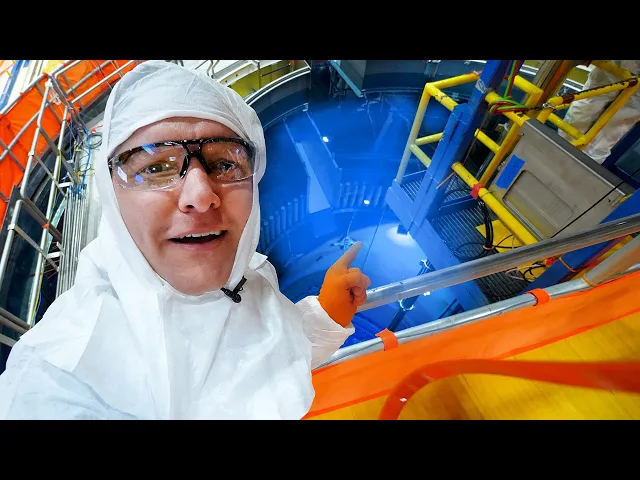
Refueling a NUCLEAR REACTOR - Smarter Every Day 311
SmarterEveryDay
0:00 [Destin] Is that a hot rod?
0:01 [Man] It is very hot.
0:03 [D] That's a very hot rod.
0:04 [M] YES.
0:04 [Chuckles knowingly] If that comes out of the water, we would no longer be here.
0:07 None of us up here.
0:08 [Destin] Really?
0:09 Really.
0:10 Hey, it's me, Destin.
0:10 Welcome back to Smarter Every Day.
0:12 I am so incredibly excited to share this video with you.
0:16 I have never experienced anything like this.
0:19 I've wanted to learn about nuclear power for years,
0:22 but I purposefully kept myself ignorant.
0:25 I deep dive into aerodynamics and all material of science, things like that.
0:30 But nuclear power is this thing that I
0:33 didn't want to approach until the time was right.
0:36 I'm telling you the time is right.
0:38 We're about to learn about nuclear power by seeing it
0:42 and by meeting the people who are making nuclear power.
0:46 And just we're going to walk inside an active nuclear power plant,
0:49 not just on any normal day.
0:51 We're going to walk in to a power plant on the day that they're refueling it.
0:56 They're taking old the fuel rods out and putting new fuel rods back in.
1:02 And we're going to see how they do that.
1:04 And it has totally demystified nuclear power for me.
1:08 This experience just changed how I feel about a nuclear
1:12 power plant being just down the road from where I live.
1:15 It's awesome.
1:16 So this is what I would ask of you to do for you.
1:19 If you would just watch the video as if you're there with me and we're walking
1:23 around and we're asking the questions together
1:26 and we're experiencing it and give yourself some grace.
1:29 Because there are moments where I have no
1:31 idea what's going on, and I'm just asking questions.
1:34 And I think it's okay to not know what's happening and then just let it happen.
1:38 And then later on in the video, we'll understand more about it.
1:41 So this is a really neat experience.
1:44 I hope you really enjoy it.
1:45 This is unlike the access most people get to the nuclear industry.
1:49 So this is very, very special.
1:52 And I want to thank the people that let this happen.
1:54 This is the culmination of months
1:57 of coordination and training and people working
1:59 behind the scene to give us this very special look into a very special
2:03 place you can't just take a camera here you have to have the proper
2:07 training and a ton of people made this happen I'm so grateful for that.
2:11 But let's go to an active nuclear power plant
2:14 and learn about nuclear power in a very real way.
2:17 Let's go get Smarter Every Day.
2:22 So something's about to happen that we've been wanting to happen forever.
2:26 We're going to get to go to a nuclear plant,
2:28 and this is my friend, Phillip, who forever...
2:32 I've called him Jimmy Neutron, as long as I can remember.
2:36 And the thing about Phillip is he's very moderate, very level.
2:42 How would you say...
2:43 Not very expressive.
2:45 This is his angry face.
2:47 This is also his happy face.
2:50 This is his excited face.
2:52 And that's who you want working in a nuclear plant, I feel.
2:56 Yeah?
2:56 I'm the most boring man you'll meet.
2:59 I have to get extra medium shirts.
3:02 Extra medium?
3:04 Okay.
3:05 All right, George, we're going to go to a nuclear plant.
3:08 You excited?
3:09 [G] I'm so pumped.
3:10 [D] All right.
3:10 There it is over there.
3:12 Where are we at, Phillip?
3:14 [P] We are leaving the training center And you are just east of the plant.
3:18 [D] What's the name of the plant?
3:20 [P] This is Browns Ferry Nuclear Plant.
3:22 [D] All right.
3:22 This is the third largest nuclear plant in the United States, correct?
3:27 [P] I don't know.
3:29 [Both laughing] It's one of the biggest ones.
3:31 [D] I believe it is.
3:32 But you guys have three units, correct?
3:34 [P] We have three units.
3:35 We are the only plant that has all three units under one roof.
3:44 [D] Watch your step Interesting.
3:46 Yeah, the safety at nuclear plants, I've heard, is over the top.
3:51 [P] Oh, yeah.
3:52 We have rules on how to climb a flight of stairs.
3:54 [D] Really?
3:55 [P] It's crazy.
3:58 But people rarely get hurt, so I guess it works.
4:02 [D] There you go.
4:03 What's up, Bill?
4:04 [B] Hey, how are you doing?
4:05 [D] Doing well.
4:06 All right.
4:07 So this is the security?
4:08 [B] It is.
4:09 This is our Westgate house.
4:10 So we're getting to the plant.
4:11 [D] Okay, cool.
4:12 Sounds good.
4:13 Bill, what's your deal here at the plant?
4:15 [B] I work with the instrument shop right now.
4:17 I've worked here for about 15 years.
4:20 I'll spend my some time in operations as a licensed operator.
4:25 [D] Is this where I need to cut off the camera for security stuff?
4:28 [B] Yeah, that's probably a good spot.
4:29 [D] Okay, we're all cut the camera here.
4:31 We just went through a lot of security that I'm not allowed to show you.
4:34 And it's pretty intense.
4:36 There's a lady that you'll probably see on camera here in a minute.
4:38 She's got a rifle.
4:40 I feel comfortable with that.
4:42 That's pretty good.
4:43 Well, we want to make sure everybody stays safe while they're working here.
4:45 [B] We don't want any issues, the wrong people be in here, right?
4:47 [D] So when you come in to work every day, you've got to go through that.
4:50 [B] Yes, sir, every day.
4:51 [D] All right, good.
4:51 All right.
4:52 Bill, what we have here?
4:53 [B] So these are our two buildings.
4:54 You'll see the larger building over here is our reactor building,
4:57 our shorter building over here is our turbine building.
5:00 Reactor building has got the reactors that are housed in there.
5:03 It's really a secondary containment just in case something went awry.
5:06 And then our turbine building over here is where we
5:08 got our turbine and our generator where we produce our power.
5:11 And then you can actually over here see all
5:12 the lines that are coming out of the plant.
5:14 That's where we supply 500,000 volts to the valley,
5:17 which goes to the substations out there to our homes, really.
5:21 Neutrons, electrons.
5:23 [D] So the reactor is actually in there.
5:25 And then this is the generator, turbine, all this.
5:28 And then that's where it's distribution.
5:31 The security stuff, it's pretty serious.
5:34 [B] I think so.
5:35 [D] Yeah.
5:36 Am I allowed to say what we had to do to get in the building?
5:40 [B] I mean, yeah, you can.
5:41 [D] But biometrics.
5:42 [B] Yeah.
5:43 [D] Biometrics.
5:44 Yeah, that was and not normal biometrics.
5:49 Browns Ferry nuclear power plant is run by TVA, the Tennessee Valley Authority.
5:55 It's a public corporation created during the New Deal,
5:57 coming out of the Great Depression,
5:59 to help manage and protect and use the Tennessee
6:01 Valley's vast waterway system as effectively as possible.
6:05 And today, it's become a major energy provider in the area,
6:08 pushing power out to over 10 million people.
6:11 This plant, Browns Ferry, was constructed in the 1960s and 1970s,
6:15 companies and is a huge deal for my local community.
6:18 We headed down to what's called dosimetry,
6:20 where we would be checked in and given devices called dosimeters that would
6:24 track our exposure to ionizing radiation as we move throughout the plant.
6:29 This video is a part of a deep dive series
6:31 on nuclear power that we're doing here on Smarter Every Day.
6:34 In a previous video, we learned about these dosimeters when George and I had
6:38 to undergo radiation training in order to enter the plant today.
6:41 If you want to go deeper into nuclear power, check out this series.
6:44 It's pretty cool.
6:45 You can subscribe on YouTube if you're into that, or you can sign
6:48 up for the email list on smartereveryday.com when the new videos come out,
6:52 I'll send them to you.
6:53 In an earlier video in the series, we explored EBR-1,
6:56 the first nuclear reactor to generate electricity and put it on the grid.
7:00 There's so much more that we're going to learn about in this deep dive,
7:03 from how we handle radioactive materials to future
7:07 nuclear technology to how to deal with nuclear waste.
7:10 In upcoming videos, we're going to explore all
7:12 this and learn everything we can about this important energy option.
7:15 But right now, let's get back to the plant.
7:17 How's it going?
7:18 I'm Destin.
7:18 [Amanda] Destin, nice to meet you.
7:19 [D] Nice to meet you.
7:20 [A] Okay, just one at a time.
7:22 I'll need you to step into...
7:27 [D] This?
7:27 [A] Yes, the gem five.
7:29 [D] Okay.
7:31 Sounds good.
7:32 [A] A little room here.
7:34 [D] And so what are we doing here?
7:35 You said your name was- Amanda.
7:37 I'm Destin.
7:38 Yeah.
7:38 [A] Radiation protection.
7:40 I'm the one that issues dosimetry.
7:42 [D] Oh, great.
7:43 [A] Yes.
7:43 [D] Awesome.
7:44 So I go right in here?
7:45 [A] Step in, face the wall.
7:47 [D] Face the wall?
7:50 [MACHINE] Three, two, one.
7:51 [A] Be careful stepping out.
7:53 This little device, as far as it's your dosimeter of legal record.
7:59 [D] Okay.
8:00 [A] When this is read, it has dose on it.
8:03 When you log in, you'll have a self-reading dosimeter.
8:07 It's real-time.
8:07 [D] Okay.
8:09 I'll carry these with me at all times, right?
8:11 [A] Well, when you go into the RCA, you'll log into the SRD,
8:15 but this will be on your person all time.
8:17 [D] Okay.
8:18 Got it.
8:20 Do you track this for everybody in the entire plant?
8:22 [A] Anyone who has to go in the RCA, yes.
8:25 [D] Wow.
8:26 That's amazing.
8:27 [A] About 2,000.
8:28 During an outage, it could be anywhere from there to 4,000.
8:33 [D] Wow, that's amazing.
8:34 While we're waiting on dosimetry, this is Angela.
8:37 [A] Hi.
8:38 [D] What instructions did they give you?
8:40 [A] No, they just said just to be with you all,
8:42 just in case anything happened, and we needed to escort you all out.
8:45 [D] You're more intimidating than I expected.
8:47 [A] Really?
8:47 [D] You are.
8:48 Yes.
8:48 [A] Thank you.
8:49 [D] You're welcome.
8:52 Ma'am?
8:52 [A] You can hold this.
8:54 [D] Oh, thank you so much.
8:55 So this is my dosimeter.
8:57 [A] Dosimeter, yes.
8:58 [D] I should feel a bond with this.
9:00 [A] Yes.
9:00 [D] Okay, thank you.
9:01 [A] Do not lose it.
9:02 [D] Okay, great.
9:03 Thank you.
9:03 Are you excited to bond with your dosimeter?
9:05 [G] I just can't wait to meet it.
9:07 [D] There's a lot of stuff.
9:13 Good thing I have three chins.
9:16 Start clipping stuff to my chins.
9:18 [B] That's why I have the beard.
9:20 [D] That's why you have the beard?
9:21 [A] Are you excited?
9:22 [D] I'm very excited.
9:23 Did you see me do a little dance just then?
9:27 [A] It's good to have people excited here.
9:31 [D] That's good.
9:33 I'm seeing a lot of beards, man.
9:35 I don't have a beard.
9:36 Do they issue you that beard?
9:38 [Bearded Man] Yes, they do.
9:40 [D] He just got a mustache.
9:41 I don't have facial hair.
9:42 I don't feel like I can be here.
9:43 Bill thought I might find it interesting to check
9:45 in with some of people in the executive offices.
9:47 So we went upstairs and met Lionel Locke, the safety manager.
9:51 What's up, man?
9:52 [L] How are you doing?
9:52 I'm Lionel.
9:53 I'm Destin.
9:54 Nice to meet you.
9:54 [L] Nice to meet you.
9:55 [D] Yeah, pleasure.
9:55 Lionel, I have heard a word over and over
9:58 ever since I got here, and it's outage.
10:02 I've heard the word outage.
10:03 What is an outage?
10:05 [L] An outage means that the plant, when it's running, it's online.
10:09 That means we're making power, putting it out there in the transmission system.
10:12 We got to turn the plant off,
10:14 cool everything down open everything up so we can fix the valves,
10:18 fix the motors, and do the maintenance of the plant.
10:20 So we're not creating any power, we're not generating any electricity.
10:23 But this is a monster.
10:25 There's three units,
10:26 and it's a challenge to manage not just the unit that we have an outage,
10:30 we still have two reactors that are running.
10:32 So it's always a challenge, and it's a good team.
10:34 It takes a solid team to manage all of this.
10:37 Some of the other sites that may just have one unit,
10:39 a little easier for them because they just got that one unit in an outage.
10:42 That's all they got to focus on, but we're
10:43 still producing power with two other units.
10:45 [D] Okay, so there's three units.
10:47 Bill, there's three units here?
10:48 [B] Yes, sir.
10:49 [D] Okay.
10:50 What are the unit one, unit two, unit three?
10:53 Is that what you call them?
10:53 [B] Yes, sir.
10:53 Each operating at about 4,000 thermo megawatts,
10:56 putting out about 1,350 megawatts electric to the grid.
10:59 [D] What's going down for the outage?
11:01 [B] Right now, Unit 2 is down,
11:04 and we're refueling that and performing all the work that Lionel discussed,
11:08 and Unit 1 and 3 are operating.
11:10 [L] We are refueling outage.
11:12 Refueling outage means we are literally taking the spent fuel out,
11:16 putting in the spent fuel pool,
11:17 and we got around 330 new assemblies that we're putting inside the core.
11:21 You have your coal plants that have
11:23 railroad cars constantly coming in with coal.
11:26 We can run two years off of a reef,
11:28 off the nuclear fuel that we put in the pot for this outage.
11:31 [D] That's happening today.
11:32 [L] Right now, as we speak.
11:33 [D] So this is a big day to be here.
11:35 [L] Yes, it is.
11:35 [D] And this is why you brought me in on a Saturday.
11:37 [B] I did.
11:37 Yes, sir.
11:37 [D] Thank you so much, man.
11:39 Lionel, thank you.
11:40 [L] Appreciate it.
11:41 [D] Is this a fuel bundle, Bill?
11:43 [B] Yeah, actually, that is a mockup of a fuel bundle.
11:45 [D] So this is what we're refueling today?
11:48 [B] That's right.
11:49 Yeah.
11:50 This is the ATRIUM-11, I believe.
11:52 It is the style on this one.
11:53 [D] Okay.
11:53 [B] These are your fuel rods.
11:55 Actually, you got a good view of the fuel pellets here also.
11:58 [D] So these are the pellets.
12:00 All right.
12:01 And so we're pulling these things out with a crane and putting them back in?
12:04 [B] Correct.
12:05 Yeah.
12:05 [D] So these fuel rods are where the magic happens,
12:07 and I want to talk about it so much.
12:10 Someone actually sent me a book after one of the first videos in this series.
12:14 I opened the book.
12:15 It's made a a long time ago.
12:16 Sure enough, the exact reactor for Browns Ferry nuclear power plant is in there.
12:21 Look at that.
12:22 Those are the fuel bundles.
12:23 And I have been researching this so much.
12:26 The thing specifically I want to talk about
12:28 is the difference between a boiling water reactor,
12:30 which is what Browns Ferry is, and a pressurized water reactor.
12:34 But we just don't have time for that in this video.
12:36 But in a future video, we're going to talk to an internationally
12:39 recognized expert named Bill Williamson.
12:41 This guy knows so much.
12:43 We are going to learn this stuff, but this video is just not the place to do it.
12:48 But for now, let's go talk to the guy that's over this nuclear power plant.
12:52 [B] Trying to hide from us?
12:54 I got some people that wanted to meet you, Quinn.
12:58 What's up, Quinn?
12:59 [Q] Hey, man.
12:59 good to see you.
13:00 [D] How's it going?
13:00 [Q] Good.
13:01 [D] Yeah.
13:01 So I'm Destin.
13:02 [Q] Yeah.
13:03 [D] We met during my training, right?
13:05 [Q] Yeah.
13:05 [D] All right.
13:05 So I met Lionel, so far as safety guy, and you're the plant manager, right?
13:09 [Q] Correct.
13:09 [D] So I learned about the outage.
13:12 So we're in an outage.
13:13 No, not plant, unit Two.
13:15 Two is down.
13:16 Is that what that means up there?
13:18 [Q] Yeah.
13:18 So one of the benefits of the plant
13:20 manager's office is megawatt meters for all three units.
13:22 [D] Is that real?
13:23 [Q] Yeah.
13:24 [D] Absolutely real?
13:26 Okay.
13:26 [Q] So you can see two is down.
13:28 One is at 100% power.
13:30 Three is right at 91% power right now.
13:34 We're coming back up to 100 from the outage that we talked about.
13:38 [D] Okay, so how long does it take to come up to...
13:40 What is 100% in terms of megawatts?
13:42 [Q] About 1300 on a good cold river day.
13:45 [D] What do you mean by cold river day?
13:47 [Q] When the river's cold, it allows us to improve our vacuum and the condenser,
13:52 which improves our megawatt output.
13:53 [D] Really?
13:54 [Q] Yeah, it's temperature dependent.
13:56 [D] Tell me, when you see these dials up
13:59 here like this, what does that make you feel?
14:01 [Q] The one on the left makes me happy.
14:04 [D] Okay.
14:05 Yeah.
14:06 [Q] The one in the center is expected, right?
14:09 Every two years, you have to take a unit
14:12 down to change out a third of the nuclear fuel.
14:15 And that's what we're doing.
14:17 That's what you'll go see here in a little bit.
14:19 So they're moving fuel in and out of the core.
14:24 [D] And the one on the far right, are you comfortable with that?
14:27 [Q] No, I like it to match the one unit one.
14:30 [D] So what I've been told is that nuclear plants, you want it to be boring.
14:37 [Q] Yeah, absolutely.
14:38 Absolutely.
14:39 Hot, straight, normal, 100% power.
14:40 Just sit there.
14:41 [D] Really?
14:42 So steady-state.
14:43 [Q] Yeah.
14:43 [D] So how long does it take to bring a plant down for an outage,
14:46 and then versus how long does it take to bring it back up?
14:49 [Q] So the way we do it for refueling outages, it takes about 12 hours.
14:54 We start around 9: 00 in the morning,
14:57 derating in steps, and then we can go in a various...
15:01 We're a BWR, which is boiling water reactor,
15:04 which means we have contaminated systems throughout the whole station.
15:09 There's areas that we can't access at 100%
15:12 power that we can access at 40% power.
15:15 We'll go in at 40%.
15:17 We'll come down from...
15:19 This last time we were coasting,
15:21 we were down around 80% power because our fuel was running out.
15:24 We were coasting down from 100 down to 80.
15:27 Then we started our outage, so we came down around 40 power,
15:32 took heaters out of service, did some inspections, looking for leaks,
15:36 looking for stuff we would need to fix during the outage
15:38 so that we had the right scope for the outage.
15:40 [D] You start ramping down.
15:42 You take an assessment because you can go more places.
15:45 [Q] That's right.
15:45 [D] Then at that time, you start planning for the outage.
15:48 Do you keep it at 40%?
15:50 [Q] No.
15:50 We come down to around 20% and then insert what we call a manual scram.
15:55 [D] What does that mean?
15:56 [Q] There's two big red buttons in the control room.
15:58 You can see those.
15:59 Operator pushes those and all the rods go in.
16:03 Bwr, they come in from the bottom.
16:06 It immediately shuts down the reactor.
16:08 [D] Okay, so what is a BWR?
16:11 [Q] A boiling water reactor means it's
16:13 designed to have boiling inside the reactor vessel.
16:17 Pressurized water reactors don't have mass boiling in their reactors.
16:22 They have nucleate boiling,
16:23 which means tiny little bubbles form on the surface of the fuel and then
16:28 immediately collapse because pressure is so
16:30 high that it doesn't turn to boiling.
16:33 We essentially are at saturation conditions inside the vessel.
16:39 We run around a thousand pounds, a thousand PSIg, which equates to what?
16:45 About 500 -[B] About 570 degrees.
16:47 Seventy degrees.
16:48 [D] Even though it's called a boiling water reactor
16:50 and the other one's called a pressurized water reactor,
16:53 you're still boiling under pressure here.
16:55 [Q] Yeah.
16:56 But we're designed to have mass boiling.
16:59 We have a huge pocket of steam inside the pressure vessel, which PWRs don't.
17:05 [D] Okay.
17:05 Like the old locomotives, the steam locomotives,
17:07 they had a big reservoir on top of steam.
17:10 [Q] Yeah, right.
17:11 That's right.
17:11 [D] What temperature will that steam be?
17:13 570, you said?
17:14 [Q] Yeah, about 570.
17:16 [B] The moderate temperature is about 570.
17:17 Yes, that's right.
17:18 [D] So these are literally the steam tables.
17:19 [Q] Yeah.
17:22 Let's see.
17:23 Saturated steam.
17:26 [D] Because every nuclear plant is just a steam plant, right?
17:30 [Q] Correct.
17:31 Ultimately, you're creating steam to drive a turbine.
17:33 So about 550.
17:35 [D] So you went to PSI, pounds per square inch.
17:42 You went down to 1,000, right?
17:44 [Q] Right.
17:46 [D] That's where this BWR operates.
17:48 Then the temperature that water boils is in this area.
17:52 [Q] About 550.
17:53 [D] About 550.
17:54 It's just physics.
17:56 We're going to see unit 2 open, which makes sense because we're in an outage.
18:03 [Q] It's flooded up, too.
18:04 You'll be able to see.
18:05 As a part of refueling, we take those concrete blocks off,
18:10 we take the drywell head off,
18:11 we take the reactor pressure vessel head off and put them on stands,
18:14 and then we flood it up, flood the water level up equal to the spent fuel pool,
18:19 and then we remove some shield blocks,
18:22 and then we just lift the fuel up, move it over and put it down.
18:26 So it's one big pool.
18:27 [D] Thanks, Quinn.
18:28 [Q] Thank you.
18:28 [D] What's this?
18:29 [B] We got some hard hats for you.
18:30 Some safety equipment for when you get out in the plant.
18:33 Great.
18:33 [G] Oh, we get a lanyard.
18:38 [D] Bill's making me do more training.
18:40 What am I doing?
18:40 [B] You're doing some form material training.
18:42 So one of the things with the core, it's open, right?
18:45 So we You want to make sure that there's nothing
18:47 that could potentially drop off you and fall onto the core.
18:50 We have methods of retrieval, obviously,
18:52 and if something happened, we'd be okay.
18:55 But what I want to make sure is that you understand the rules
18:58 and regulations associated with going over the core
19:00 and As far as foreign material goes, we don't want to drop something.
19:03 [D] I don't drop something.
19:04 I'm taking training, so I don't drop camera pieces or anything in the core.
19:08 [B] That's right.
19:08 [D] I guess the point is, I'm not just going over an open nuclear reactor.
19:12 This is a coordinated event,
19:14 and we're going to have to be careful about how I hold things, right?
19:18 [B] Yeah, absolutely.
19:18 [D] Okay, cool.
19:19 Thank you.
19:20 Okay, time to dress out.
19:26 I don't feel naked, but I feel less clothed.
19:32 [P] Well, you are.
19:34 [D] Okay, cool.
19:35 Where are we going exactly?
19:36 We're going over the fuel?
19:38 [B] Yeah, we're going to go on the refuel floor bridge.
19:40 [D] What is this?
19:41 Can we look at this?
19:43 [B] Yeah, actually, that's a really good picture right there.
19:45 What they're doing is this is a picture of our core uncovered right here.
19:49 [D] That's where we're going?
19:51 [B] Yeah, there's a bridge that's sitting over there,
19:53 and there's almost near about 100 feet of water that's over all that fuel.
19:58 We're going to ride a bridge, a crane,
20:00 essentially, that goes over there and moves the fuel.
20:02 [D] Is that what is happening here?
20:04 I'm seeing a camera.
20:05 Is this on the crane that's moving?
20:07 [B] Yeah, that's on the mast on the crane.
20:08 That's all the way down.
20:10 Right now, there's another portion that you're not seeing.
20:11 The spent fuel pool.
20:12 That's where they're at right now.
20:13 But there's a mast that goes all the way down into the core,
20:16 and it'll latch onto the fuel, and we'll move the fuel.
20:19 [D] This blue that I'm seeing, is that Cherenkov radiation or is that lighting?
20:24 [B] Well, that's probably lighting over there.
20:27 You'll see this, some Cherenkov.
20:29 When we moved, when we pick up On the bundle here, you'll probably see it,
20:32 but there is a blue glow that'll be around the fuel itself.
20:37 [D] Is this a crane operator actually grabbing things?
20:40 [B] That's right.
20:41 You'll see it when we go over the next bundle, but there's an open claw,
20:45 and then the camera is in the open claw,
20:48 and then it'll sit down on the bundle, and it'll latch onto the bundle.
20:51 [D] Really?
20:52 Okay, cool.
20:53 All these are different fuel.
20:54 Man, it's crazy.
20:55 It's just like the claw game, almost.
20:58 They're just putting things in the little slots.
21:00 [B] Yeah, they've all got specific places where they're supposed to go.
21:04 We keep very close track of where everything's at.
21:07 There's a lot of, I guess I'll say, poisons, especially in the spent fuel pool,
21:12 where we make sure that we can put the fuel,
21:15 and the fuel in the stays subcritical at all times.
21:17 [D] This is the reactor?
21:21 [B] This is the reactor.
21:22 [D] Then this is the spent fuel pool.
21:23 [B] Well, the crane is going over to the reactor at this point in time.
21:27 It was in the spent fuel pool.
21:29 Now you'll see it come over the reactor here.
21:31 [D] Whoa, that was a cool reveal.
21:33 That was pretty neat.
21:35 So this is what the reactor looks like?
21:37 [B] Yeah.
21:38 [D] Okay, so I guess this is a question I have.
21:40 So we've got cameras.
21:43 Phillip, you were saying don't use like a non-cotton fabric.
21:48 You're saying that's bad, right?
21:50 [P] Not necessarily bad.
21:52 Synthetic fibers tend to have more static electricity,
21:55 and the static is what radon gets, it will adhere to it.
22:00 When the radon attaches to it,
22:01 [D] I'm not going to be able to get this out because the RP won't let me.
22:05 [P] Right.
22:06 It'll set off the radiation detectors.
22:08 Then you can, most of the time, you can just let it sit for a little while
22:13 and it will decay and you can get it out.
22:16 It might be the next day, but- [B] That radon is all naturally occurring.
22:20 [D] That's not from the plant.
22:21 [B] That's not us.
22:23 [D] The RP personnel that I learned about in the safety training,
22:27 the people that have to scan you so that you can come out,
22:29 they have to make sure that you're clean.
22:32 A lot of times, radon is the stuff that gets on your bag,
22:35 and that'll set off their detectors and you can't get it out.
22:37 [P] Yeah.
22:38 [B] Right.
22:38 [D] Okay.
22:38 [P] Same thing with your clothes.
22:40 If you wear synthetic fibers, polyester, or nylon,
22:44 stuff like that, it does the same thing.
22:47 [D] Got it.
22:48 [B] You're about to pull a fuel bundle out of the core,
22:49 and I think you'll actually see this rank off effect here when it comes out.
22:52 [D] Really?
22:56 He's trying to grab it first?
22:57 [B] Yeah.
22:59 Actually, what they're doing is they're on the bundle,
23:02 and they've each got unique identifiers, serial numbers.
23:05 You can see it right here.
23:06 They're going to verify that they're on the right bundle.
23:09 Then once now he's sitting on it, and then he'll latch onto it,
23:12 and then he'll make sure that he's got a good hold of it,
23:14 and then he'll bring it up.
23:15 [D] This is what you used to do, isn't it?
23:17 [B] I did this for a little while, yeah.
23:18 [D] What do you call this person?
23:20 [B] I was the reactivity manager over the fuel handler.
23:23 [D] Fuel handler.
23:24 Okay, cool.
23:25 So he's securing?
23:26 [B ]Yeah.
23:29 [D] Is there some video we can get of this?
23:32 [B] Absolutely.
23:32 [D] Are they recording this?
23:33 [B] They are.
23:36 [D] So now he's flying the bundle, or she, whoever it is.
23:41 [B] There's just a Cherenkov effect right there.
23:43 [D] Oh, yeah.
23:47 How far above the pool will we be?
23:49 [B] See, really well in the hole right there, which is vacated.
23:52 We're about to head to the plant.
23:54 We're going to swing by RP.
23:55 They're going to give us a RWP, a Radiation Worker Permit.
23:59 We're going to sign in to go into the plant.
24:01 We're going to understand our dose limits and all that type of stuff.
24:04 Then when we get up, I'll take it up to the floor,
24:06 and then when we get up to the floor,
24:07 you and I are going to change the jobs that we're
24:09 doing because we're going to go out on the bridge.
24:10 You and I will have another RWP we'll log on to.
24:13 I have written down the reasons why you should use the sponsor for this video.
24:17 It’s gonna be the simplest sponsorship ever.
24:19 .....It’s FREE.
24:20 The thing I’m gonna tell you about is free.
24:24 and it’s GOOD.
24:25 It’s AnyDesk AnyDesk is remote control software where
24:29 you can control a computer from a different location.
24:33 Let’s see what else I wrote....
24:35 (What the paper says) You can control computers from you phone.
24:40 If you have a machine that you’ve gotta run..
24:42 and there’s a dedicated computer to it.,,,
24:43 You can figure out a way to use AnyDesk To be at that machine when you’re not.
24:48 So you can be at other places...
24:49 For example, last week I went to fall break with my family
24:53 I got to see dragonflies in front of a sunset.
24:56 They were swarming.
24:57 It was the coolest thing ever.
24:58 I got to see those dragonflies because of AnyDesk.
25:01 They let me control my computer That was
25:04 editing a video that I’m working on (this one).
25:06 They let me control that computer...
25:08 from the beach.
25:09 It was a really big deal.
25:10 Let’s see what else we have here.
25:11 Uh..
25:12 it works on tons of platforms.
25:13 It can work on a Mac vs a PC.
25:16 You could work Linux.
25:16 There’s all kinds of platforms that AnyDesk works on.
25:19 {What the thing says} No joke...
25:22 I’ve worked on my PhD stuff...
25:23 I think I’ve talked about that on here before..
25:25 I’ve worked on machining stuff, I’ve worked on editing..
25:28 I use this product all the time.
25:30 It’s really, really good.
25:31 Which is why...
25:32 If you want to try it for FREE you can
25:35 go to AnyDesk Dot Com Slash SMARTER Just check it out,
25:38 see if you like it, if you don’t, that’s fine you’ve lost nothing.
25:41 AnyDesk dot com slash SMARTER Give it a shot,
25:44 they know you’re gonna like it and they know you might
25:46 take it to work and get a business account at work.
25:48 THAT’s where they make their money.
25:49 But for you, a consumer, it’s FREE.
25:51 So...
25:51 yeah.
25:52 AnyDesk dot com slash SMARTER.
25:54 Big thanks for AnyDesk for supporting Smarter Every Day.
25:57 I’m grateful.
25:58 I think you’re gonna love the product.
26:00 I only talk about things here on Smarter
26:01 Every Day that I genuinely use and love.
26:03 AnyDesk is one of those.
26:05 So...
26:05 yeah!
26:06 Consider it.
26:06 AnyDesk dot com slash SMARTER I just had to take
26:11 a bunch of training about foreign material dropping into the pool,
26:14 and so I'm hyper aware of that right now.
26:17 [B] It's the one thing we do.
26:18 I mean, it's taking weeks to get you in here.
26:20 The only thing we've done is really just train you for a week,
26:22 pretty much, before we got in here, right?
26:24 [D] Yeah, absolutely.
26:25 [B] We want to make sure you're prepared.
26:26 Yes and yes.
26:27 All right, buddy.
26:29 Hey, what's going on?
26:32 [B] That's an interesting fellow right there.
26:35 [D] Yeah?
26:36 [B] He's our valve guy.
26:38 [D] A valve guy?
26:39 [B] Yeah.
26:40 [D] You have a whole guy just for valves?
26:41 [B] Yeah, we have a couple of guys just for valves,
26:44 but he's our lead guy for valves.
26:46 Sitting there and he's going...
26:47 We've only got one right now.
26:49 I'm like, Well, that's a little different than the ten.
26:51 [D] Can I see your tattoo real quick?
26:53 Yeah.
26:53 That's awesome.
26:55 That's cool.
26:56 Thanks.
26:58 Pretty good.
26:59 I think this is RP?
27:03 This is RP.
27:03 [B] Yeah, this is our briefing station before we head out
27:06 in the plant to make sure we understand what RWPs we're getting off.
27:08 [D] That's good.
27:09 When you go to log in, It's going to ask
27:12 you to scan the front of your dosimeter first,
27:15 scan that barcode, and you're going to scan.
27:17 It's going to say, Bet scan the back.
27:19 It'll be that barcode.
27:20 It's going to ask you for a work order number.
27:23 Type this number right here, that's 125, 129, 292.
27:29 then it's going to give you a drop-down box.
27:31 Hit the little arrow, and that's going to be the only number that's available.
27:34 It ends in that 121, okay?
27:36 [D] Yes, sir.
27:37 That's going to be you all's RWP.
27:38 It's going to get you all up to the refuel floor,
27:40 traveling through Unit 1, Bill will take you all in the office.
27:43 You can check in up there.
27:44 Now, when you get up there,
27:45 make sure you let them know your set points for your RWP is
27:48 5 millilre rim dose alarm and 40 millilre rim per hour dose rate alarm.
27:52 That's fairly low to be going on the refuel floor.
27:55 That would determine where they're going to allow you to go or if
27:57 they want you all to be on a different RWP with higher set points.
28:01 Okay?
28:02 [G] Five and 40?
28:03 Five and 40.
28:04 All good?
28:04 Just make sure that the technicians that you talk to up there know that.
28:07 [B] Yeah, I will.
28:12 All right.
28:12 Let's get you one of these.
28:15 [D] We can grab any of them.
28:17 [B] Well, we want a smaller one.
28:18 We don't want a screamer.
28:21 [D] A screamer meaning a loud one?
28:23 [B] Yeah.
28:23 If you're in a high noise area.
28:26 Okay, so we're going to go to a white trip ticket area.
28:30 White.
28:30 Anyone that says white is fine.
28:32 Put your dosimeter in there first.
28:36 There you go.
28:38 Yeah.
28:40 Then it's going to ask you to scan the back.
28:44 Now, this is where you pull up your view of your RWP.
28:47 Click RWP.
28:51 This is what we talked about earlier in the training, right?
28:54 [D] Mm-hmm.
28:56 So every worker does this.....
28:58 [Beeping in background] [B] You are granted access to the RCA.
29:05 [D] That's a pretty big deal.
29:06 [B] And then you're going to put that right next to your DLR.
29:09 [D] Sounds great.
29:10 Here we go.
29:11 I'm about to go in.
29:12 So you've been saying for years you didn't ever think this would happen.
29:15 [P] No, I really didn't think Bill would pull this off.
29:18 [Everyone laughing like little kids] [D] So we're actually about to do it,
29:22 which is a pretty big deal.
29:24 Bill, are you proud that you pulled it off?
29:26 [B] Let's not give me all the credit because if this goes awry,
29:28 I don't want to be the one that goes down, man.
29:30 [D] [Laughing] [D] But it's a pretty big deal to be
29:33 able to take a camera into a place like this.
29:35 [B] It is a huge deal.
29:35 [Guy walking by]: Philip!
29:36 That's what I'm talking about baby!
29:38 Get in there!
29:38 [B] It's exciting.
29:39 [Everyone is laughing at dude walking by] [B] Is that Kevin?
29:42 [P] Yeah Alright, so...
29:44 Here's what we're going to do.
29:45 We're going to go in the RCA.
29:47 You're going to put your dad on here.
29:49 Phil will go in last.
29:50 Just make sure you're all good.
29:51 You get the green light and we'll go in.
29:54 Okay.
29:54 Now you got your hard hat.
29:56 [D] Yes, sir.
29:57 [B] If glasses, ear protection, DOR, and your dad, right?
30:01 [D] Yes, sir.
30:01 [B] Good to go.
30:03 [D] Great.
30:07 Currently, I have zero millirem.
30:10 [B] Remember, we're going in an industrial environment,
30:11 so it can get a little loud, okay?
30:13 [D] Yes, sir.
30:14 [B] All right.
30:14 You all ready?
30:16 Let's go.
30:22 [D] So we're in the RCA now?
30:30 [B] We are actively in the RCA.
30:31 That's correct.
30:33 [D] It's very clean.
30:35 [B] It is.
30:41 Video.
31:06 [B] Okay, so what I'm about to take
31:08 you into is the secondary containment area, right?
31:10 You'll notice that there's some locked
31:11 doors and everything like water tight doors.
31:13 We do this intentionally because this is
31:15 our absolute last means if something bad happened, that's where we keep it all.
31:19 We keep this area at a negative pressure just to make sure we
31:22 keep all the containment products inside secondary
31:24 containment if something were to have happened.
31:26 That's why you see the doors like that.
31:28 [D] That's an air and a water door.
31:31 [B] A flow tight.
31:32 Yeah, it's not really an air door.
31:33 It's mostly a water door.
31:34 [D] Okay, I see.
31:36 Do we have to badge in to go?
31:38 [B] Yeah, we're going to have to badge in.
31:39 So I'm first in.
31:50 We're going to walk up to the elevator through
31:52 the operating spaces because there's less traffic over this.
31:55 [P] Before we go any farther,
31:57 when you see the floor drains, don't step on those.
32:00 They're a lot of times contaminated.
32:02 [D] Okay.
32:03 So be looking for floor drains.
32:17 [B] We have 185 control rods.
32:19 It's 185 of these accumulators,
32:21 which will assist the control rod to enter the vessel in the event of a scram.
32:26 [D] Got it.
32:28 So they're individual pressure tanks with check valves to maintain pressure?
32:31 [B] Effectively, yes.
32:32 [D] Okay.
32:35 So it's contaminated just because water has gone down into it?
32:38 [B] At some point in time.
32:39 The surface is most likely not from where we're at, but inside those drains,
32:44 there may be some contamination.
32:46 We don't know.
32:47 And getting into the drains and free-releasing it is very difficult.
32:50 So we just say, Stay out of it.
32:52 [D] Don't touch it.
32:53 Got it.
32:54 I'm getting no dose.
33:02 [B] We're going to go up to the fourth elevation.
33:04 We'll pick up our C zone close that I suspect they're going
33:07 to ask us for, and then we'll head up to the refuel for it.
33:09 [B] Okay.
33:12 [D] What RP you on?
33:13 Or how do you say?
33:14 RWP?
33:15 RWP.
33:15 I'm on 252-00022.
33:20 [D] Is that how I would say that to you?
33:21 What RWP you on?
33:22 Yeah, that's typically how it goes.
33:24 [D] It's more like how long till lunch.
33:26 That's what we normally talk about.
33:27 Something like that.
33:30 [D] This is a big motor.
33:37 [B] Yeah, they're abandoned in place at this point in time.
33:40 That's how we used to control the speed
33:41 of the research before we had static control.
33:44 So we moved over to the research drive.
33:45 But these are some big old motor generator.
33:47 [D] It's easier just to leave them there.
33:48 [B] Yeah.
33:50 [D] Abandoned in place.
33:54 Interesting.
33:55 So we're going to dress out here?
33:57 [B] No, we'll take our stuff up to the refill floor and get briefed up there,
34:01 but we're going to grab our booties and everything here.
34:04 [D] Okay.
34:04 Are you getting one for each of us?
34:06 [B] I can, yeah.
34:10 [D] I'm scared to touch anything.
34:12 [B] That's good.
34:13 Stay that way.
34:13 [D] Stay that way?
34:14 [B] No.
34:15 I have no clear plastic.
34:17 Do you have any clear plastic?
34:18 [D] I have no clear plastic.
34:19 Thank you.
34:20 [D] Thank you.
34:24 [B] Your license?
34:29 I do that.
34:30 [D] How are you all doing?
34:31 Good.
34:32 How are you?
34:32 So you're the RP?
34:34 Yes, sir.
34:35 [D] If there's one thing I learned in that training is to say Mother,
34:37 may I to you before I do anything.
34:41 I don't really.
34:42 That's what he is going to love these guys.
34:45 Yeah.
34:46 We've been briefing him up.
34:50 This will be my test for him.
34:53 What do you think they're going to do to me?
34:55 You're going to get the We're trying to get all that stuff out of the way.
34:59 You think so?
35:00 Yeah.
35:00 Trying to get that on the bridge?
35:02 Yeah.
35:02 Got to see the cameras.
35:04 Good luck.
35:05 A lot of straps.
35:07 A lot of straps.
35:09 Yeah.
35:09 What's your name?
35:10 [T] Trenton.
35:10 [D] Trenton.
35:11 I'm Destin.
35:11 Nice to meet you.
35:12 I didn't like that handshake.
35:13 Let's do it again.
35:14 That's a better one.
35:15 How long you been here?
35:16 In terms of years.
35:17 Yeah, nuclear.
35:18 [T] 2011.
35:19 [D] Really?
35:20 [B] Just me and Destin will be...
35:23 Yeah, we're going to take the other guys up to the Crow's Nest,
35:26 and Destin and I we'll be out on the bridge.
35:29 [D] So you're RP?
35:30 That's right.
35:31 I'm going to get you ID.
35:33 18504.
35:35 [D] Always be nice to people on the elevator.
35:37 They might be your RP later.
35:38 Now I got to ask you what your RP means.
35:41 [D] My RWP is- Don't start stuttering now.
35:44 [D] 121?
35:46 Is that it?
35:47 That's my work order.
35:50 It's 125 129 292.
35:52 [B] That's your work order.
35:54 You're right.
35:54 Your RWP is 121.
35:55 [D] Yeah, 121 is my work order.
35:58 [B] Your RWP.
35:58 [D] RWP.
35:59 Da gummit.
35:59 What's your ID number on that?
36:01 [D] My ID number is 37467.
36:07 So you're being on 25.
36:08 Like I said, you're being on 25, 200, Dose alarm is 60 millirem,
36:15 the dose rate alarm is 250 millirem per hour.
36:18 All right, this is what our RWP looks like when you go to look at it.
36:22 Got your description.
36:23 This is for refuel floor activities.
36:26 It's for high radiological risk,
36:27 so this will gain you entry into higher radiation areas,
36:30 even though we don't have one post where you all will be at.
36:36 But just in case moving things around the water,
36:40 high radiological risk is a possibility,
36:43 which is why your dose long thing is 60 millirem around.
36:47 So the area where you'll be at on the bridge.
36:51 If you look over there.
36:52 The orange part?
36:54 Yes.
36:55 If you look at this top right Here.
36:58 I'm going to go wait a bit.
37:00 This is the bridge.
37:03 See all these people on here?
37:04 [D] Yes, sir.
37:05 That's where ya'll be at.
37:08 [D] Yes, sir.
37:10 Dose rates up there are about one to two millirem an hour.
37:16 So that's where we come to our dose rate alarm.
37:18 Your dose rate alarm is set to 250 millirem an hour.
37:22 On the bridge, you shouldn't get close to that at all.
37:25 [D] Because of the water.
37:26 Because of the water.
37:27 Water's your shield, waters your mediator.
37:30 We got stop work criteria.
37:34 In the event of a dose alarm, our unanticipated dose rate alarm will notify RP.
37:41 That's a microphone.
37:42 Oh.
37:43 I was just having a hard time hearing it.
37:45 Oh, there we go.
37:46 Yeah, stop work criteria.
37:49 In the event of a dose or a dose rate alarm, immediately notify RP.
37:55 Stop work will leave the area.
37:58 We have air monitors on the north side.
38:02 So if you hear those go off, and you'll hear them go off,
38:06 that means everyone in the C zone or on the floor
38:09 will evacuate and will help that transition We'll leave the floor entirely.
38:15 [D] Will RP be on the Bridge?
38:17 We will have RP in the zone, and they will be covering the Bridge.
38:21 We have telemetry, so we can constantly monitor the dose rates in the area.
38:33 So right here, you see these little dose rates?
38:37 [D] Yes, sir.
38:38 So that's for inside the 360 platform and that's for on the Bridge.
38:45 So if you look back to our screen over here,
38:49 you'll notice on the left camera, there's a 360 platform here.
38:55 So we have RDS 31s monitoring the dose
39:00 where the workers are actively working in the 360.
39:05 So this just helps us see the progression of dose rates in the area from afar.
39:13 That way we can let anyone know what's going on.
39:17 [D] So you've got instrumentation right there,
39:19 and we're going to be on the bridge right there where they are, correct?
39:23 [RP] Correct.
39:24 [D] And then so you're monitoring it in real-time,
39:27 and because the RWP is active, you know that we're out there.
39:30 [RP] That's correct.
39:31 [D] Okay.
39:32 [RP] Yeah.
39:32 So everyone's covered all the way around, both ways and backwards.
39:36 [D] Sounds good.
39:37 Right now, I'm at 0.
39:39 1 millirem an hour, which is nothing.
39:42 [RP] right.
39:42 Now you're about to sign off out here and sign on to...
39:47 Because you probably come up on what?
39:48 71?
39:49 [B] It came up on 121.
39:51 [RP] 121.
39:52 We're going to sign on to 252-000-92.
39:55 [D] Yes, sir.
39:57 Then my rate alarm will go up.
40:00 [RP] Right.
40:01 So your set points will change.
40:02 You'll go to a dose alarm of 60 millirem
40:05 and a dose rate alarm of 250 millilrem an hour.
40:07 [D] Cool.
40:08 Thank you.
40:09 I appreciate.
40:09 What was your name?
40:10 [RP] Christian.
40:10 [D] Nice to meet you, Christian.
40:11 [C] Nice to meet you.
40:12 Yeah.
40:12 All right.
40:13 Now, as you stop back by this window, we got a full brief on it.
40:18 We do a reverse briefing.
40:19 Yes, sir.
40:21 The dose alarm and dose rate alarm,
40:23 we usually typically what we do is say, Hey, what's your dose alarm?
40:29 You repeat back to me what the dose alarm is.
40:32 Which would be 250.
40:34 Then I ask you, What's your dose rate alarm?
40:36 [D] Sixty.
40:37 You say 250.
40:39 It's 250 millirem per hour?
40:40 250 millirem per hour.
40:41 Yes, that's Dose rate.
40:42 [D] What's my limit dose?
40:43 Is it 60?
40:44 It was 60, so I said that backwards.
40:46 [D] Okay.
40:47 Yes.
40:47 The dose rate alarm is 250, and the dose limit is 60.
40:53 Yes, sir.
40:53 Millirem.
40:54 [D] Millirem.
40:54 Once a millirem, and once a millirem per hour.
40:57 [D] Yes, sir.
40:57 So the dress out is going to be a full dress
41:01 out with the single dress out with the hood on the bridge.
41:07 That's to protect you because you're going to go into a contaminated area.
41:11 The contamination levels in the area on the bridge is less than 1,000 DPM,
41:15 per cm square, up to 2,000 DPM, per cm, going to sell this.
41:21 Low-level contamination, minimal dressout.
41:25 We have several different This is the same dress out,
41:27 so this would be the minimal dress-out.
41:29 [D] We're not going to be quite to the level he is,
41:30 or is it going to be the level he is?
41:32 This is the same dress-out as.
41:34 [B] You want a hood and a skullcap?
41:36 Yes.
41:36 [B] Okay.
41:37 We'll have to get a hood.
41:38 Okay.
41:38 Appreciate it, guys.
41:39 Okay.
41:40 My max is 60.
41:42 My rate is 250.
41:43 It's a single.
41:44 Then you do want to send hood and skullcap.
41:46 Right.
41:47 Then it gets a little bit tougher, 80% of 60.
41:50 [D] 80% of 60 is 40.
41:54 Hold on.
41:55 It's 60 minus 12 Which is 48.
41:59 At 48, yeah.
42:00 [D] At 48 is when I need to start looking for the door.
42:02 Right.
42:03 Okay.
42:03 That'll be the time you have to be back away.
42:06 [D] Yes, sir.
42:06 Other than that, Christian brief you on the dose rates on the bridge.
42:15 Now you have the information for the contamination levels on the bridge.
42:19 You did a reverse briefing.
42:22 Is there any questions or concerns?
42:25 [D] I have a question for you guys.
42:27 What do you guys think I'm going to get dose-wise while I'm in there?
42:30 You're around about 0.
42:32 5 millirem per hour.
42:33 0.
42:34 [D] 0.5?
42:35 What do you think my total is going to be?
42:36 It's going to be based on time.
42:37 It's going to be 0.
42:38 5 millirem per hour.
42:39 You're going to be in there an hour.
42:40 Okay.
42:41 Okay.
42:42 Cool.
42:42 Thank you.
42:43 Appreciate it.
42:44 All right.
42:45 You're welcome.
42:45 [B] You're not going to be in there an hour.
42:47 [D] Mr.
42:48 Somers, right?
42:49 [S] Yes, sir.
42:51 Yeah.
42:51 Thank you, Mr.
42:52 Somers.
42:52 Appreciate it.
42:53 Thanks, Christian.
42:53 What was your name?
42:54 Jonah.
42:54 Jonah?
42:55 Nice to meet you guys.
42:56 All right.
42:57 Sorry.
42:59 [B] All right.
42:59 Welcome to the refill floor.
43:00 Hey, what's up?
43:01 [D] We're on the refill floor now?
43:03 [B] We're on the refill floor.
43:04 [D] Okay.
43:04 [B] We'll go ahead and take you up for the crows nest.
43:06 This is probably the best place to be.
43:08 [J] What are you carrying in?
43:10 [B] Are you going into foreign material?
43:11 [J] Yes, that's what I was trying to figure out how to go about it.
43:15 [D] Would you like this on my head?
43:18 I met Jeffrey from FME, or Foreign Materials Exclusion.
43:22 I didn't really understand what he was doing at the time,
43:25 but he was starting a process that was happening in the background.
43:28 He looked at all the cameras that I wanted to take out over the reactor,
43:32 and he started working a solution for how to attach them to me.
43:36 [B] Why don't we come up here?
43:49 [D] We're in a really interesting place, but everybody's all business.
44:01 [B] All right, so this is our refuel floor.
44:03 You got three units up here.
44:05 You can see all three units spent fuel pools.
44:07 You can see all the bridges and everything like that.
44:09 We're currently in refueling operations on unit two right now.
44:13 They're right over the fuel pool and they're moving either blade
44:17 guides or fuel over to the reactor at this point in time.
44:19 They're actually in the process of shuffling their fuel.
44:22 [D] Okay, so I didn't realize when I heard nuclear reactor units one,
44:27 two, three, I didn't realize it was all under one roof.
44:34 [B] Oh, yeah.
44:34 [D] I didn't know that.
44:35 [B] Yeah.
44:36 It's a big building.
44:39 [D] So that's a reactor.
44:40 [B] That's right.
44:42 [D] That's That's a fuel pool.
44:43 [B] That's right.
44:44 [D] That's a fuel pool.
44:45 [B] That's right.
44:46 [D] That's a reactor.
44:47 And then what do I have going the other way?
44:48 Oh, the square first.
44:49 [B] The fuel pool and the reactor.
44:50 [D] It looks...
44:50 The fuel pool and the reactor.
44:51 [B] Three, two, and three look identical to each other.
44:52 [D] Why are these fuel pools next to each other?
44:55 [B] So they were made originally when it was constructed.
44:57 They just constructed Unit One and Two as mirror objects of each other.
45:00 Then at some point in time during initial construction, they said,
45:04 We want to add a third Unit Two, and then just mirrored Unit Two again.
45:07 It was just from an original design.
45:09 [D] I see.
45:10 Interesting.
45:10 This was made when?
45:12 [B] Back in the mid '60s.
45:14 [D] Mid '60s.
45:15 That's amazing.
45:16 I can see into the pool.
45:18 I can see the tops of...
45:21 I need to flip my camera to a tighter camera, I think.
45:23 Let me do that.
45:24 There's a nuclear reactor around that ring.
45:27 It's in the center of that.
45:29 That's unit one?
45:30 [B] That's Unit 1, correct.
45:31 [D] Here's the fuel pool for Unit 2.
45:36 Now, is this spent fuel?
45:37 [B] The square is the spent fuel, that's correct.
45:40 [D] Okay, and then the reactor is right there.
45:44 Right now, are we taking fuel out of the reactor or are we putting it in?
45:48 [B] It's a little bit of a combination of both.
45:51 We have 764 bundles in the core, and we only get about 350 new
45:56 bundles every refueling average every couple of years.
45:59 We actually reuse the fuel for about six years.
46:03 They call it a shuffle.
46:04 You may be moving a once burnt fuel is what we call it,
46:06 one cycle, moving it to a different location in the core.
46:08 [D] Got it.
46:09 [B] Right now, the main priority for fuel shuffle
46:12 one is to move the fuel in an appropriate
46:14 location so that we can access the parts
46:16 of the core that we want to do maintenance on.
46:18 [D] That makes sense.
46:20 Can you walk me through?
46:21 I see a lot of people in this room.
46:23 I see a lot of people doing different things.
46:26 This looks like there's a lot of equipment
46:28 over here that's not being used at the moment.
46:31 Is this a monitoring station?
46:33 [B] Yes.
46:33 [D] Okay, so it's monitoring radiation.
46:37 I don't see any people here.
46:41 I see these people here.
46:42 They look like they're getting ready to do something.
46:44 [B] Yeah, so you got a bunch of groups that are working here.
46:46 You've got some, I'll say,
46:48 work management individuals down here from different groups.
46:50 [D] That's what these people are doing?
46:51 [B] These guys are helping track the fuel moves that they're
46:54 on, making sure that they're on the right bundles, etc.
46:57 They're also tracking the work that's going on on the refuel floor,
46:59 reporting to our outage control center.
47:01 [D] That's why people are coming in and signing in with her.
47:04 [B] That's right.
47:04 They're just tracking the work of what's going on.
47:06 That's really what they're doing.
47:07 You got a bunch of boiler makers out there
47:10 that their job is to essentially remove or disassemble the vessel.
47:14 [D] Is that who you're seeing here?
47:16 [B] There's a couple of boiler makers down there.
47:18 There's a bunch of miscellaneous stuff.
47:20 If anything that requires any crane movement
47:22 or anything like that outside of the bridge, you got boiler makers involved.
47:25 You got floor material,
47:27 individuals out there that are tracking what form of material is going where.
47:31 [D] Okay, and then up on the bridge, they're over the reactor now.
47:34 I'm seeing some people right at the edge of the reactor.
47:37 [B] Yeah, those guys are actually part of our in-vessel inspection team.
47:41 And what they is they go and they have cameras that they put in the core.
47:45 Look at our nozzles, look at our welds,
47:47 look at all that stuff to make sure that there's no wear,
47:52 essentially, and that the life of the core is maintained.
47:57 [D] Got it.
47:58 That's an individual on the on the bridge right there.
48:01 Is that the individual getting the fuel rods?
48:03 [B] That would be the fuel handler himself, yes.
48:05 [D] Okay.
48:06 Then there's support people beside the fuel handler.
48:08 [B] You've always got a fuel handler.
48:10 He's got a peer check that's with him.
48:12 Then you have a licensed senior reactor operator
48:14 to authorize the fuel moves that are occurring.
48:16 [D] Wow.
48:17 Is there a physicist somewhere?
48:19 Is there a really smart nuclear physicist around the room somewhere?
48:24 [B] Well, there are nukes that are
48:26 watching all this, but they're in another room.
48:28 [D] That's what they're called, nukes?
48:28 [B] Yeah, we call them nukes.
48:29 [D] Okay.
48:29 [B] The reactor engineers, and they're in another room outside of here.
48:32 They just stay and limit their dose that they're receiving, right?
48:35 [D] I see.
48:36 [B] I could take you to them later,
48:38 but they're in another room over there and they're watching all of this.
48:41 They have worked with our corporate fuels guys to figure
48:43 out what the appropriate way to shuffle the core is.
48:46 [D] Got you.
48:47 Okay.
48:47 And so these people over here, if you look at my camera screen,
48:51 those people just went into the C zone.
48:53 You call it the C zone.
48:54 That means contaminated?
48:55 [B] Yeah, contamination zone.
48:56 That's correct.
48:57 [D] Okay.
48:57 So somebody's coming out.
48:59 So he's about to come down and derobe.
49:03 What do you call the act of taking off your...
49:06 Someone handed him something.
49:08 [B] Yeah, well, we had to get something into the C zone area,
49:11 so he passes what's in.
49:13 And once it goes in, it's okay, but they can't take it back out.
49:15 [D] Okay, I noticed the bridge just moved.
49:18 And what is happening now?
49:21 So is he...
49:23 He's above the reactor itself.
49:24 [B] Yeah, it looks like he's going down to get
49:26 a fuel bundle at this point in time in the pour.
49:34 He probably has one latched on.
49:36 He's coming right now through the cattle shoot.
49:38 [D] Oh, he can go straight through.
49:40 [B] Yep.
49:41 [D] You call that the cattle shoot?
49:42 [B] Yeah, it's just a generic term that we utilize.
49:46 [D] It's a gate?
49:46 [B] It's a gate that we can come through.
49:48 He'll have the fuel at the end of that crane,
49:50 and then he'll put it in the appropriate location to spend fuel pool.
49:56 [D] What is the coordinate system for where the fuel is located.
49:59 [B] There's a map down here I'm happy to show you.
50:02 [D] Yeah, I'd love to see that in just a second.
50:03 I want to watch what he does here real quick.
50:08 [B] They get over the location that they want to go either
50:10 in the core of the spent fuel pool The bridge will automate
50:13 to where it's supposed to be at, and then he'll call out
50:16 the core location or the spent fuel pool location that they're at.
50:20 Then his peer check will agree with them.
50:22 They'll lower it.
50:23 Before they latch or unlatch,
50:24 the SRO will give their authorization that it's appropriate.
50:27 [D] I actually see the hole he's about to...
50:29 Do they light up the holes where they're going?
50:31 [B] Yeah, there's some lighting down there
50:33 so they can see where they're working.
50:36 [D] I can see what he's trying to align to.
50:45 [B] Here's one of our refueling SRO's leaving right now.
50:48 [D] Should we talk to him?
50:49 [B] Sure.
50:50 [D] Sure.
50:50 [B] Hey, Sarah.
50:53 [D] I just back down that ladder because I saw you back down the ladder.
50:57 [B] That's fine.
50:57 Do you know why he did that?
50:59 [D] No, why?
50:59 This sign right here says, Hey, this is a ship's ladder.
51:04 The incline isn't appropriate for you to walk up it normally,
51:08 so you've got to maintain three points of contact.
51:11 That's He should have seen that you had all this equipment on you,
51:15 and he should have said, Hey, Austin.
51:17 Can you just say Austin?
51:19 Destin.
51:19 Destin.
51:20 I'm so sorry.
51:20 He should have said, Hey, Destin,
51:22 make sure you secure your equipment and maintain your points.
51:25 for safety.
51:26 [D] I'm What's your name?
51:27 [S] Hi, I'm Sarah.
51:28 [D] I'm Destin.
51:29 [S] Nice to meet you.
51:30 [D] Sarah, I'm torn right now because,
51:32 A, I want to appreciate you for doing that, but also
51:36 I can tell that you're talking smack to Bill.
51:39 [S] No, not well.
51:41 [B] Coach Coaching's coaching.
51:42 That's how we take it.
51:43 [D] It's coaching.
51:44 Okay.
51:44 [S] No, it's up and down.
51:46 Like 100%, this is normal.
51:48 [D] Got it.
51:50 [S] Is this your first time in a nuclear power plant?
51:53 [D] Yes, ma'am.
51:54 One second I'm gonna turn this off Sarah, what's your role at the plant here?
51:57 [S] I'm a Senior Nuclear Reactor Operator, and I'm a fuel handling supervisor.
52:02 I just came off of Unit 2's Refuel Bridge,
52:05 and we're in the process of refueling Unit 2.
52:09 We're in the process of 202 fuel moves in fuel shuffle number one.
52:15 I'm providing direct oversight of the fuel handlers.
52:20 So there's two people here where the mast is,
52:24 and then there's Allison, who's got the red gloves She's my counterpart.
52:28 She's just taking shift.
52:30 She's the fuel handling supervisor providing the oversight of the fuel movers.
52:35 [D] She's in charge?
52:36 [S] That's right.
52:37 They're operating underneath her license in her direction.
52:40 [D] She's a reactor operator?
52:42 [S] She is a senior nuclear reactor operator.
52:44 That's right.
52:45 [D] Forgive me.
52:45 What's the difference in just a normal reactor operator and a senior?
52:48 [S] You have a technical specification responsibility that you
52:55 maintain that the plant is operating within its license.
53:00 [D] Sarah, you had to train to be a reactor operator.
53:03 That's right.
53:04 What's your background?
53:05 [S] I went to Mississippi State.
53:07 I was a biology chemistry major, and I joined the National Guard.
53:11 I deployed to Iraq I came back, and my husband had come to Huntsville,
53:16 so I transferred all my hours to UAH.
53:19 I finished up my degree there.
53:20 [D] In what?
53:22 [S] In biology and chemistry.
53:24 They were not hiring in Huntsville,
53:25 so I decided to work on my PhD in biotechnology.
53:29 And finally, TVA came for a job fair, and they were not looking for engineers.
53:36 They were looking for biology, chemistry majors.
53:38 I hired on here at TVA as a chemist,
53:42 a chem tech and I celebrated 16 years here at Browns Ferry just in February.
53:48 And so I worked for nine years as a chemistry technician.
53:51 I became a supervisor.
53:53 And then three years ago, I went to a transition into Operations,
53:57 which is a two-year training program.
54:00 And I've been a senior nuclear reactor operator for about 18 months.
54:03 [D] That's awesome.
54:05 Congratulations.
54:05 [S] Thank you so much.
54:06 [D] There's a lot there.
54:07 [S] There is.
54:08 Yeah.
54:09 [D] So how long will it take them to do the refueling in total?
54:13 [S] Well, we break it up into small pieces.
54:15 Browns Ferry actually holds the record at one point
54:19 in time for a refueling outage of taking the vessel apart,
54:23 changing out, putting it all back together.
54:25 I think maybe 12 days.
54:26 Bill can correct me.
54:28 We have the record on that.
54:30 However, this refueling outage is scheduled for about 30
54:33 days because when you shut a nuclear reactor down,
54:36 you have to do all this maintenance that you can't do while online.
54:39 Imagine driving your car.
54:41 You can't change tires while driving your car.
54:43 You got to stop it, lift it up, change out the tires.
54:47 So we're doing all that maintenance that we can't do while online.
54:50 [D] Okay, so that one's an outage.
54:53 [S] Yes.
54:54 [D] But this one's operating, right?
54:56 [S] A hundred%.
54:57 [D] It It literally is 100%.
54:58 [S] Literally 100%.
54:59 A nuclear reactor loves being at 100% and just hot,
55:04 fast, and normal all the way.
55:05 [D] So I would have thought that I would be seeing something come out of there,
55:09 but it's got a cap on it, right?
55:11 [S] Well, So this is the spent fuel pool.
55:15 Over here where all that stuff is on top of it are the shield blocks,
55:19 and the reactor is hidden all the way down there inside a drywell,
55:24 and then the reactor head on top of it.
55:28 So this thing right here.
55:29 [D] The big sphere?
55:30 [S] The big dome.
55:32 [D] Okay.
55:32 [S] That is the drywell head for Unit 2.
55:36 And around the corner is the reactor head for Unit 2.
55:40 [D] Got it.
55:40 [S] That would sit inside of it.
55:42 [D] But we're We're not going to see that because that's in the C zone.
55:44 [S] I don't know.
55:45 Bill might be able to take you along this way in the clean area,
55:49 and you might be able to get a view over there.
55:51 [D] Okay, interesting.
55:52 The fact that you're refueling is the one time you get to see the reactors open.
55:57 So this is a very special time that we're here.
56:00 [S] That's right.
56:01 When you are riding this bridge and you're looking down into the vessel,
56:04 it's really, really neat.
56:05 It's just there.
56:09 You guys are here at a great time.
56:11 The water's really still.
56:13 We're not doing a lot of inspections right now,
56:15 so you're going to have great views down into it.
56:17 [D] Really?
56:17 [S] Yes.
56:18 [D] Do you have any recommendations of things I should
56:19 look for if I'm going to get on the bridge?
56:20 [S] Oh, I mean, you're going to look for the blue Cherenkov radiation.
56:24 You're going to watch for You're going to watch for how the people operate.
56:31 So don't just think about the mechanics of it.
56:33 Also think about how you're seeing people operate,
56:35 how we work together as a team to make sure it's safe,
56:39 error-free, making sure communication is crisp and clear.
56:42 [D] So the communication is very clear?
56:44 [S] Always.
56:44 [D] It's like aviation where there's a call and a call back thing?
56:48 [S] We actually have three-way communication.
56:50 You send it, they say it back, and you tell them if it's right or wrong.
56:53 [D] Really?
56:53 [S] That's right.
56:54 [D] Okay, that's awesome.
56:55 And what is the name of the lady that's the senior reactor operator?
56:59 [S] That's Allison Vagoya.
57:00 She and I actually were in class together.
57:02 And her background, she's an engineer.
57:04 She's providing direct oversight of the fuel handlers.
57:07 And so there's...
57:09 Bill's here.
57:10 He's going to tell you everything about it because Bill did
57:13 my job before he changed into being a supervisor of INC.
57:17 So he'll be able to tell you everything.
57:19 He's ridden that bridge.
57:20 He's done this job.
57:21 But Allison is going to be providing oversight
57:23 to make sure that we have no mistakes at all.
57:26 [D] Okay, so, Sarah, I've got a I have a question for you.
57:28 So you've done all this stuff you've done.
57:31 You're a reactor operator.
57:32 [S] That's right.
57:34 [D] You've moved fuel rods.
57:36 Are you comfortable with a nuclear reactor
57:38 in your backyard here in North Alabama?
57:41 Do you feel safe?
57:42 [S] 100%.
57:44 I have three.
57:45 I take pride in it.
57:46 When people are like, Oh, there's a nuclear power plant?
57:49 Where?
57:49 I'm like, Oh, Southwest of Athens.
57:51 Do you like having electricity?
57:53 Two million homes.
57:55 I roll up into some place and they're like, What do you do?
57:57 I'm like, I'm a senior nuclear reactor operator.
57:58 You're welcome for the lights.
58:01 [D] But you feel like it's all safe?
58:02 People make mistakes.
58:05 Something I've wondered about,
58:06 if this is a manmade system and people made this and people do make mistakes,
58:12 how do you know it's safe?
58:14 Is it because of the procedures or operations?
58:16 Why are you comfortable with it?
58:19 [S] We sweat the small stuff.
58:21 I just corrected you on how to use a ladder.
58:24 Did you think that- She did, yeah.
58:26 Did you think that you were going I've been a bit told about a ladder?
58:29 But that's it.
58:30 And we're always watching out for each other.
58:33 Bill's three levels above me, but he takes it as a piece of thing
58:38 of, I should have looked out for someone like that.
58:41 [D] So it's culture.
58:42 [S] It Is.
58:44 One of the great things about nuclear power is
58:47 being able to raise concerns without the fear of retribution.
58:51 And us knowing that we live here.
58:54 This is our home.
58:55 We had to take care of it.
58:56 [D] Tell me more about that, being able to raise concerns without...
59:01 [S] It's called SCWE.
59:02 It's the Safety Conscious Work Environment.
59:04 It's something that the nuclear power NRC mandates that we have.
59:08 If we had any concern, we can always bring it up.
59:11 If you If you don't feel that anyone is acknowledging your concern,
59:16 you go to the next level.
59:18 If you have to do it anonymous, if you have to go straight to the NRC, you can.
59:22 But no one is going to turn you away on a safety concern.
59:27 [D] That's awesome.
59:28 Thank you, Sarah.
59:29 [S] You're welcome.
59:29 [D] You went to Mississippi State?
59:30 [S] I did.
59:31 [D] You didn't smuggle a cowbell in here anywhere, did you?
59:33 [S] No, but it would be great if I did.
59:35 [D] Okay, great.
59:36 [B] This is your core map, and it's got every fuel bundle location in the core.
59:41 You can see the crosses.
59:42 Those are where your control rods normally sit at.
59:44 [D] How many fuel rods are there?
59:47 [B] 764 bundles on each core.
59:49 [D] 764?
59:50 [B] That's right.
59:50 [D] That is way more than I thought.
59:53 [B] Yeah, there's a lot.
59:54 [D] That's way more than I thought, okay.
59:56 You said the crosses are the Cruciform control rods.
1:00:00 [B] That's right.
1:00:01 [D] Okay.
1:00:03 This is rod...
1:00:05 How do I say this?
1:00:06 [B] It's just an X, Y, and X, Y map, right?
1:00:08 That'd be rod 4732 is what we call it.
1:00:11 4732.
1:00:11 [D] What the unit?
1:00:14 [B] Just core location.
1:00:16 It's an arbitrary unit that we put up of mappings.
1:00:19 [D] I see.
1:00:20 Got it.
1:00:21 When we're out there, what are we going to see?
1:00:25 Are they going to say, Go get this rod and go put it in the spent fuel?
1:00:29 [B] Yeah, they'll say, Coming to core location 1740,
1:00:32 and then you'll have another guy agree with the location that they're going
1:00:35 to go to the next control rod or the next time fuel bundle.
1:00:38 Then they'll go over that location, say we're on top of location,
1:00:41 and they'll lower the mast to sit on top of the fuel bundle.
1:00:43 Then they'll look to make sure that the fuel bundle in the location,
1:00:46 the serial number we showed earlier, all that matches.
1:00:49 Then once everybody concurs, the SRO will say,
1:00:51 I agree, you can engage on the bundle.
1:00:54 Then they'll engage, bring the bundle up,
1:00:56 and then they'll talk to the next location to go in the spend field pool.
1:00:59 [D] Who is doing that?
1:01:01 Who's keeping up with what rod's removed when?
1:01:04 [B] There's a FATF that we have.
1:01:07 This is what Jessica is keeping track of.
1:01:10 They have a manual one on that bridge.
1:01:13 They've also got a...
1:01:16 The bridge is automated now, right?
1:01:19 So there's actually- [J] This information is loaded into it.
1:01:22 [B] Yeah, so there's a computer on the bridge that will
1:01:25 help utilize to make sure that it's- [D] So Jessica, I noticed...
1:01:28 I'll see that mic for just a second.
1:01:30 So these are fuel bundles moving from one location to the next?
1:01:34 [J] It's showing them that they're going
1:01:36 to pick this up from a reactor location,
1:01:38 and then they are taking it to a location in the spent
1:01:42 fuel [D] So that's a location that means something to you.
1:01:45 [J] Yes, this is where that fuel bundle,
1:01:47 this is its home, and this is where it's going to rest.
1:01:50 [D] I see.
1:01:51 And it'll be there for two years or something like that?
1:01:53 [J] Not necessarily.
1:01:55 It could be going back to the floor.
1:01:57 It's just on this first fuel shuffle.
1:01:59 This is where it's going to rest.
1:02:00 It could be picked up and taken back and forth.
1:02:02 [D] I see.
1:02:03 Okay, Bill and I are about to go up on the bridge, which is a pretty big deal.
1:02:08 He's getting our work order number.
1:02:09 [B] Scroll down to RWP 92.
1:02:12 This is what we were brief to, right?
1:02:14 [D] Yeah.
1:02:14 [B] 62, 50.
1:02:15 We'll hit yes and yes.
1:02:17 All right.
1:02:17 [D] All right.
1:02:18 So that reset my dosimeter.
1:02:19 [D] It did.
1:02:22 Okay.
1:02:23 [B] All right.
1:02:24 Then we'll come over here and we'll get dressed out.
1:02:28 [D] I'm constantly thinking about where I set things down.
1:02:30 All right, so I'm getting dressed now, right?
1:02:32 [B] Yeah.
1:02:34 Thank you.
1:02:37 Thank you.
1:02:37 We don't wear our hard hats inside the C zone.
1:02:40 [D] Okay.
1:02:40 [B] Where we're going,
1:02:41 so you can take that off right now while we're getting dressed.
1:02:44 [D] Thank you.
1:02:46 I'm good without the ear pro for now?
1:02:48 [B] Yeah.
1:02:48 [D] Okay, great.
1:02:50 Christian's a smart cookie, isn't he?
1:02:51 [B] Well, they all are.
1:02:52 [D] Man, I wanted to...
1:02:54 Everything got itchy all of a sudden.
1:02:56 [B] Well, you got a couple more seconds.
1:02:58 You can scratch yourself.
1:02:59 [D] Can I scratch?
1:02:59 [B] Yeah.
1:03:00 You're not in the C zone yet.
1:03:01 [D] Oh, great.
1:03:02 [B] Scratch away.
1:03:04 Everything got itchy.
1:03:04 So how do I look?
1:03:06 Then hood over the top of this?
1:03:07 [B] Yeah, hood over the top.
1:03:08 You look pretty good.
1:03:09 Got my dad, got my TLD.
1:03:12 We're good.
1:03:13 [D] My TLD.
1:03:14 Okay, cool.
1:03:15 All set to go.
1:03:16 You're all gone.
1:03:17 You're ready to go?
1:03:19 Yeah.
1:03:20 Validate your R on RWP 25-200-092.
1:03:25 [B] Correct.
1:03:27 Your dose alarm is?
1:03:28 [B] 250.
1:03:30 Dose alarm is 60.
1:03:31 Dose rate alarm is 250.
1:03:32 Dose rate alarm is 250.
1:03:34 Millirem per hour.
1:03:35 [B] That's correct.
1:03:36 So you are good to go.
1:03:37 [D] Thank you.
1:03:46 I need to take it out?
1:03:47 [C] No.
1:03:48 So it's right here against your chest.
1:03:51 So what you'll do is you'll just...
1:03:54 [D] Okay.
1:03:55 [C] You need to get the green light to go through.
1:03:57 [D] Roger that.
1:03:57 [C] Just like that.
1:03:58 [D] Yes, sir.
1:03:59 So you all go, you all go, try that out.
1:04:02 [B] You ready?
1:04:02 [D] I'm ready.
1:04:10 [C] All right, you got the green light,
1:04:11 so you can progress [D] I'm going to hand this to you, Bill.
1:04:15 Okay.
1:04:21 Thank you.
1:04:27 [C] Do you all have any questions?
1:04:29 You can hand them to me, people.
1:04:30 There's another radiation protection mission inside the flail.
1:04:34 [D] Actually, I'll give that to you.
1:04:35 [B] Okay.
1:04:36 Yeah.
1:04:36 [C] Thank you.
1:04:37 [D] Thank you.
1:04:38 [B] All right.
1:04:39 You are in officially a C zone.
1:04:41 [D] We're in the C zone, The contaminated zone.
1:04:42 The contaminated zone.
1:04:43 [B] That's right.
1:04:44 [D] So this is the top of the reactor?
1:04:46 [B] Make sure you hold the handrail.
1:04:47 [D] Hold the handrail, yes, sir.
1:04:48 [B] This is actually the drywell right here.
1:04:50 This is the drywell cover.
1:04:56 This right here is our FME buffer zone, right?
1:04:59 These are our FME guys that are going to help us out
1:05:01 to make sure that we can get on inside that FME buffer zone.
1:05:06 How are you all doing today?
1:05:07 [B] We're well.
1:05:08 How are you?
1:05:08 We're good.
1:05:09 I'm going to get you all to sign this.
1:05:12 Yes, sir.
1:05:15 Please write as legitably as you can.
1:05:18 [D] Hard in gloves.
1:05:19 Do you remember me saying the foreign material exclusion people
1:05:22 wanted to make sure I didn't drop anything into the reactor?
1:05:26 Well, to do that, it required a lot of straps
1:05:28 attached to a lot of gear attached to me,
1:05:31 and we even had to wrangle another guy to come over and help us make it happen.
1:05:35 You're going to take the other one?
1:05:36 Yeah, I'm going to take this one.
1:05:40 What's your name, sir?
1:05:41 Philip.
1:05:42 [B] Philip's been with us for a long time up here.
1:05:45 [D] Has he?
1:05:48 Now, by signing this paper,
1:05:49 you all acknowledge all the rules and requirements of the F&B zone, correct?
1:05:52 [D] Yes, sir.
1:05:53 You all have no loose jewelry, no ear plugs on.
1:05:56 You have chums on your glasses.
1:05:57 [B] I do.
1:05:57 [D] Yes, sir.
1:05:58 All right.
1:05:59 Now, when you all go in there, you all understand everything that is going
1:06:02 on on the bridge and the work that's being performed.
1:06:04 [D] Yes, sir.
1:06:05 And these are to remain on your wrist at all times.
1:06:07 [D] Yes, sir.
1:06:08 All right.
1:06:08 You all understand everything to do to mitigate F&B risk?
1:06:11 [D] Yes, sir.
1:06:12 I took the training this morning.
1:06:13 All right.
1:06:13 [D] Yes, sir.
1:06:14 Brian, right?
1:06:14 Yes, sir.
1:06:15 [D] Thank you, Brian.
1:06:16 [P] What we do once they get back, this is over the spent fuel post,
1:06:21 we'll acknowledge it and let them know we're
1:06:23 coming on the bridge and down to us.
1:06:25 [D] Okay, Phillip, you're going to be with us.
1:06:27 [P] I'm going to hold this.
1:06:28 I'm going to hold this, and I'll hand it to you.
1:06:30 [D] It's recording now, just letting you know.
1:06:31 [P] Oh, are you going to put it?
1:06:33 [D] Feel free to just point it places.
1:06:35 If you find something interesting, feel free to point it, or don't.
1:06:38 [B] Before you all walk in, I need to look at the bottom of your feet,
1:06:40 make sure there's nothing stuck to it.
1:06:42 [D] Yes, sir.
1:06:42 Tell me when you'd like to do that.
1:06:44 [B] Right before you walk in, first of the night.
1:06:46 [D] Okay, so we're not in the zone yet.
1:06:48 [B] We are in the C zone.
1:06:49 We are not in that four material battery.
1:06:51 [D] Two different levels.
1:06:52 [B] That's right.
1:06:53 [D] Yeah.
1:06:53 Okay.
1:06:54 [P] He's going to go over there and put it in the trainer.
1:06:56 When he puts it in the trainer, we'll have about 30 seconds.
1:06:59 We're going to get on the train.
1:07:00 [D] Phillip, what's your role here?
1:07:02 [P] I'm an OSK Boilermaker.
1:07:04 [D] A Boilermaker?
1:07:05 [P] Yeah, OST.
1:07:06 Honest Service Technician.
1:07:08 [B] He just talks like it's no big deal.
1:07:10 This man disassembles the reactor vessel for So he knows what he's doing.
1:07:13 He knows exactly what he's doing.
1:07:14 [D] Okay.
1:07:14 So he's humble, too.
1:07:15 [B] He is very.
1:07:16 [D] All right, Brian.
1:07:19 [B] Good.
1:07:21 Good.
1:07:21 Enjoy yourself, sir.
1:07:24 [D] All right.
1:07:25 Good Philips enjoying this.
1:07:30 So that's the reactor right there.
1:07:33 That's the reactor.
1:07:36 [B] We got waived on by the SRO.
1:07:38 Go ahead, Destin.
1:07:39 You go in front of me.
1:07:40 [D] Yes, sir.
1:07:52 [B] You got the chain?
1:07:54 Thank you.
1:07:55 [D] Hello.
1:07:56 That's been doing well.
1:07:57 How are you?
1:07:59 Thank you.
1:08:00 We're at the cleaner.
1:08:02 [D] Where would you like me?
1:08:03 [B] Staying over here away from everybody.
1:08:04 [D] Yes, sir.
1:08:05 [B] You're in a really unique spot.
1:08:07 I have never seen anybody,
1:08:09 never taken anybody up here for this particular I've never seen this happen.
1:08:13 [D] This is a big deal.
1:08:14 [B] It's a huge deal.
1:08:17 Right now, you're over the spent fuel pool.
1:08:19 You can see we have coordinates.
1:08:21 If you really look carefully,
1:08:23 you'll see on the walls a map of where we're putting the spent fuel pool racks.
1:08:31 [D] Over there.
1:08:31 [B] Yeah.
1:08:33 Just try to be careful not to lean over the rails with your camera.
1:08:37 [D] Can I swap with you, Phillip?
1:08:38 [P] Yeah.
1:08:41 [D] So we just do it.
1:08:42 How are you going to do this?
1:08:42 [P] Man, I'm going to hand you this and I'm going to stay with you.
1:08:45 [D] Okay.
1:08:47 [P] You just keep that one around your wrist.
1:08:48 I'll keep this one and I'll stay with you.
1:08:50 [D] Yes, sir.
1:08:51 I'm going to look at...
1:08:53 We're pulling one out now?
1:08:54 [P] No, they're washing one.
1:08:55 [B] Now, hey, listen, that bridge will jar a little bit when it moves.
1:09:00 [D] You're telling me it's going to move, don't freak out.
1:09:03 [B] When it does, it'll hold on to everything because I don't
1:09:05 want you to think- [D] Tell me when it's going to happen, please.
1:09:07 [B] I can't promise I'll know that.
1:09:09 [D] Okay.
1:09:09 [P] When that fuel bundle comes up out
1:09:11 of that, when that's sticking down in there, when it comes up out of there.
1:09:18 He's going to move here in a second.
1:09:20 [D] He's moving the bundle?
1:09:21 [P] When it comes up out of the hole, see it coming up?
1:09:23 [D] Oh, my goodness.
1:09:24 I can see the Cherenkov.
1:09:26 [P] Yeah.
1:09:27 It'll come up to a safe hop, and then they'll take it and put it in a fuel rack.
1:09:32 [D] It's free right now.
1:09:33 I can see it's out of the hole.
1:09:47 Phillip, was that a new rod or what was that?
1:09:49 [P] That is an old one.
1:09:50 [D] That's an old rod.
1:09:51 How do you know?
1:09:51 [P] You can tell how it's burned.
1:09:53 See the blow around it?
1:09:54 [D] Yes, sir.
1:09:55 [P] See the tops?
1:09:56 They're shiny over there.
1:09:57 Them's new ones.
1:09:58 You can tell the difference because they'll be shiny like that all the way down.
1:10:00 [D] Okay, so those over there,
1:10:02 they're shiny meaning- [P] They're all new fuel rod.
1:10:04 [D] Those are brand new.
1:10:06 These are all old?
1:10:07 [P] Yes.
1:10:08 [D] A lot of this is empty, right?
1:10:09 [P] Yes.
1:10:10 Or they're going to bring it out the floor and place them there.
1:10:12 [D] So that blue glow I'm seeing is the Cherenkov radiation.
1:10:15 [P] That is correct.
1:10:18 [B] That's correct.
1:10:23 [D] I've never been more aware of my camera.
1:10:26 [B] I'm glad [D] and not dropping it.
1:10:29 Okay, what is he doing now, Philip?
1:10:31 [P] He just placed it in the fuel rack.
1:10:32 [D] He's putting it in the fuel rack.
1:10:38 [P] See it going down in there?
1:10:40 Yeah.
1:10:40 Most people think the radiation's green, but as you can see, it's not.
1:10:44 [D] It's blue.
1:10:45 [P] Yeah.
1:10:47 [D] Phillip said, Most people think the radiation's green, but it's blue.
1:10:51 [P] On all the shirts, it's green, the red and green.
1:10:55 It ain't really true.
1:10:57 [D] Phillip, what's your story, man?
1:10:59 I'm gonna level with you, man.
1:11:00 You got an Alabama accent.
1:11:01 [P] Yes, I do.
1:11:02 [D] Where are you from?
1:11:03 [P] Been here all my life.
1:11:03 [D] Been here all your life?
1:11:05 [P] Yeah.
1:11:08 [D] Okay, what just happened, Phillip?
1:11:12 It They released it?
1:11:13 [P] He released it.
1:11:14 Now, he's coming up.
1:11:17 [D] Is that a camera on the end of it?
1:11:19 [P] It is.
1:11:19 We got two cameras.
1:11:20 [D] Are we going to the reactor now?
1:11:22 [P] Yes, we are.
1:11:23 [D] Can you turn around this way, Bill, and just face that way?
1:11:26 Yeah, let me Right here.
1:11:28 [P] Let me call for you.
1:11:30 [D] Swap cameras with me.
1:11:31 [P] Swapping cameras again?
1:11:32 [B] I can't tell what this is pointing, and I apologize.
1:11:35 [D] That's okay.
1:11:36 [B] Right now, we're centering up to go through
1:11:38 the cattle shoot in order to get to the core.
1:11:40 [D] Yeah.
1:11:46 Holy cow.
1:11:48 [B] You are now officially over a reactor vessel in refueling operations.
1:11:53 [D] Oh, my goodness.
1:11:57 That's a nuclear reactor.
1:12:07 And they're just sitting there.
1:12:10 [B] Those guys are doing their inspections with the camera.
1:12:12 That's what they're working on.
1:12:13 They're trying to get a camera down to inspect the welds on the vessel.
1:12:17 [D] They're doing what?
1:12:18 [B] They're working.
1:12:18 We call them IVVI.
1:12:20 They're doing inspections of the welds and all
1:12:21 that type of stuff inside the reactive vessel barrel.
1:12:24 [D] Really?
1:12:26 [B] Let's get out of Allison's way.
1:12:27 [D] Sorry, Allison.
1:12:30 [B] So now, Destin, they're going over a core location.
1:12:34 They're going over a core location to pick up a bundle.
1:12:39 [D] I'm going to stay right here unless somebody tells me to move.
1:12:44 How far down is that?
1:12:47 [B] I'd say probably somewhere between 80 to 100 feet of water.
1:12:51 [D] So earlier, Sarah had talked about
1:12:53 the importance of communication on the bridge.
1:12:55 And I have been in environments like aircraft before where
1:12:58 they do this call and response or the positive communication.
1:13:02 But I didn't expect it the way it was happening on the bridge
1:13:05 because there were so many people spread out and they all had different tasks,
1:13:09 and they were all being very clear about what they were doing.
1:13:13 So it's like there was this tone on the bridge that was different.
1:13:17 And I could feel that I was in the way, but I was off to the side.
1:13:21 So they were letting me be there with Philip and Bill.
1:13:24 But at the same time,
1:13:26 you could just feel the professionalism of the people around you.
1:13:29 And of course, I wanted to be that way because we're
1:13:32 literally moving nuclear fuel rods in a reactor, which is awesome.
1:13:36 Okay, this is footage from inside the pressure vessel.
1:13:41 The reactor core is just down below us.
1:13:43 This is what the team is actually doing.
1:13:45 These are video cameras that are in the water with the nuclear reactor.
1:13:50 Obviously, it's not running right now.
1:13:51 It would be boiling.
1:13:52 But this blows my mind that we're even able to see this.
1:13:56 Let's take a look at what they're doing.
1:13:57 Browns Ferry is in the middle of a nuclear refueling outage, right?
1:14:01 So they're moving fuel rods.
1:14:03 This thing is called the Refuel Bridge Crane,
1:14:05 or sometimes called the main hoist.
1:14:08 This person is operating the hoist,
1:14:09 which can go up and down and rotate on its axis.
1:14:13 The hoist is connected to the hole bridge, which can move in X and Y.
1:14:17 Now, at the end of the hoist, there's a couple of cameras and a grapple.
1:14:21 The first camera is offset just a bit,
1:14:23 mounted behind the grapple with a bit of a wide view.
1:14:26 It offers context for the operator so that they know exactly where they are.
1:14:30 The second camera is right on the end of the grapple,
1:14:32 so the operator gets a close up view of exactly the thing they're picking up,
1:14:36 and they also get feedback on how the grapple is gripping the item.
1:14:40 Let's watch them actually grab a fuel rod.
1:14:43 Using a computer-controlled indexing system,
1:14:45 the mast has automatically moved into the position that they
1:14:48 specify with some type of coordinates that they typed in.
1:14:51 They then fly in and they use the coaxial
1:14:54 camera to verify they are where they want to be.
1:14:57 They then approach carefully and look closely at the fuel bundle.
1:15:00 Using the camera at the end of the mast,
1:15:03 they then verify the serial number on the top of the fuel bundle handle.
1:15:06 And then once they're satisfied with that and everything's correct,
1:15:09 they then lock onto the handle with a grapple.
1:15:12 After When they verify they have a solid grip on the fuel bundle,
1:15:15 they can then extract it.
1:15:17 They can then do any number of things with the bundle.
1:15:20 They can use other cameras to inspect it.
1:15:22 They can move it.
1:15:24 They can rotate it.
1:15:25 They can even put it in an on it cleaner.
1:15:28 For every four fuel bundles that are in the reactor core,
1:15:31 there's a control rod in the shape of a plus or a cross.
1:15:34 It's called a cruciform control rod,
1:15:36 and it's inserted from the bottom of the reactor.
1:15:39 That's what stops the reaction.
1:15:41 Because Because these control rods are so long,
1:15:43 if they ever remove more than two bundles, that control rod could wobble.
1:15:48 So to control this wobble, they have these things called blade guides.
1:15:51 Anytime there's two or more bundles removed from a certain grid,
1:15:55 they insert these blade guides to hold the control rod in position.
1:15:59 If you look down into the core, you can see these bright, shiny spots.
1:16:02 Now, I thought those were new fuel rods, but they're actually blade guides.
1:16:06 You'll notice that they're always in sets of two.
1:16:09 The operators say that inserting a blade guide is wiggling a pair of pants
1:16:13 and trying to get the two legs to line up with two holes.
1:16:16 It's pretty hard, they say.
1:16:17 Now, while all this fuel rod movement is happening,
1:16:20 there's this other team that Bill told us about,
1:16:23 the IVVI team, which stands for In-Vessel Visual Inspection team,
1:16:27 they're using a bunch of cameras on jib arms.
1:16:30 You can see one of those cameras here.
1:16:32 You see it's got a long arm and it can articulate.
1:16:34 They use these cameras to closely inspect the mechanical
1:16:38 integrity of the reactor vessel and any of its components.
1:16:41 Watching them to do this is so awesome,
1:16:44 and it made me really respect the process that's going on here.
1:16:47 Everything that's done has a crazy attention to detail about it,
1:16:50 and it's clear that these nuclear industry
1:16:53 workers really care about getting everything exactly right.
1:16:57 Now that we understand what we're looking at and we know what they're doing,
1:17:00 let's just watch the team in action.
1:17:02 They're about to take a rod from the reactor core,
1:17:05 and they're going to put it over in the spent fuel pool.
1:17:08 I want to scratch my nose so bad.
1:17:10 [B] Don't do it.
1:17:11 [D] I will not.
1:17:12 Phillip, what's he doing, man?
1:17:15 Did he just grab it?
1:17:16 [P] Yeah, I think he's got one on there.
1:17:19 Yeah, he's coming up.
1:17:20 [D] Is that a light in the pool?
1:17:22 [P] Yeah, we have cavity lights.
1:17:25 [D] And he changed the orientation?
1:17:26 [P] He did.
1:17:28 He just rotated it back.
1:17:30 [D] Does orientation matter?
1:17:31 [P] Yes, orientation matters.
1:17:32 [D] Why does it matter?
1:17:34 [P] Because when you put four in there, you got to have them orientated right.
1:18:12 [D] I see the train caught.
1:18:14 So, Phil, that's called the cattle gate we're going through?
1:18:17 [P] Cattle shoot.
1:18:17 Yes, sir.
1:18:17 [D] Cattle chute.
1:18:22 Wow.
1:18:40 Is that a hot [P] It is very hot.
1:18:43 [D] That's a very hot rod.
1:18:45 [P] Yes.
1:18:47 If that come out of the water we would no longer be here.
1:18:50 None of us up here.
1:18:51 [D] Really?
1:18:51 [P] Really.
1:18:54 [D] The water is protecting us from the neutrons right now.
1:18:57 [P] At least six and a half feet or below.
1:19:12 What location is K-O-F-Eleven South West.
1:19:15 Is he right?
1:19:16 [P] What they're doing now is verifying the location where they're putting it.
1:19:21 They read the serial, the rack number.
1:19:24 They can say they're putting it in golf.
1:19:27 Big golf.
1:19:28 Yeah.
1:19:29 Well, golf 11 is where they're putting it in.
1:19:34 [D] Oh, I see.
1:19:35 I see the numbers on the rack over here.
1:19:36 I see the letters.
1:19:37 Yeah.
1:19:37 I'm going to watch him drop it, and then I'm going to look at his letters.
1:19:39 Yeah.
1:19:40 [P] Numbers over here, letters over here.
1:19:42 They keep up with the location that we put them.
1:19:44 When we do a dry cast, we'll put them in and know which one it's to get.
1:20:04 [D] That was golf 11?
1:20:06 [P] Yup.
1:20:14 [D] So we were in golf 11.
1:20:19 [P] 3 back.
1:20:21 13, 12, 11.
1:20:23 [D] So now he's releasing.
1:20:32 [P] Now, they're come up to the safe location to get back to the cattle chute.
1:20:35 [Inaudible] [D] So we're in the refuel pool,
1:20:45 and we're going to the reactor, right?
1:20:55 We're going through the cattle chute now.
1:20:56 For most of my life, I haven't understood nuclear power, but it was here,
1:21:02 standing safely over the top of an open nuclear reactor with fuel in it,
1:21:06 that I started to realize something.
1:21:08 One of the main reasons people fear this technology is they don't understand it,
1:21:14 but everything was starting to make sense to me.
1:21:16 And with that, I was starting to run out of things to be afraid of.
1:21:26 Thank you, gentlemen.
1:21:27 No problem.
1:21:28 That's okay.
1:21:28 Thank you, Allison.
1:21:32 Don't want to hit that button.
1:21:34 [B] What is it?
1:21:35 The E-stop?
1:21:35 [D] The E-stop.
1:21:36 That's awesome.
1:21:38 There's just a few more important things I want to show you.
1:21:40 The first of which is in the equipment storage pool.
1:21:43 What is this over here to the right?
1:21:45 [B] That's your steam dryer.
1:21:46 [D] And what is this?
1:21:47 [B] That's your moisture separator.
1:21:48 [D] Now, how does a moisture separator work?
1:21:50 [B] Well, so it's essentially as the steam boils,
1:21:54 it's got cylindrical torturous path for the steam, right?
1:21:59 So only the superheated steam is going to make
1:22:02 it out of the steam separator and the remaining, I guess we say condensation,
1:22:07 if you want to call it the water,
1:22:09 moisture content in the water will drop back down to the [D]
1:22:11 So it's almost like a still, but just for steam.
1:22:14 [B] That's right.
1:22:14 [D] Really?
1:22:15 But it uses some of the energetic properties of steam to separate it.
1:22:18 [B] Yeah.
1:22:18 All it is is really a big hunk of metal and lets the steam do the work.
1:22:21 [D] Oh, really?
1:22:21 [B] Yeah.
1:22:22 [D] I see.
1:22:23 Wow.
1:22:23 Why is it in the pool?
1:22:25 [B] Well, because it sits on top of the reactor.
1:22:27 [D] Oh, that's right.
1:22:28 [B] Because we boil inside the reactor,
1:22:30 and then we use that to make our steam high quality,
1:22:35 and then we get it through the dryer and then after the steam lines.
1:22:39 [D] Okay.
1:22:40 I'm starting to understand.
1:22:41 I had not considered this part of it.
1:22:43 You make hot water in there, in the reactor, it boils, and it goes up.
1:22:51 When it goes up, it goes into that?
1:22:54 [B] That's right.
1:22:55 [D] Then is that like a heat exchanger?
1:22:57 It bumps?
1:22:58 I'm noticing pipes.
1:23:01 [B] No.
1:23:03 All they are are like cylindrical pipes.
1:23:05 There's no- [D] There's no ceiling.
1:23:07 [B] No.
1:23:07 [D] It's just to make it go in a direction.
1:23:09 [B] That's correct.
1:23:10 It's a torturous path for the steam to go through.
1:23:12 In order to allow the moisture content to drop.
1:23:15 [D] I see.
1:23:16 Okay.
1:23:17 Then that hot water gets circulated out,
1:23:21 and then that goes to the turbine, right?
1:23:23 [B] The steam.
1:23:24 [D] The steam, excuse me.
1:23:25 [B] The superheat of steam.
1:23:26 [D] Yes.
1:23:27 Yeah, okay, because the top is steam.
1:23:29 [B] Right.
1:23:29 You want as low moisture content as possible, right?
1:23:32 Going to the turbine.
1:23:33 [D] This gentleman come through.
1:23:35 [P] Just a big dryer filtration.
1:23:37 [D] Big dryer filtration?
1:23:38 [P] It comes up, it gets the steam drier and drier.
1:23:41 [D] Really?
1:23:42 It was now time to exit the contamination
1:23:44 zone and make our way over to the turbine, which I was super excited about.
1:23:49 But first, we had to have all our camera equipment examined to make
1:23:52 sure that no pieces had fallen off while we were on the bridge.
1:23:56 While they were doing that, we took off our radiation protection clothing,
1:23:59 and after that, we had to sign out of that RWP for the bridge
1:24:02 and back on to the one that we had been on when we entered the plant.
1:24:06 We then had to do some radiation testing to make sure we were clean,
1:24:08 and Bill took us down and over to see the turbine.
1:24:11 [B] Back the way we came and then go in another elevator.
1:24:13 [D] And you still have the gun.
1:24:17 [A] Would you like to carry it?
1:24:19 [D] No.
1:24:20 [B] No.
1:24:21 [A] I would not.
1:24:25 [D] On our way over to the turbine, we had to go back through the room that had
1:24:29 a lot of the control infrastructure for the control rods in it.
1:24:32 We walked past that drain that we walked
1:24:34 into when we went into the water tight door.
1:24:37 We had to make sure we didn't step on the drain.
1:24:38 Then we went through that water tight door and we ended up here.
1:24:42 Where are we, Bill?
1:24:43 [B] We're on the turbine deck right now.
1:24:45 [D] Turbine deck?
1:24:46 [B] Yeah, we're going to show you what the main turbine looks like.
1:24:55 Typically, this is inaccessible when we're operating, right?
1:24:59 You couldn't go to any of the other units.
1:25:02 But this is our main turbine.
1:25:04 [D] This is the turbine?
1:25:05 [B] That's correct.
1:25:07 Three-stage turbine.
1:25:11 [D] And it's It is not running right now?
1:25:13 [B] It is not running.
1:25:14 That's correct.
1:25:15 [D] So the fact that we're here is pretty cool.
1:25:16 [B] I think so.
1:25:17 You got your high pressure turbine and your three low pressure turbine stages.
1:25:20 [D] So this is the high pressure turbine right here?
1:25:22 [B] That's right.
1:25:25 [D] What's it wrapped in?
1:25:27 [B] Just lagging.
1:25:28 [D] For what?
1:25:29 [B] Just to keep it cool or in case somebody touches it.
1:25:31 [D]Insulation?
1:25:32 [B] Insulation.
1:25:33 [D] Yeah.
1:25:33 What did you call it?
1:25:34 [B] Lagging.
1:25:35 [D] Lagging.
1:25:36 [B] That's right.
1:25:36 [D] Okay, cool.
1:25:37 Following you, man.
1:25:38 [B] All right.
1:25:42 [D] So this is the high pressure side?
1:25:44 [B] This is the low pressure side.
1:25:45 [D] Low pressure.
1:25:46 [B] We got three low pressure sides.
1:25:50 [D] Wow.
1:25:51 And so normally that thing's moving real fast.
1:25:54 A lot of energy.
1:25:55 [B] About 1800 RPM.
1:25:57 [D] So this is what keeps my lights on.
1:26:02 1800 RPM is a lot for something this massive.
1:26:05 [B] That's right.
1:26:06 [D] So you have to start it because of rotational inertia.
1:26:09 There's no way that you start with steam initially?
1:26:13 [D] Yeah.
1:26:13 You don't have a booster to get it going.
1:26:16 [B] We have a jacking gear that we'll run it on.
1:26:18 [D] A transmission?
1:26:20 [B] Effectively.
1:26:21 Well, really, the jacking gear just rolls.
1:26:24 It's an electric motor that just rolls the turbine.
1:26:26 So while we have steam getting ready to be applied to it,
1:26:29 it doesn't bow the rotor.
1:26:30 So really, it's steam that rolls this turbine.
1:26:33 [D] Wow.
1:26:36 It's huge.
1:26:41 And so those lifting lugs are to take the top of it off.
1:26:45 So is this a crane overhead?
1:26:46 [B] That is, yeah.
1:26:48 And somehow it just will actually expose all this and show some
1:26:52 turbine and have the low pressure turbine available and we'll work on it.
1:26:55 [D] So is there a turbine for each unit?
1:26:58 [B] Yes, sir.
1:26:59 [D] Which unit is this?
1:27:00 This is unit two.
1:27:01 I guess there has to be because we're producing on the other ones.
1:27:04 [B] That's right.
1:27:04 [D] I'm sorry for the dumb questions.
1:27:05 I'm overwhelmed.
1:27:06 [B] Not at all.
1:27:08 [D] So this is unit two's turbine.
1:27:11 Are the other unit one and unit two turbines in a different room?
1:27:14 [B] They are very similar to this, mirrored
1:27:16 to this, just inaccessible right now because they're operating.
1:27:18 [D] What's on the other end?
1:27:19 Is the generator down there?
1:27:20 [B] That's the generator.
1:27:22 So you can see.
1:27:23 Actually, that's a good view.
1:27:24 You can see some of your pole pieces in the generator right there.
1:27:27 [D] Wow.
1:27:37 That's amazing.
1:27:38 Yeah, definitely.
1:27:39 So in order to make a round thing run true,
1:27:42 a lot of times you have an indicator that you put,
1:27:46 anchor it to something else and you touch off.
1:27:49 Then as the thing rotates, you can see if it goes up or down.
1:27:54 I see one of those, but it's Where it is, it's confusing me.
1:28:03 That's a dial indicator.
1:28:08 Phillip, have you ever worked in the turbine area?
1:28:10 [P] I have.
1:28:11 [D] Have you ever worked on [P] Let me say what you're looking at.
1:28:14 [D] Okay.
1:28:15 Yeah.
1:28:19 [P] I have not.
1:28:20 [D] I have.
1:28:22 I have not.
1:28:25 That's great.
1:28:26 [B] Yeah, I suspect they're checking bearing round this.
1:28:28 [P] Yeah, it's checking for run out on the shaft.
1:28:31 [D] Say it again.
1:28:32 [P] Checking for run out on the shaft.
1:28:34 [D] What does that mean?
1:28:35 [P] If the shaft were not perfectly round, then as it rotated,
1:28:39 you would see a change in that distance that they're measuring.
1:28:44 [D] How do they turn the shaft?
1:28:46 It's massive.
1:28:47 So how can they turn it in this motor?
1:28:50 [P] This motor right here.
1:28:52 It has a worm gear on it.
1:28:54 That worm gear would drive a You can see there.
1:28:58 It's interfacing right there.
1:28:59 [D] Is that the jacking motor you were talking about?
1:29:01 [B] That's the jacking motor, yeah.
1:29:02 [D] Oh, wow.
1:29:03 So this motor is specifically to turn the shaft so that they can test it.
1:29:14 That is so cool.
1:29:17 [P] This is two different sections of the turbine shaft,
1:29:20 so they've got their dial indicator set up as a reference on one,
1:29:24 and they're measuring the other.
1:29:25 They're looking to see that those two shafts are lined up.
1:29:28 [D] So they will spin one relative to the other?
1:29:30 [P] Right.
1:29:31 [D] So this is the exact junction between the turbine and the generator?
1:29:34 [P] Yes.
1:29:34 [D] Got it.
1:29:35 Is there a clutch or anything there, or is it direct bolted connection?
1:29:38 [P] It's directly coupled.
1:29:40 [D] Really?
1:29:41 When it spins up, when you guys bring up a unit,
1:29:44 will you get any wobble or vibration?
1:29:46 [P] There will be some, but it's minimal.
1:29:50 It's contracted out.
1:29:52 There's a crew that balances this thing, and it's amazing how closely balanced.
1:29:58 [D] Really?
1:29:58 [B] When we spin this turbine, we keep a very close eye on the vibrations on it.
1:30:02 We're typically around seven mils at worst.
1:30:05 [D] Really?
1:30:06 [B] On any bearing.
1:30:07 There's 12 bearings that are through here.
1:30:09 We watch every single one of them.
1:30:10 [D] Really?
1:30:12 [B] 7 mils is about where we get it.
1:30:14 [D] That's amazing for something that's large.
1:30:16 [B] Oh, yeah.
1:30:17 [D] Where is it machined?
1:30:19 Where do you buy a turbine like this?
1:30:21 [B] This is GE's turbine.
1:30:23 [D] Oh, General Electric.
1:30:24 Do they own the turbine, too, or they made it?
1:30:26 [B] They made it.
1:30:27 [D] They made it and you guys bought it.
1:30:28 [B] Yes.
1:30:29 [D] Got it.
1:30:29 I live in North Alabama, so we say turbine.
1:30:32 If I lived in the UK, we would say turbine.
1:30:35 When it comes to making energy out of steam,
1:30:38 there's a lot of semantics that a lot
1:30:40 of engineers like to get wrapped around the axial about.
1:30:43 But we're not going to worry about that right now.
1:30:44 I recognize that energy and power
1:30:47 and all these, they have specific engineering units.
1:30:50 But for now, let's just suspend all that and let's
1:30:53 be kids talking about a really cool thing.
1:30:56 Okay?
1:30:56 So the cool thing about a nuclear plant is it makes steam.
1:31:00 Almost all power plants make steam.
1:31:03 Steel is compressed and it's expanding if you allow it to, right?
1:31:07 Well, we can use that.
1:31:09 So I've got these little models here.
1:31:11 These are little cheap little turbine blade things that I bought.
1:31:15 And I've got one right here that's got a single turbine blade in it.
1:31:18 And I've got this little valve set up right here to an air compressor.
1:31:23 And if I turn this little valve right here,
1:31:26 I can actually allow this thing to turn.
1:31:29 Now, this is a little different.
1:31:30 This isn't expanding steam.
1:31:31 It's just air running through this.
1:31:33 So watch this.
1:31:36 So I can create a gas that's moving into torque that turns a shaft, right?
1:31:43 Now, it's just compressed air.
1:31:44 This is not expanding steam.
1:31:45 But let's think about this, for example.
1:31:47 There's a lot of wasted air that's moving out of this thing, right?
1:31:52 Well, what you can do for that is you can use multiple blades.
1:31:56 So as the air comes in one side and it goes to the next one.
1:31:59 And the next one, if you have these multiple blades stacked up,
1:32:02 you can get more energy out of that gas.
1:32:05 So I've got another valve here, so I can turn this thing.
1:32:11 Okay, You get the idea.
1:32:12 Multiple blades, I can get more energy out of the steam.
1:32:16 So again, this is compressed gas.
1:32:18 This isn't steam, but it's interesting.
1:32:21 Now, let's look back at those images
1:32:23 from this turbine blades that we saw earlier.
1:32:25 This is a turbine blade from when Browns Ferry was first being constructed.
1:32:29 You notice it's got this bow tie-looking shape to it.
1:32:32 And then this is a turbine blade from a recent
1:32:35 upgrade of the Unit 2 steam turbine here at Browns Ferry.
1:32:38 You notice it looks like it's got little things
1:32:40 in the middle and then big things out to the side, right?
1:32:43 In the middle, we have high pressure,
1:32:45 and as it expands, it's like going to a lower pressure.
1:32:48 You need a larger surface area on those turbine blades so you
1:32:52 can act on it and get the same amount of torque, right?
1:32:55 So that's why it's growing.
1:32:57 If you look back at the actual turbine blades,
1:32:59 you can see that the center shaft is solid.
1:33:01 And the reason for that is that's where the steam is inserted.
1:33:04 It's inserted right here in the middle,
1:33:06 and then it runs along the fan blades out each end of the turbine.
1:33:11 And the The reason it's a bow tie shape is actually fascinating.
1:33:15 In my little model here, I've got a single turbine blade, right?
1:33:17 You see that?
1:33:18 So watch what happens when I apply the air.
1:33:21 It's actually going to try to push it out.
1:33:23 So watch this flywheel push to the side.
1:33:25 You ready?
1:33:27 See it?
1:33:28 It's very subtle.
1:33:29 And watch again.
1:33:30 So it's actually trying to push out of the journal bearings here.
1:33:34 So they mirror it, and that axial thrust is
1:33:37 canceled out by the axial thrust in the other direction.
1:33:40 So they flip the turbine blades on each side, which is fascinating.
1:33:45 Now, Bill said there are four turbines in that building.
1:33:48 One, two, three, four.
1:33:50 And one seems to be smaller than the others.
1:33:52 Let me show you how this works.
1:33:53 So we have in the reactor that we saw earlier, we have neutrons, uranium-235,
1:34:00 and these neutrons are in water in a very special way in the reactor core,
1:34:05 but they're making steam, right?
1:34:07 And they're making that steam at a thousand something PSI,
1:34:10 but it's coming off of that at like,
1:34:13 900 something PSI after it goes through some valves and stuff.
1:34:16 And so, 900.
1:34:18 And what happens there is they take that steam
1:34:21 and they put it in a high pressure steam turbine.
1:34:24 So it goes into that bow tie thing,
1:34:28 like we were talking about earlier, but this is the high pressure steam turbine.
1:34:33 Now, as it goes through that, it goes through the middle and it expands out.
1:34:38 After that, you've got this other steam that's coming out of this thing.
1:34:42 It's 250 PSI, but it still wants to expand.
1:34:46 So what they do is they take more steam
1:34:49 turbines and they put them in the same room.
1:34:52 Now, these are low pressure steam turbines, okay?
1:34:54 So they take this 250 PSI steam,
1:34:57 and then they put it on all the different low pressure steam turbines like this.
1:35:04 So you can take that and you can run them in parallel paths.
1:35:08 So you've got this thing you've built now
1:35:10 where you've got uranium making You're pumping steam,
1:35:13 and you're pumping 900 PSI steam into the high pressure turbine,
1:35:17 and then out comes this 250 PSI steam.
1:35:21 And there's other things going on, like separators and condensers
1:35:24 that we're not going to talk about right now.
1:35:25 But these lower pressure steam turbines, they're bigger.
1:35:29 And the reason they have to be bigger is because they're at a lower pressure.
1:35:33 And if you're going to act on a lower pressure on a larger surface area,
1:35:38 you can end up getting the same force
1:35:40 because pressure is equal to force by area.
1:35:42 You get it.
1:35:43 You're smart.
1:35:43 You know what's going on here.
1:35:45 So if we have all of these turbines on the same shaft,
1:35:49 and then we put a generator right there at the end,
1:35:53 voila, we have a nuclear power plant.
1:35:56 We've gone from hot rocks making steam, and that steam can go to making torque.
1:36:02 And then we're putting all these different turbines on the same shaft.
1:36:06 It's really cool, by the way, how they balance the torque along this.
1:36:09 I think that's fascinating.
1:36:10 Maybe we'll talk about that later.
1:36:12 All All that goes to a generator here, and you get electrons out the other side.
1:36:16 So nuclear power to electrons.
1:36:20 It's fascinating.
1:36:21 So high pressure turbines, low pressure turbines, generator.
1:36:26 So high pressure side, low pressure generator.
1:36:31 Is that right, Bill?
1:36:32 [B] That's right.
1:36:33 [D] Okay.
1:36:36 So dumb question.
1:36:39 Why is high pressure upstream.
1:36:43 So does the steam run down as it goes?
1:36:46 [B] It's lower quality steam on the low pressure side.
1:36:48 [D] But it doesn't run along the turbine.
1:36:51 It runs in and out.
1:36:52 [B] No.
1:36:52 These are actually steam valves, CIVs down here.
1:36:55 So it'll actually run in and out and under the generator.
1:36:57 [D] Got it.
1:36:58 [B] Or under the turbine, excuse me.
1:36:59 [D] The last thing Bill is going to show us is the generator that's
1:37:01 hooked up to the end of one of those long turbine shafts, which is amazing.
1:37:06 But before he does that, I want to tell you something.
1:37:08 There's going to be a long cut on the second channel
1:37:10 when I get through with the security review process and all that.
1:37:14 But there's like hours of footage, like three and a half,
1:37:17 four hours of footage that I'm going to put over on the second channel.
1:37:20 Go check that out.
1:37:21 Smarter Every Day 2.
1:37:22 It's amazing.
1:37:23 There's a lot of stuff not included
1:37:25 in this video that will be on the second channel.
1:37:27 Please go check that out.
1:37:29 Okay, let's go see the generator.
1:37:30 [B] This is an operating generator.
1:37:32 So the generator is really from here to the wall over there.
1:37:39 [D] It's just hard to hear you.
1:37:41 [B] That's fine.
1:37:41 The generator's from here to the wall.
1:37:43 And this is what's generating that 1,300 to 50
1:37:46 megawatts electric that you saw in Quinn's office earlier.
1:37:49 [D] So that meter in Quinn's office is coming right off of this.
1:37:52 [B]That's right.
1:37:52 [D] That's cool.
1:37:54 So it's quieter than I thought.
1:37:57 [B] That's not too bad.
1:37:58 It's a little loud.
1:37:59 [D] So what did we see in the other room?
1:38:01 You said you couldn't go in that room normally.
1:38:04 [B] The turbine.
1:38:05 So that's the turbine that fits the rotor.
1:38:07 It's got a common rotor.
1:38:08 [D] So the turbine is that way.
1:38:10 [B] That's right.
1:38:11 So three things to make electricity, right?
1:38:13 [D] Yeah.
1:38:13 [B] Rotating, element, magnetic field, current carry, conductive, right?
1:38:18 You got hole pieces inside this generator.
1:38:20 You got a magnetic field on the rotor that's spinning,
1:38:24 cutting lines of current down to the generator.
1:38:27 Now, through the ISO, the bus is out to the grid.
1:38:29 [D] So this thing right here is what makes 60 hertz power?
1:38:34 [B] Yes, it is.
1:38:36 Absolutely.
1:38:37 [D] So how do you synchronize this to the grid?
1:38:41 [B] That's That's an excellent question.
1:38:43 So typically what will end up happening is
1:38:46 this is running at a certain speed, right?
1:38:49 And I always like the phrase nuclear power equals 120 times the fun.
1:38:53 That's an equation for us.
1:38:55 Np equals 120 f.
1:38:58 The speed of the machine times the number
1:39:00 of the poles is equal to 120 times the frequency, right?
1:39:05 So what we're able to do, what that really means is frequency is
1:39:08 directly related to the speed of the machine.
1:39:10 So I can control the speed of machine before we're synchronized
1:39:13 to the grid to make it come up a little higher.
1:39:16 If you think about your ice cream for three days they see, right?
1:39:19 [D] Yeah.
1:39:19 [B] We can make it come up a little bit faster,
1:39:22 and then we'll synchronize the grid.
1:39:23 We have this thing called a synchroscope,
1:39:25 and it'll spin around, spin around, and When it's at 12:00,
1:39:28 it means the phase from the grid and the phase
1:39:30 from the generator are synchronized and we'll close it.
1:39:32 [D] That happens right here.
1:39:34 [B] Well, the breakers down below us, they do it up in the control room.
1:39:37 That's what's out putting the energy into the grid.
1:39:40 [D] As we headed to the exit,
1:39:41 I was just struck how much Bill knows and how complicated this plant is,
1:39:45 and I asked him about that.
1:39:47 There's a lot of things to know here.
1:39:49 [B] There are.
1:39:50 There are.
1:39:51 [D] Is it intimidating for you?
1:39:53 [B] When I first got in the nuclear power, it was very intimidating.
1:39:56 I had a study really hard.
1:39:58 But the more and more you work here,
1:39:59 the more and more you understand what's important, the easier it is.
1:40:03 Everybody has a little piece we understand, too.
1:40:05 Right?
1:40:06 We're not working their team.
1:40:07 Somebody who's more than somebody else in the process of learning something.
1:40:10 Even when you think you know everything, I promise you, you don't.
1:40:13 Yeah, nobody here knows everything.
1:40:15 [D] The last thing we had to do was exit the radiologically-controlled area,
1:40:19 which meant we had to make sure
1:40:21 we didn't have any radiation contamination on us,
1:40:24 which I thought was going to be pretty easy.
1:40:25 So we took apart the camera gear and handed
1:40:28 it over to be checked, and we failed.
1:40:31 Oh, come on.
1:40:32 These things.
1:40:33 4,500.
1:40:38 [D] Is that a lot?
1:40:39 No, it's just too high.
1:40:42 Let's put your other one in.
1:40:43 [D] Okay.
1:40:44 Put this one in?
1:40:46 All right.
1:40:47 Maybe, hopefully, we'll get at least one camera out.
1:40:52 So we went back and we cleaned everything,
1:40:54 gave it a really good wiping down to have it rechecked, and we failed again.
1:40:59 Now, possibly radon.
1:41:05 It's possible radon gas.
1:41:06 This was most likely that radon that's emitted naturally,
1:41:09 and the fact that the testing machines are so sensitive, they're picking it up.
1:41:13 George and I are slowly trying to get the cameras out.
1:41:15 [G] Bye, little camera.
1:41:20 [D] Yeah, cook it.
1:41:22 Almost.
1:41:24 We ended up disassembling the cameras because things
1:41:27 could make it out if they were smaller, physically, for some reason.
1:41:31 So once we disassembled everything and made
1:41:33 sure everything was cleared to go, we passed.
1:41:37 Yeah, we made it.
1:41:38 Now that we had officially left the RCA, logged out of our RWP,
1:41:42 keys and turned in our dosimeters,
1:41:43 we started to make our way out of the secure area.
1:41:46 A big thank you to Bill.
1:41:48 Angela keeping us safe.
1:41:49 Phillip.
1:41:50 Thank you, Clarissa.
1:41:51 Thank you, George.
1:41:52 I can't point at George because there's stuff that way.
1:41:54 [B] Thank you for visiting us.
1:41:55 [D] Thank you very much.
1:41:56 Bill's got to get home.
1:41:57 Alright, real quick I just wanna show you something that I
1:42:00 was thinking about when I went to shoot the outro here look
1:42:03 at this this is something I keep on the wall here
1:42:06 at Smarter Every Day It's some little posters that my Daughter made
1:42:10 years ago and I was just sitting here looking
1:42:13 at that and thinking man like we went from just making videos like
1:42:16 that to being able to go into a nuclear power plant and I
1:42:21 think the reason that happens Is over a long period of time
1:42:26 developing trust and I just want to say thank you to TVA
1:42:31 for trusting me with this story also thank you to Idaho
1:42:34 National Lab because it's apart of the nuclear power deep dive
1:42:37 series We're going to get to learn all kinds of stuff
1:42:40 and so I was looking at this little poster and I
1:42:42 was like I'm just a dude in Alabama Over years people have
1:42:47 started trusting what we do here on Smarter Every Day and I
1:42:50 want to say thank you to you as the viewer because you,
1:42:54 watching these videos and taking me seriously,
1:42:57 I don't know why you do that but you take me seriously I'm grateful because,
1:43:01 that elevates my reputation so when I call somebody their like yes,
1:43:08 we will let you do this and it's a really big deal so I'm grateful
1:43:13 for the trust that you have placed in me
1:43:15 I'm grateful for the trust from the TVA,
1:43:17 organizations like this It's a big deal and we get to learn some amazing things.
1:43:21 Nuclear power is a thing I've always wanted
1:43:24 to learn about and we've just been given that opportunity
1:43:27 in an amazing way and we're going to continue
1:43:29 to do that we're gonna learn about how they
1:43:31 arrange the fuel we're gonna learn about how they
1:43:33 opperate the plant we're gonna learn so much more
1:43:35 and were also gonna learn at Idaho National Lab
1:43:37 about the future of nuclear power It's an amazing thing,
1:43:41 I feel so blessed to have this opportunity I'm excited about it,
1:43:44 another thing I just wanna say is thank you
1:43:47 to everybody that supports Smarter Every Day on patreon,
1:43:50 you never have to support on patreon if
1:43:52 you don't want to, but just know It decouples
1:43:55 me from the algorithm and lets me make
1:43:57 the content I want to make the goal is inteligent,
1:44:00 respectful, humble content so, let me show you a thing we do every year
1:44:04 I send out stickers to the patreons of Smarter Every Day
1:44:08 like physically mail them to you the first year we
1:44:10 were the super sonic baseball team we've been the exploration team,
1:44:13 last year we were the discovery team that was
1:44:16 the year the cicadas came out and also we shot
1:44:18 a rocket that year one of the cool sticker we
1:44:21 had 1 year this is probably my favorite so far,
1:44:23 this was the James Webb Space Telescope space team
1:44:26 so I usually send a big sticker and small sticker
1:44:29 to everyone who supports on patreon make sure your address
1:44:32 is in there and it's a really cool thing,
1:44:34 we get to order stickers in bulk and mail them out,
1:44:37 and that's a really big deal for Smarter Every Day because,
1:44:41 yes we're supported by sponsors here at Smarter Every Day,
1:44:44 but also the patrons make it happen because I
1:44:47 know I've been able to say no to sponsorships
1:44:49 I'm going to do videos this way at this pace cause I think this is what a good
1:44:53 video would be like I don't want it
1:44:55 to be sensational I don't want to chase the algorithm
1:44:58 so thank you to everybody that supports on patreon
1:45:00 you allow that to happen and I'm grateful, forgive me for saying so many words
1:45:04 here I'm just trying to express my gratitude.
1:45:06 If you're interested in learning more about nuclear power we're
1:45:10 continuing the Smarter Every Day deep dive series in nuclear
1:45:13 power here and I'm so very excited So feel free
1:45:16 to subscribe if you're into that sort of thing if not,
1:45:19 no big deal Smarter Every Day's always free and available for you and I'm
1:45:22 grateful that you've chosen to spend this time
1:45:25 perhaps on your couch with your family
1:45:26 on your phone at lunch break what ever your doing right now just know that I'm
1:45:31 grateful that you are learning about nuclear power
1:45:33 with me because it's something I'm very, Oh!
1:45:35 the power just went out!
1:45:37 oh man, I need to go call Browns Ferry!
1:45:40 [Laughing] The lights just went out I'm
1:45:44 assuming this is a power distribution problem, not the nuclear plant.
1:45:48 Okay powers back on looks like it was a broken cross arm
1:45:51 on a power pole so distribution is hard too power is amazing,
1:45:54 the fact that we have lights in our house awesome.
1:45:58 That's it, I'm Destin, you're getting Smarter Every Day Have a good one, Bye