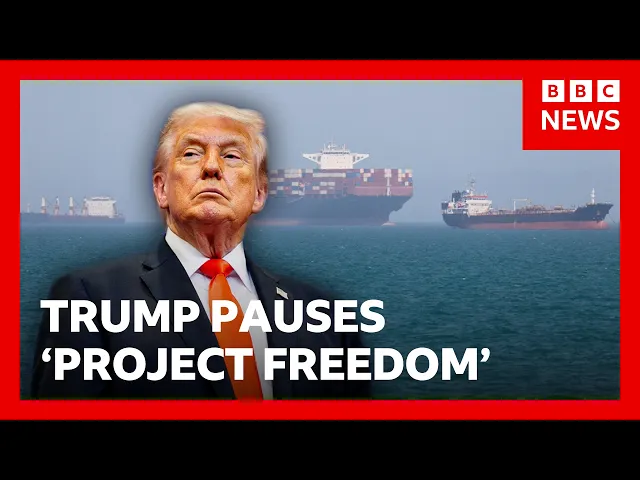
Trump says US to pause operation to guide vessels through Strait of Hormuz | BBC News
BBC News
0:00 Donald Trump has announced the operation to help commercial ships sail through
0:04 the straight of Hormuz will be paused less than 48 hours after it began.
0:10 He said it's because there's been progress toward
0:12 a deal with Iran and wrote on social media,
0:16 "We have mutually agreed that while the blockade
0:19 will remain in full force in effect,
0:21 Project Freedom will be paused for a short period of time to see
0:26 whether or not the agreement can be finalized and signed." The president's
0:31 post comes just hours after his secretary of state Marco Rubio said
0:36 the initial US-Israeli offensive in Iran
0:38 was over with all its objectives achieved.
0:42 That's despite Iran continuing to threaten navigation in the Strait of Hummus
0:46 and the US still hoping to negotiate an end to the Iranian nuclear program.
0:53 Mr.
0:53 Rubio spent about 50 minutes answering questions from the media.
0:57 Let's get more on what he had
1:00 to say from our North America correspondent, David Willis.
1:03 Hello, David.
1:04 So, he got quite a grilling.
1:06 Talk us through it.
1:08 Yes, he did, Sally.
1:09 He answered questions for quite some time in the White House press
1:13 briefing room and he announced most crucially the end of Operation Epic Fury.
1:20 That's the uh basic combat mission name that was given
1:24 to the US and Israel assault if you like on Iran.
1:31 Mr.
1:31 Rubio said that the focus now would be on Project Freedom and that was
1:37 a defensive operation that the United
1:39 States was launching to basically guide vessels,
1:43 oil tankers in particular, through the Strait of Hormuz,
1:47 which of course Iran had also claimed was uh it was in control of.
1:53 Well, only a few minutes uh a couple of hours I should say after Mr.
1:57 Rubio had concluded his remarks and stepped down from the lectern.
2:02 Uh, President Trump went on social media, Truth Social,
2:06 to announce that basically Project Freedom was a thing of the past
2:11 a day and a half after it had come into operation.
2:16 the president saying, as you mentioned,
2:18 that he was pausing the operation in order to make time
2:24 for talks between or to capitalize on talks between the US and Iran,
2:29 which he seemed to think were bearing fruit.
2:32 What are we to make of all this?
2:34 I mean, frankly, your guess is as good as mine.
2:37 It does seem that project freedom that move by the US
2:42 to guide ships through the straight of hormers had antagonized Iran.
2:48 They had promised to attack ships that were going through escorted uh by the US.
2:56 But is the US on the verge of some
2:59 sort of agreement with Iran over its nuclear stockpile?
3:04 something that President Trump suggested might be
3:07 the case in that truth social posting this evening.
3:11 We really don't know and uh the next few days
3:15 may perhaps shine some light on it or maybe not.
3:19 Yeah, interesting David in terms of what might happen
3:22 next because the price of oil has come down
3:25 in the hope I I'm assuming that there could
3:27 be some negotiation uh in the in the near
3:30 future between both sides and of course we've
3:32 got Iran's foreign minister in China and China
3:35 may exert some pressure on Iran to reopen
3:39 that straight because for China it's very important.
3:43 Well, that's true.
3:44 And of course, if you're to believe Donald Trump,
3:46 then it is Pakistan that has been exerting pressure as well,
3:50 Sally, seeking to get the two sides back to the negotiating table.
3:56 But of course, there's only been
3:57 one face-to-face negotiation between the two sides.
4:01 This conflict began towards the end of February,
4:05 and that resulted in the two sides walking away, still a long way apart.
4:11 So, a lot of questions among them, of course, uh what happens to the 1,600 or so
4:17 vessels still stranded in the Strait of Hormuz,
4:21 some of which have been there for up to two months with sailors,
4:26 according to Marco Rubio, in some cases dying of starvation.
4:31 We will just have to wait and see.
4:33 Okay, David, thank you very much indeed.
4:34 David Willis there with the latest uh from the White House.
4:38 Well, let's now focus on Iran's foreign minister's trip to China.
4:42 He is in Beijing and has begun a meeting with his Chinese counterpart.
4:48 Asked about that visit, Secretary of State Marco Rubio had this to say.
4:52 I hope the Chinese tell him what he needs to be told,
4:54 and that is that what you are doing
4:55 in the Straits is causing you to be globally isolated.
4:58 You're the bad guy in this.
4:59 You well, you you guys should not be blowing up ships.
5:01 You should not be putting mines.
5:02 You should not be holding hostage the global
5:05 trying to hold hostage the global economy.
5:07 It is in China's interest that Iran stop closing the straits.
5:10 It's harming China as well.
5:13 Well, let's go live to Beijing now.
5:14 Our China correspondent there is Steven McDonald.
5:17 Uh Steven, so is uh Iran's foreign minister in meetings with Wang Yi right now.
5:25 Yes, that's right.
5:26 And what we're waiting for is the official
5:29 readout which will come at some point.
5:32 This is the sort of notes that both governments give us.
5:36 It's not a verbatim record of what's said,
5:40 but will give us the highlights of points discussed.
5:43 Certainly in terms of what the governments want to tell us, though.
5:46 The interesting thing about this though is why are they meeting face to face?
5:51 Why has Iran's foreign minister flown all the way to Beijing for this meeting
5:56 when these two foreign ministers have had
5:59 plenty of phone conversations since the war started?
6:02 And I think most analysts would say it's because it's
6:07 in the leadup to Donald Trump visiting here later next week.
6:11 China would love to be able to say to the US, look,
6:14 we're doing our best to end the gridlock in the straight of Hormuz.
6:21 We've been having these discussions with the Iranian government on that front.
6:26 Now, we heard US Secretary of State Marco Rubio saying that basically
6:30 Wang Yi should be reading the riot act to the Iranian government,
6:34 saying that you're the bad guys in all this.
6:39 You should stop blocking that straight because and it's
6:42 because of your actions that you're essentially an international pariah.
6:46 Well, the Chinese government is not going to say that Iran is the bad
6:49 guy because they think that the US and Israel are also the bad guys.
6:54 After all, they started the war.
6:56 The official line from the Chinese government is
6:58 that everyone needs to sit down and start talking.
7:01 And naturally, the Chinese government wants that straight to open as well
7:06 as other countries because even though this is a very strong economy,
7:11 that war is also hurting China.
7:13 Yeah.
7:13 Yeah, I mean China's role in all of this is very interesting in that China is
7:18 uh seen as a friend to Iran um an ally of Iran and yet the same time
7:22 it's got huge economic and investment ties in the Gulf and a lot of its energy
7:28 flows through the strait of Hormuz which is
7:30 to all intents and purposes shut at the moment.
7:33 So China is trying to mediate here in a very diplomatic
7:37 way and and gain points on the international stage for doing so.
7:43 Yeah, you're absolutely right.
7:45 And what's more, we're hearing that the Chinese
7:48 government has been telling these Chinese companies which
7:51 are buying Iranian oil to keep doing it
7:54 even though they're facing sanctions from the US.
7:57 Now, that could also be so that when Donald Trump and Xigin
8:01 Ping sit down at the end of next week and have these talks,
8:04 there's leverage on that front.
8:06 So both sides have got something to give if you like.
8:10 Uh for the moment though,
8:12 China is still buying this oil from Iran and Beijing would argue,
8:16 well, why shouldn't we?
8:17 We didn't start the war.
8:18 We're not a party to the war.
8:21 Why should we stop buying Iranian oil just because the US
8:24 and Israel are involved in a conflict with that state?
8:28 Okay, Stephen, for now, thank you very much indeed.
8:30 Well, let's now uh pick the brains of the director
8:33 of the Iranian studies at Stanford University, Abbas Milani.
8:37 Abbas, I know you were listening into all of that.
8:39 So, what do you think Wang Yi's messages for Abbas Agarachi today?
8:46 First of all, I think one message is
8:48 that Iran must open for China has been very clear.
8:52 They have repeated it several times that this is
8:55 the international waterway and it should be opened.
8:59 Uh I think he might be reading the right act.
9:01 I'm not sure.
9:02 Uh but China is very clear on that.
9:05 But China also has a lot of interest in um
9:08 United Arab Emirates that has been attacked by Iran repeatedly.
9:12 There are 150,000 I think about Chinese
9:16 citizens who live in United Arab Emirates.
9:20 I would be very surprised if the Chinese government doesn't tell Iran
9:24 that it they should cool their heels and stop attacking United Arab Emirates,
9:29 which is a non-combatant in all of this.
9:32 But don't you think China as well is seeing this as a great opportunity,
9:37 this war initiated by Israel and and the US to undermine the US
9:43 on the international stage and to uh show
9:46 China as the place of stability and collaboration.
9:50 Well, absolutely.
9:50 I think China is cherishing the position that it has.
9:54 It is doing exactly as you suggest.
9:57 I think one of the things that the Iranians
9:59 literally have been writing about as their anxiety,
10:03 the Iranian regime particularly is that China might
10:06 make a deal with the United States when Mr.
10:10 Trump goes there.
10:11 They want to make sure that they're on the same page
10:14 with the Chinese that they won't be part of some kind of a deal.
10:19 But China has extensive contacts with Saudi Arabia,
10:22 with the United Arab Emirates,
10:24 with Qatar, with all of the countries on the other side of the Persian Gulf.
10:27 So China is sitting in a very comfortable position.
10:31 But also it has been criticized China.
10:33 There has been accusations that it's been providing military support to Iran
10:38 in the same way that Russia has been seen to be doing so.
10:42 But China is uh refuting that, isn't it?
10:46 Yeah, China has refuted it.
10:47 that I would be surprised if they haven't
10:50 given some aid some for example intelligence as Russia
10:56 apparently has done but that's the least you can
10:59 expect of China has been considered Iran's chief ally
11:05 in the international community next to Russia both
11:09 of those countries I think have decided to sit
11:12 on essentially the sideline they have provided enough just
11:16 enough to Iran to say that they're still an ally,
11:20 but they have made their sentiments very clear
11:22 that they don't think Iran is doing the right things.
11:25 They might be critical of Israel and the United States for attacking,
11:29 but I think they believe, for example,
11:31 the attacks on the other China's allies on the other side of the Persian Gulf,
11:36 closing the straight of all of these things
11:39 I don't think sits well with the Chinese.
11:41 And just briefly, Abbas,
11:43 do you think we could be on the verge of a deal between the US and Iran?
11:48 Uh, I would be surprised if it wasn't.
11:50 I think both sides uh need a deal.
11:53 Both sides want a deal and both sides will declare a victory after
11:57 a deal where I think both of them will have probably made some concessions.
12:01 Okay, Abbas Milani, thank you again for your