Making A Giant Zipper To Explain How They Work
Veritasium
0:00 (zipper whirring)- How does a zipper actually work?
0:03 Like try to push down on a zipper from above and it probably won't budge,
0:08 but if you just use the pull tab, suddenly it's buttery smooth.
0:11 So how does it do this?
0:12 We've made more zippers than there are stars in the Milky Way.
0:16 You probably used one 10 times today without even noticing,
0:19 except the only time you do is when one breaks.
0:22 I'll show you what to do when this happens,
0:24 but what is actually going on inside this thing?
0:27 I mean, obviously the teeth come together inside the slider,
0:30 but it turns out there is a surprising amount of engineering to this thing.
0:33 All of this is too small to see on a real zipper, which is why we made this one.
0:39 This is a video about the surprising genius of zippers.
0:45 What is that?
0:46 This is a device that basically started it all.
0:50 The idea was just to take a bunch of hooks and eyes
0:54 and try to put them together in some fashion to make them quote,
0:58 "automatic", unquote.
0:59 [Gregor] The hooks seemed very sharp,
1:00 like I don't think I'd want this on my fly.
1:02 No, no.
1:03 Oh, definitely not there.
1:04 (Robert laughing)- By the 1800s, clothes were typically fastened using laces,
1:09 buttons, brooches, and hooks and eyes.
1:12 These got the job done, but they all shared the same flaw.
1:15 If you had a series of these fasteners on a piece of clothing,
1:18 well, you have to close them one by one.
1:20 Most people were satisfied with the state of affairs, but one man,
1:24 American engineer, Whitcomb Judson, thought the world deserved something better.
1:28 The idea, primarily,
1:30 it appears to be that he would put them in shoes and people who
1:33 had to lace up would be able to do it in one quick motion.
1:37 So that was the device that he had in mind, and it didn't work.
1:44 Judson was a pretty bad inventor.
1:46 Most of his patents had never gotten much traction, but he was a great salesman.
1:51 In 1893 at the Chicago World's Fair,
1:54 he presented this fastening device as the next big thing,
1:57 claiming that in no time at all this would replace buttons and laces,
2:01 and not just on shoes, but on all sorts of garments.
2:04 A few wealthy investors actually believed it.
2:06 So with their backing, the Universal Fastener Company was born.
2:11 A decade later, the company managed to carve out a small niche,
2:14 primarily selling its fasteners for women's skirts.
2:17 "A pull and its done!" said their ads, but that was a lie.
2:21 Judson's fastener design was a mess.
2:23 It jammed constantly.
2:25 And because it was delicate and made from rust prone steel,
2:28 it actually had to be removed from the garment before you could wash it.
2:32 So literally unsewn from your skirt.
2:35 Moreover, if a single hook and eye were out of place,
2:38 the whole fastener became unstable,
2:40 so simply bend over and the whole thing could pop open.
2:44 Naturally, the Universal Fastener Company had very few repeat customers,
2:48 and they fell into debt.
2:51 But in 1906, a new engineer joined the team,
2:55 25-year-old Gideon Sundback, who had just moved to the US from Sweden.
2:59 Why does someone like Gideon Sundback with a good
3:02 degree in electrical engineering decide to join this failing company?
3:07 Well, it's a great story.
3:09 [Gregor] See, one of the managers
3:11 at the company had-- An absolutely drop-dead gorgeous daughter.
3:15 (Gregor chuckles) And that daughter came into the eye of Gideon Sundback,
3:21 and he was completely smitten.
3:22 So he ends up working for the fastener manufacturer so
3:27 that he can cozy up to that daughter and they marry.
3:31 [Gregor] For the next few years,
3:32 Sundback made minor improvements to Judson's hook and eye design,
3:36 but none were ever enough to make the product truly functional.
3:39 Then soon after giving birth to a daughter, his wife Elvira, fell ill and died.
3:46 [Robert] And Sundback was absolutely devastated.
3:49 So the romantic tale is that he threw himself into his work
3:53 at that point out of fighting the grief from the loss of his wife.
3:58 This dark period in his life led to a major breakthrough.
4:03 Sundback realized that this (paper crinkling) was never gonna work.
4:07 So after years of tinkering, he submitted a patent of his own.
4:11 This is a patent from 1914, but if you take a look,
4:15 it is nearly identical to a zipper from today.
4:19 Sundback's modern zipper starts with two rows of teeth,
4:23 and the teeth are shaped so that they're wider
4:26 at the end than the opening on the other side.
4:29 So if you try to push them together, it's pretty hard.
4:33 Now, this is especially true on a real
4:35 size zipper where it's practically impossible.
4:39 But if I add this slider to the bottom and try pulling on the pull tab here,
4:50 suddenly it's effortless.
4:52 So how does it do it?
4:54 Well, I can remove the cover from the slider
4:56 to reveal that it's just a Y-shaped cavity.
5:00 That's it.
5:01 See, as you zip up, the Y-shaped cavity
5:04 tilts the teeth at just the right angle so
5:07 that the tooth has enough space to slot
5:10 into its groove without bumping into the tooth above.
5:14 And as you zip down,
5:16 this wedge shaped piece separates the teeth, allowing you to unzip.
5:22 This results in one awkward design quirk.
5:24 At the top, no zipper is ever fully zipped up because the wedge is always there.
5:29 It has to remain between the teeth.
5:31 Now, Sundback's original design was a little different to this big guy.
5:35 It sported rectangular teeth with a bump on the top called the nib,
5:39 and an equivalently shaped indent on the bottom called the scoop.
5:43 That way, when the teeth would align,
5:44 each nib would fit neatly into its neighbor's scoop,
5:47 forming a strong connection.
5:50 But there was a problem, even though Sundback had a new design and a patent,
5:54 manufacturing a zipper like this in the 1910s was very impractical.
5:59 Each of the tiny teeth needed to be precisely shaped for the fastener to work,
6:03 but at the time, there were simply no tools around that could do this reliably.
6:08 So he had to come up with some extraordinarily clever machineries that allowed
6:14 them to automate the production of the zipper from the very beginning.
6:18 Sundback's machine worked like this.
6:19 It took Y-shaped wire made from a nickel alloy as an input.
6:23 First, it sliced pieces off the wire to serve as individual teeth,
6:28 and then it stamped the scoop and nib into each tooth.
6:32 Finally, the machine would clamp the two arms of the Y-shape
6:35 together onto a piece of fabric called the tape.
6:38 This tape held all the teeth in place, and it was the part of the zipper
6:41 that would later get stitched onto clothes and other products.
6:45 Sundback's machines worked wonders.
6:48 Even in their earliest forms,
6:49 they could already make 150 meters of zippers per day,
6:54 and these zippers were incredibly strong.
6:56 That's because for a tooth to become unpaired,
6:59 it needs to get some distance between itself,
7:01 and its neighbors, enough for the nibs on either side to pop out.
7:04 But since the machines spaced the teeth so precisely,
7:08 there was simply no room for that to happen.
7:10 Now, you might think you could just
7:11 stretch the zipper vertically to separate the teeth,
7:14 but the zipper tape itself is made from strong inelastic fabric.
7:17 So even if the garment itself is stretchy,
7:20 the teeth are connected to the tape which is designed not to stretch,
7:23 so they won't come loose.
7:25 But there is a way for this mechanism to fail.
7:27 If even a single tooth falls off, well,
7:30 then its neighbors have enough space to come loose,
7:32 and then their neighbors come loose,
7:34 and this causes a cascading effect, and the whole zipper pops open.
7:39 This isn't something you had to worry about with buttons,
7:41 which can only fail one at a time.
7:44 But even with this flaw,
7:45 Sundback's employers thought this patent was a gold mine.
7:49 So the Universal Fastener Company decided
7:50 to launch the product under their new name, 'The Hookless Hooker'.
7:55 They abandoned that name pretty quickly and decided
7:57 to call it 'The Hookless Fastener' instead.
7:59 This new fastener was a successful product, but not a mainstream one.
8:03 Its first applications were pretty niche.
8:05 You'd find it on money belts, essentially the fanny packs of the 1910s,
8:09 as well as tobacco pouches and rubber boots.
8:12 Now, those rubber boots were particularly important.
8:15 They were manufactured by the B.F.
8:17 Goodrich Company.
8:18 When they got a hold of the device, they were convinced that, yes,
8:22 this will give us a leg up on our competitor.
8:25 We will introduce this automatic fastener, but we need a name for it.
8:30 [Gregor] Then the company's president had an idea.
8:32 Well, you know, it worked really well.
8:34 They're pretty nice.
8:35 You can just sort of...
8:36 It just goes sort of zip when you're closing it and when you're opening it.
8:40 So, B.F.
8:40 Goodrich came out in the early 1920s with their zipper boots.
8:46 The boots were such a hit that the name zipper
8:48 transcended the shoe and became the name for the fastener itself.
8:51 Soon, consumers wanted the zipper on everything.
8:57 By the 1930s, the Universal Fastener Company became very, very successful.
9:02 They got a new name, too: Talon, since their fasteners had a secure grip,
9:07 it was kind of like the talons of an eagle.
9:09 Talon's new zippers were way sturdier than Judson's hook and eye design,
9:13 because their parts were way simpler,
9:15 and they were also made out of rust resistant nickel alloy instead of steel,
9:19 which meant you could leave them on in the wash.
9:22 By the way, if you are putting
9:23 something with a zipper inside the washing machine, you should always zip it up.
9:27 That will prevent the zipper from snagging on your other clothes,
9:29 and it'll also protect the zipper itself.
9:32 Now, even though zippers rapidly became popular,
9:35 there was pushback among the older and more conservative consumers,
9:39 especially about putting them on the fly.
9:41 And urban legends began to spread.
9:44 One of the most famous ones is the myth
9:46 of the fellow who has come to his fiance's parents for dinner,
9:50 he's seated down at the table, he looked down and realized,
9:54 "Oh my God, I haven't zipped up my fly," so he zips it up.
9:58 But then when he gets up a few minutes later to leave the table,
10:02 he has caught the tablecloth in the fly of his trousers,
10:05 and so ends up sending the entire table
10:08 tumbling after him as he gets up and leaves.
10:14 I'm still a bit confused by...
10:16 zippers are more expensive, more temperamental than buttons and laces,
10:19 and anyways, they become huge regardless of that.
10:23 Well, now you see the heart of the mystery.
10:25 The novelty of a zipper itself was something that took hold of people.
10:30 People wanted to be modern,
10:32 and it came to be closely identified with being modern.
10:37 I found it very interesting that looking at World War II,
10:41 the zipper manufacturer in Germany was one of the protected industries,
10:47 despite the fact that it used fairly precious metal,
10:50 metals that were very important for munition and the like.
10:53 But the zippers were protected because
10:55 they were closely identified with modern prosperity,
10:59 with the idea that if we can have zippers then everything must be okay.
11:05 But a more obvious reason for the zipper's
11:07 popularity is that it's just so easy to use.
11:10 How much quicker is a zipper than a series of buttons?
11:13 I have a jacket that has both, so let's time it.
11:14 Three, two, one.
11:22 There we go.
11:27 I mean, it's a pretty great example of how
11:29 a more automatic approach can save you a bunch of time,
11:32 which is what today's sponsor Hostinger is all about.
11:36 Say you have a bunch of projects spread out over Slack, and email, and WhatsApp.
11:40 If you're trying to keep track of everything manually,
11:42 it's a pretty slow process, and it's super easy to miss something.
11:45 But with Hostinger and their virtual private server or VPS,
11:49 you can quickly zip up your entire
11:51 project and bring everything together in one place.
11:54 In just a single click, a Hostinger VPS lets you deploy OpenClaw,
11:57 which is a multi-channel personal assistant.
12:00 And OpenClaw's declutter feature will go through all of your inboxes and pluck
12:04 out all the most important messages and zip them together into one central hub.
12:08 It's also a great research tool, so if there's a topic you're interested in, you
12:11 can use OpenClaw to scrape the web for relevant sources,
12:15 and also keep up to date on posts everywhere from Reddit to Nature.
12:19 And because it runs 24/7, you can wake up each morning to a fresh
12:23 batch of articles delivered straight to your inbox.
12:25 So if you're interested in running OpenClaw,
12:28 head to hostinger.com/veritasiumopenclaw,
12:32 or click on the link in the description,
12:34 and make sure you use code Veritasium to get
12:36 an exclusive discount on all yearly VPS plans.
12:39 So I wanna thank Hostinger for sponsoring this part of the video.
12:41 And now back to zippers.
12:44 Fast forward to today,
12:45 Sundback's design is still the one we most associate with zippers.
12:48 Besides the classic metal variant, which was sturdy and reliable,
12:52 zippers also started being produced from plastic,
12:54 which was cheaper and more flexible.
12:57 But you'd probably be surprised to know that these two
12:59 zipper types aren't the most common zipper in the world.
13:02 In fact, the world's most popular zipper doesn't have teeth at all,
13:06 and it's this thing.
13:08 (dramatic music) Okay, at first it just looks like other zippers,
13:11 but if I pull out the threads,
13:13 you can see that everything here is just a single weird piece of plastic.
13:18 Imagine you have a coil of plastic that you somewhat flatten.
13:21 You can mold the plastic such that one side
13:23 of every loop bulges out more on the top and bottom.
13:27 If you do this a second time with a second piece of plastic,
13:30 you'll notice that you now have ridges that fit perfectly together,
13:33 much like zipper teeth.
13:35 Stitch these two coils onto fabric, then add a slider,
13:39 and bam, you have a functional zipper.
13:41 This is known as a coil zipper.
13:43 It showed up around the 1940s as a cheap alternative to the original design,
13:47 and now you can find it everywhere,
13:49 especially on things like suitcases and backpacks where
13:52 the zipper needs flexibility to maneuver around corners.
13:56 Coil zippers also have another benefit.
13:58 Since all of their teeth are one interconnected piece of plastic,
14:02 there's no way for a single tooth to fall off,
14:04 so that itself cannot cause that cascading failure.
14:09 But there was still a problem zippers had to solve,
14:11 and that was that they were kind of too good,
14:13 especially zippers that have been used a lot and are
14:15 kind of worn down in the slider, they can...
14:19 just unzip on their own.
14:21 To prevent that, Gideon Sundback himself actually
14:24 designed a locking mechanism like a break.
14:27 Under the piece that connects the pull tab to the slider,
14:30 there is a small metal pin.
14:32 When the pull tab is in its typical resting position,
14:35 one end of the pin sticks through a hole in the bottom face of the slider,
14:39 lodging itself between the zipper's teeth or coils.
14:42 That way the slider is stuck in place.
14:44 But when the pull tab is pulled forward,
14:47 this releases the pin, allowing the slider to move.
14:50 Now you can see that there's like this little
14:52 tiny gap through which you can see light,
14:54 and that's because the zipper stop is now engaged.
14:57 But if I grab the pull tab and start pulling,
15:00 you can see that because of the way that it's shaped,
15:02 it's actually gonna end up pushing that part up,
15:05 even though I'm pulling to the side, and that's gonna disengage.
15:09 You can try to pull apart the fly on your pants,
15:11 but unless you actually grab the pull tab and pull it down,
15:14 it is not gonna open.
15:16 These locking mechanisms aren't on every zipper,
15:18 but they're more common than you might think.
15:20 I counted up 65 zippers in this room in total,
15:23 33 of those 65 had stopping mechanisms, which is over 50%.
15:28 Which is also something I never noticed on a zipper.
15:31 But as I was hunting for zippers in my room.
15:33 I noticed something else,
15:34 on pull tab after pull tab there's no mention of Talon,
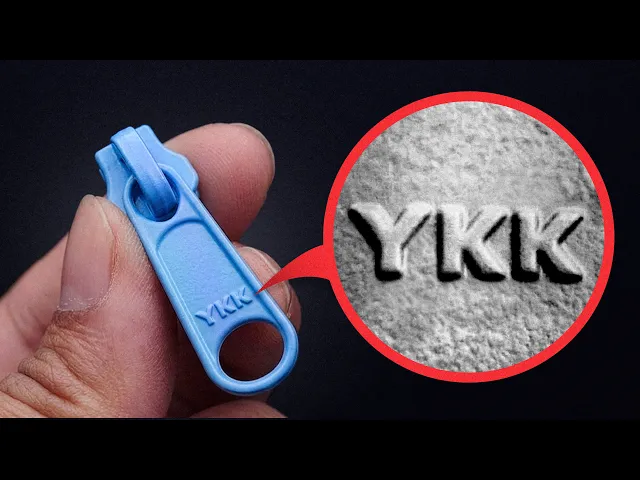
15:38 but I kept finding the same three letters instead: YKK, YKK, YKK.
15:43 YKK.
15:44 Even on clothes and objects from completely different brands.
15:48 If you look at your zipper now, you'll probably see the same thing.
15:51 So at first, I thought this might refer
15:53 to a particular style of zipper or something,
15:55 but then I Googled it, and it turns out that YKK is a company,
15:58 the biggest zipper company in the world.
16:00 If Talon has the original patent rights and they own the original zipper,
16:05 how don't I have a single Talon zipper in my room,
16:07 and how did YKK end up dominating the zipper world?
16:11 Well, Talon pretty much ruled the zipper market until the 1930s, but in 1934,
16:17 Sundback's original patent expired,
16:19 so the playing field was wide open to competitors.
16:23 That same year, Japanese businessman, Tadao Yoshida,
16:25 founded a new fastener company, the Yoshida Manufacturing Corporation, or YKK.
16:33 It began as a single workshop in Tokyo where each zipper was made by hand.
16:37 Then in 1945, that workshop was completely destroyed by allied bombs,
16:42 but Yoshida was undaunted.
16:44 He rebuilt the plant, and after the war,
16:46 he started buying zipper making machines from the US.
16:49 They improved the machine, particularly they improved the speed.
16:53 [Gregor] They then also decided to switch to manufacturing
16:56 everything in-house from the zippers themselves to the machines,
16:59 to even the boxes that the zippers were shipped in.
17:02 And YKK emphasizes quality above everything else.
17:07 So they make a real point of saying that if you have a YKK zipper,
17:11 you can depend on it utterly.
17:13 And that turned out to be an enormously successful sale tactic.
17:18 [Gregor] Around 1980, YKK surpassed Talon as the world's biggest zipper maker,
17:23 and by the early 2000s, Talon's US market share had fallen to a mere 7%,
17:28 while YKK's surged to around 45%.
17:31 YKK surpassed the 10 billion annual zipper unit sales last year.
17:37 I mean, that's a very impressive number.
17:38 Like 10 billion is crazy.
17:40 It's equivalent to more than 3 million kilometers in length.
17:45 It could be like around like 80 trips around the world.
17:50 [Gregor] And not all of these are regular everyday zippers either.
17:54 So this is an airtight, watertight zipper,
17:56 and this relies on rigid metal to metal sealing,
18:00 where nickel teeth are forced tightly together against
18:03 a rubber tape providing an extreme pressure resistance.
18:06 I mean, that looks like a mean zipper.
18:07 What's an extreme use case for a zipper like this?
18:10 Deep sea diving, submarine escape suits.
18:13 Submarine escape suits sound really cool.
18:16 In case of an emergency evacuation of a submarine,
18:18 you need a suit that can balloon up
18:20 with air to counteract the pressure of the deep ocean,
18:23 and that can provide buoyancy helping you shoot up to the surface.
18:26 But you also need to be able to put it on super quickly.
18:30 And the best option seems to be this suit
18:32 with a giant watertight and airtight zipper on the front.
18:36 Airtight zippers like these even made it onto spacesuits.
18:40 And that's the zipper.
18:41 It's this surprisingly genius invention that no one really asked for.
18:48 I hate when this happens.
18:51 I think a zipper slider may get stuck if fabric becomes caught in the chain.
18:56 So if dirt or debris enters in the zipper,
19:00 the best fix is to carefully remove any trapped fabric or debris,
19:05 or move the slider gently.
19:08 Okay, so carefully removing stuff from the zipper.
19:10 Yeah, yeah.
19:11 Because my first reaction is just like, try and jam over the slider.
19:15 So you're saying I shouldn't do that?
19:16 Yeah, no.
19:18 Move it carefully.
19:20 Carefully!
19:22 And if there isn't any visible debris causing the zipper to get stuck,
19:25 you can try lubricating the area with graphite
19:27 from a pencil in order to get the slider moving again,
19:30 because it's a great dry lubricant.
19:32 But probably the most annoying zipper problem is when
19:34 a zipper unzips on both sides of the slider.
19:37 This usually happens when the slider becomes worn or bent,
19:40 and can no longer apply enough pressure
19:42 to properly interlock the zipper elements as a result.
19:46 So the zipper chain separates behind the slider.
19:50 A worn down slider is something you might be able to fix at home.
19:52 Just take some pliers and crimp the slider together from the sides.
19:56 That will make the inner cavity more narrow, just like when it was new,
19:59 which should make it bring the teeth together again.
20:01 Just don't crimp it too tightly.
20:04 I just can't get over the fact
20:05 that the first patent Gideon Sundback submitted was around 1914,
20:09 and in those 112 years so many other
20:13 devices that we've invented have been completely transformed,
20:17 got better, got faster, cheaper,
20:19 but it seems like the zipper is mostly just the same.
20:23 So it's just that Sundback's design was that good?
20:26 It's that good.
20:27 (Robert laughing) I don't have any better explanation.
20:30 It really is.
20:31 It's that good.