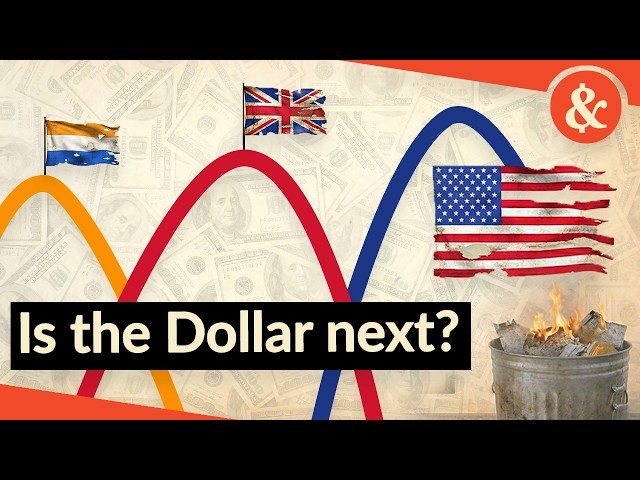
Is the Dollar finally on the way out?
Money & Macro
0:00 History tells us that no currency remains at the top forever.
0:04 First it was the Dutch Gilder, then the British pound,
0:06 and now the world is asking [music] if the US dollar is next.
0:11 A so-called sell America trade.
0:13 The American currency slipped to [music] its lowest
0:15 level against the euro in more than four years.
0:18 A slow erosion of [music] confidence in dollarbased assets.
0:22 So is Trump finally pushing the world to move
0:24 away from using the dollar as their currency of choice?
0:27 This would be a massive deal.
0:30 Even Trump himself has said that
0:32 if you want to go to third world status, lose your reserve currency.
0:36 But is it actually true?
0:37 Both Britain and the Netherlands have lost
0:39 their reserve currency status a while ago.
0:41 And yet they are still wealthy countries today.
0:43 And while perhaps easily forgotten, we have actually [music] been here before.
0:47 In the 1970s, many economists thought that the US dollar was done
0:51 for and would be replaced by gold or a basket of other currencies.
0:55 [music] yet it came back stronger than ever.
0:58 Could the same thing happen to the dollar today?
1:01 And if the dollar does fall, what can [music] we expect?
1:05 To answer these questions,
1:06 we could not just look at the latest data like we normally do on this channel.
1:10 [music] Instead, we had no choice but to go back
1:13 400 years in time to track in detail the rise,
1:16 survival, resurgence, [music] and fall of the British pound,
1:19 the rise, fall, and resurgence of the US dollar.
1:22 And [music] first chapter one, the rise and fall of the Dutch Gilder.
1:26 The year is609.
1:28 The newly established Dutch Republic is quickly becoming the global
1:32 trading powerhouse with the city of Amsterdam [music] at its center.
1:36 As one of the few places where money was protected by the rule of law,
1:40 even if your country was literally waging war against the republic,
1:44 your money would still be safe in Amsterdam.
1:46 As a consequence, silver coins from all over Europe were flooding
1:50 to the bank that would later become the template for all central banks,
1:54 the Bank of Amsterdam.
1:56 Officially, the Bank of Amsterdam promised that all deposits
2:00 there were backed by silver coins in the vault.
2:02 But it would later be revealed that this was not fully the case.
2:05 In fact, [music] the bank was using its silver to provide
2:09 basically for free cheap loans to the biggest corporation of the time,
2:13 the Dutch East India Company.
2:15 and the city of Amsterdam itself.
2:18 This meant that the Dutch colonial efforts
2:21 managed by the East India [music] Company
2:23 and the Dutch government effectively enjoyed something
2:27 the French would later call exorbitant privilege.
2:31 Issuing the reserve currency gave the Dutch three massive
2:35 advantages over much larger rivals such as France and England.
2:38 First, the Dutch could borrow at a lower
2:41 interest rate than they otherwise could.
2:43 For example, Dutch provinces typically had to pay around 2 to 3% while the much
2:47 larger British had to pay 5 to 6% and the unreliable French 10 [music] to 12%.
2:53 Second, the Dutch could borrow much more than they otherwise could,
2:56 allowing them to fund a massive navy that dominated
2:59 the seas [music] despite the Dutch Republic being a tiny country.
3:03 Finally, during a massive geopolitical crisis,
3:05 money often flowed to the safe haven of Amsterdam rather than away from it.
3:11 Therefore, while borrowing was often extra expensive for most European states,
3:15 at the moment that they needed it most,
3:17 crucially, the Dutch could borrow at extra low rates in times of a crisis.
3:21 This was crucial during the so-called year of disaster, Rampia,
3:26 when the tiny republic was invaded by its [music] two much larger rivals,
3:30 France and England, plus two German bishop bras.
3:33 Despite troops rapidly closing in on the Bank of Amsterdam,
3:36 the Dutch provinces could still borrow at rates much lower than the invaders.
3:41 This privilege allowed the tiny country
3:43 to hire German mercenaries and simultaneously
3:46 subsidize the Spanish and Austrian Habsburgs to enter the war on its side.
3:51 Meanwhile, King Charles II of England was so low on money
3:54 that he was forced to partially default on his debts,
3:57 leading to a major financial crisis in London.
4:00 So exorbitant privilege quite literally saved the Dutch Republic.
4:06 However, at some point all of that money
4:09 did lead [music] to a dark side as well.
4:11 Perhaps we should call this the exorbitant burden.
4:15 The crux of it is that money had essentially gotten too easy.
4:18 This encouraged over borrowing by both the provincial
4:21 governments and the [music] East India Company.
4:23 Easy money also contributed to rampant real
4:26 estate speculation and to overreach by the bank
4:29 of Amsterdam which massively increased its loans
4:32 to the overstretched Dutch East India Company.
4:34 [music] Finally, most of these financial profits went mostly
4:37 to an increasingly rich financial elite [music] increasing inequality.
4:41 Economists like Yandere and Atanderada have argued that this exorbitant
4:46 burden made the Dutch Republic increasingly specialized in global
4:50 banking which then crowded out [music] the trading and crafts
4:54 that had made the republic great in the first place.
4:57 Then ironically the Dutch financial elite got [music] rich funding
5:00 the industrial rise of the very nations that would overtake the republic,
5:05 France, the US and especially England.
5:09 First, the Dutch continued investments to England's rebellious
5:12 American colonies and this then led to the fourth
5:15 Anglo Dutch war which ruined the Dutch economy
5:18 and led to the bankruptcy of the East India Company.
5:21 This in turn caused a major loss of trust in the Bank of Amsterdam and this made
5:25 money issued by them worth less than
5:27 the money they supposedly had in their vault.
5:29 However, while clearly on the decline,
5:31 the Dutch financial system managed to cling on partially because the Dutch
5:35 had diversified their investments by lending a lot to the French crown.
5:40 But ironically, this would soon lead to their final demise
5:43 as the French king was overthrown in a violent revolution,
5:46 further weakening the Dutch so much that it was
5:49 easily conquered by the French revolutionary forces in 1795,
5:53 who saw Dutch wealth as a great way to fund their armies.
5:57 However, ironically, this would mostly benefit their arch rival, the British,
6:01 as from that point on, money was no longer saved in Amsterdam,
6:04 cementing the status of London as Amsterdam successor.
6:08 [music] And even after being liberated from the French,
6:11 the Dutch were in so much debt, and London was now so strong that the Dutch
6:14 would never again regain their exorbitant privilege.
6:18 They spent well over a century paying back their international debts,
6:22 leading to a century of economic stagnation.
6:25 [music] And when borrowing, the Dutch paid a premium now over the English.
6:29 And especially in times of crisis, the Dutch had to tighten their belt as money
6:33 now flowed to the great British [music] Empire instead.
6:37 But before getting to that story, let's first review how similar the experience
6:40 of the Dutch Republic is to the dollar situation today.
6:44 First, the US today is also said to have an exorbitant privilege.
6:47 Despite having some of the highest debts in the world
6:50 and one of the highest government deficits in the world right now,
6:54 the US can borrow at real interest rates that are close to 2%.
6:58 Very low indeed.
6:59 On top of that, during big crisis such as during 2007208,
7:05 the Americans could borrow more and more cheaply as money from all around
7:10 the world wanted to go back to the safety of New York City.
7:14 But just as the Dutch Republic, many have argued that the US is
7:18 now also suffering from everinccreasing government overreach,
7:22 more and more financial bubbles, and increased inequality.
7:25 And just like the Dutch elites funded the rise of France and especially Britain,
7:30 so did China's rise mostly come about thanks to the US dollar system.
7:35 Near the end of their exorbitant privilege,
7:38 the Dutch faced a series of financial crisis and shocks.
7:41 The first signal of their decline was that they could no longer borrow
7:44 more during crisis such as the fourth Anglo Dutch war or French invasion.
7:50 And this is why after Trump's liberation day, for the first time ever,
7:55 markets were panicked because money flowed out
7:58 of the US during this crisis rather than into it.
8:01 Losing this part of exorbitant privilege was literally
8:04 the beginning of the end for the Dutch Republic.
8:07 Just a couple of years later, Amsterdam was occupied by the French.
8:10 But of course, there are at least two very big differences
8:13 between the tiny Dutch Republic back then and the US today.
8:16 The first is obvious.
8:17 America today is not at risk of an invasion.
8:20 But more importantly for our story,
8:22 the second difference is that the dollar today is
8:24 not tied to a metal like the Dutch guilder was.
8:27 Thirdly, where the Dutch were in trouble, there was a clear alternative.
8:31 Britain had a far bigger economy and thanks to a recent
8:35 influx of Dutch bankers who helped establish the Bank of England,
8:39 it was the clear alternative.
8:41 Britain would go on to have the exorbitant privilege next.
8:46 Today, America's situation looks much less
8:49 clear-cut than that of the Dutch Republic.
8:51 There is no clear alternative right now.
8:54 So to find out what will actually happen to the dollar,
8:57 we need a more comparable example,
9:00 which leads us to the rise and fall of the British pound.
9:04 Let's go back to 1799.
9:06 Napoleon had just come to power in France,
9:09 meaning there were now two rising powers
9:12 vying to become the new global hedgeimon.
9:14 [music] France had the biggest army and it was rapidly acquiring land,
9:19 [music] but Britain had the biggest navy, allowing it to dominate global trade.
9:24 And while France occupied the wealthy Dutch Republic, by doing so,
9:28 France had arguably given Britain the biggest price of all,
9:32 exorbitant [music] privilege.
9:34 Britain could now borrow at 3% while France had to pay 10% or more.
9:39 [music] Using this privilege, Britain essentially hired the armies of Europe
9:43 to fight France on its behalf by subsidizing Austria, Prussia, and Russia.
9:48 On top [music] of that, they used
9:49 their giant navy to blockade France and its allies.
9:53 But to do so, the British state had to borrow
9:55 to levels previously unseen at almost 200% of GDP.
10:00 This was so much that it caused a run on the Bank of England,
10:03 meaning that they had to suspend the pound's convertability to silver and gold,
10:07 essentially making the pound a so-called fiat currency,
10:11 [music] much like the dollar is today.
10:13 Much to the surprise of everybody, this did not make the pound worthless.
10:18 How can a currency be worth [music] anything
10:20 at all if it's not backed by a precious metal?
10:23 The answer is simple.
10:24 The British pound [music] was backed by the mighty British state.
10:27 you could always use it to pay taxes in Britain.
10:30 This in turn meant you could always use it to pay
10:32 British merchants who were the most productive in the world.
10:36 So was the pound during this era exactly like the dollar?
10:39 No, not quite.
10:41 Because unlike with the dollar today,
10:42 the Bank of England promised that the pound would once
10:45 again be as good as gold after the war was over.
10:49 And they kept that promise.
10:51 After Napoleon was defeated, Britain was now the unquestioned hedgeimon
10:56 where everyone wanted to store their money.
10:58 Whether that was at the Bank of England, at the London Stock Exchange,
11:01 or British banks, interest rates were lower than ever.
11:05 And while this had facilitated excess and bubbles in the tiny Dutch Republic,
11:09 in the [music] 18th century in Britain,
11:12 ultra cheap money fueled the first industrial revolution,
11:15 making Britain both the unquestioned industrial and financial superpower.
11:21 This is crucial because Britain's industries guaranteed
11:24 that gold would always flow to Britain.
11:26 Therefore, the papers issued by the Bank of England,
11:29 the British state, and banks were never questioned.
11:32 They were free to lend to the world on an epic scale,
11:36 providing it with a global currency that they used
11:39 to trade between them even if Britain was not involved.
11:42 However, as happened to the Netherlands before it,
11:45 over time, ultra cheap money fueled complacency.
11:48 Just as Dutch financiers had financed the rise of Britain and France,
11:52 London now played a crucial role in financing the rise
11:55 of US industry and to a lesser extent Germany.
11:59 To make matters the dominant position of British
12:01 industry began to suffer for two reasons.
12:04 First, while new inventions like electricity
12:06 and the assembly line enabled a second industrial revolution,
12:11 it did not take off in Britain because
12:12 its steam and water powered industries resisted the change.
12:16 Second, Germany and the US did not play completely fair.
12:20 While Britain was committed to globalization that made it rich to be fair,
12:24 the US and Germany developed their industries
12:26 behind massive tariff walls only to unleash them
12:29 on the world when they reached such massive scale
12:31 that it would be almost impossible to overtake them.
12:34 Meanwhile, like the Dutch before them,
12:36 cheap money allowed the British state to overextend itself.
12:39 Fighting for more and more colonies in, for example, Africa,
12:42 that did not do much to increase Britain's industrial [music] power.
12:47 Yet, the power of the British pound helped
12:49 Britain fight off a new continental challenger, Germany.
12:53 Britain's army again could not defeat Germany on its own.
12:56 But thanks to its exorbitant privilege,
12:58 it funded both France and Russia to fight on its behalf while the mighty
13:02 British Navy [music] starved Germany of vital
13:05 resources which ultimately led to its financial collapse.
13:08 Yet this again meant the British state had to borrow
13:10 to the hilt and had to limit convertability to gold.
13:14 However, this time unlike after Napoleon,
13:16 there was now an alternative to the British pound, the US dollar.
13:20 But this was honestly quite a surprise for Britain.
13:23 You see, just before the war,
13:25 the US dollar was not seen as a serious alternative to the pound,
13:29 despite the US's industrial and economic strength.
13:32 This all changed in 1913 when the US created the US Federal Reserve.
13:36 On top of that, it removed tight restrictions on foreign
13:39 US bank branches and allowed them to fund foreign trade.
13:44 These changes meant there was now suddenly
13:46 a true alternative to the British pound.
13:49 So unsurprisingly, as Britain exited the First World War with sky-high debt,
13:54 increasingly people began to doubt that Britain's
13:56 pound was as actually as good as gold.
14:00 This is when Britain made the choice that the Dutch were never able to make.
14:04 It decided to defend the pound
14:06 reserve currency status by increasing interest rates.
14:09 These sky-high interest rates depressed Britain's economy for much of the 1920s.
14:15 However, it allowed Britain to hang
14:16 on to the other exorbitant privileges a little longer.
14:20 And while the US dollar actually overtook the pound in the 1920s,
14:24 high British interest rates and the loss
14:26 of trust in the stability of the US during
14:28 the Great Depression actually meant that the pound
14:30 regained its position before the Second World War.
14:34 So unlike the Dutch in 1795,
14:37 Britain had some of its exorbitant privilege when it faced yet
14:41 another existential threat from the rising of a new European power.
14:46 Specifically, the dominance of the pound in its current and former colonies
14:49 allowed the [music] UK to borrow trillions from its empire during the war.
14:54 However, by this time, its main financial rival,
14:56 the US, had already lost trust in the pound.
14:59 Anything the UK bought from the US had to be paid for in gold till 1941.
15:05 And after that, when Britain was effectively broke,
15:08 it paid the US by handing over British
15:10 military bases and by dismantling British trade protections.
15:14 So by the end of the war,
15:15 the British state had essentially maxed out its exorbitant privilege.
15:20 It had borrowed more than it ever had before,
15:23 while its main monetary rival now held about
15:25 80% [music] of all the gold in the world.
15:27 So when 44 nations came together to design the monetary
15:30 system of the new world at the Bretonwoods conference,
15:34 Britain had almost no leverage.
15:36 It joined a system that officially made the dollar
15:39 the only reserve currency that would be convertible to gold.
15:42 Yet, Britain managed to cling on to some of its
15:44 exorbitant privilege for a long time through the so-called Sterling area,
15:49 which included much of its former colonies like Australia, New Zealand,
15:54 as well as much of the Middle East, [music] South Asia, and Africa.
15:57 And since all of these nations committed
15:59 to continue most of their reserves in pounds,
16:02 Britain continued with its exorbitant privilege
16:05 and this allowed it to repay its massive war
16:08 debts much faster than it otherwise would
16:11 by keeping interest rates much lower than inflation.
16:14 [music] Yet despite this, much like the Dutch Republic had before it,
16:19 Britain's declining currency coincided with a century
16:23 of relative stagnation, where, for example,
16:26 it kept becoming poorer compared to the US,
16:30 as well as compared to continental European powers that had
16:33 for decades been poorer like Germany and its old rival, the Netherlands.
16:38 On top of that, Britain faced relatively volatile decades where the value
16:43 of the pound took major hits in major currency crisis in for example 1976,
16:49 the early 1980s around Brexit and again in 2022 when the prime minister
16:54 Lististras seemed to have forgotten that Britain
16:57 had long lost its exorbitant privilege.
17:00 So what can Britain's run tell us about the fate of the dollar today?
17:05 The first lesson I think is that despite the changing
17:08 times and massive power differences between the British and the Dutch,
17:12 the three benefits of exorbitant privilege remained the same.
17:16 Britain could borrow at lower rates and it could borrow more.
17:18 And crucially crucially during times of crisis, it could borrow more, not less,
17:24 allowing it to defeat major threats like
17:27 France and Germany by subsidizing foreign armies.
17:30 But while Britain's fate was less dramatic than that of the Dutch,
17:34 they also first faced major volatility followed
17:37 by a rapid loss of geopolitical power, a financial meltdown,
17:41 and a century of relative stagnation that is arguably still going on today.
17:47 So, what can we learn today from this experience?
17:50 Well, I think that the presence of alternatives is what really matters.
17:55 This insanely high Napoleonic war debt could have
17:58 stopped the rise of the pound in its tracks.
18:00 But because there was no real alternative, Britain's currency, power,
18:04 and economy surged, allowing it to prosper and repay its debts.
18:08 On the other hand, while the dollar looked non-threatening in 1913,
18:12 just a few policy changes made it overtake the pound in 1920.
18:16 Yet, thanks to major sacrifices, the pound made a comeback,
18:19 arguably helping Britain survive yet another war.
18:22 But still, we now know that the pound was on its way out ever since 1920.
18:28 Is this the case for the US dollar as well?
18:31 Not so fast because the dollar has been here before and unlike the pound,
18:36 it came back stronger than ever.
18:39 So to truly understand what we can expect from the dollar,
18:42 we need one more historical story.
18:45 The story of the rise and fall and rise of the US dollar.
18:51 Okay, this story starts in 1944 when
18:53 the dollar became the undisputed king of global finance.
18:57 But the following Bretonwood's era unfolded in an eerily similar way
19:01 to the eras [clears throat] of the Dutch and British dominance.
19:04 The US started out as the undisputed industrial and financial power
19:09 and this essentially guaranteed that gold always flowed back to the US.
19:13 The US financial system supplied the world
19:16 with dollars through loans and Marshall Plan subsidies.
19:19 This gave the US the exorbitant privilege to build the biggest navy in the world
19:24 and to subsidize allies fighting against rivals
19:27 and to fight wars all around the world.
19:29 Meanwhile, its financial elite got more and more powerful while
19:32 they funded emerging industrial rivals who were protected behind tariff walls.
19:38 [music] Finally, exorbitant privilege led
19:40 to overspending by the US government until
19:43 so much gold had left the US that it was forced [music] to
19:47 suspend temporarily the convertability of the dollar
19:50 into gold or other reserve assets.
19:53 Sounds familiar, right?
19:54 But just as there were clearly no superior
19:57 alternatives to the pound after Napoleon was defeated,
20:00 there was no clear alternative to the US dollar in the 1970s.
20:05 Instead, the Reagan administration convinced allies
20:07 to realign their currencies with the dollar,
20:10 just as how Britain convinced the world
20:12 to join its gold standard in the 19th century.
20:15 However, this is where the similarities to history end.
20:19 You see, while Nixon temporarily suspended the convertability to gold in 1971,
20:24 we now know that this suspension was not temporary.
20:28 And that makes sense.
20:29 Why would you want to tie your currency to a yellow rock?
20:33 The British had shown that currencies can actually
20:36 survive without [music] it for short periods of time.
20:39 And now the Americans would prove that the dollar
20:41 could not just survive without being backed by gold, it [music] could thrive.
20:46 But make no mistake, just as with the pound under Napoleon,
20:50 today the US dollar is not backed by nothing.
20:53 The dollar is backed by the US state,
20:55 which taxes its [music] citizens in dollars and which
20:58 forces all US citizens and companies to accept dollars.
21:01 For a foreigner like me,
21:03 this means I know I can spend my dollars on anything made in America.
21:06 And since everyone in the world knows this, I can
21:09 also spend my dollars on foreign goods and services as well.
21:13 [music] Importantly though, abandoning the gold standard completely changed
21:17 the way a reserve currency works.
21:19 Instead of lending money to the world,
21:21 which would then always flow back to the main financial center,
21:24 America now spends its money into the global economy.
21:28 And instead of the world borrowing [music] from the global financial center,
21:31 the world now lends to America.
21:34 So ironically, where spending more than you earned used
21:37 to be a death sentence for your reserve currency,
21:41 economists like Michael Pettis now argued that this is
21:43 exactly what makes the dollar so dominant today.
21:47 Conclusion.
21:48 So why is the fiat dollar so dominant?
21:51 Well, you see, while global investors will
21:53 always choose the currency that is most convenient,
21:56 foreign governments can and do influence this in a major way.
21:59 For example, when Russia was shut from dollars and euros in 2022,
22:04 its companies switched to renmi in no time.
22:07 On the flip side, the political union of the sterling zone
22:10 prolonged Britain's exorbitant privilege way
22:12 longer than it otherwise would have.
22:14 And today many developing nations especially in Asia
22:18 have chosen to set up their economic
22:20 development model in such a way that they grow by exporting to the US.
22:24 The only country in the world that makes
22:27 its currency easily available through its spending.
22:31 This has two major implications for what we can expect from the dollar next.
22:35 The first is that it will be really much more difficult today
22:39 than it was back then for any currency to dethrone the dollar.
22:43 Yes, China already has the industrial strength to do it.
22:47 And much like the US did in 1913,
22:49 they could really surprise the world by making money much safer
22:53 and easier to store in Shanghai with just a few rule changes.
22:57 However, that will probably not be enough.
23:00 The dollar is extremely attractive for exportoriented
23:03 economies precisely because Americans spend so much
23:07 making it the reserve currency that is
23:10 relatively safe to build your economic model around.
23:13 [music] However, now we are getting to implication number two.
23:17 Make no mistake, the US can still push this system too far.
23:22 The US's exorbitant privilege still depends on the willingness
23:26 of foreigners to lend or to invest in the United States.
23:30 Together, relatively low inflation and the rule of law kept your dollar safe.
23:34 Heck, America's incredible stock markets made holding
23:37 many dollar as it's very profitable indeed.
23:40 But first, Biden undermined the dollar's perceived safety
23:43 by freezing reserves from nations that it didn't like,
23:46 [music] something the Dutch never dared and the British only
23:50 did to nations that they were in a full-scale war with.
23:54 Then second, Trump shocked the world when his administration announced sky-high
23:58 tariffs against allies and even discussed to potentially tax foreign reserves
24:03 in the US as a means to bring the value
24:06 of the dollar down which he he believes has become an exorbitant burden.
24:11 This can explain why the US immediately
24:13 experienced the first signs of losing exorbitant privilege,
24:17 increased volatility, and losing the ability to borrow more thanks to a crisis.
24:23 If this trend continues, the US will likely see a massive reduction
24:27 in its ability to wage war all over the globe.
24:30 And given that the status of the dollar now
24:32 largely comes from foreigners investing ever more in the US,
24:36 the end of foreign trust will probably tank the [music] American stock markets.
24:40 and lead to a century of relative stagnation.
24:44 Because as we've seen, losing your exorbitant privilege does not mean
24:48 you lose your exorbitant burden as well.
24:50 And to get an idea how much weaker the US may become, consider this.
24:54 The American economy is just as big
24:56 as the EU and quite a bit smaller than China.
25:00 If we just look at all the goods and services that are produced there,
25:03 it's only thanks to the awesome power of the dollar
25:05 that America still has the biggest economy in the world by far.
25:09 Luckily for Trump, history has shown
25:11 that even if you lose reserve currency status, it may [music] be recovered.
25:15 Heck, given that both the EU and China have far worse demographics,
25:19 if the US starts playing it safe from now
25:22 on, the dollar may even come back stronger than ever.
25:25 [music] But of course, this all depends on what Trump will do next and whether
25:29 or not his successor will appreciate the dollar's exorbitant privilege again.
25:34 But yeah, [music] that is my take.
25:37 one that is honestly a bit less scientific
25:39 than usual because unlike when it comes to migration,
25:43 gun violence, and war economies,
25:45 we simply don't have that much data on reserve currencies,
25:49 especially not fiat reserve currencies like the US dollar is today.
25:54 Therefore, for this video, I heavily relied on the work
25:56 of economists that have studied history extensively,
25:59 such as Barry Iiken Green, Yan De, and Michael Pettis.
26:03 Still, to get the full picture,
26:05 I highly recommend you check out other analysis about
26:08 what a world with a weaker dollar will look like,
26:10 such as the excellent analysis done by our advertising sponsor, The Economist.
26:16 Specifically, I recommend you check out this analysis on why
26:20 the current fall of the dollar may not have been about selling,
26:23 but rather about hedging behavior by foreign investors.
26:27 Then follow up with this analysis about why
26:29 the dollar may have much further to fall.
26:32 And then this analysis on why years after its fall as a global currency,
26:38 why the pound is still strangely popular today.
26:41 [music] As these articles show, I believe the economist delivers insights to let
26:46 you see the bigger picture and think for yourself.
26:48 This is why I used each of these articles as a source
26:51 for this video and why I highly recommend you subscribe to The Economist,
26:55 which I'm excited to say has agreed to give
26:58 a special 35% discount for Money Macro viewers.
27:02 Whether you want daily journalism in the Economist app,
27:05 or you are like me and prefer to catch up on the global
27:08 economy during the weekends with a cup of coffee and the paper edition,
27:12 you'll always stay on top of the latest
27:14 global developments no matter where you are.
27:16 and signal to others in the meantime that you care
27:19 about factual information and the values of integrity and responsibilities.
27:24 So don't miss out.
27:24 Click the link in the description or top comment below
27:27 or head over to economist.com/moneymacro to claim your exclusive 35% discount