How Earthquake Bearings Work
Practical Engineering
0:01 In 1994, the Northridge earthquake struck
0:04 the Greater Los Angeles area in California.
0:07 The shaking was so intense in the west San
0:11 Fernando Valley that buildings collapsed and bridges were ruined.
0:14 Billions of dollars of damages were inflicted on parking garages,
0:19 office towers, apartments, and warehouses,
0:21 thousands were injured, and 57 people died.
0:25 One factor that compounded the earthquake's devastation was
0:28 the extent of the damage it caused to hospitals.
0:31 Just when they were needed most,
0:33 eleven of the area's hospitals were completely or partially closed,
0:37 with patients evacuated to outside medical centers.
0:40 But one hospital stayed open.
0:42 At USC University Hospital, now USC Keck, patients felt the rumble,
0:48 but it was more of a gentle sway than
0:51 the violent tremors felt in other parts of Los Angeles.
0:54 The facility was one of the few in the area
0:56 that was able to accept new patients after the earthquake.
0:59 The reason it could stay open amid the chaos all comes down to the foundation.
1:05 The hospital was built in 1991, only three years prior to the quake,
1:09 and the design included what was a pretty innovative
1:12 idea for its time (at least in the US).
1:15 It is dead simple in theory:
1:16 just physically decouple the superstructure from the ground.
1:20 Of course, in practice, there are a lot of engineering details to get right.
1:25 So I built a little model to show you how this works.
1:28 I’m Grady, and this is Practical Engineering.
1:41 Earthquakes can put enormous demands on buildings.
1:44 In seismically active areas for low- and mid-rise buildings,
1:47 there really is no worst-case loading condition for structural engineers.
1:51 It’s a big deal.
1:53 Earthquakes are a lot like floods:
1:55 you can’t predict the timing, and their intensity varies tremendously.
1:58 In most situations, you just can’t afford to design for the worst case.
2:04 If you can imagine a destructive earthquake,
2:06 there’s an even stronger one possible.
2:08 Of course, they’re difficult to design against,
2:11 and we’ll get to that, but there’s the additional challenge
2:14 of just drawing a line in the sand that says:
2:16 “This is the level of risk we’re willing to accept.” With floods,
2:20 we often choose a somewhat arbitrary limit, like the 1-percent storm,
2:24 to size drainage infrastructure and delineate
2:27 the floodplain where development is restricted.
2:30 Same idea with earthquakes.
2:32 The code outlines site-specific seismic risks across the US and says,
2:37 essentially, your building has to “survive” this amount of shaking.
2:41 But that word “survive” might not mean what you expect.
2:45 Earthquake accelerations and the resulting deflections can be so strong that it
2:50 usually isn’t feasible to design a building to completely resist the forces.
2:55 Instead, we design buildings to absorb earthquake energy
2:58 by deforming and yielding in a controlled and predictable manner.
3:03 Seismic loads aren’t like other structural demands, like gravity and wind,
3:07 where we add strength as needed to resist them entirely.
3:11 If the “design earthquake” required by the code ever comes,
3:15 the expectation is that ordinary buildings are going to be damaged,
3:20 maybe even beyond repair.
3:21 The intent is simply that they don’t collapse.
3:24 Let’s go to the garage and I’ll show you what I mean.
3:27 I designed this little shake table so
3:29 we can simulate an earthquake on the bench.
3:33 It just uses a cordless drill for motion.
3:35 I’m doing this in one dimension for simplicity,
3:38 but most earthquake engineering has
3:40 to consider shaking in any horizontal direction.
3:43 Vertical motions usually aren’t as intense in earthquakes,
3:46 and buildings are a lot stiffer in the vertical direction
3:49 since they sustain a full G of vertical acceleration constantly,
3:53 so it’s not as big a factor in design.
3:56 I built a little building using these magnetic pieces,
3:59 and let’s give it a little shake.
4:04 This is exaggerated for effect, but I wouldn’t want to be in there!
4:09 It’s a little worse for wear after the quake,
4:11 but as a whole, it’s still standing.
4:13 This is what the code allows for many types of buildings.
4:17 It’s all about life safety: protect the people inside.
4:20 And it’s generally a reasonable tradeoff.
4:22 For rare events like earthquakes,
4:24 it’s often just not feasible to invest in a building
4:27 that’s strong enough to come away from the shaking unscathed.
4:30 But there are situations where it makes sense to have additional protection.
4:35 Hospitals are the perfect example.
4:37 Even if the building doesn’t collapse, it might need to be evacuated and closed
4:41 while the structure is repaired after an earthquake.
4:44 Lives are still endangered by interruptions in procedures and lack of capacity.
4:49 And think about all the expensive equipment and contents inside.
4:52 Even if the building itself survives a major earthquake,
4:56 a lot of that stuff is going to be damaged beyond repair.
4:59 When you factor in the impact of ruined contents and the time
5:02 it would take to get things back up and running,
5:05 it tilts the calculus of savings versus
5:08 safety when it comes to earthquake design.
5:10 This concept is called resilience.
5:12 For offices and homes,
5:13 we might be willing to accept the risk of having to rebuild
5:17 after an earthquake to avoid the cost of building an extremely strong structure.
5:23 For hospitals, fire stations, emergency shelters,
5:26 and other critical buildings, it’s just not acceptable.
5:29 They need to be more resilient.
5:31 But there’s a challenge there.
5:33 Let me stiffen up my building on the shake table, and I’ll show you what I mean.
5:38 Now this structure is resilient against earthquakes.
5:40 Give it a good shake and all the pieces
5:43 are still connected just the way they were before.
5:45 But watch what happens when I put some stuff inside.
5:51 Almost all the accelerations from the ground
5:53 are transmitted through the building, where contents feel the shaking.
5:57 You can see how stiffness plays two parts:
6:00 it keeps the structural members from bending and deflecting so much,
6:04 but it also means that more of the accelerations
6:07 are “felt” by the building and what’s inside.
6:09 So sometimes we need an alternative.
6:12 For that, we need to look at an earthquake.
6:16 This is an accelerogram of an earthquake.
6:18 It’s a simple plot to understand:
6:21 time on the x-axis; acceleration on the y-axis.
6:24 It looks almost like a sound wave you might record through a microphone.
6:28 By itself, it isn’t that useful at first glance, except, I guess,
6:32 to let you know that earthquakes
6:34 are “noisy.” The ground movements are broadband;
6:37 they contain a lot of different frequencies.
6:40 And frequency matters a lot in seismic engineering.
6:43 Let’s go back to the garage to see why.
6:46 I have a few rods set up on the table now.
6:50 These are very simple oscillators, and I can excite them with my drill.
6:58 If I shake it slowly,
6:59 the longest rod has an extreme response while the others are mostly unbothered.
7:03 A little faster, and now it’s the medium rod responding.
7:08 Faster still, and the smallest rod is
7:10 responding while the other two are barely moving.
7:13 The displacement is the same for all three oscillators,
7:17 but the response is completely frequency-dependent.
7:23 I think this is pretty intuitive.
7:25 Instead of frequency, we usually talk in terms of period in seismic engineering.
7:29 That’s the time it takes to complete one cycle of an oscillation.
7:34 Every structure has a fundamental period at which it naturally sways.
7:38 For short buildings it’s usually less than a second.
7:42 For skyscrapers, it can be multiple seconds.
7:45 And the closer an excitation gets to a building’s fundamental period,
7:50 the more its response to that excitation grows.
7:53 Imagine if I could build a shake table with a lot of these oscillators,
7:58 ranging in fundamental period,
7:59 and then take our accelerogram from earlier and feed it into the demo.
8:03 Some of the oscillators would shake a lot.
8:06 Some barely at all.
8:07 If we plot the response of the whole group,
8:10 we get this graph called a response spectrum.
8:13 This is the plot for a single event.
8:15 For many earthquakes, acceleration tends to peak for periods less than a second.
8:21 Plus, oscillators with a longer period naturally smooth out rapid ground motion.
8:26 So it’s pretty typical that you have a stronger response at the lower periods.
8:30 The building codes look at a wide range
8:33 of earthquakes to create site-specific hazard curves that look
8:36 a little like this: a high plateau
8:39 at the shorter periods that decays as periods get longer.
8:42 If you’re the designer of a low or mid-rise building,
8:46 this curve is an issue for you.
8:49 With a shorter fundamental period,
8:51 your building is at the worst part of this curve;
8:54 it’s the most susceptible to seismic ground movement.
8:57 This is why it’s common to see
9:00 more damage in shorter buildings after an earthquake,
9:02 when the skyscrapers survive unscathed.
9:05 Lower buildings have shorter fundamental periods,
9:08 so they have to be designed against much higher accelerations.
9:11 But what if you could just adjust a building’s natural
9:15 period so that it “feels” less power from the earthquake?
9:18 That’s the idea with base isolation.
9:21 Let me set up another example.
9:24 Now my building is on rollers, and I’m using rubber bands to hold it in place.
9:29 I’ll put the two examples side-by-side so you can see the difference.
9:34 Pretty remarkable.
9:36 And here’s what happens to the stuff inside.
9:38 What I love about this solution is how intuitive it is.
9:42 You know, all that exposition about
9:45 acceleration spectra and oscillators and ground
9:48 motion response… you don’t need any of that to understand how this works.
9:52 And because of that, it’s not really a new idea.
9:55 The concept of using a loose connection between
9:59 foundation and underlying soil has been used for centuries,
10:02 and many historic monuments and buildings
10:04 have probably benefitted from an isolated base,
10:07 whether it was an intentional seismic protection or not.
10:10 Lots of older patents on the idea make use of rollers or ball bearings,
10:16 kind of like my demo.
10:17 The general idea is the same in all cases:
10:20 make the structure’s fundamental period longer
10:23 to get the peak accelerations down.
10:25 Modern designs typically use one of two solutions.
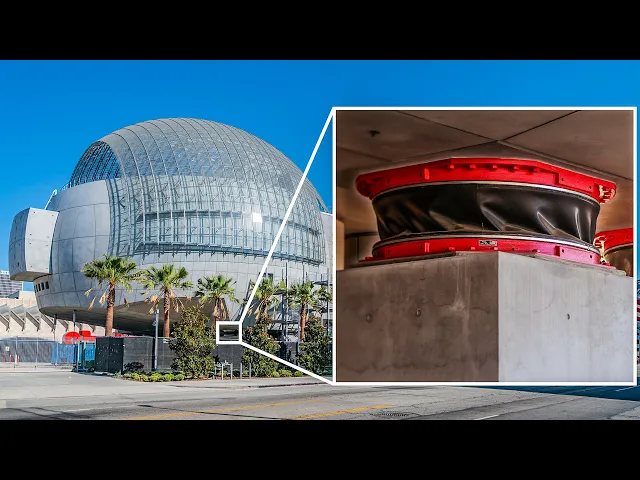
10:29 The first is rubber bearings.
10:31 Instead of resting directly on the pile foundation,
10:34 isolation devices separate the superstructure from the substructure.
10:38 When an earthquake comes, the building acts more like a skyscraper,
10:43 smoothing out the high-frequency ground motions so the floors feel less shaking.
10:47 Early isolators were plain rubber, but it didn’t work that well.
10:51 It would bulge out under the weight of the building,
10:54 making the bearings less effective over time.
10:56 Modern isolation bearings use a composite
10:58 of steel plates with rubber in between them.
11:02 This makes them highly elastic in the horizontal direction,
11:05 but stiff in the axial direction so they
11:08 can withstand a lot more load without bulging.
11:10 And this system has a lot of advantages.
11:13 Of course you get the lengthening of the building’s fundamental period,
11:17 which lowers its response to most earthquakes.
11:19 That makes a huge difference in resilience
11:22 for both the structure and the stuff inside it,
11:25 shortening or entirely eliminating the time required to put
11:28 it back into service after a seismic event.
11:31 It also means that the structural members themselves don’t have to be as strong.
11:35 I put the original, more flexible structure
11:37 on the shake table with the isolation system, and it held up just fine.
11:42 Even the stuff inside it was mostly unbothered by the shaking.
11:46 So you sometimes see an offset in the cost
11:48 of the isolation system from the rest of the building,
11:51 and there are situations where they pay for themselves entirely.
11:54 They’re also also big for retrofits.
11:56 Strengthening older buildings to meet modern seismic codes is often
12:01 disruptive to architectural elements or even to the structure's function.
12:06 New beams and braces require removal
12:08 of decorative features or changing the floor plan.
12:11 Instead, you can just temporarily support
12:13 the building and insert isolators below.
12:15 That’s exactly what they’re doing on the Salt Lake Temple in Utah,
12:19 and the same idea has been used
12:22 in a lot of seismic retrofit projects across the world.
12:25 That’s a lot of advantages, but we can do even better.
12:29 Isolation lengthens the fundamental period,
12:31 reducing the building’s response to an earthquake,
12:33 but it doesn’t inherently absorb the energy.
12:36 We don’t want our buildings to vibrate like a guitar string ringing out,
12:40 so damping is also important.
12:41 There are lots of ways to improve the damping of buildings.
12:44 I’ve done a couple of videos on unique solutions in tall buildings.
12:49 But base isolation systems make it easy.
12:51 You can just use a special blend of rubber in the bearings that absorbs some
12:55 of the energy instead of transmitting it
12:58 into the superstructure (so called high damping rubber).
13:01 Another option is to use a lead plug in the center of the bearing.
13:06 As the plug plastically deforms, it absorbs the energy of the shaking.
13:10 This reduces the accelerations of the building even further
13:13 and helps kill the oscillations faster after an earthquake,
13:17 so the building doesn’t ring like a bell.
13:19 And not just buildings, but other structures too.
13:22 Lots of bridges use similar isolation systems to manage earthquake loads.
13:27 Rubber bearings are a great solution and probably
13:30 the most widely used base isolation system.
13:33 But their properties can change based on temperature, they’re kind of bulky,
13:37 they’re susceptible to damage from exposure to oils and ozone,
13:40 and they can degrade with age.
13:42 They’re not always the perfect fit for every application.
13:46 An alternative is curved surface sliding bearings,
13:49 often known by one of the most common trademark names,
13:54 friction pendulum isolators.
13:55 Instead of rubber, these use a sliding element
13:58 on a curved surface to separate the superstructure and substructure.
14:02 If an earthquake comes, the building rides on the bearings.
14:05 Damping comes from the sliding friction,
14:08 and the restoring force comes from the curved surface,
14:10 keeping the building in place when the shaking is over.
14:14 These get pretty creative with two or three separate elements that offer
14:18 more control over the displacement and period
14:21 under a wide range of accelerations.
14:24 The amount of displacement a building
14:26 experiences on the isolators is pretty important,
14:29 because buildings don’t just float on their foundations.
14:33 They’re connected to stuff!
14:34 People have to get in and out of buildings, of course.
14:38 Usually, that’s not so complicated,
14:39 since most structures don’t move relative to the ground,
14:43 but it’s not true for base-isolated buildings.
14:45 For the system to work,
14:47 a building’s only connection to the ground has to be through the bearings.
14:51 So buildings equipped with a seismic isolation system
14:54 often have some kind of “moat” around them, providing a space to move.
14:59 It’s usually pretty easy to spot an isolated building
15:02 because it has a big gap all the way around,
15:05 although often this joint is bridged with some kind of expandable cover,
15:08 similar to the way expansion joints work on bridges.
15:12 Utilities are also a challenge.
15:14 You can’t have a solid water or sewer
15:16 connection to a building that wiggles around.
15:19 So, engineers have to design sometimes elaborate,
15:22 flexible connections for water, sewer, gas, and electricity.
15:25 Finally, you have to be thoughtful about long-period earthquakes.
15:29 There are situations where a base isolation can
15:32 actually amplify the shaking if it’s not carefully tuned.
15:36 Earthquakes are such a challenge in engineering:
15:39 unpredictable both in time and intensity.
15:42 There’s only so much you can do
15:44 when the ground underneath your structure shakes uncontrollably.
15:47 But I love this solution of base isolation because it’s so intuitive.
15:52 It’s something my five-year-old would come up
15:54 with: just put a suspension system on a building.
15:57 But it works!
15:58 It works really well, actually, to the point where it's been installed
16:01 on thousands of buildings across the world.
16:04 It’s not a catch-all, but I suspect that, as the technology improves and as we
16:08 get more data about how these buildings perform in real-world situations,
16:13 it’s only going to be more common to see
16:16 little moats around important buildings in seismically active regions.
16:19 Most people will probably never notice,
16:22 but you and I will know what’s underneath.
16:26 I love talking about the engineering of the built world that often
16:30 goes unseen like the isolation bearings below lots of famous buildings.
16:34 It can be hard to appreciate how this stuff works,
16:37 so a lot of my videos feature these demonstrations I build in my garage.
16:42 And a lot of those models feature parts from today’s sponsor, Send-Cut-Send.
16:47 Honestly, the fact that this is possible,
16:49 let alone affordable, is incredible to me.
16:52 Design your part in your favorite CAD software, upload it to the platform,
16:56 choose any additional services like bending, tumbling,
16:59 countersinking, or tapping, and get an instant quote.
17:02 I love the price transparency, and I even go back to the drawing board sometimes
17:07 to make revisions to try and get that cost down.
17:10 Parts are made in the USA, they’re out the door in a day or two,
17:14 and there’s no minimum quantity, so the value proposition is hard to beat here:
17:18 I could spend half a day in the shop making a part,
17:21 or I could have Send-Cut-Send do it for me for a very reasonable price,
17:26 freeing up my time for other stuff.
17:28 It’s just unlocked this whole new world of possibilities for the stuff I build.
17:31 If you’re in the US or Canada and want to give it
17:34 a try click that link below for a discount on your first order.
17:37 Thank you for watching, and let me know what you think!